The Real Science of How You Charge the Battery
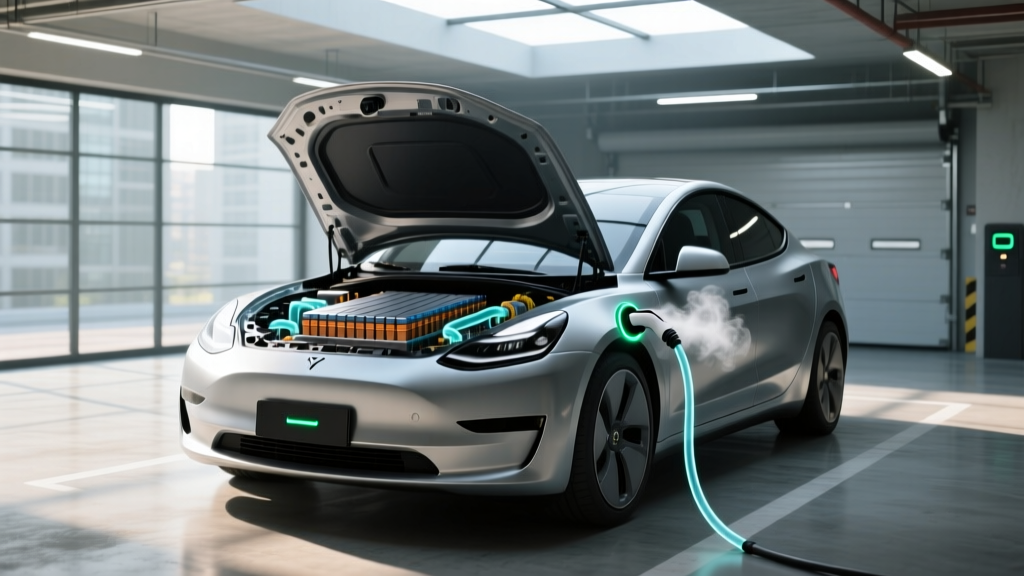
Every time you plug in, a complex electrochemical process unfolds inside your EV's high-voltage traction battery. Lithium ions shuttle between the anode and cathode through a liquid electrolyte, and the choices you make — how often you fast-charge, what state of charge you store the car at, whether you precondition in cold weather — directly affect how quickly those ions degrade the cell structure over years of use.
This guide breaks down exactly what happens when you charge the battery in a modern EV, which chemistry your car likely uses, what degradation data actually shows, and how to maximize your pack's useful life. We'll use real numbers from manufacturer warranties, independent testing, and EPA data — not marketing claims.
LFP vs NMC vs NCA: Which Chemistry Is in Your Battery?
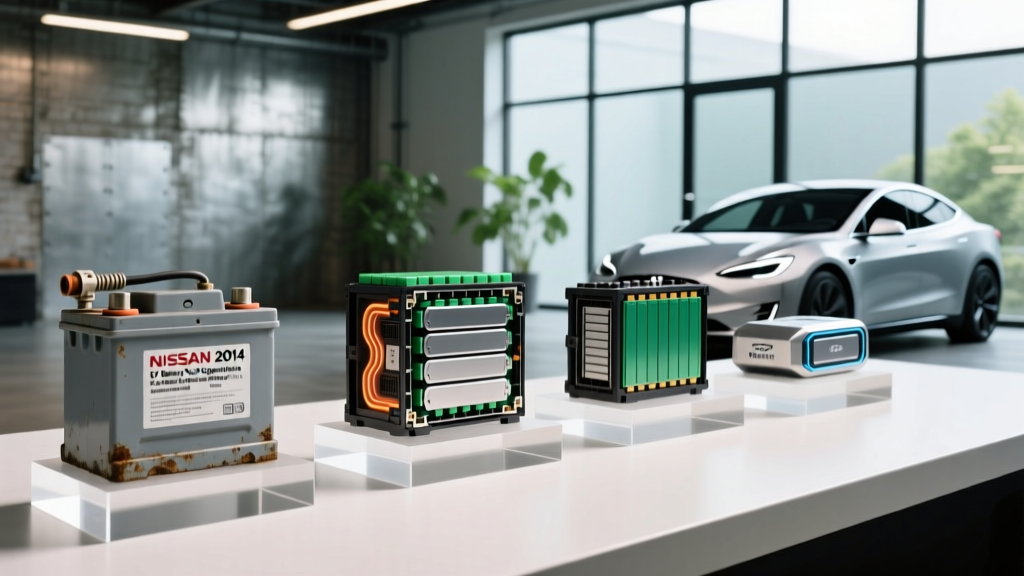
Not all EV batteries are built alike. The cathode chemistry determines your car's energy density, charging tolerance, cold-weather behavior, and expected cycle life. As of 2026, three chemistries dominate the US market:
- NMC (Nickel Manganese Cobalt): Used in most long-range EVs — Hyundai Ioniq 5, Ford Mustang Mach-E Extended Range, BMW i4. High energy density, moderate cycle life.
- NCA (Nickel Cobalt Aluminum): Tesla's primary chemistry for Long Range and Performance trims. Similar profile to NMC with slightly higher energy density.
- LFP (Lithium Iron Phosphate): Found in Tesla Model 3/Y Standard Range, Ford Mustang Mach-E Select (2025+), and several entry-level EVs. Lower energy density but far superior cycle life and thermal stability.
| Attribute | LFP | NMC | NCA |
|---|---|---|---|
| Energy Density | ~160 Wh/kg (lower) | ~220-260 Wh/kg (higher) | ~250-280 Wh/kg (highest) |
| Cycle Life (to 80% SoH) | 3,000-5,000+ cycles | 1,000-2,000 cycles | 1,000-1,500 cycles |
| Cold-Weather Performance | Moderate loss; slower charging below freezing | Better low-temp conductivity | Best low-temp conductivity |
| Recommended Daily SoC | 100% (manufacturer-approved) | 80% for daily; 100% for trips | 80% for daily; 100% for trips |
| Thermal Runaway Risk | Very low | Low with active BMS | Low with active BMS |
| Cost per kWh (pack-level) | ~$90-$110 | ~$120-$145 | ~$125-$150 |
| Common Vehicles (2026) | Tesla Model 3 RWD, Model Y RWD, base Mach-E | Ioniq 5/6, EV6, Mach-E ER, i4 | Tesla LR/Performance, Rivian R1T/R1S |
The practical takeaway: If your daily commute is under 200 miles and you want minimal charging-habit anxiety, an LFP vehicle lets you charge the battery to 100% every night without accelerated degradation. If you need 300+ miles of EPA range for road trips, NMC or NCA gives you the energy density — but you should follow the 80% daily rule.
How Long Do EV Batteries Actually Last?
The short answer: longer than most buyers expect, and usually longer than the rest of the car. Data from fleet operators, manufacturer warranty claims, and independent analysis consistently shows that modern EV batteries lose roughly 1-2% of total capacity per year under normal use.
- Tesla 2025 Impact Report: Model 3/Y packs retained ~88% of original capacity at 200,000 miles. Model S/X retained ~85% at the same milestone.
- Geotab fleet study (2024, 10,000+ EVs): Average annual degradation of 1.8% across all brands; LFP-equipped vehicles averaged 1.2%/year.
- Recurrent Auto (2025 data, 15,000 vehicles): Only 3.1% of EVs in their dataset required battery replacement outside of warranty — and most of those were early-generation packs (2012-2016 model years).
- Hyundai/Kia 8-year warranty claims: Internal data suggests fewer than 1% of Ioniq 5/EV6 owners have filed battery capacity claims as of late 2025.
At a 1.5-2% annual loss rate, a battery starting with 80 kWh usable capacity will still hold roughly 68-72 kWh after 10 years — plenty for daily driving. The pack doesn't "die" at a specific mileage; it gradually holds less energy, reducing your range proportionally. Most EV owners sell or trade the car long before the battery becomes impractical.
What the Battery Warranty Actually Covers
Federal law mandates a minimum 8-year/100,000-mile battery warranty for all EVs sold in the US. Several manufacturers exceed this. Here's what the fine print actually means:
| Manufacturer | Warranty Period | Mileage Cap | Capacity Threshold | Notes |
|---|---|---|---|---|
| Tesla (Model 3/Y RWD — LFP) | 8 years | 100,000 mi | 70% retention | LR/Performance: 8yr/120,000mi |
| Hyundai / Kia | 8 years | 100,000 mi | 70% retention | Some states: 10yr/150,000mi (CARB states) |
| Ford (Mach-E, F-150 Lightning) | 8 years | 100,000 mi | 70% retention | Covers cell + module replacement |
| GM (Ultium-based) | 8 years | 100,000 mi | 70% retention | Lyriq, Blazer EV, Equinox EV |
| BMW | 8 years | 100,000 mi | 70% retention | Includes i4, iX, i7 |
| Rivian | 8 years | 175,000 mi | 70% retention | Higher mileage cap for R1T/R1S |
| Volkswagen (ID.4) | 8 years | 100,000 mi | 70% retention | CARB states: 10yr/150,000mi |
Critical detail: The warranty covers capacity loss below the threshold (typically 70% of original), not cosmetic issues or 12V auxiliary battery failures. If your 80 kWh pack drops to 54 kWh (below 70%) within the warranty period, the manufacturer must repair or replace it — often by swapping individual modules rather than the full pack. If you live in a CARB-adopting state (California, Colorado, Maine, Massachusetts, New York, and others), the warranty extends to 10 years/150,000 miles.
EV Battery Replacement Cost: What to Expect
Out-of-warranty battery replacement is the single biggest fear among prospective EV buyers. Here's what the numbers actually look like in 2026:
| Vehicle | Battery Size (usable kWh) | Chemistry | Full Pack Replacement | Module Repair (typical) |
|---|---|---|---|---|
| Tesla Model 3 RWD | 57 kWh | LFP | $8,000 - $11,000 | $2,500 - $4,000 |
| Tesla Model Y Long Range | 75 kWh | NCA | $12,000 - $16,000 | $3,500 - $5,500 |
| Hyundai Ioniq 5 | 77.4 kWh | NMC | $13,000 - $18,000 | $3,000 - $5,000 |
| Ford F-150 Lightning ER | 131 kWh | NMC | $22,000 - $30,000 | $5,000 - $8,000 |
| Chevrolet Equinox EV | 85 kWh | NMC (Ultium) | $14,000 - $19,000 | $3,500 - $6,000 |
| BMW i4 eDrive40 | 83.9 kWh | NMC | $16,000 - $22,000 | $4,000 - $7,000 |
Two important context points. First, most owners never pay this. Battery failure rates within the first 15 years remain well under 5% for modern chemistries, and warranty coverage handles the vast majority of cases. Second, pack-level prices have dropped roughly 14% per year since 2020, and by the time a 2026 model-year EV actually needs an out-of-warranty replacement (likely 2036+), costs will be substantially lower. Independent shops are also increasingly capable of module-level repairs, which cost a fraction of a full pack swap.
How to Charge the Battery for Maximum Lifespan
How you charge the battery day-to-day has a measurable effect on long-term health. Here's an evidence-based checklist drawn from manufacturer recommendations and battery research:
- Set a daily charge limit of 80% for NMC/NCA vehicles. LFP owners can charge to 100% daily without penalty.
- Minimize DC fast charging to road trips. Daily Level 2 home charging (7-11 kW) generates far less thermal stress than repeated 150+ kW DC sessions.
- Precondition the battery before fast charging in cold weather. Most EVs do this automatically when you navigate to a charger; if yours doesn't, use the app to start climate control 15-20 minutes before plugging in.
- Avoid storing the car at 100% SoC for extended periods. If you won't drive for a week or more, leave the battery at 50-60%.
- Avoid letting SoC drop below 10% regularly. Deep discharge stresses the anode. The BMS buffer protects against true 0%, but habitually running the pack very low accelerates wear.
- Park in shade or a garage when possible. Sustained battery temperatures above 95°F (35°C) accelerate calendar degradation, even when parked.
- Use scheduled charging to time your Level 2 session so the car finishes charging shortly before you leave — minimizing time spent at high SoC.
The single most impactful habit? Charging primarily at home on Level 2 and limiting DC fast charging to 1-2 times per month. A study by the Idaho National Laboratory found that vehicles charged exclusively on DC fast chargers showed approximately 10% more degradation over 40,000 miles compared to vehicles charged primarily on Level 2 — though the gap narrowed significantly with modern thermal management systems.
Monitoring Your Battery's State of Health (SoH)
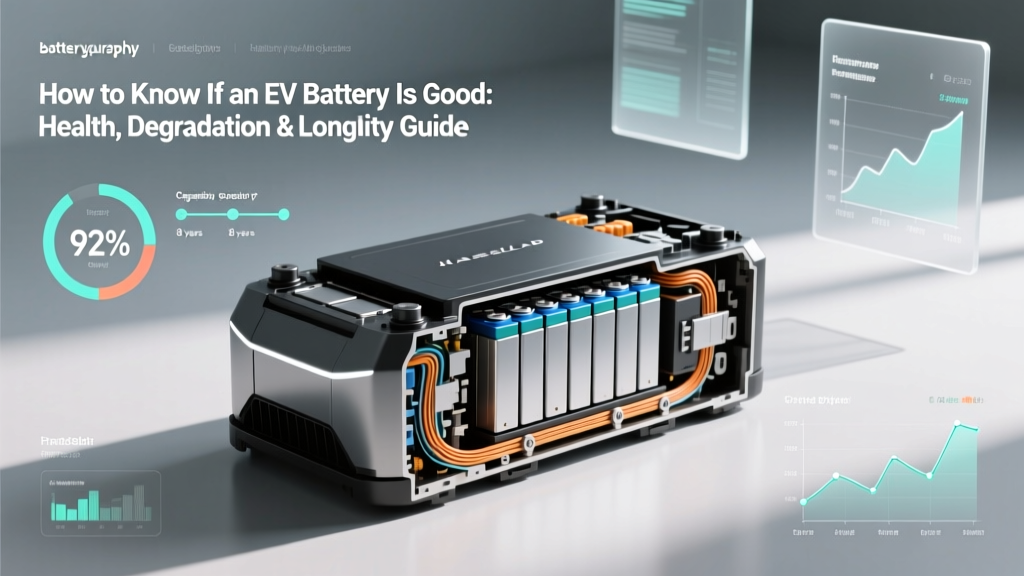
State of Health (SoH) is the percentage of original capacity your battery currently holds. A new EV starts at 100% SoH; at 70% SoH, you've hit the typical warranty replacement threshold.
How to check SoH:
- In-car displays: Tesla shows a battery health estimate in the Service menu. Hyundai/Kia provides a battery condition readout via the EV diagnostics screen. GM's Ultium vehicles display SoH in the Energy app.
- OBD-II apps: Tools like LeafSpy (Nissan), Scan My Tesla, or Car Scanner ELM OBD2 can read the BMS-reported SoH directly. This is often more accurate than the dashboard estimate.
- Third-party services: Recurrent Auto offers a free battery health report that compares your vehicle's degradation curve against a fleet of identical models. Some dealerships can pull a detailed SoH report during service visits.
- Manual tracking: Note your displayed range at 100% SoC periodically. If your EPA-rated 310-mile car shows 285 miles at 100% after two years, that's roughly 92% SoH — right in line with expected degradation.
If your SoH drops sharply (more than 5% in a single year), it's worth scheduling a diagnostic. Sudden drops can indicate a weak cell module that the BMS is working around, and catching it under warranty is far better than discovering it later.
What's Next: Solid-State and Silicon Anode Batteries
Several next-generation battery technologies are in active development, but none are available in production US-market EVs as of early 2026. Here's a realistic timeline:
- Silicon anode cells: Companies like Sila Nanotechnologies and Group14 are supplying silicon-dominant anode materials to manufacturers including Mercedes-Benz and Panasonic. These cells offer 20-40% higher energy density than graphite anodes. Limited production has begun for the Mercedes G-Class electric (2026 model year), with broader availability expected by 2028-2029.
- Semi-solid-state: Toyota, Samsung SDI, and QuantumScape have demonstrated prototype cells with solid or semi-solid electrolytes that promise faster charging (10-80% in under 10 minutes), higher energy density, and improved safety. Toyota has announced a 2027-2028 production target, but these will debut in limited, premium models at high cost.
- Full solid-state: Widespread, affordable solid-state batteries remain a 2030+ prospect. Manufacturing challenges — particularly scaling solid electrolyte production and achieving consistent cell-to-cell quality — are substantial.
For buyers today, current lithium-ion chemistries (LFP and NMC) are mature, well-understood, and backed by extensive warranty coverage. Waiting for solid-state means waiting several years and likely paying a premium when it arrives.
Frequently Asked Questions
How long do EV batteries last in years and miles?
Most modern EV batteries retain 85-90% of their original capacity after 10 years or 150,000-200,000 miles. LFP chemistries tend to outlast NMC/NCA by a meaningful margin. The battery doesn't "fail" at a specific point — it gradually holds less charge, reducing range. Many EVs from 2013-2017 are still on their original packs with 80%+ SoH.
How much does an EV battery cost to replace?
Full pack replacement ranges from roughly $8,000 for a smaller LFP pack (Tesla Model 3 RWD) to $30,000 for a large NMC pack (F-150 Lightning Extended Range). However, most repairs involve individual module replacement at $2,500-$8,000. Battery prices continue to decline, and by the time a 2026 EV needs out-of-warranty service, costs will be significantly lower.
What does the battery warranty actually cover?
The federal minimum is 8 years/100,000 miles with a capacity retention threshold (typically 70% of original). If your usable capacity drops below that threshold within the warranty window, the manufacturer repairs or replaces the battery — often at the module level. CARB-adopting states get extended coverage of 10 years/150,000 miles. The warranty does not cover damage from accidents, misuse, or unauthorized modifications.
LFP vs NMC — which is better and why?
Neither is universally better; they serve different needs. LFP wins on cycle life (3,000-5,000+ cycles vs 1,000-2,000), cost (~$90-110/kWh vs $120-145/kWh), and daily charging convenience (100% SoC is fine). NMC wins on energy density (~220-260 Wh/kg vs ~160 Wh/kg), which translates to more range in the same physical space, and better cold-weather charging performance. If you need 300+ miles of range, choose NMC. If you commute under 200 miles daily and want the longest possible pack life, choose LFP.
Does fast charging damage my EV battery?
Occasional DC fast charging (1-2 sessions per week) has a modest effect on degradation — studies show roughly 0.2-0.5% additional annual loss compared to Level 2-only charging. Daily fast charging is more stressful. The real risk is heat: if your vehicle has active liquid cooling (nearly all 2020+ EVs do), the BMS manages temperatures during fast charging. Older or passively-cooled EVs are more vulnerable. Preconditioning before fast charging and avoiding charging above 80% on DC (where the charge curve tapers and heat builds) minimizes wear.
How do I check my battery health?
Use your vehicle's built-in diagnostics screen, an OBD-II reader app (Scan My Tesla, Car Scanner), or a free service like Recurrent Auto's battery health report. Track your displayed range at 100% SoC over time as a simple proxy. A sharp or sudden drop warrants a dealership diagnostic visit.
Sources: fueleconomy.gov (EPA range and efficiency data), IRS §30D clean vehicle credit guidelines, manufacturer warranty documentation (Tesla, Hyundai, Ford, GM, BMW, Rivian, Volkswagen).