If you're shopping for an electric vehicle or already own one, few questions carry more weight than this: how long does the battery actually last — not just on a single charge, but over the life of the car? The answer involves chemistry, climate, charging habits, and a level of nuance that most manufacturer brochures skip over. This guide breaks down the real data on EV battery longevity in 2026, from degradation curves to replacement economics, so you can buy and own with confidence.
How Long Do EV Batteries Last in Years and Miles?
The short answer: most modern EV traction batteries are engineered to outlast the vehicle they're installed in. Based on fleet data and long-term owner reports, the typical liquid-cooled lithium-ion pack in a 2024–2026 model-year EV will retain 70–85% of its original capacity after 150,000 miles or 10–12 years. That means a car with an EPA-rated 300-mile range when new would still deliver roughly 210–255 miles per charge at that point — still very usable for daily driving.
Geotab's large-scale fleet study of over 10,000 EVs found an average degradation rate of approximately 2.3% per year across all brands, with significant variation by chemistry and thermal management. Vehicles with active liquid cooling (Tesla, Hyundai/Kia E-GMP, Ford, BMW) consistently outperform passively cooled packs (older Nissan Leaf models) by a wide margin.
It's critical to distinguish the high-voltage traction battery (the large pack that powers the motor, typically 50–130 kWh) from the 12V auxiliary battery (a small lead-acid or lithium unit that runs lights, infotainment, and computers). The 12V battery may need replacement every 3–5 years, just like in a gas car, but it's a $200–$400 service — not the five-figure concern buyers worry about.
LFP vs NMC: Which Battery Chemistry Lasts Longer?
Battery chemistry is the single biggest determinant of how your pack ages. In 2026, nearly all consumer EVs use one of two lithium-ion chemistries: LFP (lithium iron phosphate) or NMC/NCA (nickel manganese cobalt / nickel cobalt aluminum). Each has distinct trade-offs.
| Attribute | LFP (Lithium Iron Phosphate) | NMC/NCA (Nickel-Based) |
|---|---|---|
| Energy Density | Lower (~160–180 Wh/kg cell-level) | Higher (~220–260 Wh/kg cell-level) |
| Cycle Life | 3,000–5,000+ full cycles | 1,000–2,000 full cycles |
| Calendar Life | Excellent; slower degradation at rest | Good; degrades faster at high SoC |
| Cold-Weather Performance | Weaker; greater range loss below 32°F | Better low-temp conductivity |
| Charging to 100% | Recommended periodically for BMS calibration | Best kept at 80% daily; 100% for trips only |
| Cost | ~15–20% cheaper per kWh | Higher due to nickel/cobalt content |
| Common In 2026 Models | Tesla Model 3/Y RWD, Ford Mustang Mach-E Select, Rivian Standard | Tesla Long Range, Hyundai Ioniq 5/6, Kia EV6/EV9, BMW iX, Porsche Taycan |
Which is better? It depends on your use case. If you prioritize maximum cycle life and don't mind slightly less range per charge, LFP is the longevity champion. Tesla's Standard Range Model 3 with an LFP pack has shown degradation of under 5% after 100,000 miles in fleet data. If you need maximum range and fast-charge speed for road trips, NMC delivers higher energy density — just follow the 80% daily charge guideline.
Real-World Degradation: What the Data Shows
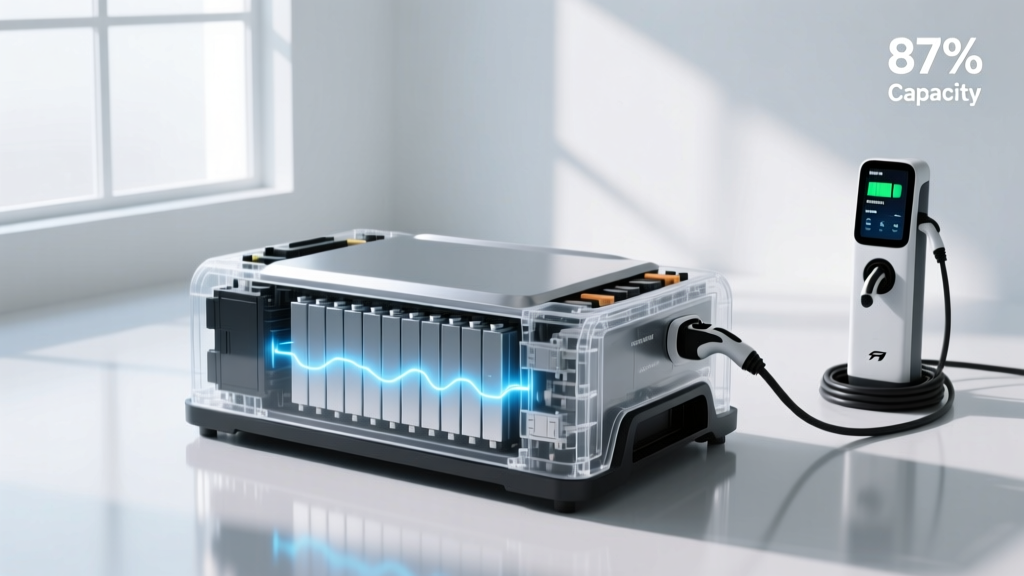
EV battery degradation is not linear. Most packs experience a steeper drop in the first 1–2 years (roughly 2–4%), then settle into a slow, gradual decline. Here's what the data shows across popular platforms:
Typical Capacity Retention by Milestone
| Milestone | Avg. Capacity Retained (Liquid-Cooled NMC) | Avg. Capacity Retained (LFP) |
|---|---|---|
| 1 year / 15,000 mi | 96–98% | 97–99% |
| 3 years / 45,000 mi | 91–94% | 94–97% |
| 5 years / 75,000 mi | 87–91% | 91–95% |
| 8 years / 100,000 mi | 82–88% | 88–93% |
| 10 years / 150,000 mi | 76–84% | 84–90% |
Sources: Geotab fleet battery health study, Recurrent Auto battery data reports, manufacturer warranty thresholds. Figures represent averages; individual results vary by climate, charging habits, and thermal management.
A few important caveats: highway-heavy driving at sustained speeds generates more heat in the cells than city driving with regen braking, accelerating wear slightly. Extreme heat climates (Arizona, Texas summers with ambient temps above 100°F) push degradation 1–2% higher over time compared to temperate regions. And frequent DC fast charging above 150 kW without preconditioning adds incremental stress — though modern battery management systems (BMS) actively mitigate this.
What Does the EV Battery Warranty Actually Cover?
Federal law mandates that EV batteries carry a minimum warranty of 8 years or 100,000 miles (whichever comes first). In California Air Resources Board (CARB) states — which include CA, CO, CT, ME, MD, MA, NJ, NY, OR, RI, VT, VA, and WA — the mandate extends to 10 years or 150,000 miles. Most manufacturers exceed the federal minimum voluntarily.
| Manufacturer | Warranty Period | Capacity Retention Threshold | Notes |
|---|---|---|---|
| Tesla (Model 3/Y) | 8 yr / 100,000–120,000 mi | 70% | Varies by trim; Long Range gets 120k mi |
| Hyundai / Kia (E-GMP) | 10 yr / 100,000 mi | 70% | Among the longest standard coverage |
| Ford (Mach-E, F-150 Lightning) | 8 yr / 100,000 mi | 70% | Covers battery and hybrid/electric components |
| BMW (i4, iX, i7) | 8 yr / 100,000 mi | 70% | Includes module-level replacement option |
| Rivian (R1T, R1S) | 8 yr / 175,000 mi | 70% | Highest mileage threshold in the segment |
| Chevrolet (Equinox EV, Blazer EV) | 8 yr / 100,000 mi | 60–70% | Varies by model; check specific terms |
The key phrase is "capacity retention threshold." If your battery drops below 70% of its original usable capacity within the warranty period, the manufacturer will repair or replace it — typically by swapping in a refurbished pack with at least 70% capacity, not necessarily a brand-new one. In practice, very few owners hit this threshold. According to Recurrent Auto's 2025 battery report, fewer than 1.5% of EVs in their dataset of 15,000+ vehicles required a warranty battery replacement.
How Much Does It Cost to Replace an EV Battery?
This is the question that generates the most anxiety — and the most misinformation. Here are the real numbers for out-of-warranty replacement in 2026:
| Vehicle / Pack Size | Battery Capacity | Replacement Cost (Parts + Labor) | Typical Replacement Timeline |
|---|---|---|---|
| Tesla Model 3 RWD (LFP) | ~60 kWh | $10,000–$13,000 | Rarely needed before 200,000+ mi |
| Hyundai Ioniq 5 (NMC) | ~77.4 kWh | $14,000–$18,000 | Rarely needed before 180,000+ mi |
| Ford F-150 Lightning Ext. Range | ~131 kWh | $22,000–$28,000 | Rarely needed before 150,000+ mi |
| Chevrolet Bolt EV (older platform) | ~65 kWh | $9,000–$14,000 | Some early recalls; generally durable |
| BMW iX xDrive50 | ~105.2 kWh | $20,000–$26,000 | Module-level repair may reduce cost |
Several factors work in the owner's favor. First, battery prices have fallen roughly 80% since 2013 on a per-kWh basis (BloombergNEF data), and that trend continues as LFP adoption grows and manufacturing scales. Second, many shops now offer module-level repair — replacing only the degraded cell modules rather than the entire pack — for 40–60% less than a full swap. BMW and some independent EV shops specialize in this. Third, most EVs are scrapped or retired before their batteries need replacement. The average age of a scrapped vehicle in the US is about 12 years; by that point, even a degraded battery with 75% capacity still provides functional daily transportation.
The fear of a sudden $25,000 bill is understandable but statistically unlikely. For context, a gas car's transmission replacement ($4,000–$8,000) or engine rebuild ($5,000–$10,000) carries similar financial risk — yet we don't see the same level of anxiety because those failures are normalized.
How to Maximize Your EV Battery's Lifespan
Battery degradation is inevitable, but the rate at which it occurs is largely within your control. These evidence-based practices, drawn from cell-level testing and fleet data, will meaningfully extend your pack's useful life:
Daily Charging Habits
- NMC/NCA packs: Set your daily charge limit to 80%. Charge to 100% only when you need full range for a trip, and try to depart shortly after reaching 100% rather than letting it sit fully charged overnight.
- LFP packs: Charge to 100% at least once a week. LFP's flat voltage curve makes it hard for the BMS to estimate state of charge accurately without periodic full charges. Tesla and Ford both recommend this in their owner's manuals.
- Avoid prolonged storage at extremes: Don't leave your EV sitting at 100% or below 10% for days at a time. If storing for weeks (vacation, etc.), set the charge limit to ~50%.
Fast Charging Strategy
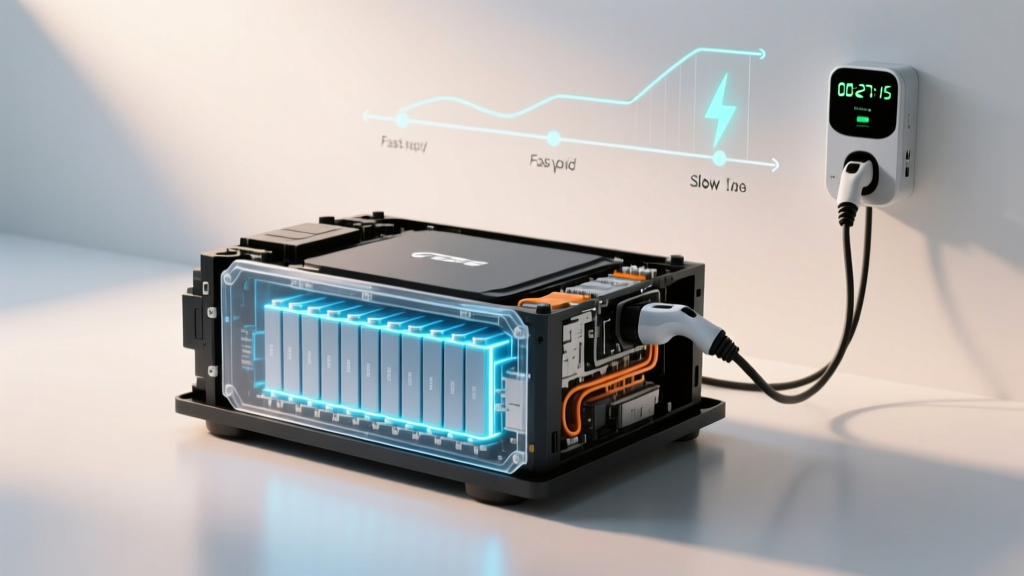
- DC fast charging is fine in moderation. Modern BMS systems actively manage charge rates and cell temperatures. Occasional 150–250 kW stops on road trips cause negligible extra wear.
- Daily fast charging accelerates degradation slightly. If you rely on DC fast charging every day (no home charging), expect 1–3% additional capacity loss over 5 years compared to Level 2 home charging. The convenience trade-off may still be worth it.
- Always precondition before fast charging. Preconditioning warms the battery to its optimal charging temperature (~77–95°F at the cell level), which reduces internal resistance and stress. Most EVs do this automatically when you navigate to a charger.
Temperature Management
- Park in shade or a garage when possible in hot climates. Sustained cell temperatures above 95°F accelerate calendar degradation.
- Plug in during extreme cold. Many EVs (Tesla, Hyundai/Kia, Ford) will use grid power to keep the battery warm when plugged in, preventing cold-induced degradation and preserving range.
- Use your EV's scheduled departure feature to precondition the battery before your morning commute — this warms the cells using grid power rather than battery power, improving both efficiency and longevity.
How to Check Your Battery's State of Health (SoH)
State of Health (SoH) is the percentage of your battery's original capacity that remains usable. A brand-new pack is 100% SoH; one that has degraded to hold 85 kWh out of an original 100 kWh is at 85% SoH. Here's how to monitor it:
- In-vehicle displays: Tesla shows battery health indirectly through the range estimate at full charge (compare your current max range to the original EPA figure). Some newer models (2025+ Hyundai/Kia) include a dedicated SoH percentage in the settings menu.
- OBD-II diagnostic tools: Devices like the OBDLink MX+ paired with apps such as EV Health or LeafSpy (for Nissan) can read the battery management system's internal SoH estimate directly. This is the most accurate consumer-accessible method.
- Third-party services: Recurrent Auto offers a free battery health report that connects to your vehicle's telematics and compares your degradation curve against their fleet database of similar vehicles.
- Dealer diagnostics: Any authorized service center can run a full battery health check. Request this during routine service visits, especially before the warranty period expires — if SoH is approaching the 70% threshold, you want it documented while coverage is active.
A useful real-world check: track your kWh per 100 miles consumption over time (displayed in your vehicle's trip computer). If your efficiency worsens by more than 10–15% over a year without a change in driving patterns, that can indicate accelerated cell imbalance worth investigating.
What's Next: Solid-State and Silicon-Anode Batteries
Looking beyond current lithium-ion technology, two advancements are generating significant attention — though neither is available in consumer vehicles as of early 2026:
Solid-state batteries replace the liquid electrolyte with a solid material (ceramic, sulfide, or polymer), promising higher energy density (potentially 400+ Wh/kg), faster charging, and improved safety. Toyota has announced a solid-state EV for 2027–2028, and Samsung SDI and QuantumScape are in advanced prototype testing with OEM partners. However, manufacturing challenges — particularly yield rates and cost — remain substantial. Realistically, solid-state packs will debut in limited, premium applications before reaching mainstream pricing, likely not before 2029–2030 at scale.
Silicon-anode batteries (used in limited form by companies like Sila Nanotechnologies and Group14) boost energy density by replacing graphite anodes with silicon-dominant materials. These are closer to production — the Mercedes-Benz G-Class EV (2025) uses a silicon-anode pack from Group14 — but current implementations are partial (silicon-blend anodes) rather than full replacements. Expect broader adoption in the 2027–2029 window as costs decline.
Neither technology changes the buying calculus for 2026. Today's liquid-cooled LFP and NMC packs are mature, well-understood, and backed by robust warranties. Waiting for solid-state means waiting at least 3–4 years for limited availability at premium prices.
Frequently Asked Questions
How long does an EV battery charge last on a single trip?
On a full charge, most 2026 EVs deliver between 230 and 350 miles of EPA-rated range. Real-world highway range at 70–75 mph is typically 10–15% below the EPA sticker, and cold weather (below 32°F) can reduce range an additional 15–30% depending on whether the vehicle has a heat pump. A Hyundai Ioniq 5 with an EPA rating of 305 miles, for example, will typically deliver ~260 miles on a warm-weather highway trip and ~210–230 miles in freezing conditions.
Is it bad to charge my EV to 100% every night?
For NMC/NCA batteries, yes — sustained high state of charge stresses the cathode and accelerates calendar degradation. Set your daily limit to 80% and reserve 100% for road trips. For LFP batteries, charging to 100% is not only acceptable but recommended at least weekly for accurate state-of-charge calibration.
Does fast charging damage my EV battery?
Occasional DC fast charging (1–3 times per week on road trips) has minimal impact on modern liquid-cooled packs. Daily reliance on 150+ kW fast charging can add approximately 1–3% extra degradation over 5 years compared to exclusive Level 2 home charging. The BMS actively throttles charge speed if cell temperatures get too high, which protects the pack at the cost of longer charge times.
What happens when my EV battery reaches 70% capacity?
Your car doesn't stop working — it simply has less range. A 300-mile EPA vehicle at 70% SoH still delivers ~210 miles per charge, which covers the average American's daily driving (37 miles round-trip per FHWA data) with substantial margin. Most EVs remain practical daily drivers well below the 70% warranty threshold.
Can I replace individual battery modules instead of the whole pack?
On some platforms, yes. BMW, Mercedes, and some independent EV repair shops offer module-level replacement, which can cost 40–60% less than a full pack swap. Tesla and Hyundai/Kia typically replace the entire pack under warranty. Module-level repair availability depends on the vehicle's pack architecture and local shop expertise.
Should I buy an EV now or wait for solid-state batteries?
Buy now if you need a vehicle. Solid-state batteries are not expected in consumer vehicles before 2027–2028, and initial availability will be limited to premium models at high prices. Current LFP and NMC packs are proven, well-warrantied, and cost-effective. The total cost of ownership advantage of today's EVs over gas vehicles is already compelling without waiting for next-generation chemistry.