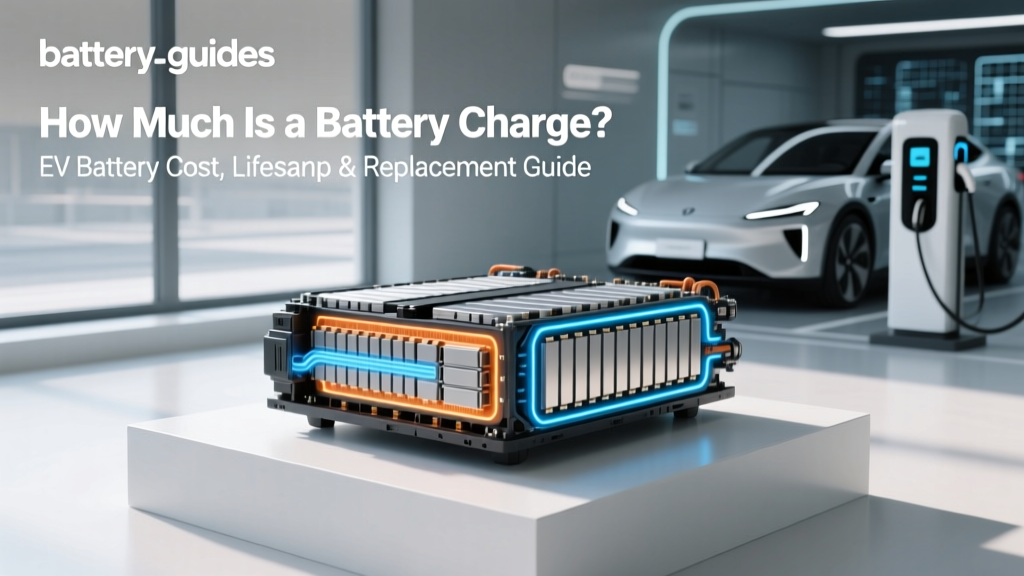
Search "how much is a battery charge" and you'll get a tangle of answers — some about the cost to fill an EV battery with electricity, others about the eventual cost to replace the battery itself. Both matter to EV ownership, but they're wildly different numbers. A full home charge might cost $8–$18 depending on your local electricity rate and battery size. A full battery replacement runs $5,000 to over $22,000 out of warranty. This guide covers both, with a deep focus on the big-ticket question: what happens when your EV's high-voltage traction battery degrades, and what it actually costs to fix it.
The Real Cost to Charge an EV Battery (kWh, Not kW)
Before tackling replacement costs, let's clear up the everyday meaning of "how much is a battery charge." The cost to recharge an EV depends on two things: your battery's usable capacity in kWh (kilowatt-hours — the unit of energy stored) and the price you pay per kWh of electricity. Do not confuse kWh with kW (kilowatts), which measures charging power or speed, not total energy.
Here's what a full charge costs for several popular 2025–2026 EVs at the U.S. average residential rate of roughly $0.17/kWh (per EIA data):
| Vehicle | Usable Battery (kWh) | EPA Range | Full-Charge Cost (Home) | Cost Per Mile |
|---|---|---|---|---|
| Tesla Model 3 RWD (LFP) | 57.5 kWh | 272 mi | $9.78 | $0.036 |
| Hyundai Ioniq 5 SEL (NMC) | 77.4 kWh | 310 mi | $13.16 | $0.042 |
| Ford F-150 Lightning XLT | 98 kWh (std range) | 240 mi | $16.66 | $0.069 |
| Chevrolet Equinox EV 2LT | 85 kWh | 315 mi | $14.45 | $0.046 |
DC fast charging on the road costs more — typically $0.30–$0.55/kWh at networks like Electrify America or EVgo, pushing a full fill to $25–$50 depending on pack size. Most owners charge at home 80%+ of the time, keeping per-mile fuel costs well below gasoline.
LFP vs NMC: Which Battery Chemistry Is in Your EV?
The two dominant lithium-ion chemistries in today's EVs are LFP (lithium iron phosphate) and NMC/NCA (nickel manganese cobalt / nickel cobalt aluminum). The chemistry inside your pack affects range, longevity, cold-weather performance, and ultimately replacement cost.
| Factor | LFP (Lithium Iron Phosphate) | NMC / NCA (Nickel-Based) |
|---|---|---|
| Energy Density | Lower (~160 Wh/kg cell-level) — heavier pack for same range | Higher (~250–300 Wh/kg) — lighter, more range per kg |
| Cycle Life | 3,000–5,000+ full cycles before 80% capacity | 1,000–2,000 full cycles before 80% capacity |
| Cold Performance | Weaker — more range loss below 32°F; slower cold fast-charging | Better low-temp conductivity and charge acceptance |
| Cost | ~20–30% cheaper per kWh (no cobalt/nickel) | Higher raw-material cost |
| State-of-Charge Tolerance | Can be charged to 100% daily without harm | Best kept 20–80% for daily use; 100% for trips only |
| Typical Applications | Tesla Model 3/Y RWD, Ford Mustang Mach-E Select (2025+), BYD models | Most long-range/AWD trims, Hyundai Ioniq 5/6, Rivian, GM Ultium |
Which is better? Neither is universally superior. LFP wins on longevity and daily convenience (charge to 100% freely) and is ideal for commuters who can charge at home. NMC wins on range-per-pound and cold-weather usability, making it the better pick for long-distance drivers and northern climates. If you're buying an EV in Minnesota, NMC's cold advantage matters. In Southern California, LFP's cycle-life edge is more relevant.
How Long Do EV Batteries Actually Last?
The short answer: far longer than most buyers expect. Modern liquid-cooled EV batteries are engineered to outlast the useful life of the vehicle itself. But "last" doesn't mean "stay at 100% capacity forever." All lithium-ion batteries degrade — the question is how much, and how fast.
Real-World Degradation Data Points:
- Geotab fleet study (2024 update, 10,000+ EVs): Average degradation of ~1.8% per year across all models, meaning a typical EV retains roughly 87–90% of original capacity after 6 years.
- Tesla Model 3/Y (NMC and LFP): Tesla's 2024 Impact Report showed packs retaining ~88% capacity at 200,000 miles. LFP variants in taxi/fleet use have shown 90%+ retention at 150,000 miles.
- Nissan Leaf (passive air-cooled, older gen): The outlier — early Leafs (2011–2017) with no active thermal management showed 15–25% loss over 8 years in hot climates, a cautionary tale for why liquid cooling matters.
- GM Ultium / Hyundai E-GMP: Too new for 10-year data, but early fleet reports and accelerated aging tests project 85–90% retention at 150,000 miles.
Most 2025–2026 EVs with liquid-cooled packs should comfortably reach 200,000 miles with 80–85% of original capacity intact — enough range to remain practical for daily use. Catastrophic failure (a pack that stops working entirely) is rare and usually covered under warranty.
What Does the EV Battery Warranty Actually Cover?
Federal law mandates that EV battery warranties cover a minimum of 8 years / 100,000 miles (in California and states adopting CARB rules, it's 10 years / 150,000 miles). But the fine print matters — specifically, the capacity-retention threshold that triggers a warranty claim.
| Manufacturer | Warranty Term | Capacity Threshold | What Triggers a Claim |
|---|---|---|---|
| Tesla (Model 3/Y RWD — LFP) | 8 yr / 100,000 mi | 70% | Battery falls below 70% retention within term |
| Tesla (Model 3/Y LR, S, X — NMC) | 8 yr / 120,000 mi | 70% | Same — below 70% SoH |
| Hyundai / Kia (E-GMP) | 10 yr / 100,000 mi | 70% | Capacity below 70% or defect |
| GM (Ultium — Cadillac, Chevy) | 8 yr / 100,000 mi | 70% | Below 70% capacity or functional defect |
| Ford (Mach-E, F-150 Lightning) | 8 yr / 100,000 mi | 70% | Below 70% retention |
| Rivian (R1T, R1S) | 8 yr / 175,000 mi | 70% | Below 70% or pack failure |
The industry-standard 70% threshold means the manufacturer will repair or replace your pack if it degrades to less than 70% of its original capacity within the warranty period. In practice, very few liquid-cooled EVs hit this threshold under normal use. A warranty claim is more likely due to a manufacturing defect (bad cell, BMS fault) than gradual wear.
Per fueleconomy.gov, most EV batteries are designed to retain useful capacity well beyond the warranty window. The warranty is a floor, not a ceiling.
How Much Does an EV Battery Cost to Replace?
This is the number that drives purchase anxiety. Here's the reality: out-of-warranty battery replacement is expensive, but it's rarely needed during the vehicle's typical ownership life. When it is needed — usually at 150,000–250,000+ miles or 12–20 years — costs vary dramatically by pack size and model.
| Vehicle / Pack Size | Battery Cost (Parts) | Labor | Total Estimated | Typical Need Timeline |
|---|---|---|---|---|
| Tesla Model 3 RWD (57.5 kWh, LFP) | $5,000–$7,000 | $1,500–$2,500 | $6,500–$9,500 | 200,000+ mi / 15+ yr |
| Hyundai Ioniq 5 (77.4 kWh, NMC) | $8,000–$11,000 | $2,000–$3,000 | $10,000–$14,000 | 180,000+ mi / 14+ yr |
| Ford F-150 Lightning Ext. Range (131 kWh) | $14,000–$18,000 | $3,000–$4,000 | $17,000–$22,000 | 150,000+ mi / 12+ yr |
| Chevrolet Equinox EV (85 kWh) | $7,500–$10,000 | $2,000–$3,000 | $9,500–$13,000 | 180,000+ mi / 14+ yr |
| Nissan Leaf (40 kWh, older gen) | $4,000–$6,500 | $1,000–$2,000 | $5,000–$8,500 | 100,000+ mi / 10+ yr |
Important context: battery prices have fallen roughly 80–90% since 2010 (from ~$1,200/kWh to ~$100–$140/kWh at the cell level in 2025). By the time a 2026 EV actually needs a replacement pack in the 2040s, costs will likely be substantially lower. Additionally, many shops now offer module-level repair — replacing only the degraded cell modules within a pack rather than the entire unit — for $2,000–$5,000.
The honest take: for most buyers planning to own their EV for 8–12 years and under 150,000 miles, battery replacement is a non-issue. It will either be covered by warranty or never needed during ownership.
What Kills an EV Battery? 6 Factors That Accelerate Degradation
Maximize your battery's lifespan with these evidence-based practices:
- Avoid chronic DC fast charging. Occasional road-trip fast charging is fine, but daily 150+ kW DC sessions generate sustained heat that accelerates cell wear. If you have Level 2 home access, use it for daily charging.
- Manage state of charge (SoC). For NMC batteries, keep daily SoC between 20–80%. Charge to 100% only before long trips. LFP batteries tolerate 100% daily charging better — follow your manufacturer's guidance.
- Avoid extreme heat exposure. Park in shade or a garage when possible. Sustained battery temperatures above 95°F accelerate degradation. Liquid-cooled packs handle this better, but thermal stress still accumulates.
- Don't let the battery sit at 0% or 100% for extended periods. If storing the vehicle, leave it at ~50% SoC. A battery at 100% SoC in a hot garage for weeks is one of the worst degradation scenarios.
- Use preconditioning. Most EVs let you precondition the battery before fast charging (or it happens automatically when you navigate to a charger). This warms the cells to optimal temperature, reducing stress and improving charge speed.
- Limit exposure to extreme cold without preconditioning. Charging a cold battery at high power causes lithium plating on the anode — permanent capacity loss. Always precondition in sub-freezing weather before DC fast charging.
How to Check Your EV's Battery Health (State of Health)
State of Health (SoH) is the percentage of your battery's original capacity that remains usable. A new EV has 100% SoH; a pack at 85% SoH has lost 15% of its original capacity to degradation. Monitoring SoH helps you understand your real-world range trajectory and whether you're approaching a warranty threshold.
How to check SoH by brand:
- Tesla: No native SoH display in the app, but you can estimate it by charging to 100% and comparing displayed range to the original EPA figure. Third-party tools like TeslaFi or OBD-II scanners (e.g., Scan My Tesla) can pull BMS data directly.
- Hyundai / Kia: The infotainment system's EV diagnostics menu shows battery health percentage on most E-GMP models (Ioniq 5, EV6, EV9).
- GM (Ultium): The myChevrolet / myCadillac app includes a battery health indicator. OnStar diagnostics can also report SoH.
- Ford: The FordPass app provides a battery health check. Dealers can run a full diagnostic via the Ford diagnostic tool.
- Universal method: Any OBD-II scanner with EV-compatible software (e.g., OBDeleven, Carista with EV add-on) can read BMS-reported SoH on most vehicles. Some repair shops offer this as a $30–$50 service.
A healthy trajectory looks like a gentle, linear decline — roughly 1–2% per year. If you see a sudden drop (e.g., 5% in a month), that suggests a cell imbalance or module fault and warrants a dealer diagnostic.
What's Next? Solid-State and Silicon-Anode Batteries
The next major leap in battery technology is solid-state batteries, which replace the liquid electrolyte with a solid material. The theoretical benefits are significant: 30–50% higher energy density, faster charging (potentially 10–80% in under 10 minutes), improved safety (no flammable electrolyte), and longer cycle life. Silicon-anode batteries — which replace graphite anodes with silicon — offer a nearer-term energy-density boost of 20–40%.
However, the realistic timeline matters:
- Silicon-anode cells are entering limited production now (2025–2026) from companies like Sila Nanotechnologies and Group14, but are currently used in niche applications and low-volume vehicles. Broader EV adoption is expected by 2028–2030.
- Solid-state batteries remain in pilot and prototype stages. Toyota, Samsung SDI, and QuantumScape have announced target production dates of 2027–2029, but industry analysts at BloombergNEF project meaningful volume production no earlier than 2030–2032. Early solid-state EVs will likely carry premium pricing.
These technologies are forward-looking and should not factor into a current purchase decision. Today's liquid-cooled LFP and NMC packs are mature, well-understood, and — as the degradation data above shows — more durable than most buyers assume.
Frequently Asked Questions
How much does it cost to fully charge an EV battery at home?
Between $8 and $20 for most EVs, depending on battery size (50–130 kWh) and your local electricity rate. At the U.S. average of ~$0.17/kWh, a 77 kWh pack (Hyundai Ioniq 5) costs about $13 to fill from empty. That's roughly equivalent to $1.50–$2.00 per gallon of gasoline in cost-per-mile terms.
Will my EV battery need to be replaced during normal ownership?
Statistically, no. Data from Geotab, Tesla, and fleet operators show modern liquid-cooled packs retaining 85–90% capacity at 150,000–200,000 miles. Most EVs will be retired or sold before the battery requires replacement. If you own the car for 8–12 years and under 150,000 miles, the battery will almost certainly outlast your ownership.
Is LFP really better than NMC for battery longevity?
For cycle life, yes — LFP cells can endure 3,000–5,000+ full charge cycles versus 1,000–2,000 for NMC. But NMC offers better energy density (more range in a lighter pack) and superior cold-weather performance. The "better" chemistry depends on your climate, driving patterns, and whether you can charge at home daily (favoring LFP) or need maximum range per charge (favoring NMC).
Does fast charging damage my EV battery?
Occasional DC fast charging (a few times a month on road trips) causes negligible additional wear on modern liquid-cooled packs. Daily DC fast charging, especially at 150+ kW without preconditioning, does accelerate degradation due to sustained heat. The best practice: use Level 2 home charging for daily needs and reserve DC fast charging for road trips.
What voids an EV battery warranty?
Typical exclusions include: physical damage (collision, flood, fire), unauthorized modifications to the battery or BMS, use of non-OEM charging equipment that causes damage, and failure to follow the manufacturer's maintenance schedule. Normal degradation below the 70% threshold is covered — that's the warranty's core purpose. Check your specific owner's manual and consult the IRS §30D guidelines if your battery replacement intersects with tax-credit eligibility questions.
Can I upgrade to a larger battery when my original pack needs replacing?
In most cases, no. EV battery packs are engineered for specific vehicle platforms with matched BMS software, cooling systems, and structural integration. Some exceptions exist — Tesla has occasionally offered upgraded packs for older Model S/X vehicles — but generally, you'll replace with an equivalent-capacity pack. Third-party upgrades may emerge as the EV fleet ages, but they're not currently mainstream.