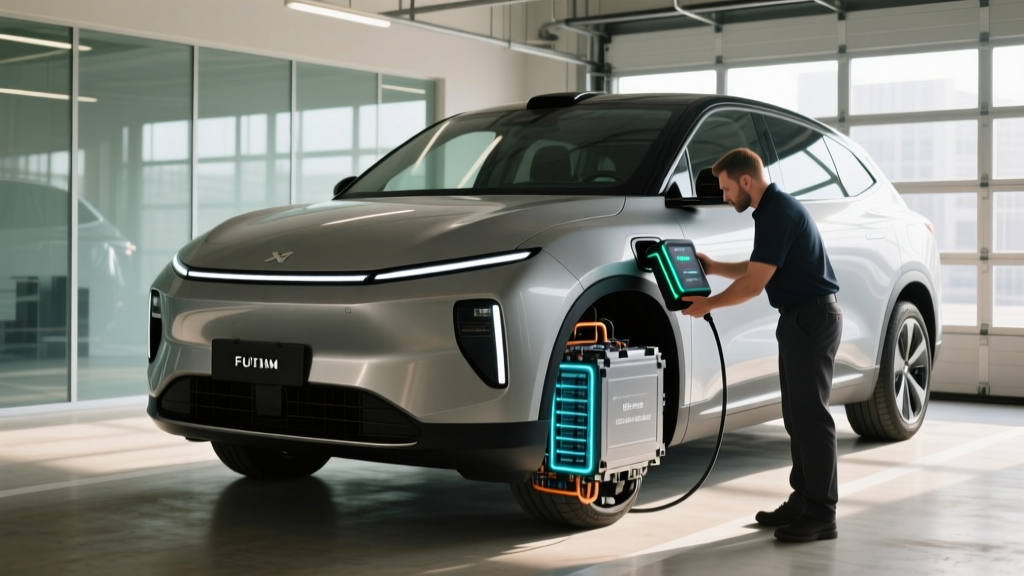
If you've ever searched for a battery tender for AGM battery maintenance, you're likely familiar with the world of 12-volt lead-acid and Absorbed Glass Mat (AGM) batteries — the kind that start gas cars, power marine electronics, and sit in your garage on a trickle charger all winter. But when you transition to an electric vehicle, battery maintenance becomes an entirely different discipline. Your EV carries two distinct batteries: a high-voltage lithium-ion traction battery (60–120+ kWh) that propels the car, and a small 12V auxiliary battery (often AGM or lithium-iron-phosphate) that runs the electronics, lights, and safety systems. A battery tender designed for AGM chemistry cannot maintain, balance, or repair your EV's main pack — and attempting to connect one would be dangerous and pointless.
This guide breaks down everything EV owners and shoppers need to know about the high-voltage traction battery: the chemistry trade-offs between LFP and NMC, real-world degradation data, warranty coverage, replacement economics, and the habits that maximize longevity. We'll also clarify where your 12V AGM battery fits in and when a battery tender for AGM battery care actually makes sense in an EV household.
The Two Batteries in Your EV: Traction vs. Auxiliary
Every modern EV sold in the U.S. contains two electrically isolated battery systems:
- High-voltage traction battery: Typically 400V or 800V architecture, 50–120+ kWh of usable energy, using lithium-ion cells (either NMC/NCA or LFP chemistry). This battery powers the electric motor(s) and is the single most expensive component in the vehicle.
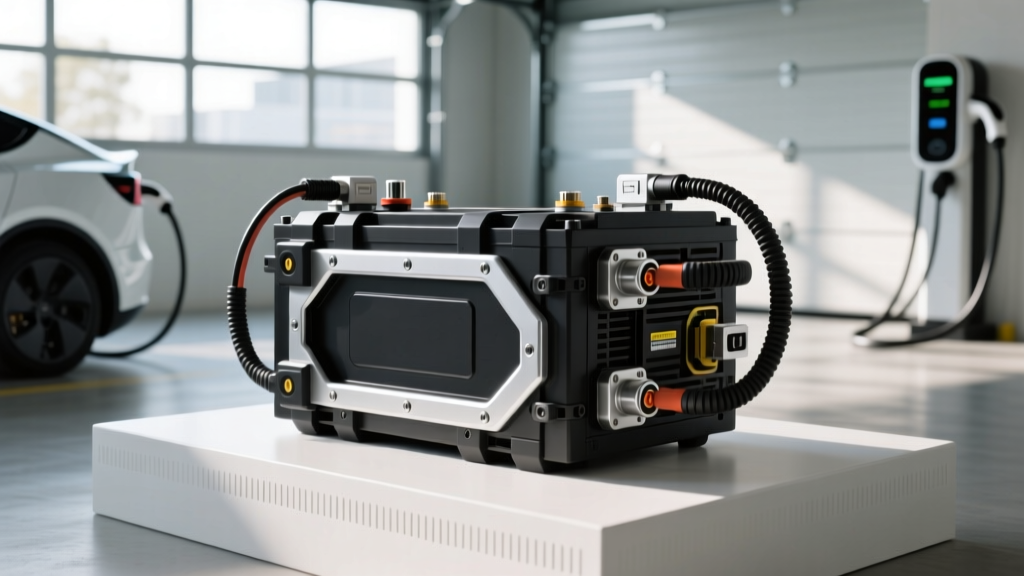
- 12V auxiliary battery: A small lead-acid, AGM, or increasingly lithium-iron-phosphate (LiFePO4) battery that powers the vehicle's computers, door locks, infotainment, lights, and safety systems. It is charged by a DC-DC converter from the traction battery.
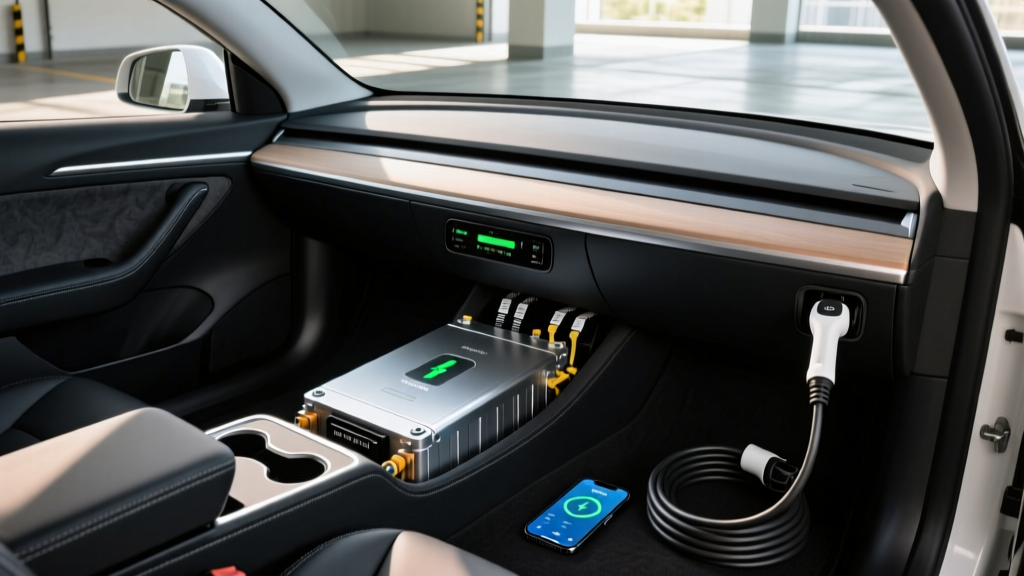
A battery tender for AGM battery maintenance is relevant only to that second, smaller battery — and even then, most EVs keep the 12V topped up automatically via the DC-DC converter whenever the car is plugged in or periodically wakes from sleep. Tesla, for example, has moved to a 16V lithium auxiliary battery in newer Model 3 and Model Y vehicles, eliminating the AGM failure problem entirely. Hyundai, Kia, and GM still use AGM 12V batteries in many 2025–2026 models, and those can fail after 3–5 years just like in a gas car.
Battery Chemistry Explained: LFP vs. NMC vs. NCA
The lithium-ion cells inside your EV's traction battery come in two dominant chemistries available to U.S. buyers in 2026. Understanding the difference directly affects your ownership experience, charging habits, and long-term cost.
| Attribute | LFP (Lithium Iron Phosphate) | NMC/NCA (Nickel Manganese Cobalt / Nickel Cobalt Aluminum) |
|---|---|---|
| Energy Density | Lower (~160–180 Wh/kg cell-level) | Higher (~220–300 Wh/kg cell-level) |
| Typical Use | Standard-range models (Tesla Model 3 RWD, Ford Mustang Mach-E Select, base Chevy Equinox EV) | Long-range and performance models (Tesla Model 3 LR, Hyundai Ioniq 5 LR, BMW iX) |
| Cycle Life | 3,000–5,000+ cycles to 80% capacity | 1,000–2,000 cycles to 80% capacity |
| Cold-Weather Performance | Moderately worse in extreme cold (10–15% more range loss vs NMC below 20°F) | Better cold-weather energy retention |
| Charging to 100% Daily | Recommended — periodic 100% charges help BMS calibration | Discouraged — daily 80% limit recommended for longevity |
| Cost per kWh (pack-level) | ~$100–$115/kWh | ~$130–$155/kWh |
| Cobalt/Contentious Minerals | None (iron + phosphate) | Contains cobalt and nickel |
| Thermal Stability / Safety | Excellent — higher thermal runaway threshold | Good — requires more active thermal management |
LFP vs. NMC — Which Is Better and Why?
Neither chemistry is universally superior; the right choice depends on your driving profile.
Choose LFP if: You primarily commute under 200 miles round-trip, can charge at home daily, want the longest possible cycle life, and prefer not to manage a state-of-charge ceiling. LFP's lower energy density means less total range (e.g., Tesla Model 3 RWD at 272 miles EPA vs. Long Range AWD at 363 miles EPA), but the trade-off is exceptional longevity and lower replacement cost.
Choose NMC/NCA if: You regularly take road trips exceeding 250 miles, live in a region with harsh winters, or need maximum range from a given battery volume. NMC's higher energy density gives more miles per kWh of pack weight, and its better cold-weather performance matters if you drive in sub-freezing temperatures regularly.
How Long Do EV Batteries Last? Real Degradation Data
The fear that EV batteries will need replacement every few years is not supported by fleet data. Most modern traction batteries are engineered to outlast the vehicle's economic life.
- Tesla Model 3/Y (NMC/NCA, 2018–2023 models): Average ~8–10% capacity loss at 100,000 miles; ~12–15% at 150,000 miles. (Source: Tesla Impact Reports, Recurrent Auto fleet data)
- Chevrolet Bolt EV/EUV (NMC, 2017–2023): ~6–9% loss at 80,000 miles; some early 2017–2018 models saw higher degradation linked to consistent 100% charging and DC fast-charging in hot climates.
- Hyundai Ioniq 5 (NMC, 2022–2025): Early data shows ~4–6% loss at 50,000 miles — consistent with Hyundai's robust thermal management system.
- Tesla Model 3 RWD (LFP, 2021–2025): ~3–5% loss at 60,000 miles. LFP's slower degradation curve is evident in early high-mileage fleet data.
- Nissan Leaf (passive air-cooled, 2011–2017): The cautionary tale — 20–30%+ loss at 80,000 miles in hot climates due to lack of active liquid cooling. Modern liquid-cooled packs have largely solved this.
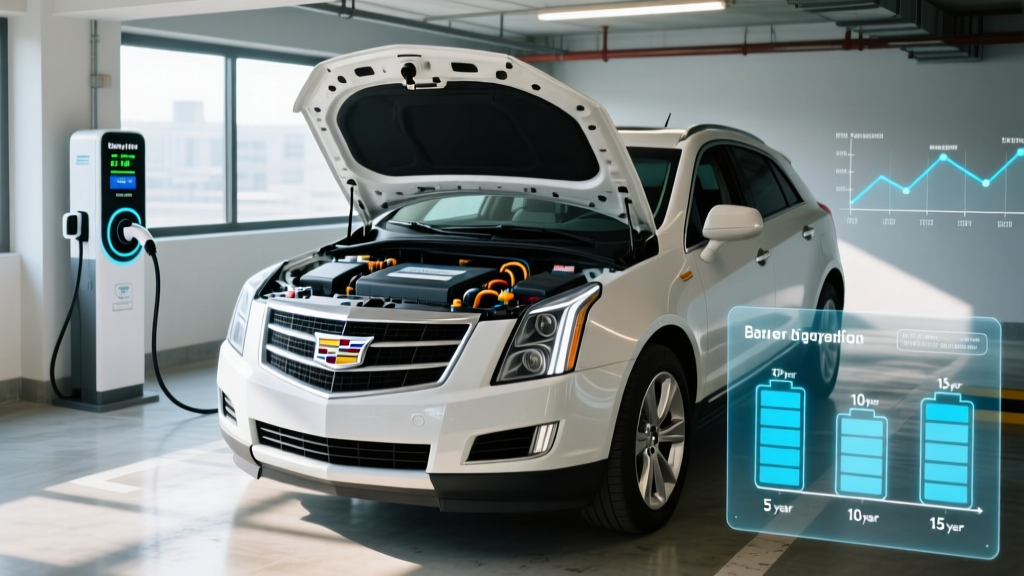
A well-maintained modern EV battery (liquid-cooled, with active thermal management) should retain 80–90% of original capacity at 150,000 miles and remain functional well beyond 200,000 miles. Catastrophic failure requiring full replacement is rare — far rarer than engine or transmission replacement in ICE vehicles at equivalent mileage.
Factors That Accelerate Degradation
- Frequent DC fast charging above 150 kW: Occasional road-trip fast charging is fine, but daily reliance on 250–350 kW chargers generates sustained heat that stresses cells. Studies from Recurrent Auto show measurable (though modest) additional degradation in fleets that fast-charge more than 3x per week.
- Sustained high State of Charge (NMC/NCA only): Parking an NMC vehicle at 100% SoC for days or weeks accelerates calendar degradation. LFP is immune to this concern.
- Extreme heat exposure: Regularly parking in 100°F+ ambient without shade, especially at high SoC, is the single biggest environmental stressor. Active thermal management mitigates this significantly in 2022+ models.
- Deep discharges to 0%: Letting any lithium-ion pack sit at or near 0% for extended periods can cause copper dissolution in the anode. Keep storage SoC between 20–80% for NMC, and don't let LFP sit at 0% for weeks.
Battery Warranty Terms: What's Covered and for How Long
Federal law mandates that EV battery warranties cover a minimum of 8 years / 100,000 miles (10 years / 150,000 miles in California and states adopting CARB standards). Most manufacturers exceed these minimums with capacity-retention guarantees.
| Manufacturer / Model | Warranty Period | Capacity Retention Threshold | Notes |
|---|---|---|---|
| Tesla (Model 3 RWD — LFP) | 8 yr / 100,000 mi | 70% | Standard range models |
| Tesla (Model 3 LR / Model Y — NMC) | 8 yr / 120,000 mi | 70% | Long Range and Performance |
| Hyundai / Kia (Ioniq 5, EV6, EV9) | 10 yr / 100,000 mi | 70% | Among the longest coverage periods |
| GM (Chevy Equinox EV, Blazer EV, Silverado EV) | 8 yr / 100,000 mi | 70% | Ultium platform; some commercial fleet terms differ |
| Ford (Mustang Mach-E, F-150 Lightning) | 8 yr / 100,000 mi | 70% | Covers cells, modules, and BMS |
| BMW (i4, iX, i7) | 8 yr / 100,000 mi | 70% | Module-level replacement where possible |
| Rivian (R1T, R1S) | 8 yr / 175,000 mi | 70% | Higher mileage threshold for adventure-use vehicles |
What triggers a warranty claim? If your battery's State of Health (SoH) — measured by the BMS as usable capacity relative to original — drops below the stated threshold (typically 70%) within the warranty window, the manufacturer must repair or replace the battery at no cost. In practice, most warranty claims involve individual module or cell replacement rather than a full pack swap.
Warranties typically exclude damage from collisions, flooding, improper modifications, or use of non-approved charging equipment. They also generally do not cover gradual capacity loss above the threshold — a battery at 72% SoH at year 9 is considered normal wear.
EV Battery Replacement Cost: What to Expect
Full traction battery replacement is uncommon within the first 150,000 miles, but it does happen — typically due to manufacturing defects, physical damage, or in very high-mileage commercial use. Here's what it costs when it does.
| Vehicle / Battery Size | Battery Chemistry | Estimated Pack Cost (Parts) | Labor + Total Estimate |
|---|---|---|---|
| Tesla Model 3 RWD (~60 kWh) | LFP | $8,000–$11,000 | $10,000–$14,000 |
| Tesla Model Y LR (~82 kWh) | NMC | $12,000–$16,000 | $15,000–$20,000 |
| Hyundai Ioniq 5 (~77.4 kWh) | NMC | $11,000–$15,000 | $14,000–$19,000 |
| Ford F-150 Lightning Ext. Range (~131 kWh) | NMC | $18,000–$25,000 | $22,000–$30,000 |
| Chevy Bolt EV (~65 kWh) | NMC | $9,000–$13,000 | $12,000–$16,000 |
| Rivian R1T Large Pack (~135 kWh) | NMC | $20,000–$28,000 | $25,000–$35,000 |
Several important caveats apply to these figures:
- Module-level repair is increasingly common: Rather than replacing the entire pack, dealers and specialized shops can replace individual modules (groups of cells) for $1,500–$5,000 depending on the fault.
- Remanufactured packs reduce cost: Third-party suppliers and OEM refurbishment programs offer remanufactured packs at 30–50% below new-pack pricing.
- Battery costs continue declining: Pack-level pricing has fallen from ~$1,200/kWh in 2010 to approximately $110–$140/kWh in 2026, per BloombergNEF data. Replacement costs in 2030 will likely be significantly lower than today.
- Most batteries outlive the car: According to data from fueleconomy.gov and fleet operators, the vast majority of EVs are retired due to collision, body corrosion, or electronic failures long before the traction battery becomes uneconomical to replace.
How to Check and Maximize Battery Health
Monitoring State of Health (SoH)
Most EVs don't display a direct SoH percentage on the dashboard, but you can assess battery health through several methods:
- Dashboard range estimate tracking: Note your vehicle's displayed full-charge range when new (e.g., 310 miles EPA) and compare it periodically. A 2025 Tesla Model 3 LR showing 285 miles at 100% charge after 30,000 miles indicates roughly 8% degradation — within normal parameters.
- OBD-II diagnostic apps: Tools like Scan My Tesla, LeafSpy (for Nissan Leaf), or Car Scanner can read BMS-reported SoH, cell voltage deltas, and cycle counts via the OBD-II port.
- Dealer diagnostic reports: Request a battery health report during routine service. Most manufacturers can pull a detailed SoH readout showing individual module balance.
- Third-party services: Companies like Recurrent and Geotab offer battery health reports that compare your degradation curve against fleet averages for your specific model.
Battery Care Best Practices
- NMC/NCA owners: Set daily charge limit to 80%. Charge to 100% only before long trips and depart promptly after reaching full.
- LFP owners: Charge to 100% at least once per week to allow the BMS to calibrate cell balancing. Daily 100% is fine.
- Minimize DC fast charging when possible: Use Level 2 home charging (7–11.5 kW) as your daily routine. Reserve 150+ kW DC fast charging for road trips.
- Precondition before fast charging: Use the vehicle's navigation-to-charger feature (Tesla, Hyundai, Ford, BMW all support this) to warm the battery to optimal temperature before arriving at a DC fast charger. This protects cells and speeds charging.
- Avoid prolonged storage at extremes: If storing for 2+ weeks, set SoC to ~50% (NMC) or ~40–60% (LFP). Keep the vehicle plugged in if possible so the thermal management system can maintain battery temperature.
- Park in shade or a garage during extreme heat: Sustained battery temperatures above 95°F accelerate calendar degradation.
- Don't let SoC sit at 0%: If you arrive with a near-empty battery, plug in as soon as possible. Extended time at very low SoC stresses the anode.
Where a Battery Tender for AGM Battery Maintenance Still Fits
If your EV uses a 12V AGM auxiliary battery (common in 2022–2026 Hyundai, Kia, GM, Ford, and Volkswagen models), that battery can still fail — typically after 3–5 years, or sooner if the vehicle sits unplugged for extended periods. The 12V battery powers the vehicle's computers, which draw a small but continuous parasitic load even when the car is "off."
A quality battery tender for AGM battery maintenance (such as the Battery Tender Plus 1.25A or NOCO GENIUS5, both of which support AGM charge profiles) is appropriate only for the 12V auxiliary battery, and only in these scenarios:
- Your EV will sit unplugged for more than 2–3 weeks (the DC-DC converter won't wake to charge the 12V if the traction battery is disconnected or deeply depleted).
- You've experienced repeated 12V failures and are maintaining a replacement AGM battery on a bench or in seasonal storage.
- You're maintaining a standalone AGM battery for accessories (e.g., a trailer battery, marine application, or off-grid setup).
For daily-driven EVs that are regularly plugged into a Level 2 home charger, the vehicle's DC-DC converter maintains the 12V AGM battery automatically. A battery tender is unnecessary in normal use.
Emerging Battery Technology: What's Next
Several next-generation battery technologies are in active development. None are available in production EVs sold in the U.S. as of 2026, but realistic timelines are coming into focus:
- Solid-state batteries: Toyota, Samsung SDI, and QuantumScape are targeting limited production in 2027–2029 models. Promised benefits include 50%+ energy density improvement, 10-minute fast charging, and 10,000+ cycle life. Realistic expectation: initial deployment in premium/low-volume models, with mainstream availability not before 2030–2032.
- Silicon-dominant anodes: Companies like Sila Nanotechnologies and Group14 are replacing graphite anodes with silicon composites, boosting energy density by 20–40%. Early deployment has begun in niche applications; broader EV adoption is expected 2027–2029.
- Sodium-ion batteries: CATL and BYD have begun deploying sodium-ion packs in Chinese-market vehicles. Lower energy density but dramatically lower cost and no lithium, cobalt, or nickel. U.S. market availability is uncertain but could arrive in budget models by 2028–2030.
- LMFP (Lithium Manganese Iron Phosphate): An evolution of LFP that adds manganese for ~15–20% higher energy density while retaining LFP's safety and cycle-life advantages. Expected in Tesla and other manufacturers' standard-range models by 2027.
These technologies are promising but remain announced and preliminary. Purchase decisions today should be based on current LFP and NMC/NCA chemistries, which are mature, well-understood, and backed by robust warranty coverage.
Frequently Asked Questions
Can I use a battery tender for AGM battery on my EV's main battery pack?
No. A battery tender outputs 12V at 1–5 amps and is designed for lead-acid and AGM chemistries. Your EV's traction battery operates at 400–800V and uses lithium-ion chemistry managed by a sophisticated BMS. Connecting any external 12V device to the high-voltage system would be ineffective and extremely dangerous. The traction battery is maintained exclusively by the vehicle's onboard systems.
How long do EV batteries last in years and miles?
Modern liquid-cooled EV batteries (2022 and newer) are designed to retain 70–85% of original capacity at 150,000–200,000 miles and 10–15 years of service. Fleet data from Tesla, Hyundai, and GM shows median degradation of 8–12% at 100,000 miles. Most EV batteries will outlast the vehicle's economic life.
How much does an EV battery cost to replace?
Full pack replacement ranges from approximately $10,000–$14,000 for a standard-range Tesla Model 3 (LFP, ~60 kWh) to $25,000–$35,000 for a large-pack Rivian R1T or Ford F-150 Lightning (~130+ kWh NMC). However, module-level repairs cost significantly less ($1,500–$5,000), and full replacements are rare within the first 150,000 miles. Pack costs continue to decline year over year.
What does the EV battery warranty cover?
Federal law requires a minimum of 8 years / 100,000 miles of battery warranty coverage (10 years / 150,000 miles in CARB states). Most manufacturers guarantee the battery will retain at least 70% of original capacity within that period. Coverage includes cells, modules, and the BMS. It excludes collision damage, flooding, unauthorized modifications, and normal degradation above the threshold. See IRS.gov for how battery sourcing requirements also interact with federal tax credit eligibility.
How do I check my EV's battery health?
Track your vehicle's displayed full-charge range over time and compare it to the original EPA rating. Use OBD-II diagnostic apps (Scan My Tesla, LeafSpy, Car Scanner) for detailed SoH and cell voltage data. Request a battery health report from your dealer during service. Third-party services like Recurrent Auto provide fleet-comparison reports.
LFP vs NMC — which battery chemistry should I choose?
Choose LFP for daily commuting, maximum cycle life, lower cost, and the convenience of regular 100% charging. Choose NMC/NCA for maximum range, better cold-weather performance, and road-trip flexibility. Both chemistries are proven and well-supported in 2026; the right choice depends on your driving pattern, not on one being objectively "better."
Will my 12V AGM battery in my EV fail like a gas car battery?
Yes — EVs with 12V AGM auxiliary batteries experience the same 3–5 year failure cycle as gas vehicles. A battery tender for AGM battery maintenance can help if the vehicle sits unplugged for weeks. However, most EVs maintain the 12V automatically via the DC-DC converter when plugged in, making a tender unnecessary for daily-driven vehicles. Tesla's newer models have eliminated the AGM 12V entirely by switching to a 16V lithium auxiliary battery.