Understanding EV Battery Capacity: kWh, Usable Energy, and the Buffer
When automakers advertise an EV's battery size, the number you see — say, 82 kWh or 100 kWh — is the gross capacity. But the vehicle's software never lets you access every electron. A locked buffer at the top and bottom of the state-of-charge window protects the cells from over-charging and deep-discharging, the two fastest paths to accelerated degradation.
For example, the 2026 Tesla Model 3 Long Range carries an 82 kWh gross pack but exposes roughly 75–77 kWh of usable capacity. The Hyundai Ioniq 5 (84 kWh gross) yields about 77.4 kWh usable. This distinction matters because EPA range and real-world efficiency calculations should use the usable figure, not the headline number.
Over time, that usable window shrinks. A pack that delivered 77 kWh on day one might deliver 72 kWh at 100,000 miles — that is a 6–7% loss in total energy storage, translating directly to fewer miles per charge. Understanding what drives that loss, and how to slow it, is the core of long-term EV ownership.
LFP vs NMC/NCA: Which Chemistry Powers Your EV?
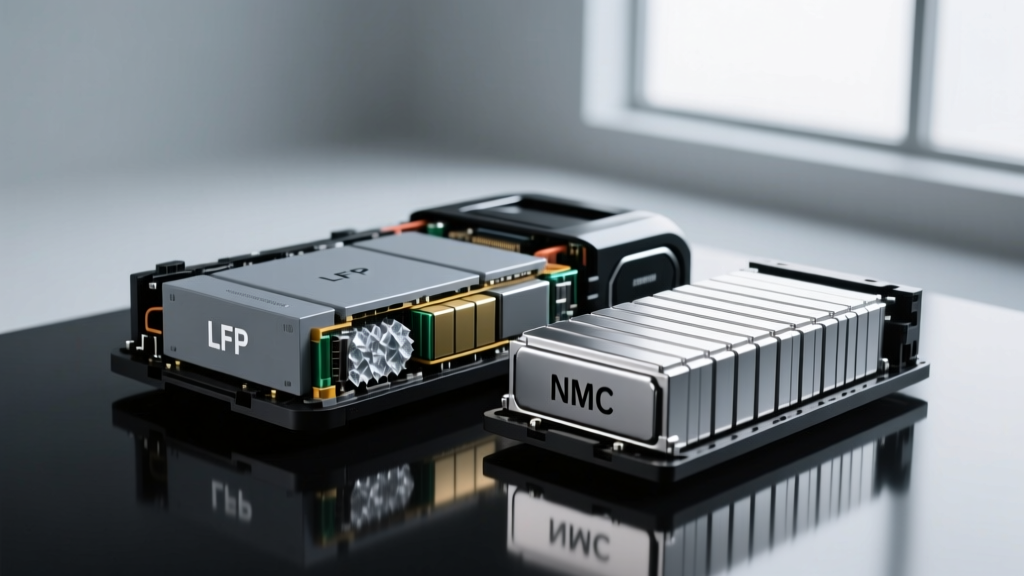
Two dominant lithium-ion chemistries power the 2026 EV market: NMC (nickel-manganese-cobalt) / NCA (nickel-cobalt-aluminum) and LFP (lithium iron phosphate). They behave very differently in daily use.
| Attribute | LFP (LiFePO₄) | NMC / NCA |
|---|---|---|
| Energy density (cell-level) | ~160–180 Wh/kg | ~230–300 Wh/kg |
| Typical cycle life | 3,000–5,000+ cycles | 1,000–2,500 cycles |
| Cold-weather performance | Reduced; slower charging below 32°F | Better low-temp conductivity |
| Thermal stability | Excellent; higher runaway threshold | Good; requires more active cooling |
| Cost per kWh (cell) | ~$80–100 | ~$110–140 |
| Recommended daily SoC | 100% is fine | 80% preferred for daily use |
| Common 2026 applications | Tesla Model 3 RWD, Model Y RWD, Ford Mustang Mach-E Select SR | Long-range AWD models, luxury sedans, trucks |
The practical trade-off: NMC/NCA packs deliver more range in a lighter, smaller package — critical for 300+ mile vehicles and cold-climate drivers. LFP packs sacrifice some energy density but gain dramatically longer cycle life, lower cost, and the convenience of regular 100% charging without degradation anxiety. For urban commuters who charge at home nightly, LFP is often the better match. For road-trippers in northern states, NMC's cold-weather edge and higher density win out.
According to IEA Global EV Outlook data, LFP's global market share in passenger EVs surpassed 40% in 2025, driven by cost advantages and supply-chain diversification away from cobalt and nickel.
Real-World Degradation: What the Data Actually Shows
Headlines about EV batteries "dying" rarely match the fleet data. Most modern liquid-cooled packs lose capacity gradually, not catastrophically.
Observed Capacity Retention by Mileage (Fleet Averages, Liquid-Cooled Packs)
- Year 1 / 15,000 mi: ~2–3% loss (initial SEI layer formation; steepest early drop)
- Year 3 / 45,000 mi: ~5–7% loss
- Year 5 / 75,000 mi: ~7–10% loss
- Year 8 / 120,000 mi: ~10–15% loss
- Year 10 / 150,000 mi: ~12–18% loss (NMC); ~8–12% loss (LFP)
Sources: Geotab fleet battery health study, Recurrent Auto battery data reports, manufacturer warranty filings.
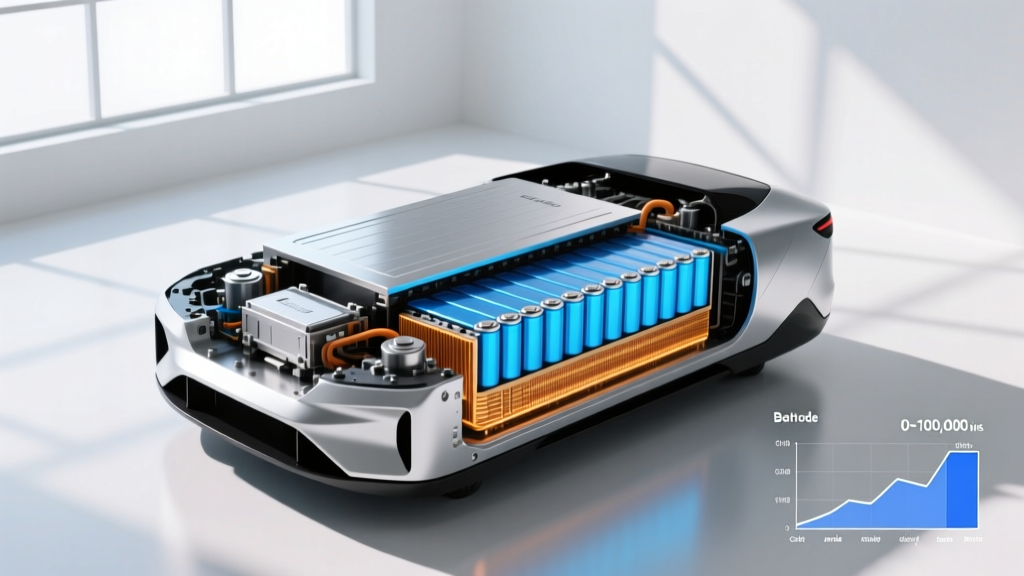
Several patterns emerge from this data. First, degradation is non-linear — the largest percentage loss occurs in the first year, then the curve flattens considerably. Second, LFP packs consistently show 3–5 percentage points less degradation at equivalent mileage compared to NMC, thanks to the iron-phosphate cathode's structural stability. Third, vehicles with robust liquid thermal management (Tesla, Hyundai/Kia E-GMP, GM Ultium) outperform air-cooled legacy packs by a wide margin.
A 2026 Model 3 RWD with its LFP pack might retain 90–92% of original capacity at 100,000 miles, while a comparable NMC long-range variant might sit at 86–89%. Both are well within warranty thresholds, and both still deliver 90%+ of original EPA range — a loss of 25–35 miles on a 300-mile vehicle over a decade.
Battery Warranty Terms: What Manufacturers Actually Cover
Federal law mandates a minimum 8-year / 100,000-mile warranty on EV battery packs for emissions-related compliance, and most automakers meet or exceed this baseline. The critical detail is the capacity retention threshold — the point at which the manufacturer must repair or replace the pack.
| Manufacturer / Model | Warranty Term | Capacity Threshold |
|---|---|---|
| Tesla Model 3 / Model Y | 8 yr / 120,000 mi (LR/AWD); 8 yr / 100,000 mi (RWD) | 70% retention |
| Hyundai Ioniq 5 / Ioniq 6 | 10 yr / 100,000 mi | 70% retention |
| Ford Mustang Mach-E / F-150 Lightning | 8 yr / 100,000 mi | 70% retention |
| Chevrolet Equinox EV / Blazer EV | 8 yr / 100,000 mi | 70% retention (60% for fleet) |
| BMW i4 / iX | 8 yr / 100,000 mi | 70% retention |
| Rivian R1T / R1S | 8 yr / 175,000 mi | 70% retention |
The 70% threshold is nearly universal. This means if your 82 kWh pack drops below roughly 57 kWh of usable capacity within the warranty window, the manufacturer covers the repair. In practice, very few liquid-cooled packs breach this threshold under normal use — the fleet data above shows most packs retain 82–88% at the 8-year mark.
What's covered: Cell defects, module failures, BMS malfunctions, and capacity loss below the stated threshold. What's typically excluded: Damage from accidents, flooding, improper charging equipment, unauthorized modifications, or cosmetic issues. Always review your specific owner's manual warranty section, as terms vary by model year and trim.
EV Battery Replacement Cost: Numbers and Context
This is the question that generates the most anxiety, and the most misinformation. Let's ground it in data.
| Vehicle / Pack Size | Out-of-Warranty Cost (Parts + Labor) | Typical Replacement Trigger |
|---|---|---|
| Tesla Model 3 RWD (60 kWh LFP) | $8,000–$12,000 | Cell failure / module imbalance (rare before 200k mi) |
| Tesla Model Y LR (82 kWh NMC) | $12,000–$16,000 | Capacity below 70% or cell defect |
| Hyundai Ioniq 5 (84 kWh NMC) | $11,000–$15,000 | Module failure or capacity loss |
| Ford F-150 Lightning Ext. Range (131 kWh) | $18,000–$25,000 | Pack-level fault or severe degradation |
| Chevrolet Silverado EV (200+ kWh Ultium) | $22,000–$30,000+ | Large pack; modular repair may reduce cost |
The critical context most coverage omits: Full pack replacement due to natural degradation alone is exceedingly rare within a vehicle's first 15 years. When replacements do occur, they are far more often due to individual cell or module defects (covered under warranty) or physical damage from collisions. Modular pack architectures — like GM's Ultium platform and Hyundai's E-GMP — allow technicians to replace individual modules rather than the entire pack, reducing out-of-warranty costs to $2,000–$5,000 per module.
Battery cell prices have also continued their long decline. According to BloombergNEF, average lithium-ion pack prices fell below $120/kWh at the cell level in late 2025, meaning replacement costs will continue trending downward as the current fleet ages. By the time a 2026 EV actually needs a new pack in 2038–2040, costs are projected to be 40–60% lower than today's estimates.
What Affects EV Battery Capacity Over Time
Degradation is inevitable, but the rate varies enormously based on how you use and store the vehicle. Five factors dominate:
1. State of Charge Habits
For NMC/NCA packs, regularly sitting at 100% SoC accelerates electrolyte decomposition and cathode stress. Tesla, Ford, and Hyundai all recommend setting daily charge limits to 80% for NMC vehicles and reserving 100% for road trips. LFP packs are an exception — manufacturers recommend periodic 100% charges to allow the BMS to recalibrate cell balancing.
2. DC Fast Charging Frequency
Occasional DC fast charging (1–2 sessions per week) has minimal measurable impact on modern liquid-cooled packs. Daily reliance on 150+ kW DC charging without preconditioning does accelerate degradation modestly — studies show an additional 1–3% loss over 100,000 miles compared to Level 2 home charging. The key mitigator: always enable battery preconditioning (automatic on most vehicles when a charger is set as your navigation destination).
3. Temperature Extremes
Prolonged exposure to ambient temperatures above 95°F degrades cells faster, particularly if the vehicle sits at high SoC. Similarly, charging an NMC pack in sub-freezing temperatures without preconditioning can cause lithium plating on the anode — a permanent capacity loss mechanism. Garage parking and preconditioning are the most cost-effective "battery insurance" available.
4. Depth of Discharge
Regularly draining the pack to 0% or near-0% stresses cells more than shallow cycles. Running between 20% and 80% (the "middle 60%") is the sweet spot for NMC longevity. LFP is more tolerant of deep cycles, which is one reason it achieves higher cycle-life ratings.
5. Calendar Aging
Even a parked EV loses capacity over time. Calendar aging is driven primarily by SoC and temperature — a vehicle stored at 100% in a hot garage will degrade faster than one stored at 50% in a cool garage. For long-term storage (2+ weeks), set the charge level to 50–60% and keep the vehicle in shade or a garage.
EV Battery Care Checklist
- Set daily charge limit to 80% (NMC) or 100% (LFP, with periodic recalibration)
- Enable battery preconditioning before every DC fast charge session
- Avoid leaving the vehicle at 100% SoC for more than a few hours
- Minimize DC fast charging to 2–3 sessions per week when Level 2 is available
- Park in shade or a garage during sustained high-heat periods
- For storage over 2 weeks, set SoC to 50–60%
- Keep tire pressure at spec — under-inflation increases energy draw and heat generation
- Use the vehicle's scheduled departure / preconditioning feature to warm or cool the battery on grid power before driving
How to Check Your EV Battery Health (State of Health)
State of Health (SoH) is expressed as a percentage: 100% means the pack holds its original rated capacity; 90% means it holds 90% of that. Monitoring SoH helps you track degradation, plan for resale, and identify warranty-eligible issues early.
In-vehicle displays: Tesla offers a Battery Health screen (Settings → Service → Battery Health) showing estimated SoH as a percentage. Hyundai and Kia provide a similar readout in the EV-specific settings menu on 2024+ models. BMW's iDrive includes a battery health indicator under the vehicle status screens.
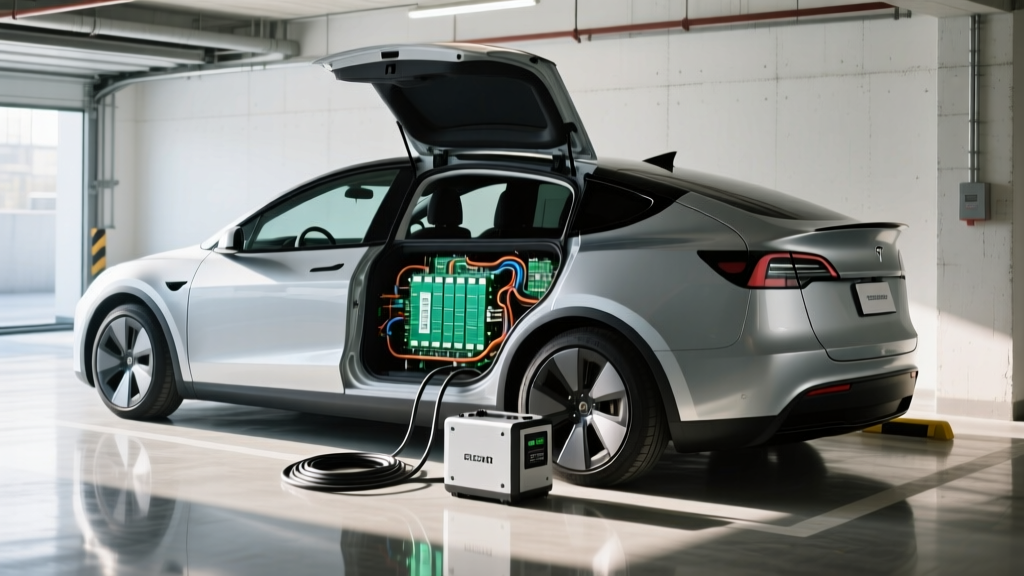
OBD-II diagnostic tools: Third-party apps like Scan My Tesla, Leaf Spy (for Nissan), and Car Scanner ELM OBD2 can read detailed battery telemetry including individual cell voltages, pack temperature, and calculated SoH. A Bluetooth OBD-II dongle ($20–$40) paired with your smartphone gives you dealer-level data.
Charging data analysis: If your vehicle doesn't display SoH directly, you can estimate it. Charge from a known low SoC (say, 10%) to a known high SoC (say, 90%) on a Level 2 charger that reports kWh delivered. Compare the kWh added to the expected value based on your pack's usable capacity. For an 82 kWh pack, going from 10% to 90% should add roughly 65.6 kWh when new. If your charger reports only 60 kWh delivered for that same swing, your SoH is approximately 91–92%.
Manufacturer service checks: During routine service visits, dealerships can pull a full battery health report. Request this at least annually if your vehicle is approaching the warranty mileage threshold, so you have documentation if a claim becomes necessary.
Emerging Battery Technology: What's Next (and When)
Several next-generation technologies are in active development. None are available in production consumer EVs as of 2026, but timelines are becoming clearer.
Solid-state batteries replace the liquid electrolyte with a solid ceramic, polymer, or sulfide layer. Benefits include higher energy density (potentially 400+ Wh/kg at the cell level), faster charging, and improved safety. Toyota has announced a solid-state battery targeting 2027–2028 production in limited models, with initial volumes likely in the low thousands. Samsung SDI and QuantumScape are also pursuing solid-state cells, but mass-market availability at competitive pricing remains a 2029–2032 prospect based on current manufacturing timelines.
Silicon-dominant anodes replace graphite with silicon, which can store roughly 10x more lithium ions per unit mass. Companies like Sila Nanotechnologies and Group14 Technologies are supplying silicon-anode materials to automakers now, with incremental energy density gains (5–15%) appearing in 2026–2027 model-year packs. This is an evolution, not a revolution — it extends range modestly without changing charging infrastructure or ownership habits.
Sodium-ion batteries use abundant sodium instead of lithium, offering lower cost and better cold-weather performance at the expense of energy density. CATL has begun production for Chinese-market micro-EVs and energy storage. US-market passenger EV adoption is unlikely before 2028, and initial applications will be in lower-range, budget-oriented models where energy density is less critical.
For buyers shopping today, these technologies are forward-looking context — not reasons to delay a purchase. Current lithium-ion packs already deliver 250,000+ mile lifespans with proper care, and replacement economics continue improving yearly.
Frequently Asked Questions
How long do EV batteries last in years and miles?
Based on fleet data from Geotab and Recurrent Auto, modern liquid-cooled EV batteries retain 82–90% of original capacity at 100,000 miles and 75–85% at 150,000 miles. In practical terms, most packs will outlast 15–20 years and 200,000+ miles before degradation makes the vehicle impractical for daily use. Catastrophic failure (sudden, total pack death) is extremely rare and typically covered under the 8-year / 100,000-mile minimum warranty.
How much does it cost to replace an EV battery?
Out-of-warranty full pack replacement ranges from approximately $8,000 for a 60 kWh LFP pack (Tesla Model 3 RWD) to $25,000+ for a 131 kWh extended-range truck pack (F-150 Lightning). However, full replacements due to degradation alone are rare — most replacements involve individual module repairs ($2,000–$5,000) or warranty-covered defects. Cell pricing continues declining, and replacement costs are expected to be 40–60% lower by the 2035–2040 timeframe when today's EVs may actually need new packs.
What does the EV battery warranty actually cover?
Standard battery warranties cover 8 years / 100,000 miles (some manufacturers extend to 10 years) against capacity loss below 70% of original capacity, cell defects, module failures, and BMS malfunctions. They typically exclude damage from collisions, flooding, unauthorized modifications, and use of non-certified charging equipment. Hyundai offers one of the strongest warranties at 10 years / 100,000 miles. Always check your specific owner's manual for exact terms, as coverage varies by model year and trim.
How do I check and maximize my EV battery health?
Check SoH through your vehicle's built-in battery health screen (Tesla, Hyundai, BMW), an OBD-II diagnostic app like Scan My Tesla or Car Scanner, or by comparing kWh delivered during a known SoC charging session against expected values. To maximize longevity: set daily charge limits to 80% for NMC packs, enable preconditioning before DC fast charging, avoid prolonged storage at 100% SoC or in extreme heat, and favor Level 2 home charging over daily DC fast charging.
LFP vs NMC — which battery chemistry is better?
Neither is universally "better" — they serve different use cases. LFP (lithium iron phosphate) offers longer cycle life (3,000–5,000+ cycles), lower cost, better thermal safety, and the ability to charge to 100% daily without degradation concerns. It sacrifices energy density (~160–180 Wh/kg vs 230–300 Wh/kg) and cold-weather charging speed. NMC/NCA delivers more range per pound, better cold-weather performance, and faster DC charging in freezing conditions, but requires more careful SoC management (80% daily limit recommended). Choose LFP for commuting and warm climates; choose NMC for long-range driving and cold climates.
Does frequent DC fast charging damage the battery?
Modern liquid-cooled packs handle DC fast charging well, and occasional use (1–3 sessions per week) has minimal measurable impact on degradation. Heavy daily DC charging without preconditioning can add 1–3% additional capacity loss over 100,000 miles compared to primarily Level 2 charging. The most important mitigations are enabling battery preconditioning (which warms the pack to optimal charging temperature before you arrive) and avoiding repeated back-to-back DC sessions that keep cell temperatures elevated for extended periods.