Why Battery Bolts Matter More Than You Think
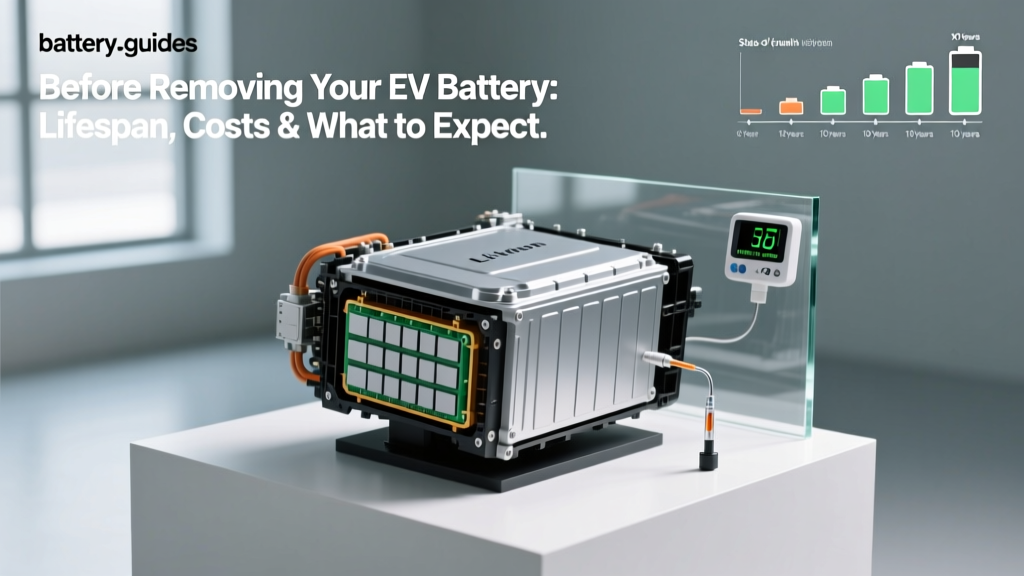
When most EV shoppers research battery technology, they focus on chemistry, kilowatt-hours, and range. But the physical hardware holding the pack together — the battery bolts, busbar fasteners, and structural tie-rods — plays an outsized role in serviceability, safety, and long-term ownership cost. A single corroded or over-torqued battery bolt can compromise the high-voltage enclosure seal, trigger an isolation fault, or make a module-level repair impossible, forcing a full pack replacement that can exceed $15,000.
This guide walks through the complete picture of EV battery longevity: the chemistry inside the cells, the degradation data from real-world fleets, the warranty safety net, the actual cost of replacement, and the hardware — including battery bolts and pack fasteners — that ties it all together. Whether you're evaluating a 2026 model-year purchase or optimizing the pack you already own, the numbers below will ground your expectations in data, not marketing.
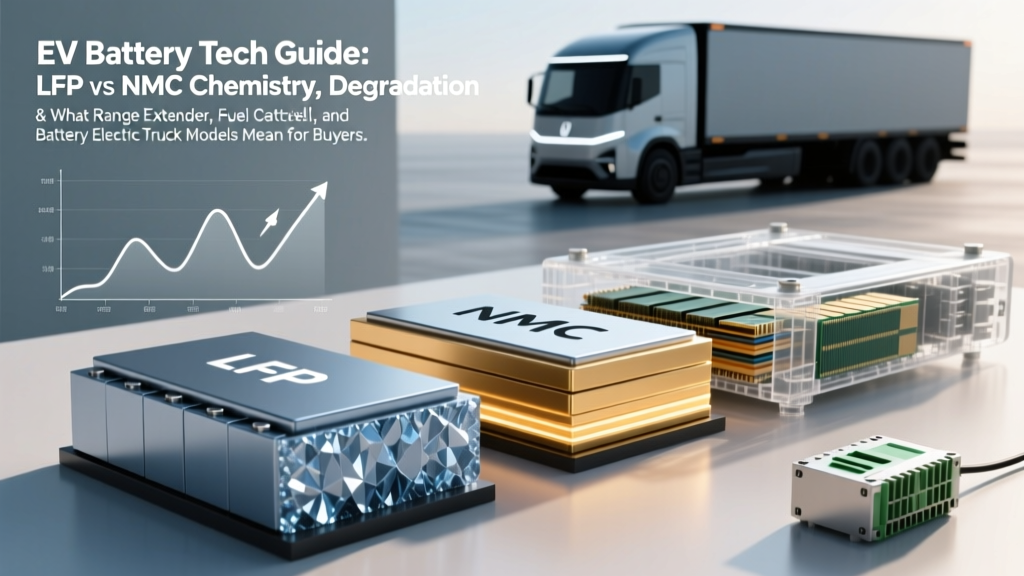
LFP vs NMC vs NCA: Chemistry Trade-Offs Explained
The two dominant lithium-ion chemistries in 2026 passenger EVs are LFP (lithium iron phosphate) and NMC/NCA (nickel manganese cobalt / nickel cobalt aluminum). Each has distinct strengths, and the right choice depends on your driving pattern, climate, and budget.
| Attribute | LFP (LiFePO₄) | NMC / NCA |
|---|---|---|
| Energy density (cell-level) | ~160–180 Wh/kg | ~230–300 Wh/kg |
| Typical cycle life | 3,000–6,000+ cycles | 1,000–2,500 cycles |
| Cold-weather performance | Moderate; slower charge below 32°F | Better low-temp charge acceptance |
| Cost per kWh (pack-level, 2026) | ~$90–$110 | ~$120–$150 |
| Thermal stability | Excellent; higher runaway threshold | Good; requires robust BMS/cooling |
| Recommended daily SoC | 100% OK (periodic full charge helps calibration) | 80% daily; 100% for trips only |
| Common in (2026 models) | Tesla Model 3 RWD, BYD, base Ford Mustang Mach-E SR | Hyundai Ioniq 5, Chevy Equinox EV, Tesla LR/Performance |
The practical takeaway: LFP wins on longevity and cost — ideal for commuters who charge daily to 100% and live in moderate climates. NMC/NCA wins on energy density, giving longer range in a lighter, more compact pack — critical for larger vehicles and cold-climate drivers who need strong charge acceptance in winter. Neither is universally "better." Match the chemistry to your use case.
How Long Do EV Batteries Actually Last?
Federal law mandates a minimum battery warranty of 8 years or 100,000 miles (10 years/150,000 miles in California and states that adopted CARB standards). But real-world data shows most packs significantly outlast those thresholds.
Observed Degradation Data Points (fleet & owner-reported):
- Tesla Model 3/Y (NMC/NCA, 2018–2023): ~5–8% capacity loss at 100,000 miles; ~8–12% at 150,000 miles. (Tesla 2023 Impact Report reports average ~12% degradation at 200,000 miles.)
- Chevrolet Bolt EV/EUV (NMC, 2017–2023): Early 2017–2019 models saw accelerated degradation in hot climates (~10–15% by 80,000 miles), addressed via recall and replacement. Post-recall and 2020+ models show ~5–7% loss at 80,000 miles.
- Nissan LEAF (passive air cooling, NMC): Historically the worst-case scenario — 2011–2017 models lost 15–25% capacity by 60,000–80,000 miles in hot climates due to lack of active thermal management. 2018+ LEAF PLUS improved but still trails liquid-cooled competitors.
- LFP-equipped vehicles (Tesla Model 3 RWD, BYD): Limited long-term data (most deployed post-2021), but early indicators show <3% loss at 50,000 miles, consistent with LFP's superior cycle life.
- Hyundai Ioniq 5 / Kia EV6 (NMC, liquid-cooled): Owner reports indicate ~4–6% loss at 60,000 miles; thermal management keeps cells in the optimal 68–95°F range.
The pattern is clear: liquid-cooled packs with active thermal management degrade far more slowly than passively cooled designs, and LFP chemistry extends the tail end of the degradation curve substantially. Most 2026-era EVs with liquid cooling will retain 85–90% of original capacity at 150,000 miles — well within warranty thresholds and far exceeding the point where most owners have traded in.
What the Battery Warranty Actually Covers
Battery warranties are not unlimited guarantees. They cover defects and excessive capacity loss, measured against a specific retention threshold. Here's how major manufacturers structure coverage for 2026 models:
| Manufacturer | Warranty Term | Capacity Retention Threshold | Notes |
|---|---|---|---|
| Tesla | 8 yr / 120,000 mi (LR/AWD); 8 yr / 100,000 mi (RWD) | 70% | Covers defects + capacity below 70% |
| Hyundai / Kia | 10 yr / 100,000 mi | 70% | Among the longest coverage in the segment |
| GM (Chevy/Cadillac) | 8 yr / 100,000 mi | 70% | Ultium platform; module-level service available |
| Ford | 8 yr / 100,000 mi | 70% | Mustang Mach-E, F-150 Lightning |
| BMW | 8 yr / 100,000 mi | 70% | Includes i4, iX, i7 |
Critical nuance: The 70% threshold means a warranty claim is only triggered if your pack drops below 70% of original usable capacity within the term. A pack at 75% after 9 years and 95,000 miles is functioning "within spec" even though you've lost 25% of your original range. Also, warranties typically do not cover damage from accidents, flooding, improper service (including incorrect battery bolt torque during aftermarket work), or modifications to the high-voltage system.
EV Battery Replacement Cost: What You'll Actually Pay
Battery replacement is the single biggest fear for prospective EV buyers — and the most misunderstood. Here's the reality in 2026:
| Vehicle / Pack Size | Full Pack Replacement Cost | Module-Level Repair (if available) | Typical Need Timeline |
|---|---|---|---|
| Tesla Model 3 RWD (~60 kWh LFP) | $12,000–$16,000 | Not typically offered; full pack swap | Rarely before 200,000+ mi |
| Tesla Model Y LR (~82 kWh NMC) | $15,000–$20,000 | Not typically offered; full pack swap | Rarely before 180,000+ mi |
| Hyundai Ioniq 5 (~77.4 kWh NMC) | $14,000–$18,000 | Module replacement: ~$3,000–$5,000 per module | Rarely before 180,000+ mi |
| Ford F-150 Lightning Ext. Range (~131 kWh NMC) | $22,000–$30,000 | Limited module service | Rarely before 150,000+ mi |
| Chevy Equinox EV (~85 kWh NMC/Ultium) | $14,000–$18,000 | Module-level service designed into Ultium | Rarely before 180,000+ mi |
Context that matters: Fewer than 2% of modern liquid-cooled EV batteries have required full replacement outside of warranty-covered defects (source: Consumer Reports EV battery analysis). The vast majority of packs outlast the vehicle's first ownership cycle. When replacement is needed, it's most commonly due to manufacturing defects caught within the warranty period — meaning you pay $0. Out-of-pocket replacements typically occur on vehicles 10+ years old, where the cost must be weighed against the vehicle's residual value.
Battery Bolts, Pack Architecture & Serviceability
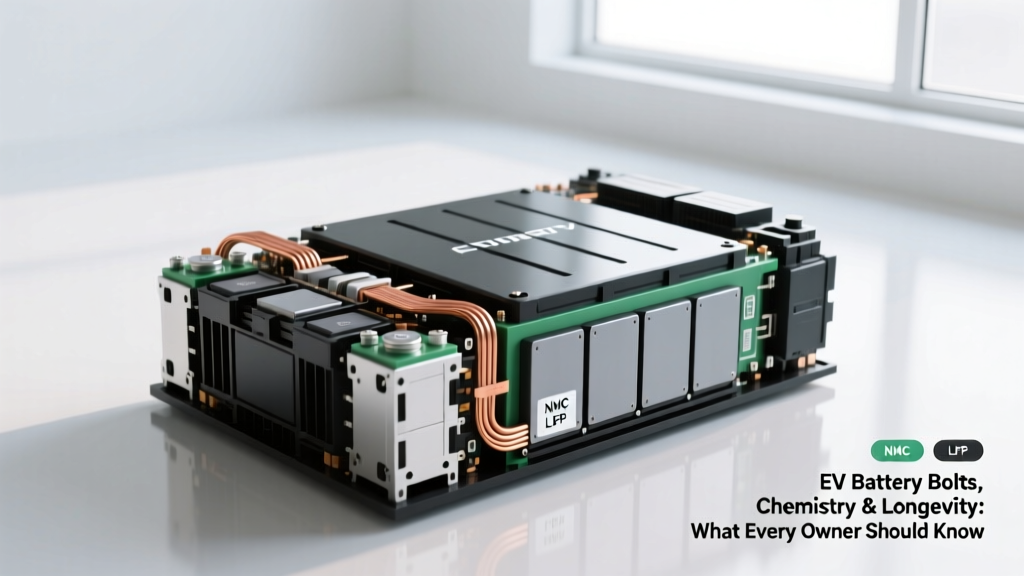
This is where hardware meets ownership reality. EV battery packs are not monolithic blocks — they're assemblies of modules, busbars, coolant plates, and high-voltage connectors, all held together by dozens of precisely torqued battery bolts and structural fasteners.
Why battery bolts matter for service:
- Module-level repair: Platforms like GM's Ultium and Hyundai's E-GMP are designed for module-level service. A technician can open the pack enclosure (by removing the battery bolts securing the lid), identify a faulty module, and replace just that unit — saving $10,000+ versus a full pack swap. This is only possible if the battery bolts and enclosure seals are in good condition and torqued to spec.
- Seal integrity: The battery enclosure gasket prevents moisture intrusion, which can cause isolation faults and corrosion on high-voltage busbars. Battery bolts maintain the clamping force on this gasket. A single under-torqued bolt can allow water ingress; an over-torqued bolt can crack the enclosure or strip threads.
- Crash safety: Structural battery bolts connect the pack to the vehicle's chassis, contributing to torsional rigidity and crash energy management. In vehicles like the Tesla Model Y and Ford F-150 Lightning, the pack is a stressed member of the structure.
- Aftermarket and salvage risk: If a third-party shop opens the pack and reuses stretched or corroded battery bolts (instead of replacing them with OEM-spec fasteners at correct torque), the enclosure seal and structural integrity are compromised. Always insist on new OEM battery bolts and documented torque specs after any high-voltage service.
Torque specifications vary by model and location — typically ranging from 8–25 Nm for module hold-down bolts and 20–50 Nm for enclosure lid bolts. These are not "tighten until snug" situations. A calibrated torque wrench and the manufacturer's service manual are non-negotiable. This is why high-voltage work should only be performed by certified EV technicians.
Factors That Accelerate Battery Degradation
Not all miles are equal when it comes to battery wear. These are the documented factors that accelerate capacity loss:
What accelerates degradation:
- Frequent DC fast charging above 150 kW: High C-rates generate heat. Occasional road-trip fast charging is fine; daily use of 250–350 kW chargers without adequate preconditioning adds cumulative stress. Studies show exclusive DC fast charging can add 1–3% additional degradation over 100,000 miles versus Level 2 home charging.
- Sustained high SoC storage: Leaving an NMC/NCA pack at 100% for days or weeks (especially in heat) accelerates calendar aging. LFP is more tolerant of 100% storage.
- Deep discharge below 10%: Regularly running the pack to near-empty stresses the anode. Keep the floor above 10% for daily use.
- Extreme heat exposure: Ambient temperatures above 95°F, combined with high SoC, are the single worst condition for lithium-ion longevity. This is why liquid-cooled packs (which actively shed heat) dramatically outperform passively cooled designs.
- Cold charging without preconditioning: Charging an NMC pack below 32°F without warming it first can cause lithium plating on the anode — a permanent, irreversible capacity loss. Most 2026 models with navigation-based preconditioning (Tesla, Hyundai, Ford) automatically warm the pack when a charger is set as the destination.
What maximizes longevity:
- Charge primarily on Level 2 (7–11 kW) at home — slower charging generates less heat
- Set daily charge limit to 80% for NMC/NCA; 100% is fine for LFP
- Use preconditioning (nav-to-charger) before every DC fast charge session
- Avoid storing the vehicle above 90% SoC or below 15% SoC for extended periods
- Park in shade or a garage during summer; plug in during extreme cold to let the thermal management system maintain pack temperature
How to Monitor Your Battery's State of Health (SoH)
State of Health (SoH) is the percentage of your battery's original usable capacity that remains. A new pack is 100% SoH; a pack that held 75 kWh when new but now holds 67.5 kWh is at 90% SoH.
How to check SoH in 2026 vehicles:
- In-vehicle diagnostics: Tesla's service menu (accessible via the software screen) displays estimated capacity. Hyundai/Kia's infotainment EV menu shows SoH percentage on 2024+ models. BMW iDrive includes a battery health indicator in the eDrive menu.
- OBD-II diagnostic tools: Devices like the OBDLink SX or OBDeleven, paired with apps such as EV Bat Health or Car Scanner, can read the BMS-reported SoH directly from the vehicle's CAN bus. This is the most accurate owner-accessible method.
- Dealer health check: Most manufacturers can run a full pack diagnostic during a service visit, providing a cell-by-cell voltage deviation report and overall SoH. Request this annually or before a warranty claim.
- Third-party services: Companies like Recurrent Auto (now part of Cox Automotive) offer fleet and individual battery health reports based on telematics data, comparing your pack's degradation to a cohort of identical vehicles.
When to be concerned: If your SoH drops more than 3% in a single year (after the initial "break-in" year, where 2–3% loss is normal), or if you notice sudden range drops that don't correlate with temperature, schedule a diagnostic. Rapid cell-level voltage deviation (one module significantly lower than others) can indicate a failing module — a targeted, lower-cost repair if caught early.
Emerging Battery Technology: What's Next and When
Several next-generation technologies are in development, but none are available in production passenger EVs as of 2026. Here's a realistic timeline based on current industry announcements:
- Solid-state batteries: Toyota has announced pilot production for 2027–2028, targeting 750+ km (WLTP) range and 10-minute fast charging. Nissan and Samsung SDI are on similar timelines. Realistic availability in US-market vehicles: 2029–2031 at earliest, initially in premium segments only. Solid-state replaces the liquid electrolyte with a solid material, improving energy density and safety — but manufacturing cost and yield remain unsolved challenges at scale.
- Silicon-dominant anodes: Companies like Sila Nanotechnologies and Group14 are supplying silicon-carbon anode materials to Panasonic and Mercedes-Benz (the latter in the G-Class EV). Silicon anodes can boost energy density by 20–40% versus graphite. Early limited deployment is underway in 2025–2026; broader adoption expected by 2028.
- Sodium-ion batteries: CATL and BYD have begun deploying sodium-ion packs in Chinese-market micro-EVs and energy storage. Lower cost than LFP but significantly lower energy density (~120–140 Wh/kg). Unlikely to appear in US-market passenger EVs before 2028–2029, and only in budget/urban segments.
- LMFP (lithium manganese iron phosphate): An evolution of LFP that adds manganese for ~15–20% higher energy density while retaining LFP's safety and cycle-life advantages. CATL and Gotion are in production ramp-up. Expected in US-market vehicles by 2027–2028.
These are forward-looking developments. For a purchase decision today, current LFP and NMC chemistries — backed by proven degradation data and robust warranties — are mature, reliable choices.
Frequently Asked Questions
How long do EV batteries last in years and miles?
Most modern liquid-cooled EV batteries (2020 and newer) retain 85–92% of original capacity at 150,000 miles and 10+ years of use. Based on current degradation curves, a well-maintained pack should deliver 200,000–300,000 miles before reaching the 70% capacity threshold that typically defines end-of-life for automotive use. LFP packs may extend beyond 300,000 miles given their 3,000–6,000+ cycle life.
How much does an EV battery cost to replace in 2026?
Full pack replacements range from $12,000 to $30,000 depending on pack size and vehicle, with most mainstream models (75–85 kWh packs) falling in the $14,000–$18,000 range. However, fewer than 2% of modern EV batteries require out-of-warranty replacement. Module-level repairs (where supported, such as on GM Ultium or Hyundai E-GMP platforms) can address localized cell failure for $3,000–$5,000.
What does the EV battery warranty cover?
Federal law requires a minimum of 8 years/100,000 miles of battery coverage (10 years/150,000 miles in CARB states). Warranties cover manufacturing defects and capacity loss below a defined threshold (typically 70% of original capacity). They do not cover damage from accidents, flooding, improper service, or modifications. Always retain service records and ensure any high-voltage work uses OEM-spec battery bolts and documented torque procedures.
How do I check and maximize my EV battery health?
Monitor SoH via the vehicle's built-in diagnostics, an OBD-II reader with EV-specific software, or an annual dealer health check. Maximize longevity by charging primarily on Level 2, limiting NMC/NCA daily SoC to 80%, using preconditioning before DC fast charges, avoiding prolonged storage at extreme SoC levels, and minimizing exposure to sustained high ambient temperatures.
LFP vs NMC — which battery chemistry is better?
Neither is universally superior. Choose LFP if you prioritize maximum cycle life, lower cost, and the ability to charge to 100% daily — ideal for commuters and moderate-climate drivers. Choose NMC/NCA if you need maximum range per charge, better cold-weather charge acceptance, or are buying a larger vehicle where energy density matters. Both chemistries, when paired with liquid cooling and proper care, will outlast the typical ownership period.
Should I worry about battery bolts during service?
If your EV requires high-voltage service — whether for a module replacement, coolant flush, or post-collision inspection — insist that the shop uses new OEM-spec battery bolts torqued to the manufacturer's specification. Reused or improperly torqued fasteners can compromise the pack enclosure seal, leading to moisture intrusion, isolation faults, and potentially voiding your battery warranty. This is a legitimate concern, not a theoretical one, and it's why certified EV technicians are essential for any work below the pack lid.