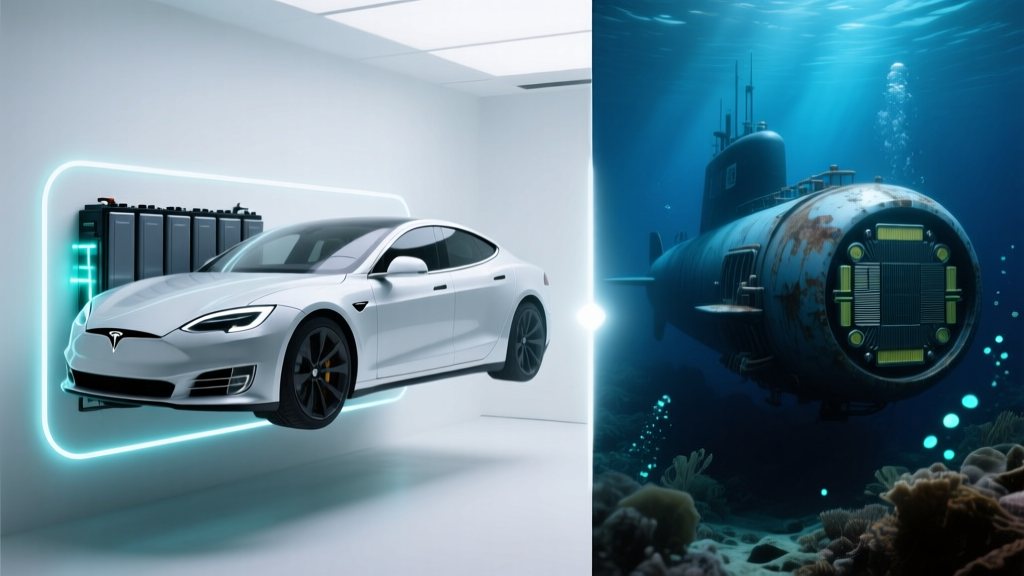
When people search for batteries for submarines, they usually land on military-spec lithium-ion packs built for extreme pressure, silence, and decades of service beneath the ocean. But the core chemistry powering modern submarine propulsion — lithium iron phosphate (LFP) and nickel-manganese-cobalt (NMC) — is the same chemistry sitting under the floorboards of your electric vehicle. The engineering priorities diverge sharply, yet the lessons from naval battery programs illuminate exactly what EV owners should expect from their own high-voltage traction packs.
This guide translates that submarine-grade engineering rigor into practical, data-backed answers for EV buyers and owners: how long your battery will actually last, what degradation looks like in real numbers, what the warranty really covers, and how to maximize the life of a pack that costs $10,000–$25,000 to replace.
LFP vs NMC/NCA: The Chemistry That Powers EVs (and Submarines)
Both the U.S. Navy's next-generation submarine battery programs and the EV industry have converged on two dominant lithium-ion chemistries. Understanding the trade-offs is essential before you buy any electrified vehicle.
| Attribute | LFP (Lithium Iron Phosphate) | NMC / NCA (Nickel-Based) |
|---|---|---|
| Energy Density | ~160–180 Wh/kg (lower) | ~220–300 Wh/kg (higher) |
| Cycle Life | 3,000–5,000+ cycles | 1,000–2,000 cycles |
| Cold Performance | Weaker below 32°F; slower charging | Better low-temp discharge capability |
| Thermal Stability | Excellent — resistant to thermal runaway | Good but requires more active cooling |
| Cost per kWh | ~$80–100/kWh (2026 cell-level) | ~$110–140/kWh (2026 cell-level) |
| Cobalt/Nickel Dependency | None — iron and phosphate only | Requires nickel, cobalt, or both |
| Typical EV Use | Tesla Model 3 RWD, BYD, Ford Mustang Mach-E Select | Tesla Long Range, Hyundai Ioniq 5, Rivian, GM Ultium |
| Submarine Parallel | Preferred for AIP subs (safety, longevity) | Used where space/weight are at a premium |
Which is better? It depends on your use case. If you prioritize maximum range per charge and live in a cold climate, NMC/NCA delivers better energy density and winter performance. If you plan to keep the vehicle 10+ years, charge daily to 100%, or want the lowest fire risk, LFP's superior cycle life and thermal stability make it the smarter long-term bet. This is the same calculus naval architects make: U.S. and allied submarine programs increasingly favor LFP for its safety margin and 20+ year service life, while space-constrained platforms may accept NMC's higher energy density.
How Long Do EV Batteries Actually Last?
The short answer: most EV traction batteries will outlast the vehicle they're installed in. But "outlast" doesn't mean "zero degradation." Here's what the data shows.
Real-World Degradation Data Points:
- Tesla Model 3/Y (NMC, 2019–2023): Fleet data from Recurrent Auto shows an average capacity loss of ~5% at 50,000 miles, ~8% at 100,000 miles, and ~12% at 150,000 miles. The degradation curve flattens significantly after the initial 20,000-mile break-in period.
- Chevrolet Bolt EV/EUV (NMC, 2017–2023): Reported ~7–10% loss at 80,000 miles. Early 2017 models affected by the LG cell recall showed anomalous degradation before replacement packs were installed.
- Tesla Model 3 RWD (LFP, 2021–2025): LFP packs show slower degradation — approximately 3–4% at 50,000 miles in fleet samples, owing to the chemistry's inherent cycle-life advantage.
- Nissan Leaf (NMC, passively cooled): Older Leaf models without active thermal management showed 15–25% degradation at 80,000–100,000 miles, especially in hot climates. This is the cautionary tale for why thermal management matters.
For context, a battery retaining 70–80% of its original capacity at 150,000–200,000 miles is still perfectly functional — it simply delivers proportionally less range. A 300-mile EPA vehicle at 80% State of Health (SoH) still gives you 240 miles. That's more daily driving than most Americans need (the average U.S. commute is ~37 miles round-trip, per the Census Bureau).
Submarine battery programs design for a similar trajectory: naval LFP packs are specified to retain ≥80% capacity after 15 years and thousands of deep cycles, because replacing a submarine battery requires dry-dock time measured in months and millions of dollars.
What Does the EV Battery Warranty Actually Cover?
Federal law mandates a minimum 8-year/100,000-mile warranty on EV battery packs (10 years/150,000 miles in CARB states like California, New York, and Massachusetts). But the details matter enormously.
| Manufacturer | Warranty Period | Capacity Retention Threshold | What Triggers a Claim |
|---|---|---|---|
| Tesla (Model 3/Y LFP) | 8 yr / 100,000 mi | 70% | SoH drops below 70% under normal use |
| Tesla (Model 3/Y Long Range) | 8 yr / 120,000 mi | 70% | Same threshold |
| Hyundai / Kia (E-GMP) | 10 yr / 100,000 mi | 70% | Below 70% capacity retention |
| GM (Ultium-based) | 8 yr / 100,000 mi | 70% (60% for some commercial) | Verified via OnStar diagnostics |
| Ford (Mach-E, F-150 Lightning) | 8 yr / 100,000 mi | 70% | Capacity below 70% of original |
| Rivian (R1T/R1S) | 8 yr / 175,000 mi | 70% | Higher mileage threshold for adventure use |
| BMW (iX, i4) | 8 yr / 100,000 mi | 70% | Verified at dealership |
Critical caveats: The 70% threshold means a battery at 71% SoH — which still works fine but has noticeably reduced range — does not qualify for warranty replacement. Some manufacturers require diagnostic verification at authorized service centers. Damage from accidents, flooding, or unauthorized modifications voids coverage. And the warranty covers defects and abnormal degradation, not the natural, gradual capacity loss every lithium-ion cell experiences.
According to fueleconomy.gov, modern EV battery packs with active thermal management are designed to retain 70–90% capacity well beyond the warranty period, making warranty claims relatively rare in practice.
EV Battery Replacement Cost: What You'll Actually Pay
This is the number that generates the most anxiety — and the most misinformation. Let's anchor it in real 2026 figures.
| Vehicle | Battery Size (usable kWh) | Replacement Cost (parts + labor) | When Is It Typically Needed? |
|---|---|---|---|
| Tesla Model 3 RWD (LFP) | 57.5 kWh | $12,000–$16,000 | Rarely before 200,000+ mi |
| Tesla Model Y Long Range (NMC) | 75 kWh | $14,000–$20,000 | Rarely before 200,000+ mi |
| Hyundai Ioniq 5 (NMC) | 77.4 kWh | $15,000–$22,000 | Rarely before 150,000+ mi |
| Ford F-150 Lightning Ext. Range | 131 kWh | $25,000–$35,000 | Rarely before 150,000+ mi |
| Chevrolet Equinox EV | 85 kWh | $14,000–$18,000 | Rarely before 150,000+ mi |
| Nissan Leaf (older, passively cooled) | 40–62 kWh | $6,500–$9,000 (remanufactured) | 80,000–120,000 mi in hot climates |
Context that matters: Catastrophic battery failure (requiring full replacement outside warranty) is statistically rare in modern, actively-cooled EV packs. Most degradation is gradual — you lose range over years, not all at once. For comparison, a submarine battery replacement runs $10–50 million and requires cutting the hull open. Your EV's pack is accessible, modular in many designs (GM Ultium and some Hyundai packs allow module-level replacement at 30–50% of full-pack cost), and increasingly supported by third-party remanufacturers offering packs at 40–60% of OEM pricing.
The honest calculus: by the time a modern EV pack degrades enough to justify replacement (below 60% SoH), the vehicle will likely be 12–15 years old, and you'll probably choose to replace the car instead. Battery replacement is a real cost, but it's not the ticking time bomb some fear-mongering suggests.
Five Factors That Accelerate (or Slow) Battery Degradation
Lithium-ion degradation is driven by electrochemical stress. Here are the five factors within your control, ranked by impact:
- 1. State of Charge (SoC) Habits — Highest Impact: Storing an NMC battery at 100% SoC for extended periods accelerates cathode degradation and electrolyte breakdown. For NMC/NCA packs, target a daily charge of 80% and only charge to 100% when you need the full range for a trip. LFP packs are the exception — Tesla and BYD recommend charging to 100% at least weekly because LFP's voltage curve is so flat that the BMS needs a full charge to accurately calibrate SoC.
- 2. Extreme Temperatures: Sustained exposure to ambient temperatures above 95°F (35°C) without active cooling accelerates calendar degradation. Cold temperatures below 20°F (-7°C) don't damage the battery permanently but dramatically slow charging speeds and reduce available range by 20–40% due to increased internal resistance. Always precondition your battery before DC fast charging in cold weather — most EVs do this automatically when you navigate to a charger.
- 3. DC Fast-Charging Frequency: Occasional fast charging is fine. Daily reliance on 150+ kW DC fast charging generates sustained heat and high C-rates that stress cells over time. Data from Idaho National Laboratory showed packs charged exclusively via DC fast charging degraded ~5–8% more over 50,000 miles than packs charged primarily on Level 2. For daily use, Level 2 home charging at 7–11 kW is the longevity sweet spot.
- 4. Depth of Discharge: Regularly draining the battery to 0% (or below 10%) stresses cells more than shallow cycles. You don't need to baby it — but if your daily driving uses 30% of your battery, there's no reason to routinely discharge to near-empty before recharging.
- 5. Prolonged Storage at Extreme SoC: Leaving an EV sitting for weeks at 100% or near 0% is one of the worst things you can do. If storing for more than two weeks, aim for 50% SoC. Most modern EVs have a "storage mode" or allow you to set a charge limit remotely via the app.
How to Monitor Your Battery's State of Health
State of Health (SoH) is the percentage of original capacity your battery currently holds. A new EV starts at 100% SoH; a pack at 85% SoH holds 85% of its original kWh. Here's how to check it:
- Manufacturer Apps: Tesla's app displays estimated range and, indirectly, degradation by comparing current max range to the original EPA figure. Hyundai/Kia's Bluelink and GM's myChevrolet/myCadillac apps provide battery health summaries. BMW's iDrive system includes a battery health diagnostic accessible through the service menu.
- OBD-II Dongles + Apps: Tools like the OBDLink MX+ paired with apps such as EVNotify or Car Scanner can read the BMS-reported SoH percentage directly. This is the most accurate consumer-accessible method and works on most modern EVs.
- Dealership Diagnostics: Any authorized service center can run a full battery health report, typically measuring actual kWh capacity vs. original spec. Request this before buying a used EV — it's the single most important data point.
- Third-Party Services: Companies like Recurrent Auto offer free battery health reports that compare your pack's degradation to a fleet of identical vehicles, giving you percentile context (e.g., "your Model 3 is at the 65th percentile for capacity retention among 2021 Model 3s with similar mileage").
For submarine operators, SoH monitoring is continuous and mission-critical — onboard BMS systems track individual cell voltages, temperatures, and impedance in real time, because a degraded cell in a submerged vessel is a safety emergency, not just an inconvenience. Your EV's BMS does the same thing, just with less dramatic consequences.
Emerging Battery Tech: Solid-State, Silicon Anode, and Beyond
The battery landscape is shifting, but timelines matter more than headlines. Here's a realistic 2026 assessment:
- Solid-State Batteries: Toyota has announced solid-state packs for limited 2027–2028 production vehicles, targeting 750+ km (WLTP) range and 10-minute fast charging. Samsung SDI and QuantumScape are in pilot production. However, manufacturing cost remains 2–3x current lithium-ion, and volume availability before 2030 is unlikely. These are not available in any production EV today.
- Silicon Anode Cells: Companies like Sila Nanotechnologies and Group14 are shipping silicon-dominant anode materials to EV cell manufacturers, boosting energy density by 10–20% in cells entering production in 2025–2026. The Mercedes-AMG EQG and updated Rivian R2 packs are expected to benefit. This is an incremental improvement, not a revolution.
- Sodium-Ion Batteries: CATL and BYD are producing sodium-ion cells for lower-cost, shorter-range EVs (primarily in China). Energy density is ~30–40% lower than LFP, but cost is significantly lower and cold-weather performance is superior. Possible in U.S.-market budget EVs by 2028–2029.
- LMFP (Lithium Manganese Iron Phosphate): An evolution of LFP that adds manganese to boost energy density by ~15–20% while retaining LFP's safety and cycle-life advantages. Tesla and Ford are evaluating LMFP for next-generation platforms.
None of these technologies are currently available in production EVs you can buy today. Treat any article claiming otherwise with skepticism. The submarine battery world faces the same timeline reality — naval programs spec proven, field-tested chemistry, not lab prototypes.
EV Battery FAQ
How long do EV batteries last in years and miles?
Modern EV batteries with active thermal management typically retain 70–85% of original capacity at 150,000–200,000 miles (roughly 12–18 years of average U.S. driving). LFP chemistry extends this further, with packs projected to retain 80%+ at 200,000 miles based on fleet data. The battery rarely "dies" — it gradually holds less energy, reducing range.
How much does an EV battery cost to replace in 2026?
Full pack replacement ranges from ~$12,000 for a Tesla Model 3 RWD (57.5 kWh LFP) to ~$35,000 for a Ford F-150 Lightning Extended Range (131 kWh NMC). However, catastrophic failure requiring out-of-warranty replacement is rare in modern packs. Many packs also support module-level repair at 30–50% of full-pack cost, and third-party remanufactured packs are increasingly available at significant discounts.
What does the EV battery warranty cover?
Federal law mandates a minimum 8-year/100,000-mile battery warranty (10/150,000 in CARB states). Coverage triggers when capacity drops below a manufacturer-defined threshold — typically 70% of original capacity. The warranty covers defects and abnormal degradation, not gradual capacity loss within the expected curve or damage from accidents, flooding, or unauthorized modifications. Check IRS §30D guidelines for how battery sourcing also affects federal tax credit eligibility.
How do I maximize my EV battery's lifespan?
Charge NMC packs to 80% daily (100% only for trips). Charge LFP packs to 100% at least weekly. Avoid prolonged storage at extreme SoC. Use Level 2 home charging for daily needs; reserve DC fast charging for road trips. Precondition the battery in cold weather. Keep the vehicle plugged in during extreme heat so the thermal management system can regulate pack temperature.
LFP vs NMC — which battery chemistry is better for me?
Choose LFP if: you plan to keep the car 10+ years, you can charge at home daily to 100%, you prioritize safety and cycle life over maximum range, and you live in a moderate or warm climate. Choose NMC/NCA if: you need the longest possible range per charge, you live in a cold climate where LFP's winter performance penalty matters, or you need the lightest possible pack for towing or performance applications.
Can batteries designed for submarines work in EVs?
The underlying LFP and NMC cell chemistry is fundamentally the same, but submarine batteries are built to military specifications (MIL-SPEC) for pressure resistance, electromagnetic silence, shock tolerance, and 20+ year service life — making them far too expensive and over-engineered for automotive use. The EV industry benefits from the same chemistry advances at a fraction of the cost, thanks to massive consumer-scale manufacturing.