When shoppers search for battery powered stoves, they're usually looking at portable induction cooktops or off-grid cooking solutions running on lithium-ion cells. But the battery technology inside a modern electric vehicle shares the same fundamental chemistry — just scaled to a vastly different purpose. Understanding how EV batteries store and deliver energy can actually help you evaluate everything from a 1 kWh camping stove battery to a 100 kWh Tesla pack.
This guide covers the real data behind EV battery longevity, chemistry trade-offs, degradation patterns, warranty coverage, and replacement costs — with context on how these same lithium-ion principles apply to smaller consumer devices like battery powered stoves and portable power stations.
LFP vs NMC: The Chemistry Decision That Defines Your EV
Every EV sold in 2026 uses one of two dominant lithium-ion chemistries in its high-voltage traction battery: LFP (lithium iron phosphate) or NMC/NCA (nickel manganese cobalt / nickel cobalt aluminum). The same chemistries show up in battery powered stoves, portable power stations, and home energy storage — just in smaller cells.
Here's how they compare on the metrics that matter:
| Attribute | LFP (Lithium Iron Phosphate) | NMC/NCA (Nickel-based) |
|---|---|---|
| Energy Density | Lower (~160-180 Wh/kg cell-level) | Higher (~220-280 Wh/kg cell-level) |
| Cycle Life | 3,000-5,000+ cycles to 80% SoH | 1,000-2,000 cycles to 80% SoH |
| Cold Performance | Weaker below 32°F; slower charging | Better low-temp discharge and charge acceptance |
| Thermal Stability | Excellent; less prone to thermal runaway | Good but requires more active thermal management |
| Cost per kWh | Lower (~$80-100/kWh at pack level, 2026 est.) | Higher (~$110-140/kWh at pack level, 2026 est.) |
| Typical SoC Recommendation | Can charge to 100% daily | Best kept 20-80% for longevity |
| Common In | Tesla Model 3/Y RWD, Ford Mustang Mach-E Select (2025+), BYD models | Tesla Long Range, Hyundai Ioniq 5/6, Rivian, BMW iX, most AWD/Performance trims |
The bottom line: LFP sacrifices range-per-pound for dramatically longer cycle life and lower cost. If you're choosing between a Standard Range Model 3 (LFP, ~272 mi EPA) and a Long Range Model 3 (NMC, ~341 mi EPA), the LFP pack will likely outlast the car in terms of cycle life, while the NMC pack gives you more range today. For battery powered stoves and portable devices, LFP is increasingly common because the lower energy density is less critical when weight isn't a vehicle-range constraint.
How Long Do EV Batteries Actually Last? Real Degradation Data
The fear that EV batteries need replacing every few years is not supported by fleet data. According to analysis from Recurrent Auto, which tracks over 15,000 EVs in real-world conditions, the average EV battery retains roughly 90-95% of its original capacity after 5 years and approximately 85-90% after 100,000 miles.
Degradation is not linear. Most EV batteries experience a steeper drop in the first 1-2 years (roughly 2-5% loss as the solid electrolyte interphase layer stabilizes), then settle into a slow, gradual decline of roughly 1-2% per year thereafter.
Degradation Data Points by Model (Observed Averages)
| Model | Chemistry | Battery Size | Avg. SoH at ~50k mi | Avg. SoH at ~100k mi |
|---|---|---|---|---|
| Tesla Model 3 Long Range (2021-2024) | NMC | 75-82 kWh | ~93-95% | ~88-91% |
| Tesla Model 3 RWD (2022-2025) | LFP | 57-60 kWh | ~96-98% | ~92-95% |
| Hyundai Ioniq 5 (2022-2025) | NMC | 77.4 kWh | ~94-96% | ~89-92% |
| Chevrolet Bolt EV/EUV (2020-2023) | NMC | 65-66 kWh | ~93-95% | ~87-90% |
| Ford Mustang Mach-E ER (2021-2024) | NMC | 88-91 kWh | ~92-94% | ~86-90% |
Key insight: LFP packs consistently show lower degradation in fleet data, partly because owners can charge to 100% regularly without the same calendar-aging penalty that NMC incurs at high states of charge. However, LFP's weaker cold-weather performance means winter range loss can be more pronounced — expect 20-30% range reduction in sub-freezing temperatures vs. 15-25% for NMC, per EPA testing data.
What Does the EV Battery Warranty Actually Cover?
Federal law mandates that EV batteries carry a minimum warranty of 8 years or 100,000 miles (whichever comes first). In California and states adopting CARB standards, that extends to 10 years or 150,000 miles. But the critical detail is the capacity retention threshold — the point at which the manufacturer will replace or repair the battery.
| Manufacturer | Warranty Period | Mileage Cap | Capacity Threshold |
|---|---|---|---|
| Tesla (Model 3/Y RWD, LFP) | 8 years | 100,000 mi | 70% retention |
| Tesla (Model 3/Y LR, S, X) | 8 years | 120,000 mi | 70% retention |
| Hyundai / Kia | 10 years | 100,000 mi | 70% retention |
| Ford (Mach-E, F-150 Lightning) | 8 years | 100,000 mi | 70% retention |
| Chevrolet (Bolt, Equinox EV, Blazer EV) | 8 years | 100,000 mi | 60% retention (Bolt); 70% (newer) |
| BMW (i4, iX, i7) | 8 years | 100,000 mi | 70% retention |
| Rivian (R1T, R1S) | 8 years | 120,000 mi | 70% retention |
What this means in practice: If your 82 kWh Tesla Model 3 Long Range battery drops below 57.4 kWh of usable capacity (70% of original) within 8 years or 120,000 miles, Tesla will repair or replace it at no cost. In reality, very few batteries hit this threshold in normal use — the vast majority of EVs will be retired or sold before the battery falls below warranty limits.
Important: warranties cover defects and abnormal degradation, not damage from accidents, flooding, or improper modifications. And the warranty applies to the high-voltage traction battery only — not the separate 12V or 16V auxiliary battery that powers the vehicle's electronics.
EV Battery Replacement Cost: What It Actually Takes
Out-of-warranty battery replacement is the single biggest concern for used-EV buyers. Here's what the numbers look like in 2026:
| Model | Battery Size | Chemistry | Estimated Replacement Cost |
|---|---|---|---|
| Tesla Model 3 RWD | 57-60 kWh | LFP | $8,000 - $12,000 |
| Tesla Model 3/Y Long Range | 75-82 kWh | NMC | $12,000 - $16,000 |
| Hyundai Ioniq 5 | 77.4 kWh | NMC | $11,000 - $15,000 |
| Chevrolet Bolt EV | 65 kWh | NMC | $9,000 - $14,000 |
| Ford F-150 Lightning ER | 131 kWh | NMC | $20,000 - $28,000 |
| Rivian R1T (Large Pack) | 128 kWh | NMC | $18,000 - $25,000 |
| BMW iX xDrive50 | 111.5 kWh | NMC | $18,000 - $24,000 |
Context that matters: Pack-level battery costs have fallen from over $1,000/kWh in 2010 to roughly $110-140/kWh in 2026, per BloombergNEF data. LFP packs are cheaper still. But replacement costs include labor, diagnostics, and dealer markup — not just the raw cells.
When is replacement typically needed? For most owners, the answer is never. Data from Recurrent Auto and IIHS studies suggest fewer than 2-3% of EV batteries are replaced under warranty. The battery will usually outlast the vehicle's economic life. For comparison, a battery powered stove with a 1 kWh LFP pack might cost $80-150 to replace — same chemistry, dramatically different scale.
What Kills EV Batteries Faster — And How to Prevent It
Not all miles are equal when it comes to battery wear. Here are the factors that accelerate degradation, ranked by impact:
Battery Care Checklist for Maximum Longevity
- Avoid sustained high SoC (NMC only): Storing an NMC battery at 100% for days accelerates calendar aging. Charge to 80% for daily use; save 100% for road trips. LFP owners can charge to 100% daily — in fact, Tesla recommends periodic 100% charges for LFP to help the BMS recalibrate cell balancing.
- Minimize DC fast charging when possible: Occasional fast charging (1-2x/week) is fine. But daily 150-350 kW DC sessions generate sustained heat that accelerates degradation. If you have home Level 2 access, use it for daily charging and reserve DC fast charging for road trips.
- Precondition in cold weather: Lithium-ion cells resist charge acceptance below ~40°F. Use your EV's preconditioning feature (most allow scheduled departure times) to warm the battery before driving or charging. This protects the cells and improves charge speed.
- Avoid deep discharge storage: Don't leave your EV sitting at 0-5% SoC for extended periods. If storing for weeks, aim for 40-60% SoC.
- Garage when possible: Extreme heat is worse than extreme cold for long-term battery health. Parking in shade or a garage in hot climates (Arizona, Texas) measurably slows calendar aging.
- Don't obsess over it: Modern battery management systems (BMS) actively protect the pack. The top and bottom ~5% of the battery's gross capacity is buffered and inaccessible — you're never truly at 0% or 100% at the cell level.
How to Check Your EV's Battery Health (State of Health)
State of Health (SoH) is the percentage of your battery's original capacity that remains usable. A new EV starts at 100% SoH; at 70-80% SoH, you'll notice meaningful range reduction but the car is still fully drivable.
Methods to Check SoH
1. In-Vehicle Displays: Some EVs show battery health directly. Tesla doesn't expose SoH in the UI, but you can estimate it by charging to 100% and comparing the displayed range to the original EPA figure. Hyundai/Kia provides a battery health indicator in the EV settings menu on newer models.
2. OBD-II Dongles + Apps: Tools like OBDeleven (for VW/Hyundai/Kia), Scan My Tesla (Tesla-specific), or Leaf Spy (Nissan Leaf) can read the BMS directly and report SoH, cell voltage imbalance, and pack temperature.
3. Third-Party Reports: Services like Recurrent provide battery health reports for used EVs, comparing your pack's degradation to the fleet average for your model and mileage. This is increasingly valuable for used-EV purchases.
4. Dealer Diagnostics: Any authorized service center can pull a full battery health report. Request this during routine service or before a warranty claim.
Emerging Battery Tech: Solid-State and Silicon Anodes
The next generation of EV battery technology is visible on the horizon, but it's important to separate announcements from availability.
Solid-state batteries replace the liquid electrolyte with a solid material (ceramic, sulfide, or polymer), promising higher energy density (potentially 400+ Wh/kg at cell level), faster charging, and improved safety. Toyota has announced a solid-state battery targeting 2027-2028 production in limited volumes. Samsung SDI and QuantumScape are also in late-stage development. However, no solid-state EV battery is available in a production vehicle as of early 2026. Manufacturing scalability and cost remain significant hurdles.
Silicon anode technology replaces the graphite anode with silicon, which can store roughly 10x more lithium ions per gram. Companies like Sila Nanotechnologies and Group14 are already shipping silicon-dominant anode materials in limited applications. Expect gradual adoption — first as silicon-graphite blends (5-15% silicon content) in premium EVs by 2027-2028, with higher silicon content following as swelling and cycle-life challenges are resolved.
Sodium-ion batteries are entering the market for lower-cost, shorter-range applications. CATL and BYD are producing sodium-ion cells for budget EVs in China. These offer lower energy density than LFP but dramatically lower raw-material cost and better cold performance. U.S. availability is not yet confirmed for 2026 models.
For context, the same R&D pipeline affects battery powered stoves and portable power stations — as cell costs drop and energy density rises, consumer devices benefit from the same supply chain improvements driving EV battery costs down.
Frequently Asked Questions
How long do EV batteries last in years and miles?
Based on fleet data from Recurrent Auto and manufacturer warranty claims, most EV batteries retain 85-90% of original capacity at 100,000 miles and 80-88% at 150,000 miles. In practical terms, the battery will typically outlast the vehicle's economic lifespan. LFP chemistries show even slower degradation, often retaining 90%+ at 100,000 miles. The car's body, suspension, and interior will likely wear out before the battery becomes unusable.
How much does an EV battery cost to replace?
Out-of-warranty replacement costs range from roughly $8,000 for a smaller LFP pack (Tesla Model 3 RWD) to $20,000-$28,000 for a large NMC pack (Ford F-150 Lightning Extended Range). However, fewer than 3% of EV batteries are ever replaced under warranty, and pack costs continue declining. Most EVs are retired or totaled in accidents before the battery needs replacement.
What does the battery warranty cover?
EV battery warranties cover defects and abnormal degradation below a specified capacity threshold — typically 70% of original capacity — within 8 years/100,000 miles (or 10 years/150,000 miles in CARB states). They do not cover accident damage, flooding, or modifications. The warranty applies to the high-voltage traction battery only, not the 12V auxiliary battery.
How do I check and maximize my EV's battery health?
Check SoH through your vehicle's settings menu, OBD-II diagnostic apps (Scan My Tesla, Leaf Spy, OBDeleven), or dealer diagnostics. To maximize longevity: charge NMC to 80% daily (100% is fine for LFP), minimize daily DC fast charging, precondition in cold weather, avoid storing at very high or very low SoC, and garage in hot climates.
LFP vs NMC — which is better and why?
Neither is universally better; it depends on your priorities. LFP offers longer cycle life (3,000-5,000+ cycles), lower cost, better thermal safety, and the convenience of 100% daily charging — but with lower energy density and weaker cold-weather performance. NMC delivers more range per pound and better cold-weather operation, but costs more and requires more careful SoC management for maximum longevity. For most commuter-use buyers with home charging, LFP is increasingly the pragmatic choice. For road-trip-heavy drivers or those in cold climates, NMC's range and cold performance advantages are meaningful.
Do battery powered stoves use the same battery chemistry as EVs?
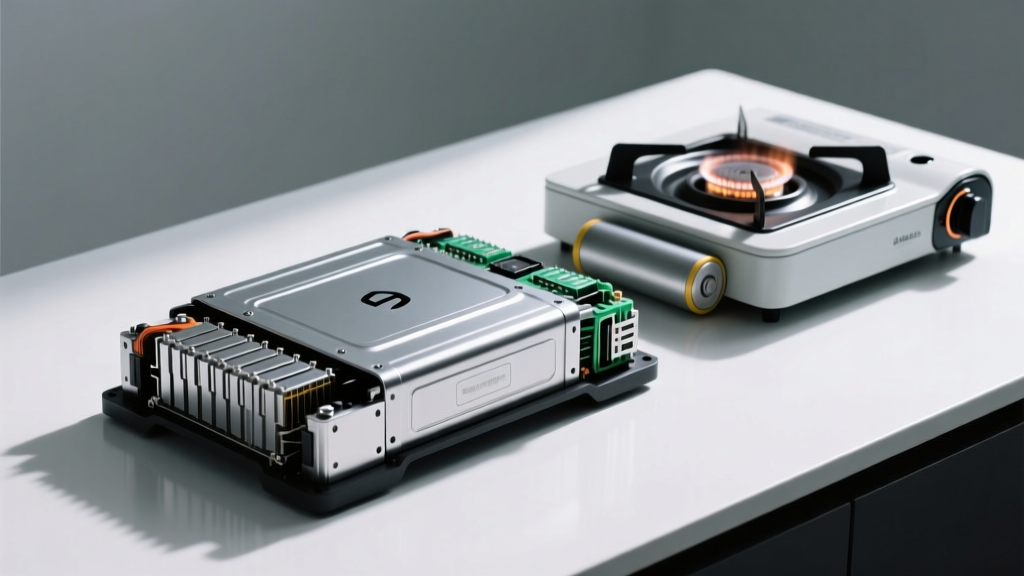
Yes — most modern battery powered stoves and portable induction cooktops use lithium-ion cells, often LFP or NMC in 18650 or prismatic form factors. The chemistry principles are identical; the scale is different. A portable stove might use a 0.5-2 kWh battery pack, while an EV uses 57-131 kWh. The same care principles (avoid extreme SoC storage, minimize heat exposure) apply to both.