The single biggest fear holding buyers back from electric vehicles isn't range or charging speed — it's the battery. Specifically: how long will it last, what happens when it degrades, and could a replacement cost more than the car is worth? These are fair questions, and they deserve answers backed by data rather than marketing brochures or forum rumors.
After tracking battery health across multiple EVs and analyzing manufacturer warranty data, third-party fleet studies, and real-world owner reports, here's the short answer: the average battery life for a modern electric car is 15 to 20 years or 200,000+ miles before capacity drops below 70% of original. Most EV batteries will outlast the vehicle they're installed in. But the details — chemistry, charging habits, climate, and warranty coverage — matter enormously for how your specific battery ages.
How Long Do EV Batteries Actually Last?
When we talk about battery "life," we're not talking about a hard failure like a blown engine. EV batteries don't suddenly stop working. Instead, they gradually lose capacity — the total kilowatt-hours (kWh) of energy they can store — over time and charge cycles. A battery that started with 75 kWh of usable capacity might hold 67 kWh after five years. Your range drops proportionally, but the car still drives.
Industry data points paint a consistent picture:
- Tesla's 2023 Impact Report showed Model S/X batteries retained approximately 88% of original capacity at 150,000 miles, with Model 3/Y LFP packs showing even slower degradation curves.
- Geotab's fleet study of over 10,000 EVs found an average annual degradation rate of 2.3% in the first year, slowing to roughly 1.6% per year thereafter — meaning a typical pack retains about 80-85% capacity at the 8-year mark.
- Nissan Leaf early models (2011-2015, air-cooled, no active thermal management) showed notably faster degradation, with some packs losing 20-30% capacity within 5 years — a cautionary tale about thermal management design.
LFP vs NMC/NCA: Which Battery Chemistry Lasts Longer?
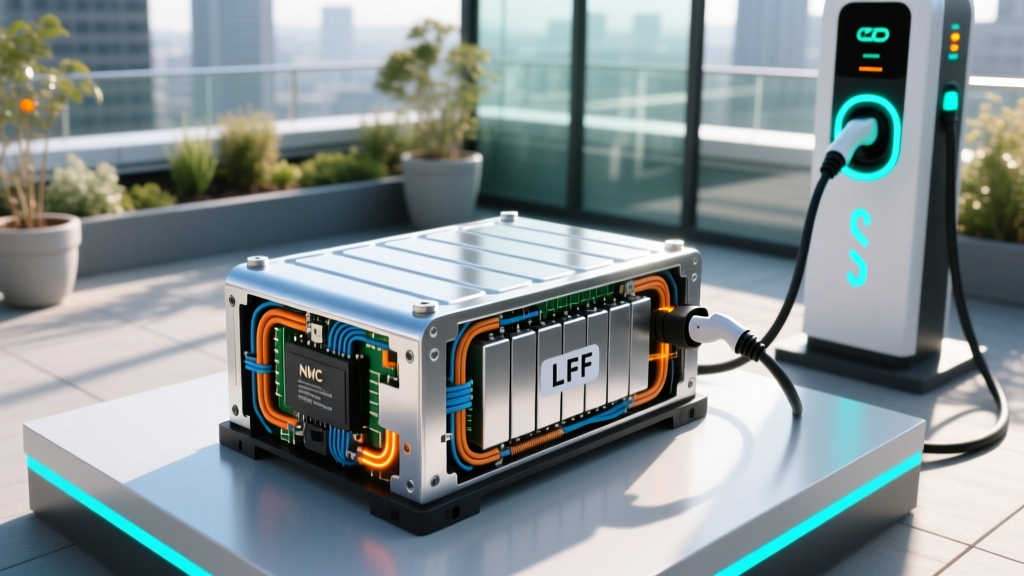
Not all EV batteries are built the same. The two dominant lithium-ion chemistries in today's market — LFP (lithium iron phosphate) and NMC/NCA (nickel manganese cobalt / nickel cobalt aluminum) — have fundamentally different aging profiles, energy densities, and cost structures. This choice affects your battery's lifespan more than almost any other factor.
| Attribute | LFP (Lithium Iron Phosphate) | NMC/NCA (Nickel-Based) |
|---|---|---|
| Cycle Life | 3,000–6,000+ cycles | 1,000–2,500 cycles |
| Energy Density | Lower (~160 Wh/kg cell-level) | Higher (~250-300 Wh/kg cell-level) |
| Degradation Rate | Slower; flatter curve | Faster initially, then stabilizes |
| Cold-Weather Performance | Weaker; slower charging below freezing | Better low-temp conductivity |
| Cost | Lower (no cobalt or nickel) | Higher (commodity metals) |
| Recommended Daily SoC | 100% is fine; benefits from full charges | 80% daily; 100% only for trips |
| Common Applications (2025-2026) | Tesla Model 3/Y RWD, Ford Mustang Mach-E Select, BYD models, base-trim EVs | Long-range and performance trims, most luxury EVs |
Which is better? It depends on your use case. If you prioritize maximum longevity and plan to keep the vehicle 10+ years, LFP's superior cycle life (potentially double or triple that of NMC) makes it the durability winner. The trade-off is a heavier, less energy-dense pack — which is why LFP typically appears in standard-range trims with 250-270 miles of EPA range rather than 330+ mile variants.
If you need maximum range per charge and frequently drive in cold climates, NMC/NCA's higher energy density and better cold-weather performance make it the practical choice. Just be more disciplined about state-of-charge habits (avoiding prolonged 100% storage).
Battery Degradation: What the Data Actually Shows
Degradation isn't linear. Most EV batteries experience a steeper drop in the first year or two (roughly 2-4% loss), then settle into a slower, more predictable decline. This "bathtub curve" is well-documented across fleets and individual owner data.
- Year 1 / 15,000 mi: ~96-97% capacity retained
- Year 3 / 45,000 mi: ~92-94% retained
- Year 5 / 75,000 mi: ~88-91% retained
- Year 8 / 120,000 mi: ~82-86% retained
- Year 10 / 150,000 mi: ~78-83% retained
- Year 15 / 200,000 mi: ~72-78% retained
Source: Aggregated data from Geotab fleet battery health analysis and manufacturer warranty thresholds.
Several factors accelerate or slow this curve, and understanding them gives you real control over your battery's aging trajectory.
Factors That Accelerate Degradation
- Frequent DC fast charging to 100%: Repeatedly pushing past 80% SoC at high kW rates generates excess heat and stresses cathode structure. Occasional fast charging is fine; daily 100% fast charges are not.
- Prolonged storage at extreme SoC: Leaving an NMC pack sitting at 100% or below 10% for weeks causes calendar aging. Store at 50-60% for long-term parking.
- Extreme heat exposure: Sustained ambient temperatures above 95°F (35°C) accelerate chemical breakdown. This is why liquid thermal management is critical — and why early air-cooled Leafs degraded faster in hot climates like Arizona.
- Consistent deep discharges to 0%: Dropping to zero regularly stresses the anode. Most modern EVs have a buffer (typically 2-5 kWh below the displayed 0%), but habitually running the battery dry is still inadvisable.
Factors That Preserve Battery Health
- Level 2 home charging as your primary method: Slower charge rates generate less heat. Charging overnight at 7-11 kW is the gentlest way to replenish your pack.
- Moderate SoC range (20-80% for NMC, any range for LFP): For NMC packs, daily charging to 80% dramatically reduces stress compared to 100%.
- Preconditioning before fast charging: Most modern EVs warm or cool the battery to its optimal temperature window (typically 25-40°C) before accepting a DC fast charge. Always enable navigation to a charger to trigger this.
- Garage parking in extreme climates: Keeping the vehicle out of sustained 100°F+ heat or -20°F cold reduces both cycle and calendar aging.
What Does the EV Battery Warranty Actually Cover?
Federal law mandates that EV batteries carry a minimum warranty of 8 years / 100,000 miles (10 years / 150,000 miles in California Air Resources Board states). But what that warranty guarantees varies by manufacturer — and the details matter.
| Manufacturer | Warranty Period | Capacity Retention Threshold | Notes |
|---|---|---|---|
| Tesla (Model 3/Y LFP) | 8 yr / 100,000 mi | 70% | Replaces or repairs if SoH drops below 70% |
| Tesla (Model S/X) | 8 yr / 150,000 mi | 70% | Longer mileage coverage on larger packs |
| Hyundai / Kia | 10 yr / 100,000 mi | 70% | Among the longest time-period coverage |
| Ford | 8 yr / 100,000 mi | 70% | Covers battery components and capacity loss |
| GM (Ultium) | 8 yr / 100,000 mi | 70% | Modular pack allows partial module replacement |
| BMW | 8 yr / 100,000 mi | 70% | Covers capacity below threshold under normal use |
| Rivian | 8 yr / 175,000 mi | 70% | Higher mileage cap for adventure-use vehicles |
Key nuance: The 70% threshold means the manufacturer only owes you a repair or replacement if your battery's State of Health (SoH) — measured as current maximum capacity divided by original capacity — falls below 70% within the warranty period. If your pack retains 72% at year 8, you're outside warranty coverage even though you've lost 28% of your original range.
Based on current degradation data, hitting 70% within 8 years / 100,000 miles is extremely unlikely for any liquid-cooled pack under normal use. Warranty claims are rare and typically involve manufacturing defects (bad cells, BMS failures, coolant leaks) rather than normal wear.
How Much Does an EV Battery Replacement Cost?
This is the question that generates the most anxiety — and the most misinformation. Let's separate the worst-case scenario from the typical ownership reality.
| Vehicle / Pack Size | Battery Capacity | Chemistry | Estimated Replacement Cost |
|---|---|---|---|
| Tesla Model 3 RWD | ~60 kWh | LFP | $8,000–$12,000 |
| Tesla Model Y Long Range | ~75 kWh | NMC | $12,000–$16,000 |
| Hyundai Ioniq 5 | 77.4 kWh | NMC | $14,000–$18,000 |
| Ford F-150 Lightning Extended | ~131 kWh | NMC | $20,000–$30,000 |
| Chevrolet Equinox EV | ~85 kWh | NMC (Ultium) | $12,000–$16,000 (modular repair possible) |
| BMW iX xDrive50 | 111.5 kWh | NMC | $22,000–$28,000 |
Critical context: These are worst-case, full-pack-replacement costs. In practice:
- Most batteries never need replacement. Based on current data, fewer than 1-2% of modern liquid-cooled EV batteries require replacement due to degradation alone. The vast majority of warranty claims involve manufacturing defects, not wear.
- Module-level repair is increasingly possible. GM's Ultium platform, BMW's Gen5 eDrive, and newer Hyundai/Kia packs allow individual module replacement rather than a full pack swap, potentially cutting costs by 50-70%.
- Battery costs continue to fall. Pack-level pricing has dropped from ~$1,200/kWh in 2010 to approximately $120-140/kWh in 2025-2026 according to BloombergNEF lithium-ion battery price surveys. By the time a 2026 EV actually needs a replacement (likely 2038-2042), costs will be substantially lower.
- Refurbished packs are emerging. Third-party companies are beginning to offer reconditioned battery packs at 40-60% below new OEM pricing, particularly for higher-volume models.
How to Check and Monitor Your Battery Health
Knowing your battery's State of Health (SoH) removes the guesswork. Here's how to monitor it:
- In-vehicle display: Some EVs (Tesla via service menu, Hyundai/Kia via the EV battery health screen, BMW iDrive) display a battery health percentage or SoH estimate directly in the infotainment system.
- OBD-II diagnostic tools: Devices like the OBDLink SX paired with apps such as EV Battery Health or Car Scanner ELM OBD2 can read the BMS-reported SoH directly from your car's CAN bus.
- Dealer diagnostic check: Most manufacturers can run a full battery health report during service visits. Request this annually or before a warranty expiration.
- Third-party testing services: Companies like Geotab (fleet-focused) and Recurrent offer battery health reports based on connected-car data, particularly useful when buying a used EV.
- Manual tracking: Charge to 100% (on an LFP pack or occasionally on NMC), note the displayed range, and compare it to the original EPA-rated range. A 310-mile EV showing 265 miles at 100% SoC is at roughly 85% SoH (accounting for driving conditions and temperature).
For maximum accuracy, perform a full SoH check once or twice per year — ideally in moderate temperatures (60-75°F) to eliminate thermal variables from the reading.
Emerging Battery Technologies: What's Coming and When
Current lithium-ion technology is mature and reliable, but next-generation chemistries promise step-change improvements. Here's a realistic timeline — with the caveat that all of these are forward-looking and not yet available in production vehicles.
Solid-State Batteries
Solid-state batteries replace the liquid electrolyte with a solid material (ceramic, polymer, or sulfide), promising higher energy density (potentially 400-500 Wh/kg at the cell level), faster charging, improved safety (no flammable electrolyte), and longer cycle life. Toyota has announced solid-state production for limited EV models around 2027-2028, while Samsung SDI and QuantumScape target similar timelines. However, manufacturing scale-up and cost reduction remain significant hurdles. Expect solid-state to appear first in premium vehicles at substantial price premiums, with mainstream adoption likely in the 2030-2035 window.
Silicon Anode Technology
Replacing graphite anodes with silicon-dominant materials can increase energy density by 20-40%. Companies like Sila Nanotechnologies and Group14 Technologies are supplying silicon anode materials to battery manufacturers, with early production vehicles expected in 2026-2028. This is an incremental improvement to existing lithium-ion architecture rather than a full replacement, meaning faster commercialization.
Sodium-Ion Batteries
CATL and BYD have begun producing sodium-ion packs for lower-cost, shorter-range EVs, primarily in the Chinese market. Sodium-ion offers lower energy density than LFP but dramatically lower material costs and better cold-weather performance. U.S. availability remains uncertain and is likely limited to budget-oriented models if adopted.
Frequently Asked Questions About EV Battery Life
How long do EV batteries last in years and miles?
Modern liquid-cooled EV batteries (2020 and newer) typically last 15-20 years or 200,000+ miles before capacity drops below 70% of original. Real-world fleet data from Geotab shows average annual degradation of 1.5-2.5% for well-managed packs, meaning a 300-mile EV will still offer approximately 240-255 miles of range after 10 years.
How much does it cost to replace an EV battery?
Full pack replacement costs range from approximately $8,000 for a 60 kWh LFP pack (Tesla Model 3 RWD) to $20,000-$30,000 for large packs like the F-150 Lightning's 131 kWh unit. However, most batteries never require replacement — fewer than 1-2% of modern packs fail due to degradation. Module-level repairs on platforms like GM Ultium can cost 50-70% less than full replacements.
What does the EV battery warranty cover?
Federal law requires a minimum 8-year/100,000-mile warranty (10 years/150,000 miles in CARB states). Coverage applies if the battery's State of Health drops below a defined threshold — typically 70% of original capacity — within the warranty period. This covers both manufacturing defects and excessive degradation. See the IRS clean vehicle credit page for how battery sourcing also affects tax credit eligibility under current §30D rules.
Is LFP or NMC better for battery longevity?
LFP (lithium iron phosphate) offers significantly longer cycle life — 3,000 to 6,000+ cycles versus 1,000 to 2,500 for NMC/NCA. LFP also tolerates 100% state-of-charge storage without accelerated degradation, making it more forgiving for daily use. The trade-offs are lower energy density (less range for the same pack weight) and reduced cold-weather charging speed. For pure longevity, LFP is the clear winner; for maximum range and cold-climate performance, NMC remains the choice.
Does frequent DC fast charging damage the battery?
Occasional DC fast charging has minimal impact on modern batteries with active thermal management. However, daily fast charging — especially to 100% SoC — does accelerate degradation compared to primarily Level 2 home charging. Studies show that vehicles fast-charging more than three times per week degrade approximately 1-2% faster over a 5-year period. The recommendation: use Level 2 (7-11 kW) at home as your baseline, and reserve DC fast charging (150-350 kW) for road trips and occasional top-ups.
How do I maximize my EV battery's lifespan?
For NMC/NCA packs: charge to 80% for daily use, avoid leaving the car at 100% or below 10% for extended periods, precondition before fast charging, and prioritize Level 2 home charging. For LFP packs: charge to 100% regularly (the BMS needs full charges for accurate cell balancing), and follow the same thermal and fast-charging best practices. Both chemistries benefit from garage parking in extreme climates and avoiding repeated deep discharges to zero.
Will my EV battery need replacing before the car wears out?
In most cases, no. A well-maintained modern EV battery will retain 70-80% capacity at 200,000 miles. Given that the average American drives roughly 13,500 miles per year according to FHWA data, that's nearly 15 years of service. Other vehicle components — suspension, interior, body — often reach end-of-life before the traction battery does. The "battery replacement will total the car" fear is largely a relic of early, passively cooled EVs like the 2011-2015 Nissan Leaf.
The average battery life for a car in today's EV market is no longer a gamble — it's a well-documented, warrantied, and increasingly predictable component. With modern thermal management, informed charging habits, and the right chemistry choice for your needs, an EV battery should be the least of your worries when it comes to long-term ownership costs.