Two Batteries, Two Very Different Jobs
Every electric vehicle sold in the US carries two separate battery systems: a high-voltage traction battery (the large lithium-ion pack that propels the car, typically 40–120 kWh) and a small 12-volt auxiliary battery (usually 12–16V, under 1 kWh) that powers the vehicle's computers, lighting, door locks, infotainment, and safety systems. When EV owners search for "12 V battery charging," they're often dealing with a dead auxiliary battery — a surprisingly common issue that can leave a multi-ton electric SUV unable to start, even when the main traction pack is at 80% state of charge.
This guide covers both systems: the practical realities of 12V auxiliary battery maintenance and charging in an EV, and the deeper science of traction battery health, chemistry trade-offs, degradation data, warranty coverage, and replacement economics. Understanding both is essential for current and prospective EV owners.
EV 12V Battery Charging: What You Actually Need to Know
The 12V auxiliary battery in an EV serves the same role as the 12V battery in a gasoline car — it boots the vehicle's control modules, runs accessory loads when the car is off, and provides the initial power to close the high-voltage contactors that connect the traction battery to the powertrain. Without a functioning 12V battery, an EV is a brick, regardless of how full the main pack is.
Why Do EV 12V Batteries Die?
Several factors make 12V auxiliary batteries a recurring pain point for EV owners:
- Parasitic drain: Modern EVs never fully sleep. Telematics, over-the-air update readiness, sentry modes (Tesla), and app connectivity draw continuous current from the 12V system — sometimes 30–50 mA or more when parked.
- DC-DC converter behavior: The EV's DC-DC converter charges the 12V battery from the traction pack, but only when the vehicle is "awake" or plugged in. Extended parking without driving or plugging in can drain the 12V battery below the threshold needed to close the high-voltage contactors.
- Lead-acid limitations: Many EVs still use conventional 12V lead-acid or AGM (absorbent glass mat) batteries. These are heavy, have shorter cycle lives (typically 3–5 years), and tolerate deep discharge poorly. Some newer models (certain Tesla vehicles from 2021 onward, some Rivian configurations) use 12V lithium iron phosphate (LiFePO4) auxiliary batteries, which are lighter and longer-lasting but more expensive to replace.
How to Charge an EV's 12V Battery
If your EV's 12V battery is depleted, here are the recovery options:
- Plug the EV into a charger (Level 1 or Level 2): On most EVs, connecting to an external charger wakes the vehicle and activates the DC-DC converter, which then charges the 12V battery from the traction pack. This is the simplest fix if the 12V battery still has enough charge to initiate the handshake with the charger. Allow 30–60 minutes of plugged-in time.
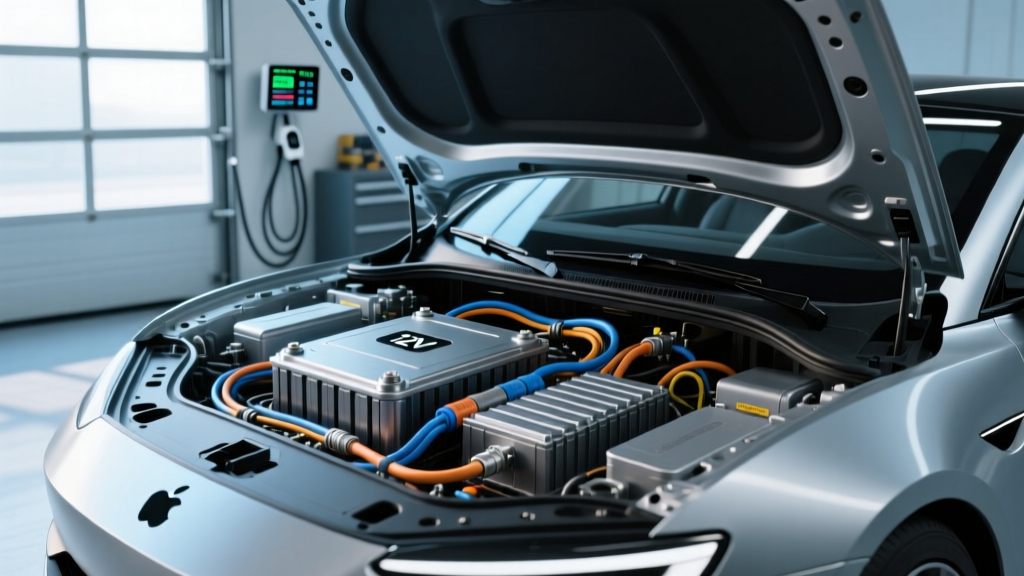
- Use a 12V battery maintainer/tender: A smart 12V battery charger (such as a CTEK MXS 5.0 or NOCO Genius 5, typically $40–$80) connected directly to the 12V battery terminals can restore it. Many EVs have accessible 12V terminals under the hood or in the frunk area — consult your owner's manual for location. Use a charger rated for AGM or lithium as appropriate for your battery type.
- Jump-start (with caution): A 12V jump pack or jumper cables from another vehicle can provide enough power to close the contactors and wake the EV. Never use a running gas car's alternator to jump an EV — voltage spikes can damage sensitive electronics. Use a dedicated lithium jump pack instead.
- 12V battery replacement: If the auxiliary battery is 3+ years old and failing repeatedly, replacement is typically $150–$350 for a lead-acid/AGM unit or $400–$700 for a lithium 12V unit, plus installation.
Preventing 12V Battery Failure
The best strategy is prevention:
- Plug in regularly: Even if you don't need traction charging, plugging in keeps the DC-DC converter active and maintains the 12V battery. Many owners set a low charge limit (e.g., 50–60%) for long parking sessions.
- Disable vampire-drain features when parking long-term: Turn off sentry mode, cabin overheat protection, and scheduled departure features if the car will sit for more than a week.
- Use a 12V maintainer for extended storage: If storing an EV for 30+ days without access to a charger, a smart 12V maintainer connected to the auxiliary battery prevents deep discharge.
Traction Battery Chemistry: LFP vs NMC vs NCA
The high-voltage traction battery is the single most expensive component in any EV. Its chemistry determines energy density, charging behavior, longevity, cold-weather performance, and cost. In 2026, two chemistry families dominate the US market: LFP (lithium iron phosphate) and NMC/NCA (nickel manganese cobalt / nickel cobalt aluminum).
| Attribute | LFP (LiFePO4) | NMC / NCA |
|---|---|---|
| Energy density (cell-level) | 160–180 Wh/kg | 250–300 Wh/kg |
| Typical cycle life | 3,000–5,000+ cycles to 80% SoH | 1,000–2,000 cycles to 80% SoH |
| Recommended daily SoC | Up to 100% (no calendar degradation penalty) | 80% for daily; 100% only for trips |
| Cold-weather performance | Moderate — slower charging below 32°F (0°C); preconditioning critical | Better low-temp charge acceptance; still benefits from preconditioning |
| Thermal stability / safety | Excellent — very resistant to thermal runaway | Good — requires robust BMS and cooling |
| Cost per kWh (cell-level, 2026) | ~$60–$80 | ~$90–$120 |
| Cobalt content | None | Varies; NMC 811 uses less cobalt than older chemistries |
| Common in (2026 US models) | Tesla Model 3/Y RWD, Ford Mustang Mach-E Select (some), BYD (not yet US), base-trim EVs | Tesla Long Range/Performance, Hyundai Ioniq 5/6, Kia EV6/EV9, Ford extended-range, most premium/long-range EVs |
Which Chemistry Is Better?
Neither is universally superior — the right choice depends on your driving pattern:
- Choose LFP if: You drive a standard-range EV for commuting, want to charge to 100% daily without guilt, prioritize longevity (3,000+ cycles means a potential 500,000+ miles of battery life), and can accept slightly lower range per kWh due to lower energy density. LFP is also the better choice if you live in a moderate climate where cold-weather charging penalties are less severe.
- Choose NMC/NCA if: You need maximum range per charge (road trips, long commutes), live in a cold climate where NMC's better low-temperature charge acceptance matters, or want the longest single-charge distance in a premium/long-range trim. You'll need to manage state of charge more carefully (80% daily limit) to maximize calendar life.
How Long Do EV Traction Batteries Last? Real Degradation Data
EV battery degradation follows a nonlinear curve: the steepest capacity loss occurs in the first 12–24 months (typically 2–5%), after which the rate flattens to roughly 1–2% per year under normal use. Based on aggregated fleet data from sources including Recurrent Auto and manufacturer warranty filings, here's what real-world degradation looks like:
- Year 1 (0–15,000 mi): 2–4% capacity loss
- Year 3 (~45,000 mi): 5–8% cumulative loss
- Year 5 (~75,000 mi): 7–12% cumulative loss
- Year 8 (~120,000 mi): 10–18% cumulative loss
- Year 10 (~150,000 mi): 12–22% cumulative loss
Source: Aggregated fleet data; individual results vary by chemistry, climate, and charging habits. LFP packs generally show slower long-term degradation than NMC/NCA at equivalent mileages.
The critical takeaway: most modern liquid-cooled traction batteries retain 80–90% of their original capacity at 150,000 miles. Catastrophic failure (sudden cell or module death requiring full-pack replacement) is rare — under 1–2% of vehicles in major fleet studies through 2025. Most EVs will be retired for other reasons before the traction battery becomes unusable.
Factors That Accelerate Degradation
- Frequent DC fast charging above 150 kW: High C-rates generate heat. Occasional fast charging is fine; daily 350 kW sessions without adequate preconditioning will accelerate wear. Most modern BMS systems limit charge rate when the pack is cold or near full to protect cells.
- Sustained high state of charge: Storing an NMC/NCA battery at 100% SoC for days or weeks accelerates calendar degradation. LFP is more tolerant of high SoC storage.
- Extreme heat exposure: Ambient temperatures above 95°F (35°C) combined with high SoC are the worst-case scenario for calendar aging. Garage parking helps significantly in hot climates.
- Deep discharge cycles: Regularly driving to 0% SoC stresses cells. Most EVs have a buffer (typically 2–5 kWh at the bottom) to prevent true zero, but habitual deep discharges still accelerate wear.
- High-mileage fast-charge patterns: Fleet vehicles (taxis, rideshare) that fast-charge 2–3 times daily show measurably higher degradation — typically 15–25% loss at 150,000 miles vs. 10–15% for home-charged personal vehicles.
EV Battery Warranty Coverage Explained
Federal law mandates that EV traction batteries carry a minimum warranty of 8 years / 100,000 miles (10 years / 150,000 miles in California and states that follow CARB emissions standards). Most manufacturers exceed these minimums. Here's how major 2026 warranties compare:
| Manufacturer | Warranty Term | Capacity Retention Threshold | Notes |
|---|---|---|---|
| Tesla (Model 3/Y RWD — LFP) | 8 yr / 120,000 mi | 70% | LFP pack; longer cycle life expected |
| Tesla (Model 3/Y LR/Perf) | 8 yr / 120,000 mi | 70% | NMC/NCA pack |
| Hyundai / Kia | 10 yr / 100,000 mi | 70% | Among the longest terms in the industry |
| Ford (Mach-E, F-150 Lightning) | 8 yr / 100,000 mi | 70% | Standard across BEV lineup |
| GM (Ultium platform) | 8 yr / 100,000 mi | 70% (some models 60%) | Varies by model; check specific vehicle |
| Volkswagen / Audi | 8 yr / 100,000 mi | 70% | MEB and PPE platforms |
| Rivian | 8 yr / 120,000 mi (175,000 mi for commercial) | 70% | Extended term for fleet/commercial use |
What triggers a warranty claim? If your traction battery's measured capacity falls below the stated threshold (typically 70% of original) within the warranty period, the manufacturer will repair or replace the battery at no cost. Capacity is usually measured via a dealer diagnostic scan or, in some cases, remotely via telematics. Keep in mind: a battery at 72% capacity still provides usable range — it just means a 300-mile EPA vehicle now delivers roughly 216 miles. Most owners find this still adequate for daily driving.
EV Battery Replacement Cost: What to Expect
Out-of-warranty traction battery replacement is the scenario that generates the most anxiety. Here's the current reality for 2026:
| Vehicle / Pack Size | Battery Capacity | Estimated Replacement Cost (Parts + Labor) | Typical Replacement Timeline |
|---|---|---|---|
| Tesla Model 3 RWD (LFP) | ~57 kWh (usable) | $8,000–$12,000 | Rarely needed within vehicle lifetime |
| Tesla Model Y Long Range | ~75 kWh (usable) | $12,000–$16,000 | Rarely needed within vehicle lifetime |
| Hyundai Ioniq 5 (standard range) | ~58 kWh (usable) | $9,000–$13,000 | Rarely needed within vehicle lifetime |
| Ford F-150 Lightning (extended range) | ~131 kWh (usable) | $18,000–$28,000 | Rarely needed; large pack degrades slowly |
| Chevrolet Equinox EV | ~85 kWh (usable) | $12,000–$17,000 | Rarely needed within vehicle lifetime |
Important context: most EV owners will never pay for a traction battery replacement. According to fleet data through 2025, fewer than 1.5% of EVs required out-of-warranty battery replacements. Cell prices have dropped roughly 90% since 2010 (from ~$1,200/kWh to ~$70–$100/kWh at the cell level in 2026), and this trend continues to push replacement costs downward. Additionally, independent EV repair shops increasingly offer module-level repairs — replacing individual failed modules rather than the entire pack — for $2,000–$5,000, depending on the vehicle.
Monitoring and Maximizing Your EV Battery's Health
Proactive monitoring helps you catch degradation trends early and adjust habits to extend pack life.
How to Check State of Health (SoH)
- In-vehicle displays: Some EVs (notably Tesla via the service menu, Hyundai/Kia via the infotainment system's EV diagnostics page) display a battery health percentage or degradation estimate. Accuracy varies — these are often modeled estimates, not direct measurements.
- OBD-II diagnostic tools: Devices like the OBDLink SX or vLinker FD, paired with apps such as EVNotify, Leaf Spy (Nissan), or Tesla-specific tools, can read actual pack capacity data from the BMS. This is the most accurate consumer-accessible method.
- Dealer diagnostics: A service center can perform a full capacity test, typically taking 1–3 hours. Request this during routine service visits, especially as you approach warranty mileage thresholds.
- Third-party services: Companies like Recurrent provide battery health reports based on telematics data (with owner consent), useful for used-EV purchases.
- Set daily charge limit to 80% (NMC/NCA) or 100% (LFP) — adjust in the vehicle's charging settings
- Precondition the battery before DC fast charging (most EVs do this automatically when a charger is set as your navigation destination)
- Avoid parking at 100% SoC for more than 24 hours, especially in hot weather
- Minimize DC fast charging to 1–2 sessions per week when Level 2 home charging is available
- Keep the battery between 20–80% SoC for daily use (NMC/NCA); LFP is more flexible
- Garage-park when possible in extreme heat or cold
- Update vehicle firmware regularly — BMS improvements are often delivered OTA
Emerging Battery Technology: What's Next (and When)
Several next-generation battery technologies are in development, but none are available in production US-market EVs as of early 2026. Here's a realistic timeline assessment:
- Solid-state batteries: Promising 2–3x the energy density of current lithium-ion, faster charging, and improved safety. Toyota has announced limited production in Japan for 2027–2028, with US-market availability unlikely before 2029–2030. QuantumScape and Solid Power are in pilot production, but scaling to automotive volumes remains the core challenge. Treat any "solid-state EV" claims before 2028 with skepticism.
- Silicon anode cells: Replacing graphite anodes with silicon can boost energy density by 20–40%. Sila Nanotechnologies and Group14 are supplying cells for limited applications (e.g., Mercedes-Benz G-Class electric, announced). Expect gradual adoption in premium models from 2026–2028, with mainstream availability by 2029–2030.
- Sodium-ion batteries: Lower cost and no lithium or cobalt required, but significantly lower energy density (~120–150 Wh/kg). CATL has begun production in China for small EVs. US-market adoption is unlikely before 2028 and will likely be limited to budget/urban EVs where range is less critical.
- Lithium iron manganese phosphate (LMFP): An evolution of LFP with ~15–20% higher energy density. Expected to enter production vehicles in 2027–2028, primarily from Chinese cell manufacturers.
These technologies are real and will eventually reach consumers, but the gap between lab announcements and automotive-grade, mass-produced, safety-certified battery packs is typically 5–8 years. Current LFP and NMC/NCA chemistries will remain dominant through at least 2030.
Frequently Asked Questions
How long do EV batteries last in years and miles?
Based on fleet data through 2025, modern liquid-cooled EV traction batteries typically retain 80–90% of original capacity at 150,000 miles (roughly 10–12 years of average US driving). LFP chemistries often exceed this, with some fleet data showing 85%+ retention at 200,000 miles. Full pack replacement within the first 10 years is rare (under 1.5% of vehicles).
How much does an EV battery cost to replace?
Out-of-warranty replacement costs range from approximately $8,000 for smaller packs (50–60 kWh) to $28,000 for very large packs (130+ kWh), including parts and labor. However, most owners never pay this — warranty coverage (8–10 years, 100,000–150,000 miles) protects against premature degradation, and actual failure rates are very low. Module-level repairs at independent shops can cost $2,000–$5,000 for isolated cell failures.
What does the EV battery warranty cover?
EV traction battery warranties cover capacity loss below a stated threshold (typically 70% of original capacity) within the warranty period (8 years/100,000 miles minimum; some manufacturers offer 10 years/100,000 miles or 8 years/120,000 miles). If your battery falls below the threshold, the manufacturer repairs or replaces it at no cost. Warranties do not cover damage from accidents, misuse, or unauthorized modifications. See the IRS clean vehicle credit page for how battery sourcing also affects federal tax credit eligibility.
How do I check and maximize my EV battery's health?
Check SoH via in-vehicle diagnostics (where available), OBD-II tools with EV-specific apps, or dealer service scans. Maximize longevity by following the care checklist above: manage state of charge (80% daily for NMC/NCA, 100% acceptable for LFP), precondition before fast charging, minimize DC fast charge frequency when home Level 2 is available, avoid prolonged high-SoC storage in heat, and keep firmware updated.
LFP vs NMC — which is better and why?
LFP offers superior cycle life (3,000–5,000+ cycles), tolerance for 100% daily charging, lower cost, and better thermal safety — ideal for commuters and moderate-climate drivers who prioritize longevity. NMC/NCA offers higher energy density (more range per kWh), better cold-weather charge acceptance, and is standard in long-range and performance trims — ideal for road-trippers and cold-climate drivers who need maximum single-charge distance. Neither is objectively "better"; the right choice depends on your driving pattern and climate.
Can I charge my EV's 12V battery with a regular battery charger?
Yes — a smart 12V charger/maintainer (rated for your battery type: AGM or lithium) connected to the 12V battery terminals will charge it. However, the preferred first step is to plug the EV into a Level 1 or Level 2 charger, which activates the DC-DC converter and charges the 12V battery from the traction pack. Only use a standalone 12V charger if plugging in doesn't resolve the issue.
Will my EV's 12V battery affect my traction battery warranty?
No. The 12V auxiliary battery and the high-voltage traction battery are separate systems with separate warranties. A failed 12V battery does not void the traction battery warranty. However, repeated deep discharge of the 12V battery (which can prevent the vehicle from waking and charging properly) may cause ancillary issues — address 12V problems promptly.