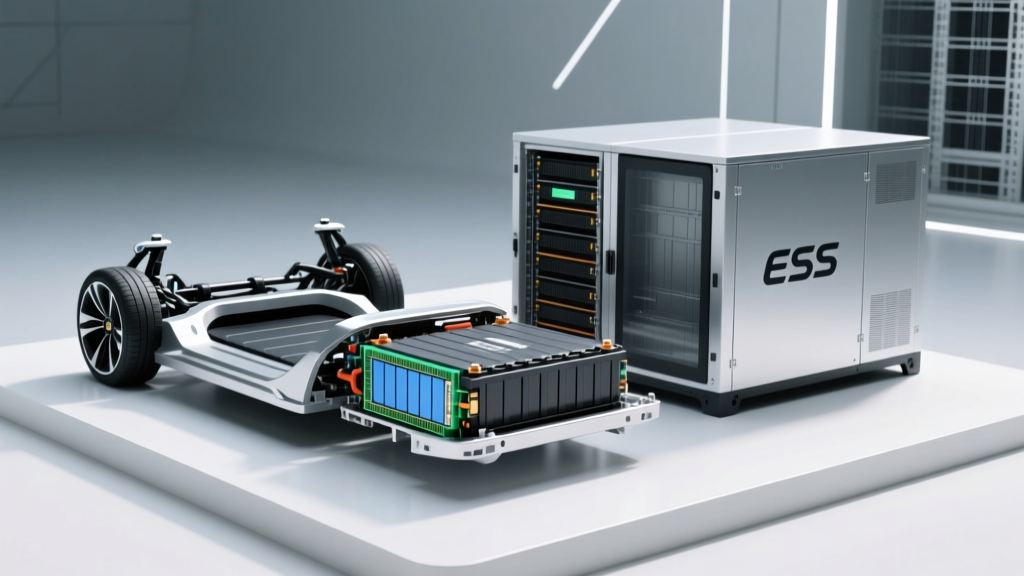
When EV owners and solar enthusiasts search for "ESS battery," they're usually asking about one of two things: the Energy Storage System batteries used in home solar and grid applications, or the high-voltage traction battery pack that propels an electric vehicle. The two share lithium-ion DNA — and increasingly, the same cell chemistries — but they're engineered for very different duty cycles. This guide dissects the battery technology behind both, with a focus on what EV buyers and owners actually need to know: chemistry trade-offs, real degradation data, warranty coverage, replacement costs, and how to maximize pack longevity.
What Is an ESS Battery and How Does It Relate to EVs?
An ESS (Energy Storage System) battery is a stationary lithium-ion pack designed to store electricity — typically from solar panels or off-peak grid power — for later use in a home or commercial building. Popular examples include the Tesla Powerwall 3 (13.5 kWh usable, LFP chemistry) and the Enphase IQ 5P (5 kWh, NMC). These systems prioritize cycle life, safety, and cost per kWh over the energy density that EV batteries demand.
EV traction batteries, by contrast, must pack as much energy as possible into a lightweight, crash-safe enclosure while delivering hundreds of kilowatts of discharge power for acceleration. A 2026 Hyundai Ioniq 5 carries an 84 kWh usable NMC pack weighing roughly 1,050 lbs; a 2026 Tesla Model 3 Standard Range uses a ~60 kWh LFP pack. The chemistry overlap is real — LFP cells are now common in both ESS and entry-level EVs — but the engineering priorities diverge sharply.
LFP vs NMC: The Chemistry Decision That Shapes Battery Life
Whether you're evaluating an ESS battery for your garage or a traction pack for your next EV purchase, the chemistry choice between LFP (Lithium Iron Phosphate) and NMC (Nickel Manganese Cobalt) — or NCA (Nickel Cobalt Aluminum) — is the single most consequential spec after capacity.
| Attribute | LFP (LiFePO₄) | NMC / NCA |
|---|---|---|
| Energy Density (cell-level) | ~160–180 Wh/kg | ~220–270 Wh/kg |
| Typical Cycle Life | 3,000–6,000+ cycles | 1,000–2,500 cycles |
| Cold-Weather Performance | Weaker below 32°F; reduced regen & range | Better low-temp discharge & charge acceptance |
| Cost per kWh (2026 pack-level) | ~$85–$105 | ~$115–$145 |
| Thermal Stability | Excellent; higher runaway threshold (~270°C) | Good; requires active thermal management |
| State of Charge Estimation | Flat voltage curve makes SoC harder to gauge | Steeper voltage curve; easier SoC estimation |
| Common EV Applications (2026) | Tesla Model 3 RWD, Ford Mustang Mach-E Select, BYD models | Hyundai Ioniq 5/6, Tesla Model Y LR, Rivian R1T, most PHEVs |
| Common ESS Applications | Tesla Powerwall 3, FranklinWH, BYD Battery-Box | Enphase IQ, some commercial-scale systems |
Which is better? It depends entirely on your use case. For an ESS battery in a solar-equipped home, LFP is the clear winner: the flat daily cycling, moderate temperatures, and stationary installation play to LFP's strengths (longevity, safety, low cost). For an EV that needs 300+ miles of EPA range in a package that fits a midsize crossover, NMC's energy-density advantage remains essential — though LFP is closing the gap in compact and midsize sedans where weight and volume are less constrained.
How Long Do EV Batteries Actually Last? Degradation Data
The fear that EV batteries need replacing every few years is not supported by fleet data. Modern liquid-cooled packs routinely retain 85–92% of original capacity after 100,000 miles, and most will outlast the vehicle they're installed in.
- Tesla Model 3/Y (NMC, 2020–2022 fleet data): ~12% average degradation at 100,000 miles; ~15–18% at 150,000 miles per Tesla's 2024 Impact Report.
- Hyundai Ioniq 5 (NMC, 2022–2024): Owner-reported averages of 5–8% loss at 50,000 miles; projected ~12–15% at 100,000 miles.
- Tesla Model 3 RWD (LFP, 2022–2024): Early data suggests 3–5% loss at 50,000 miles, consistent with LFP's higher cycle-life rating.
- Nissan Leaf (passive air-cooled, 2018–2023, NMC 40/62 kWh): Historically higher degradation — 10–20% at 60,000 miles — underscoring the importance of active liquid cooling.
- Chevrolet Bolt EV/EUV (NMC, 2017–2023): Post-recall battery replacements showed minimal degradation in early units; ~5–8% at 60,000 miles in liquid-cooled packs.
The degradation curve is not linear. Most packs experience a steeper drop in the first 10,000–20,000 miles (calendar aging and initial SEI layer formation), then settle into a slow, linear decline of roughly 1–2% per year under normal use. A 2026 EV with an EPA range of 310 miles can reasonably be expected to deliver ~275–285 miles at the 5-year, 75,000-mile mark.
For context, a typical ESS battery like the Tesla Powerwall 3 is warrantied for 10 years with a minimum 70% capacity retention — and because it cycles once daily at low power, actual degradation is often far less.
What Does the Battery Warranty Cover?
Federal law (EPA emissions warranty requirements) effectively mandates that automakers warrant EV battery packs for at least 8 years or 100,000 miles, whichever comes first. California Air Resources Board (CARB) states extend that to 10 years / 150,000 miles. Most manufacturers match or exceed these minimums.
| Vehicle | Warranty Period | Capacity Retention Threshold | Notes |
|---|---|---|---|
| Tesla Model 3 RWD (LFP) | 8 yr / 100,000 mi | 70% | Shorter coverage than LR/AWD trims |
| Tesla Model 3 Long Range / Model Y | 8 yr / 120,000 mi | 70% | NMC pack |
| Hyundai Ioniq 5 / Ioniq 6 | 10 yr / 100,000 mi | 70% | Among the longest coverage terms |
| Ford Mustang Mach-E | 8 yr / 100,000 mi | 70% | Extended-range battery (NMC) |
| Chevrolet Equinox EV / Blazer EV | 8 yr / 100,000 mi | 60% (8 yr); some trims 70% | Verify trim-specific terms |
| Rivian R1T / R1S | 8 yr / 175,000 mi | 70% | Higher mileage cap reflects truck use case |
| BMW i4 / iX | 8 yr / 100,000 mi | 70% | NMC; includes thermal management defects |
What's covered: Capacity loss below the stated threshold (e.g., dropping below 70% of original usable kWh), manufacturing defects, and thermal management system failures. What's typically excluded: Damage from accidents, improper charging equipment, flooding, or modifications. Always read your specific warranty booklet — the capacity retention threshold is the number that matters most.
Source: fueleconomy.gov EV Technology Guide
How Much Does an EV Battery Cost to Replace?
This is the question that dominates EV ownership anxiety. Here's the reality: out-of-warranty battery replacement is expensive, but it's rarely needed within a vehicle's typical lifespan. The vast majority of EVs will be retired or sold before their packs fall below the warranty threshold.
| Vehicle / Pack Size | Approx. Replacement Cost (Parts + Labor) | When Typically Needed |
|---|---|---|
| Tesla Model 3 RWD (~60 kWh LFP) | $8,000–$12,000 | Rarely before 200,000+ mi |
| Tesla Model Y LR (~82 kWh NMC) | $12,000–$16,000 | Rarely before 180,000+ mi |
| Hyundai Ioniq 5 (~84 kWh NMC) | $12,000–$18,000 | Rarely before 175,000+ mi |
| Ford F-150 Lightning Ext. Range (~131 kWh NMC) | $20,000–$30,000 | Large pack; rarely before 150,000+ mi |
| Chevrolet Bolt EV (~65 kWh NMC) | $9,000–$14,000 | Post-recall packs show strong longevity |
| Nissan Leaf (40 kWh, air-cooled) | $6,500–$9,000 | May need replacement at 100,000–120,000 mi in hot climates |
| ESS Battery (Tesla Powerwall 3, 13.5 kWh LFP) | $7,500–$9,500 (unit only) | 15–20+ year service life typical |
Important context: These costs are declining. Pack-level pricing has fallen from ~$1,200/kWh in 2010 to roughly $100–$145/kWh in 2026, per BloombergNEF data. Module-level repairs (replacing individual failed modules rather than the entire pack) are increasingly offered by specialized EV shops for $2,000–$6,000, depending on the vehicle. Also, the growing EV salvage market provides lower-cost used packs for older models.
Factors That Accelerate (or Preserve) Battery Health
Battery degradation is driven by electrochemical stress. Here are the primary factors and practical mitigation strategies:
- Avoid sustained 100% SoC (NMC/NCA): Charge to 80% daily; reserve 100% for road trips. LFP packs are an exception — manufacturers like Tesla recommend periodic 100% charges for cell balancing and SoC calibration.
- Minimize DC fast charging when possible: Frequent 150+ kW sessions generate heat and accelerate electrolyte decomposition. Use Level 2 (7–11.5 kW) for daily charging; save DCFC for road trips. One or two fast charges per week is fine — daily is what adds up.
- Precondition before fast charging: Navigating to a Supercharger or Electrify America station triggers battery preconditioning, warming the pack to ~95°F for optimal charge acceptance and reduced stress. This also reduces charge-curve taper above 80% SoC.
- Avoid extreme SoC in extreme temperatures: Don't leave the car at 100% in a 105°F parking lot for days, and don't store it at 5% SoC in sub-zero weather. Aim for 40–60% SoC for long-term parking.
- Use scheduled departure / climate preconditioning: Warming the battery while plugged in (using grid power, not pack energy) reduces cold-weather range loss and avoids high-current regen into a cold pack.
- Don't obsess over the 12V battery — but don't ignore it either: The 12V auxiliary battery powers electronics and contactors. If it dies, the high-voltage pack can't engage. Most 2026 EVs use a lithium 12V or a DC-DC converter that eliminates this concern.
How to Check Your EV Battery's State of Health (SoH)
State of Health (SoH) is expressed as a percentage of original capacity — a new pack is 100% SoH, and a pack that holds 85% of its original kWh is at 85% SoH. Here's how to monitor it:
- In-vehicle displays: Tesla's app shows estimated range vs. original; Hyundai/Kia's infotainment includes an EV battery health screen (under EV settings → Battery). BMW and Mercedes provide SoH via their service menus.
- OBD-II diagnostic tools: Devices like the OBDLink SX paired with apps such as ABRP (A Better Route Planner) or Leaf Spy (for Nissan) can read the BMS (Battery Management System) directly for precise SoH figures.
- Dealer diagnostic reports: Request a battery health printout during service visits. This is especially useful pre-warranty-expiration to document any capacity loss approaching the threshold.
- Third-party services: Companies like Recurrent Auto provide fleet-based degradation benchmarks so you can compare your pack against thousands of identical vehicles.
Pro tip: Track your vehicle's displayed range at a consistent SoC (e.g., 80%) over time. If your 80% charge showed 250 miles when new and now shows 230 miles, that's roughly an 8% loss — consistent with normal early degradation. A sudden drop warrants a BMS diagnostic.
Emerging Battery Tech: Solid-State and Silicon Anodes
Looking ahead, two technologies promise to reshape both EV and ESS battery performance:
Solid-state batteries replace the liquid electrolyte with a solid ceramic, polymer, or sulfide conductor. Benefits include higher energy density (~400–500 Wh/kg at cell level), faster charging potential, and improved safety (no flammable electrolyte). Toyota has announced a solid-state EV for 2027–2028 with a projected 466-mile range and 10-minute 10–80% charging. Samsung SDI and QuantumScape are targeting 2027–2029 production timelines. These are announced/preliminary targets — solid-state EVs are not available for purchase as of 2026.
Silicon anode technology (used in limited form in the 2026 Porsche Taycan's Performance Battery Plus and several startup cells) increases the anode's lithium storage capacity by incorporating silicon alongside graphite. This yields a 10–20% energy density improvement at the cell level without the manufacturing complexity of solid-state. Expect broader adoption across premium EVs by 2027–2028.
For ESS batteries, sodium-ion chemistry (commercialized by CATL and BYD in 2025–2026) is emerging as a low-cost alternative to LFP for stationary storage where energy density is less critical. Early sodium-ion ESS products offer ~140 Wh/kg at significantly lower raw material cost.
Frequently Asked Questions
How long do EV batteries last in years and miles?
Modern liquid-cooled EV battery packs typically last 15–20 years or 150,000–250,000 miles before degrading to 70–80% of original capacity. Fleet data from Tesla, Hyundai, and others shows an average degradation rate of ~1.5–2.5% per year under normal use. LFP packs often exceed 300,000 miles before reaching 70% SoH. The vehicle's body, suspension, or electronics are more likely to end its service life than the battery.
How much does an EV battery cost to replace?
Full pack replacement costs range from ~$6,500 for a small pack (Nissan Leaf 40 kWh) to $30,000 for a large pack (Ford F-150 Lightning Extended Range, 131 kWh). Most mainstream EVs (75–85 kWh packs) fall in the $10,000–$18,000 range including labor. However, replacement is rarely needed within the vehicle's ownership life, and module-level repairs can cost $2,000–$6,000.
What does the EV battery warranty actually cover?
Federally mandated minimum coverage is 8 years / 100,000 miles. The warranty guarantees that the battery will retain a specified percentage of its original capacity (typically 70%) and covers manufacturing defects and thermal management failures. It does not cover accident damage, improper charging, or environmental damage. In CARB states, coverage extends to 10 years / 150,000 miles.
How do I check and maximize my EV battery health?
Monitor SoH through your vehicle's battery health screen, OBD-II diagnostic apps, or dealer service reports. To maximize longevity: charge NMC packs to 80% daily (LFP to 100% periodically), use Level 2 charging for daily needs, precondition the battery before DC fast charging, avoid storing at extreme SoC in extreme temperatures, and keep up with software updates that optimize BMS algorithms.
LFP vs NMC — which battery chemistry is better for an EV?
NMC offers higher energy density (~220–270 Wh/kg vs ~160–180 Wh/kg), making it the choice for long-range and performance vehicles. LFP delivers superior cycle life (3,000–6,000+ vs 1,000–2,500 cycles), better thermal stability, and lower cost — ideal for standard-range EVs and ESS batteries. LFP's main drawback is reduced cold-weather performance. Neither is universally "better"; the right choice depends on your range needs, climate, and budget.
Can I use an EV battery as a home ESS battery?
Second-life EV batteries are increasingly repurposed for stationary storage. A used 75 kWh EV pack at 75% SoH still holds ~56 kWh — enough to power an average home for 1–2 days. Companies like Redwood Materials and Betteries refurbish retired EV modules for ESS applications. However, integration requires a compatible inverter, BMS, and safety systems — this is not a DIY-friendly project without significant electrical expertise.
Sources: U.S. DOE fueleconomy.gov, IRS §30D Clean Vehicle Credit, manufacturer warranty documentation (Tesla, Hyundai, Ford, Rivian).