The Raw Materials Inside Your EV Battery Pack
Every electric vehicle on the road stores energy in a high-voltage traction battery — not the small 12V auxiliary battery that runs your infotainment and lights, but the large pack underneath the floor that actually propels the car. Understanding what that pack is made of matters because the chemistry inside determines your real-world range, how fast you can charge, how the battery ages over a decade, and what you'll pay if something goes wrong out of warranty.
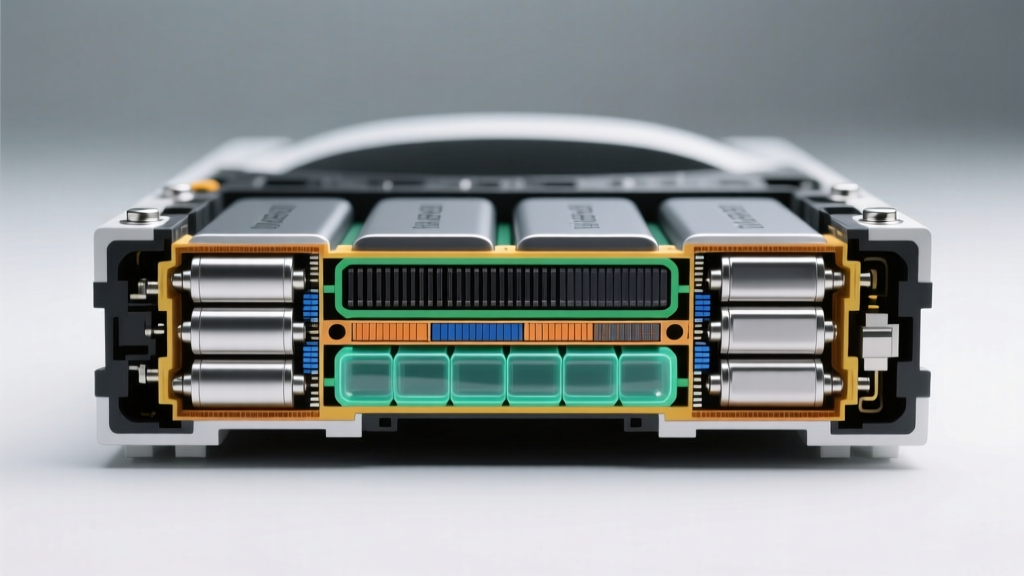
At the cell level, modern EV batteries are lithium-ion — the same fundamental technology in your phone, but scaled to 60–120+ kilowatt-hours (kWh) of usable energy. The key word is lithium-ion, which describes a family of chemistries, not a single formula. The two dominant cathode chemistries in 2026 passenger EVs are:
- NMC (Nickel Manganese Cobalt) and its cousin NCA (Nickel Cobalt Aluminum) — used in most long-range and performance-oriented models.
- LFP (Lithium Iron Phosphate) — increasingly used in standard-range, cost-optimized models.
Both use lithium ions shuttling between a graphite (or silicon-blend) anode and a metal-oxide or phosphate cathode through a liquid electrolyte. The difference is what the cathode is made of, and that difference drives every trade-off you experience as an owner.
LFP vs NMC: The Chemistry Trade-Offs That Matter
The choice between LFP and NMC isn't about one being universally "better." It's about which trade-offs match how you drive, where you live, and what you're willing to pay. Here's how they compare across the metrics that affect real ownership:
| Attribute | LFP (Lithium Iron Phosphate) | NMC / NCA (Nickel-based) |
|---|---|---|
| Energy density (cell-level) | ~160–180 Wh/kg | ~220–270 Wh/kg |
| Typical pack size | 50–65 kWh (standard-range models) | 75–120+ kWh (long-range/performance) |
| Cycle life (to 80% SoH) | 3,000–5,000+ cycles | 1,500–2,500 cycles |
| Cold-weather performance | Moderate range loss; slower cold charging | Better low-temp energy delivery |
| Charging to 100% regularly | Recommended — no degradation penalty | Avoid sustained 100%; 80% daily is ideal |
| Cobalt content | Zero | Varies; trend toward low-cobalt formulations |
| Cost per kWh (cell-level, 2026) | ~$75–$95/kWh | ~$100–$130/kWh |
| Common in | Tesla Model 3/Y RWD, Ford Mustang Mach-E SR, base Rivian R1S | Tesla LR/Performance, Hyundai Ioniq 5 LR, BMW iX, Lucid Air |
What this means practically: If you commute 30–50 miles daily and can charge at home, an LFP pack gives you extraordinary longevity — potentially 300,000+ miles before meaningful degradation — at a lower purchase price. If you regularly road-trip 300+ miles, tow, or live in a climate with harsh winters where every mile of range counts, the higher energy density of NMC lets automakers fit more kWh into the same physical space, giving you 300–400+ miles of EPA-rated range.
LFP's tolerance for daily 100% charging is a significant ownership advantage. Tesla explicitly recommends charging LFP vehicles to 100% at least weekly to keep the battery management system (BMS) calibrated. With NMC, the long-standing guidance is to set your daily charge limit to 80% and only charge to 100% before a long trip — a habit that adds minor friction to ownership but materially slows degradation.
How Long Do EV Batteries Actually Last?
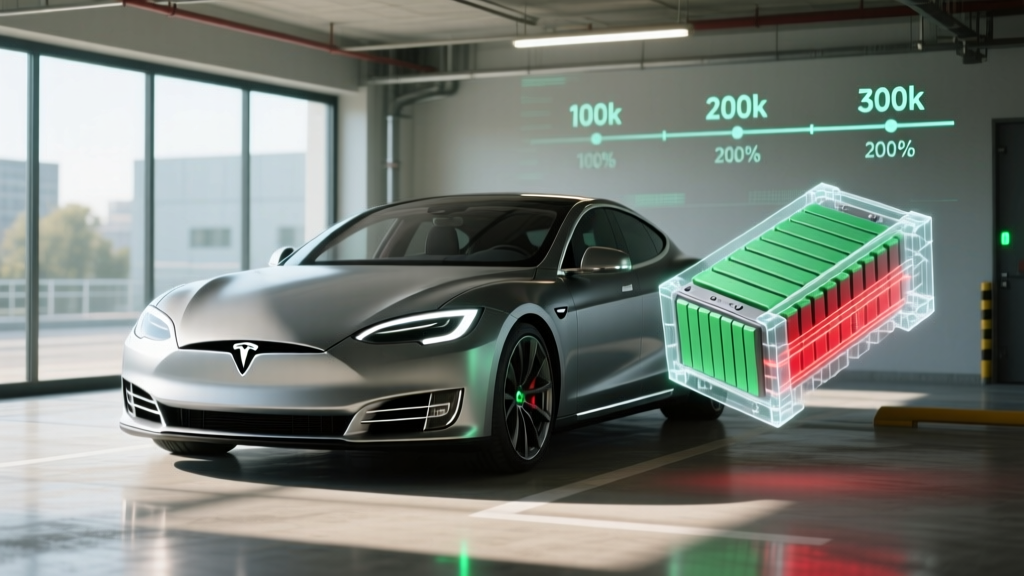
The fear that EV batteries "need replacing every few years like a phone" is not supported by fleet data. According to data compiled from Tesla's 2023 Impact Report and independent analyses by Recurrent Auto, the average lithium-ion EV battery retains approximately 90–95% of its original capacity after 100,000 miles, and roughly 85–92% after 200,000 miles, depending on chemistry and usage patterns.
Typical degradation trajectory (fleet-averaged):
- Year 1 / 15,000 miles: 2–4% capacity loss (initial "break-in" degradation, steepest part of the curve)
- Year 3 / 45,000 miles: 5–8% total loss
- Year 5 / 75,000 miles: 7–10% total loss
- Year 8 / 120,000 miles: 10–15% total loss
- Year 10+ / 150,000–200,000 miles: 12–18% total loss for NMC; often under 10% for LFP
Source: Aggregated fleet telemetry from Recurrent Auto, Tesla Impact Report, and owner-reported data on InsideEVs forums. Individual results vary based on climate, charging habits, and thermal management system quality.
The critical insight is that degradation is non-linear. Most capacity loss happens in the first 20,000–30,000 miles as the solid electrolyte interphase (SEI) layer forms on the anode. After that, degradation slows significantly and proceeds at a roughly linear rate of 1–2% per year under normal use. LFP batteries show an even flatter curve after the initial break-in, which is why they're increasingly favored in commercial and high-mileage applications.
Most EV batteries will outlast the vehicle they're installed in. The average age of a scrapped passenger vehicle in the US is approximately 15 years, and at typical American driving distances (~13,500 miles/year per FHWA data), that's roughly 200,000 miles — right where fleet data shows most packs still holding 82–90% capacity.
What the Battery Warranty Actually Covers
Federal law mandates a minimum 8-year / 100,000-mile warranty on EV battery packs for emissions-related compliance, and virtually every automaker selling EVs in the US matches or exceeds this baseline. Here's how the major manufacturers structure their coverage as of the 2026 model year:
| Manufacturer | Warranty Period | Capacity Retention Threshold | Notes |
|---|---|---|---|
| Tesla (Model 3/Y) | 8 yr / 120,000 mi (LR/AWD); 8 yr / 100,000 mi (RWD) | 70% minimum | Includes labor and replacement cell/module/pack |
| Hyundai / Kia | 10 yr / 100,000 mi | 70% minimum | Among the longest coverage in the industry |
| Ford (Mustang Mach-E, F-150 Lightning) | 8 yr / 100,000 mi | 70% minimum | Covers battery and electric powertrain components |
| General Motors (Ultium platform) | 8 yr / 100,000 mi | 70% minimum (varies by model) | Modular pack design allows individual module replacement |
| BMW | 8 yr / 100,000 mi | 70% minimum | Includes high-voltage battery and associated electronics |
| Rivian | 8 yr / 175,000 mi | 70% minimum | Higher mileage cap reflects adventure/truck use case |
The 70% threshold is important context: if your 300-mile EPA-rated EV degrades to 215 miles of range, that's roughly 72% retention — still above the warranty trigger. In practice, fleet data shows that very few batteries fall below 70% within the warranty period under normal use. Warranty claims tend to involve manufacturing defects (bad cells, BMS faults, coolant leaks) rather than gradual capacity loss.
What the warranty does not cover: damage from accidents, improper modifications, using non-approved charging equipment that causes electrical damage, or failure to follow basic maintenance (like coolant service intervals that keep the battery thermal management system functioning).
EV Battery Replacement Costs: The Numbers
This is where most fear-mongering lives, so let's anchor the discussion in actual data. Full battery pack replacement is rare — most EVs will never need one — but when it is necessary (typically due to physical damage, a manufacturing defect outside warranty, or extreme degradation on a high-mileage vehicle), the costs are substantial:
| Vehicle / Pack Size | Pack Capacity | Estimated Replacement Cost (2026) | Context |
|---|---|---|---|
| Tesla Model 3 RWD (LFP) | ~60 kWh | $8,000–$12,000 | LFP cell costs have dropped significantly; module-level repair often possible |
| Tesla Model Y Long Range (NMC) | ~75 kWh | $12,000–$16,000 | Structural pack design increases labor complexity |
| Ford F-150 Lightning Extended Range | ~131 kWh | $18,000–$28,000 | Largest consumer packs carry highest replacement costs |
| Hyundai Ioniq 5 Long Range | ~77.4 kWh | $10,000–$15,000 | Hyundai's modular E-GMP platform supports partial replacement |
| Chevrolet Silverado EV (Ultium) | ~200 kWh (max) | $25,000–$38,000 | Very large packs; GM's modular Ultium design may allow module-level service |
Several factors are driving these costs down over time. Cell-level pricing has fallen from over $1,000/kWh in 2010 to roughly $80–$130/kWh in 2026 depending on chemistry (source: BloombergNEF battery price survey). And increasingly, shops can replace individual modules rather than the entire pack — a single failed module in a 12-module pack might cost $1,500–$3,000 to swap rather than $15,000 for a full pack.
When is replacement typically needed? Based on current fleet data, the vast majority of replacements occur due to:
- Physical damage (collision, ground strike, flood) — covered by insurance, not the battery warranty.
- Manufacturing defects — almost always caught within the warranty period.
- Gradual degradation past the 70% threshold — extremely rare before 200,000+ miles with current chemistries.
What Degrades an EV Battery — and What Doesn't
Battery degradation is driven by a handful of well-understood electrochemical mechanisms. Not all miles are equal, and not all charging sessions are equal. Here's what the data actually shows:
Factors that accelerate degradation (highest to lowest impact):
- Sustained high state of charge (NMC only): Storing an NMC battery at 100% SoC for days or weeks accelerates electrolyte decomposition. Keep daily charge at 80%.
- Extreme heat exposure: Ambient temperatures above 95°F combined with high SoC stress the cathode. Vehicles with active liquid cooling (Tesla, Hyundai E-GMP, GM Ultium) manage this far better than passive-cooled packs.
- Frequent DC fast charging at peak rates: Exclusively using 150–350 kW DC fast chargers without ever using Level 2 adds measurable wear. Fleet data from Recurrent Auto shows vehicles that fast-charge more than 90% of the time see approximately 2–4% additional degradation over 100,000 miles compared to primarily Level 2 charging.
- Deep discharge cycles: Regularly driving the battery below 10% SoC stresses the anode. The BMS maintains a buffer (typically 2–5% at the bottom), but habitually arriving at 0% isn't ideal.
- Cold-weather fast charging without preconditioning: Charging a cold battery at high power can cause lithium plating on the anode. Always use your vehicle's preconditioning feature before a DC fast charge session in cold weather.
Factors that are often feared but have minimal impact:
- Normal daily driving and Level 2 charging: This is what the battery is designed for. Negligible accelerated wear.
- Occasional 100% charges (NMC): Charging to 100% before a road trip and driving down shortly after causes minimal stress. It's sustained storage at 100% that matters.
- Regenerative braking: Regen sends current back to the battery, but at modest C-rates. It does not meaningfully accelerate degradation.
- Calendar aging: Even a parked EV battery degrades slightly over time, but at roughly 1–2% per year when stored at moderate SoC (40–60%). This is unavoidable but minor.
How to Check and Monitor Your Battery Health
State of Health (SoH) is the percentage of original capacity your battery can still hold. A new battery is 100% SoH; at 85% SoH, a 75 kWh pack holds roughly 63.75 kWh of usable energy, which translates to proportionally less range.
Most EVs don't display a direct SoH percentage on the dashboard, but there are several ways to monitor it:
- In-vehicle range estimation trend: Track your full-charge range estimate over time. If your EV showed 310 miles at 100% when new and now shows 280 miles at 100% (at similar ambient temperatures), that's roughly 90% SoH.
- Third-party OBD-II tools: Devices like the OBDLink MX+ paired with apps such as EVNotify or LeafSpy (for Nissan Leaf owners) can read BMS-reported capacity data directly. Tesla owners can access detailed battery health data through the app's service menu or third-party tools like TeslaFi.
- Dealer diagnostic scan: Any authorized service center can pull a full battery health report, including individual cell-group voltage variance, which reveals whether one module is degrading faster than the rest.
- Recurrent Auto and similar services: Some fleet analytics companies offer consumer-facing battery health reports based on telematics data, comparing your pack to a cohort of identical vehicles.
A healthy battery doesn't just retain capacity — it also maintains voltage balance across cell groups. If one module is significantly weaker than the others, the BMS limits the entire pack to protect that module, which feels like accelerated range loss. A dealer can sometimes rebalance the pack through a controlled charge-discharge cycle, or replace the individual weak module.
What's Next: Solid-State, Silicon Anodes, and Realistic Timelines
The battery industry is actively developing next-generation chemistries that promise higher energy density, faster charging, and longer life. Here's where the most-discussed technologies stand as of 2026 — with realistic timelines, not concept-car hype:
Silicon-dominant anodes: Current lithium-ion cells use graphite anodes with a small percentage of silicon oxide blended in (typically 5–10%). Pure silicon can theoretically store 10x more lithium ions per gram than graphite, but it swells up to 300% during charging, cracking the electrode. Companies like Sila Nanotechnologies and Group14 Technologies have begun commercial production of silicon-dominant anode materials, with early deployments in premium EVs expected between 2026 and 2028. Expect 15–25% energy density improvement, not a revolution overnight.
Solid-state batteries: These replace the liquid electrolyte with a solid ceramic, polymer, or sulfide-based conductor, potentially enabling lithium-metal anodes, 400+ Wh/kg energy density, and faster charging with reduced fire risk. Toyota, Samsung SDI, and QuantumScape have all announced pilot production lines, with Toyota targeting limited solid-state EV production around 2027–2028. However, manufacturing yield, cost (currently 3–5x liquid lithium-ion per kWh), and cycle-life durability at scale remain unsolved challenges. Widespread solid-state adoption in mainstream, affordable EVs is more realistically a 2030+ prospect.
Sodium-ion batteries: CATL and BYD have begun shipping sodium-ion cells in Chinese-market micro-EVs and energy storage. Sodium is abundant and cheap, but energy density is roughly 30–40% lower than LFP. In the US market, sodium-ion is most likely to appear first in grid storage and low-speed commercial vehicles before reaching consumer passenger EVs.
None of these technologies are currently available in US-market consumer EVs. When they arrive, they'll debut in premium segments first and trickle down over 3–5 model-year cycles. For anyone shopping today, current LFP and NMC chemistries are mature, well-understood, and backed by extensive fleet data.
Frequently Asked Questions
LFP vs NMC — which battery chemistry is better for me?
Choose LFP if you primarily commute under 60 miles daily, charge at home, want maximum cycle life (3,000–5,000+ cycles), and don't need 300+ miles of range. Choose NMC/NCA if you regularly take road trips, need maximum range per charge, tow frequently, or live in a very cold climate where energy density matters. Neither is universally superior — they optimize for different use cases.
How long do EV batteries last before needing replacement?
Fleet data shows most modern EV batteries retain 82–92% of original capacity at 200,000 miles (roughly 15 years of average US driving). Full replacement before 200,000 miles is uncommon and usually due to physical damage or a manufacturing defect covered by warranty. LFP batteries in particular are projected to exceed 300,000 miles before reaching the 70% capacity threshold.
How much does it cost to replace an EV battery?
Full pack replacement ranges from approximately $8,000 for a 60 kWh LFP pack to $25,000–$38,000 for a 200 kWh truck pack, based on 2026 pricing. However, module-level repairs (replacing a single degraded section) often cost $1,500–$3,000. Most owners will never pay for a replacement — the battery typically outlasts the vehicle or is covered under the 8–10 year warranty.
What does the EV battery warranty cover?
Standard coverage is 8 years / 100,000 miles (some brands offer 10 years or higher mileage caps) guaranteeing the battery will retain at least 70% of its original capacity. The warranty covers defects in materials and workmanship and excessive degradation below the threshold. It does not cover physical damage from collisions, flooding, or aftermarket modifications.
Does frequent DC fast charging damage my battery?
Exclusively relying on DC fast charging (150–350 kW) shows a measurable but modest impact — approximately 2–4% additional capacity loss over 100,000 miles compared to primarily Level 2 home charging, per Recurrent Auto fleet data. Occasional fast charging on road trips is perfectly fine. The highest risk is fast charging a cold battery without preconditioning, which can cause lithium plating. Always precondition in cold weather.
Can I check my battery's State of Health myself?
Yes. Monitor your full-charge range estimate over time (adjusted for temperature), use an OBD-II reader with EV-specific apps like EVNotify or TeslaFi, or request a diagnostic scan from your dealer. Significant variance between cell groups (visible through OBD-II tools) may indicate a weak module that can be individually replaced.