When you see a battery-electric transit bus pull away from a curb, you're watching one of the most demanding battery applications on the road. An electric bus battery endures 200+ kWh of daily cycling, constant DC fast charging, extreme temperatures, and 12- to 15-year service expectations — far beyond what any passenger EV faces. The engineering lessons from electric bus batteries directly inform the packs inside your Tesla Model Y, Ford F-150 Lightning, or Hyundai Ioniq 5.
This guide translates heavy-duty electric bus battery technology into actionable knowledge for passenger EV buyers and owners. Whether you're evaluating LFP versus NMC chemistry, decoding warranty fine print, or trying to predict when (or if) you'll ever need a battery replacement, the data from transit fleets provides some of the most rigorous real-world evidence available.
LFP vs NMC: The Chemistry Split Dominating EV Batteries
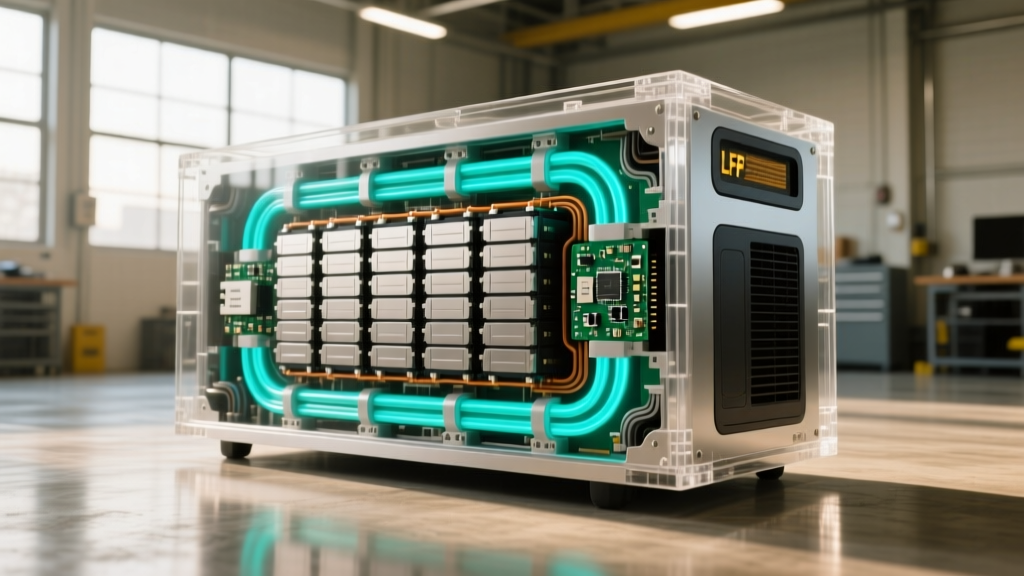
Every electric bus battery — and every passenger EV battery — relies on one of two dominant lithium-ion chemistries: Lithium Iron Phosphate (LFP) or Nickel Manganese Cobalt (NMC), with NCA (Nickel Cobalt Aluminum) as a Tesla-specific variant. The chemistry determines energy density, cycle life, thermal stability, cost, and cold-weather behavior.
Transit buses overwhelmingly use LFP. The reason is cycle life: a city bus may complete 5,000 to 7,000 full charge-discharge cycles over a 12-year service life, and LFP handles that far better than NMC. Passenger EVs are increasingly adopting LFP for the same reason — Tesla's Standard Range Model 3 and Model Y, the base Ford Mustang Mach-E Select, and the Rivian R1S/R1T Standard packs all use LFP cells as of the 2025–2026 model years.
| Attribute | LFP (Lithium Iron Phosphate) | NMC / NCA (Nickel-based) |
|---|---|---|
| Energy Density (cell-level) | 160–180 Wh/kg | 230–280 Wh/kg |
| Cycle Life (to 80% SoH) | 3,000–6,000+ cycles | 1,000–2,500 cycles |
| Thermal Stability | Excellent — resistant to thermal runaway | Good — requires more active thermal management |
| Cold-Weather Performance | Moderate — more range loss below 32°F | Better — retains more capacity in cold |
| Cost (per kWh, cell-level) | ~$70–$85 (2025–2026) | ~$95–$120 (2025–2026) |
| Cobalt / Nickel Content | None — iron and phosphate only | Significant — supply chain and ethical concerns |
| Typical Use Case | Standard-range EVs, buses, fleet vehicles | Long-range EVs, high-performance models |
| Charging to 100% Regularly | Recommended — BMS needs full-charge calibration | Not ideal — accelerates degradation; 80% daily recommended |
Which is better? It depends on your driving pattern. If you want maximum range per charge and don't mind managing state-of-charge habits, NMC delivers 30–50% more energy in the same weight. If you want a battery that will outlast the vehicle with minimal degradation, can be charged to 100% daily without worry, and costs less to manufacture, LFP is the stronger choice. Electric bus fleets chose LFP for exactly these reasons — and passenger EV buyers are following.
How Long Do EV Batteries Actually Last? Degradation Data
The question "how long do EV batteries last?" has two answers: calendar life (years) and cycle life (charge-discharge events). For most passenger EVs, the battery will outlast the rest of the vehicle.
Electric bus battery data is especially valuable here because fleets publish degradation reports. Studies from the U.S. Department of Energy's Alternative Fuels Data Center and transit agencies operating Proterra, New Flyer Xcelsior CHARGE, and BYD buses show that LFP-based electric bus batteries typically retain 80–85% of original capacity after 8 years and 250,000+ miles of heavy daily cycling.
Real-World Degradation Benchmarks
- Electric bus battery (LFP, 200–400 kWh): ~2–3% loss per year under daily DC fast charging; 80–85% SoH at year 8.
- Passenger EV (NMC, 60–100 kWh): Data from Recurrent Auto and Geotab fleet studies show an average of ~1.8% capacity loss per year for liquid-cooled packs; approximately 88–90% SoH at year 8.
- Passenger EV (LFP, 50–75 kWh): Early Tesla Model 3 Standard Range LFP data suggests ~1.5% annual loss with regular 100% charging; projected 85–90% SoH at year 8.
- Outlier cases: Early Nissan Leaf (passively cooled, NMC/LMO, 24–30 kWh) showed 15–25% loss over 8 years due to lack of active thermal management. This is not representative of modern liquid-cooled packs.
The key takeaway: modern liquid-cooled batteries in both transit and passenger applications lose roughly 1.5–3% capacity per year under normal use. A 2026 Hyundai Ioniq 5 with a 77.4 kWh NMC pack rated at 260 miles EPA range should still deliver roughly 225–235 miles of range after 8 years — well within usable daily service.
What Does the Battery Warranty Actually Cover?
Federal law mandates that EV batteries carry a minimum warranty of 8 years or 100,000 miles (whichever comes first) in most states, and 10 years or 150,000 miles in California Air Resources Board (CARB) states including California, New York, Massachusetts, Oregon, Washington, and others. But the details matter enormously.
| Manufacturer | Warranty Period | Capacity Retention Threshold | Chemistry |
|---|---|---|---|
| Tesla (Model 3/Y RWD — LFP) | 8 yr / 100,000 mi | 70% minimum | LFP |
| Tesla (Model 3/Y Long Range — NMC) | 8 yr / 120,000 mi | 70% minimum | NMC |
| Hyundai / Kia (E-GMP platform) | 10 yr / 100,000 mi | 70% minimum | NMC |
| Ford (Mach-E, F-150 Lightning) | 8 yr / 100,000 mi | 70% minimum | NMC / LFP (varies by trim) |
| GM (Ultium platform — Equinox EV, Blazer EV, Silverado EV) | 8 yr / 100,000 mi | 70% minimum (60% for commercial) | NMC |
| Rivian (R1S/R1T) | 8 yr / 175,000 mi | 70% minimum | NMC / LFP (varies) |
| BMW (i4, iX, i7) | 8 yr / 100,000 mi | 70% minimum | NMC |
What the warranty covers: If your high-voltage traction battery falls below the stated capacity retention threshold (typically 70% of original kWh) during the warranty period, the manufacturer must repair or replace it at no cost. This covers cell-level degradation — not damage from accidents, flooding, or unauthorized modifications.
What it does NOT cover: The 12V auxiliary battery (which powers lights, infotainment, and computers) is a separate component with its own shorter warranty, typically 3 years/36,000 miles. Normal range reduction from cold weather or aging tires is not a warranty claim. Cosmetic issues or minor cell imbalance that stays above the threshold are excluded.
Electric bus batteries carry similar warranties — Proterra and New Flyer typically warrant their packs for 8–12 years with a 70–75% retention threshold, reflecting the longer service life expected in transit.
EV Battery Replacement Cost: What to Expect
This is the question that generates the most anxiety — and the most misinformation. Let's ground it in data.
| Vehicle / Pack Size | Battery Chemistry | Estimated Replacement Cost (Parts + Labor) | Typical Replacement Timeline |
|---|---|---|---|
| Tesla Model 3 RWD (~57 kWh) | LFP | $8,000–$12,000 | Rarely needed before 200,000+ mi |
| Tesla Model Y Long Range (~75 kWh) | NMC | $12,000–$16,000 | Rarely needed before 200,000+ mi |
| Hyundai Ioniq 5 (~77.4 kWh) | NMC | $11,000–$15,000 | Rarely needed before 200,000+ mi |
| Ford F-150 Lightning Extended Range (~131 kWh) | NMC | $18,000–$25,000 | Rarely needed before 200,000+ mi |
| Chevrolet Equinox EV (~85 kWh) | NMC (Ultium) | $12,000–$17,000 | Rarely needed before 200,000+ mi |
| Electric transit bus (200–400 kWh) | LFP | $80,000–$150,000+ | Year 10–15 of service (planned refurb) |
Context that matters: Cell prices have dropped from over $1,000/kWh in 2010 to roughly $80–$120/kWh at the cell level in 2025–2026, according to BloombergNEF battery price surveys. Pack-level costs (including BMS, cooling, housing) run higher, but the trend is firmly downward. By the time a 2026 EV actually needs a battery replacement — likely in the 2038–2042 timeframe — costs will be substantially lower than today's estimates.
Furthermore, most EV batteries never need full replacement. Module-level repairs (replacing individual degraded modules rather than the entire pack) are increasingly common and cost 30–50% less. Tesla, Rivian, and Hyundai all support module-level service. Electric bus fleets routinely perform module swaps to extend pack life without full replacement.
Factors That Accelerate (or Preserve) Battery Life
Battery degradation isn't random — it's driven by specific, controllable factors. Transit fleet operators have refined battery care into a science, and the same principles apply to your passenger EV.
Battery Care Best Practices
- Limit DC fast charging frequency: Occasional road-trip fast charging is fine. Daily reliance on 150+ kW DC fast charging accelerates degradation by ~0.3–0.5% per year versus Level 2 charging. Electric bus fleets that can charge overnight on Level 2 (or even 50 kW DC) show measurably better longevity than those dependent on 350 kW opportunity chargers.
- Avoid sustained high state of charge (NMC only): For NMC/NCA batteries, storing the vehicle at 100% SoC for days or weeks accelerates calendar degradation. Set your charge limit to 80% for daily use and charge to 100% only before long trips. LFP batteries, by contrast, benefit from regular 100% charges — the BMS needs full-charge events for accurate state-of-charge calibration.
- Don't store at very low SoC: Leaving any lithium-ion battery below 10% SoC for extended periods risks cell damage. If storing an EV for weeks, set the charge level to 50–60%.
- Precondition before fast charging: Cold batteries charge slowly and accept charge less efficiently. Use your EV's built-in preconditioning feature (navigation to a charger typically triggers this automatically) to warm the pack before DC fast charging.
- Park in shade or a garage when possible: Sustained high battery temperatures (above 95°F ambient, especially in direct sunlight) accelerate calendar aging. This is why liquid-cooled packs — standard on virtually all 2026 EVs — are so important.
- Use regenerative braking moderately: Maximum regen settings generate higher current flows into the battery. In cold weather, this can stress cells. Most modern EVs manage this automatically, but easing regen in sub-freezing conditions is prudent.
How to Monitor Your Battery's State of Health (SoH)
State of Health (SoH) is the percentage of original battery capacity remaining. A new EV has 100% SoH; a battery at 85% SoH has lost 15% of its original capacity. Monitoring SoH is essential for understanding your EV's remaining range and resale value.
How to Check SoH
- In-vehicle displays: Some 2026 EVs (notably Hyundai/Kia E-GMP vehicles, BMW iDrive 8+ models, and Tesla via the service menu) show estimated SoH or battery health percentage directly. Check your owner's manual for access instructions.
- OBD-II diagnostic tools: Devices like the OBDeleven, Carista, or dedicated EV tools (such as the AVILOO battery test) can read detailed battery data including SoH, individual cell voltages, and temperature history. An AVILOO test (~$30) generates a certified SoH report useful for resale.
- Manufacturer service centers: Any dealership or service center can run a full battery health diagnostic, usually for free under warranty or for a modest fee ($50–$100) out of warranty.
- Telematics apps: Services like Recurrent (free for members) track your battery's range and efficiency over time, comparing your degradation curve to a fleet of identical vehicles. This is one of the easiest passive monitoring methods.
Electric bus fleet managers use far more sophisticated telematics — National Renewable Energy Laboratory (NREL) studies show transit agencies track per-cell voltage, temperature, and impedance in real time. Passenger EV owners don't need that level of detail, but an annual SoH check (via OBD-II tool or dealer visit) is a smart ownership habit.
Emerging Battery Technologies: Solid-State and Beyond
Next-generation battery technologies are in active development, but none are commercially available in production passenger EVs as of early 2026. Here's a realistic assessment:
- Solid-state batteries: Toyota, Nissan, Samsung SDI, and QuantumScape are leading development. Toyota has announced a solid-state EV for 2027–2028 with a claimed 600+ mile range and 10-minute fast charging. However, manufacturing scale-up remains the primary challenge. Realistic availability in volume-production passenger EVs: 2028–2030. Electric bus applications will likely follow passenger vehicles due to cost sensitivity.
- Silicon-dominant anodes: Companies like Sila Nanotechnologies and Group14 are replacing graphite anodes with silicon composites, boosting energy density by 20–40%. Early production applications are appearing in limited runs. Realistic volume availability: 2026–2028.
- Sodium-ion batteries: CATL and BYD have begun producing sodium-ion cells for low-cost, lower-energy-density applications (urban delivery vans, micro-cars). These are unlikely to appear in U.S.-market passenger EVs before 2028+, but they could transform electric bus battery economics for shorter-route transit.
- Lithium-sulfur: Still in laboratory and early prototype stages. Offers theoretical energy density 3–5x current lithium-ion, but cycle life remains a fundamental challenge. Realistic availability: 2032+.
None of these technologies should delay a current EV purchase. Today's LFP and NMC batteries, properly maintained, will serve reliably for 15–20 years — by which time the next generation of technology will be mature and affordable.
Frequently Asked Questions
How long do electric bus batteries last compared to passenger EV batteries?
Electric bus batteries (typically LFP, 200–400 kWh) are engineered for 12–15 years and 500,000+ miles of daily heavy cycling. Passenger EV batteries (60–130 kWh, LFP or NMC) are designed for 15–20 years and 200,000–300,000+ miles. In both cases, the battery is expected to outlast the rest of the vehicle. The key difference is that bus batteries cycle far more energy daily but use LFP chemistry optimized for cycle life, while passenger EV batteries balance energy density with longevity.
How much does an EV battery cost to replace in 2026?
Passenger EV battery replacement costs range from approximately $8,000 for a smaller LFP pack (Tesla Model 3 RWD, ~57 kWh) to $25,000 for a large NMC pack (F-150 Lightning Extended Range, ~131 kWh), including parts and labor. However, full replacement is rarely needed — most batteries retain 80%+ capacity after 200,000 miles. Module-level repairs, when needed, cost 30–50% less than full pack replacement. Cell prices continue to decline, so replacement costs in the 2030s will likely be significantly lower.
Is LFP really better than NMC for daily driving?
For most daily-driving scenarios, yes — LFP offers superior cycle life, lower cost, better thermal safety, and the convenience of regular 100% charging. The trade-off is lower energy density (meaning heavier packs for the same range) and slightly worse cold-weather performance. If you need maximum range in a single charge (frequent 300+ mile road trips) or live in a very cold climate, NMC may be preferable. For commuters, city drivers, and fleet use, LFP is the pragmatic choice — which is why electric bus batteries are almost universally LFP.
Does fast charging really damage my EV battery?
Occasional DC fast charging causes negligible harm. The concern is exclusive reliance on high-power (150+ kW) DC fast charging with no Level 2 charging. Studies from Geotab and the Idaho National Laboratory show that vehicles charged exclusively on DC fast chargers degrade approximately 0.3–0.5% faster per year than those charged primarily on Level 2. For context, that's the difference between 90% SoH and 87% SoH after 8 years — meaningful but not catastrophic. Modern battery management systems also throttle charge speed when the pack is hot or cold, providing built-in protection.
Will my EV battery need to be replaced before I sell the car?
Statistically, no. The vast majority of EV batteries retain 80%+ of original capacity through 200,000 miles. Average U.S. drivers cover ~14,000 miles per year, meaning it would take 14+ years to reach that mileage. Most EVs are sold or traded long before battery replacement becomes necessary. If you buy a 2026 EV and drive it for 10 years, the battery will very likely still be functional and within warranty coverage thresholds for much of that period.
Sources: U.S. Department of Energy Alternative Fuels Data Center, National Renewable Energy Laboratory (NREL), EPA fueleconomy.gov, IRS §30D Clean Vehicle Credit guidance.