What You Need to Know About EV Battery Chemistry
The electric battery is the single most expensive component in any EV or PHEV. It defines your vehicle's range, charging speed, long-term durability, and eventual resale value. Yet most buyers never look beyond the EPA range sticker. Understanding the chemistry inside your pack — and how it ages over time — is the difference between a confident purchase and an expensive surprise.
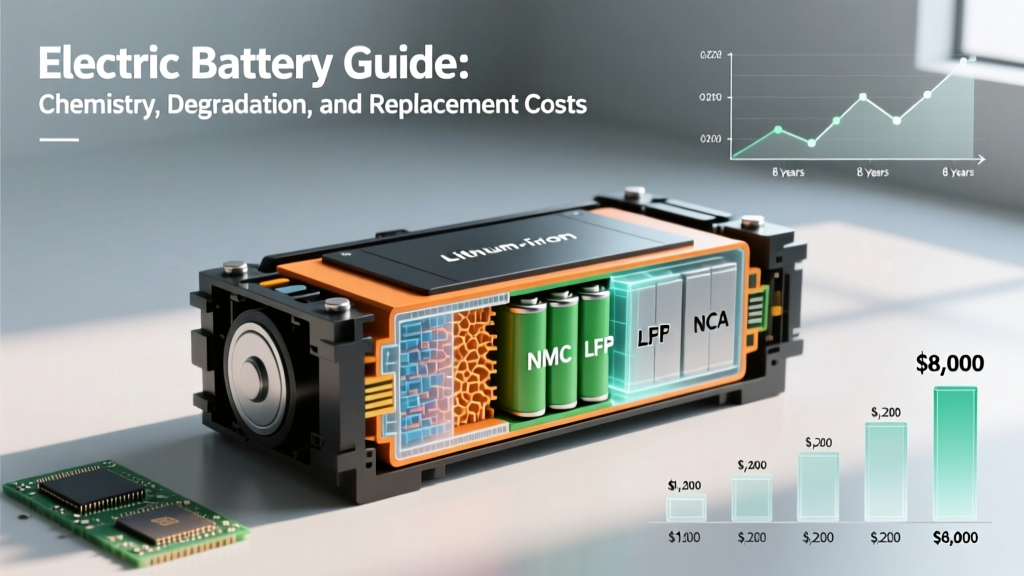
There are two dominant chemistries in today's EV market: lithium iron phosphate (LFP) and nickel manganese cobalt (NMC), with some manufacturers using nickel cobalt aluminum (NCA). Each has distinct trade-offs in energy density, cycle life, cold-weather performance, and cost. Neither is universally "better" — the right choice depends on your driving patterns, climate, and budget.
LFP vs. NMC/NCA: The Chemistry Comparison
| Attribute | LFP (Lithium Iron Phosphate) | NMC / NCA (Nickel-based) |
|---|---|---|
| Energy Density | Lower (~160–180 Wh/kg cell-level) | Higher (~220–300 Wh/kg cell-level) |
| Typical Range Impact | Shorter range for same pack weight | More range per kilogram of battery |
| Cycle Life | 3,000–5,000+ full cycles to 80% capacity | 1,000–2,000 full cycles to 80% capacity |
| Cold-Weather Performance | Weaker — more range loss below freezing | Better low-temperature discharge capability |
| Thermal Stability | Superior — less prone to thermal runaway | Good but requires more active thermal management |
| Cost | Lower raw material cost (no cobalt or nickel) | Higher — nickel and cobalt price exposure |
| Recommended SoC for Daily Use | 100% charging is acceptable and encouraged | 80% daily recommended; 100% for long trips only |
| Notable Applications | Tesla Model 3/Y RWD, Ford Mustang Mach-E Select (LFP option), BYD models | Tesla Long Range/Performance, Hyundai Ioniq 5/6, Rivian, most long-range EVs |
The key takeaway: LFP batteries sacrifice some energy density for vastly superior longevity and lower cost. If you commute short distances and can charge at home daily, LFP is arguably the better ownership experience. If you need maximum range in a single charge or regularly drive in freezing temperatures, NMC/NCA packs still hold an edge.
One nuance that catches buyers off guard: LFP packs have a very flat voltage curve, which makes it harder for the battery management system (BMS) to estimate remaining charge accurately. Tesla and other manufacturers recommend periodically charging LFP vehicles to 100% so the BMS can recalibrate. With NMC, habitual 100% charges accelerate degradation — so follow the manufacturer's SoC guidance for your specific chemistry.
How Long Do EV Batteries Last?
The short answer: almost certainly longer than you think. Data aggregated from hundreds of thousands of vehicles shows that most modern EV batteries lose between 5% and 15% of their original capacity over the first 100,000 miles or 8 years. Catastrophic failure requiring full replacement is rare and declining with each model year.
Real-World Degradation Data Points
Based on fleet data, owner surveys, and manufacturer reports compiled through 2025–2026:
- Tesla Model 3/Y (NMC, 2018–2023): Average ~10–12% capacity loss at 100,000 miles. Tesla's own 2024 Impact Report stated average degradation of approximately 12% at 150,000 miles across the fleet.
- Tesla Model 3 RWD (LFP, 2021–2025): Early data suggests 5–8% loss at 80,000 miles, consistent with LFP's superior cycle life.
- Nissan Leaf (2011–2017, air-cooled NMC): Notable outlier — some packs lost 20–30%+ capacity by 80,000 miles due to lack of active thermal management. The 2018+ Leaf with liquid cooling performs significantly better.
- Hyundai Ioniq 5 / Kia EV6 (NMC, 2022–2025): Owner-reported degradation of 4–7% at 50,000 miles, consistent with modern liquid-cooled pack designs.
- Chevrolet Bolt EV/EUV (NMC, 2017–2023): Recall-related battery replacements aside, non-recalled packs show approximately 8–10% loss at 80,000 miles.
Source: fueleconomy.gov and manufacturer fleet data reports.
The pattern is clear: liquid-cooled packs with modern BMS software degrade far more slowly than early-generation or passively cooled designs. If you're buying a 2024-or-newer EV from a major manufacturer, the battery will very likely retain 85–90%+ of its original capacity at the 8-year / 100,000-mile mark — well within the federal warranty threshold.
What Does the EV Battery Warranty Actually Cover?
Federal law mandates that all EVs sold in the United States carry a battery warranty of at least 8 years or 100,000 miles, whichever comes first. In California Air Resources Board (CARB) states — which include California, Colorado, Connecticut, Maine, Maryland, Massachusetts, New Jersey, New York, Oregon, Rhode Island, Vermont, Virginia, and Washington — the mandate extends to 10 years or 150,000 miles.
| Manufacturer | Warranty Period | Capacity Retention Threshold | Notes |
|---|---|---|---|
| Tesla (Model 3/Y RWD, LFP) | 8 yr / 100,000 mi | 70% | Covers defects + degradation below 70% |
| Tesla (Model 3/Y LR, Model S/X) | 8 yr / 120,000 mi | 70% | Longer mileage for LR/Performance trims |
| Hyundai / Kia | 10 yr / 100,000 mi | 70% | Among the longest in the industry |
| Ford (Mustang Mach-E, F-150 Lightning) | 8 yr / 100,000 mi | 70% | Covers defects + excessive degradation |
| GM (Chevrolet, Cadillac, GMC) | 8 yr / 100,000 mi | 70% | Ultium platform packs included |
| Rivian | 8 yr / 120,000 mi | 70% | 175,000 mi for commercial fleet vehicles |
| BMW | 8 yr / 100,000 mi | 70% | Extended to 10 yr / 150,000 mi in CARB states |
The critical detail is the capacity retention threshold. Most warranties guarantee the battery will retain at least 70% of its original capacity. If your 250-mile EPA-rated EV drops below ~175 miles of range due to degradation within the warranty period, you're entitled to a repair or replacement. In practice, very few packs fall below this threshold under normal use — which is why warranty claims for degradation (as opposed to manufacturing defects) remain uncommon.
What's typically not covered: damage from accidents, flooding, improper charging equipment, or aftermarket modifications. Always review the specific warranty language in your purchase agreement.
How Much Does It Cost to Replace an EV Battery?
This is the question that dominates EV forums, and the honest answer requires context. Out-of-warranty battery replacement is expensive — but it's also increasingly rare, and costs are declining year over year as pack prices fall and the third-party repair ecosystem matures.
| Vehicle | Battery Size | Estimated Replacement Cost | Typical When Needed |
|---|---|---|---|
| Nissan Leaf (40 kWh) | 40 kWh | $6,500 – $9,000 | Rarely; mostly 2011–2017 models |
| Chevrolet Bolt EV | 65 kWh | $14,000 – $17,000 | Mostly recall-related; newer packs improved |
| Tesla Model 3 (NMC LR) | ~75 kWh usable | $12,000 – $16,000 | Very rare under 200,000 mi |
| Tesla Model S / X | ~90–100 kWh usable | $18,000 – $25,000 | Older 2012–2017 models more affected |
| Ford Mustang Mach-E (ER) | ~88 kWh usable | $15,000 – $20,000 | Rare; limited out-of-warranty data |
| Hyundai Ioniq 5 | ~77.4 kWh usable | $13,000 – $18,000 | Too new for significant data |
Several important caveats:
- Module-level repair is increasingly viable. Many shops can now replace individual degraded modules within a pack for $2,000–$5,000 rather than swapping the entire battery.
- Remanufactured packs are becoming available for older models (Leaf, early Model S) at 40–60% of the cost of a new OEM pack.
- Most EV batteries outlive the vehicle. According to data from Recurrent Auto and other fleet analysts, the median EV battery replacement rate before 150,000 miles is well under 5% for liquid-cooled packs manufactured after 2018.
- For context, a federal tax credit under IRS §30D can offset up to $7,500 on a new EV purchase — which effectively pre-funds a potential future replacement most owners will never need.
Factors That Accelerate (or Slow) Battery Degradation
Battery wear is not simply a function of time or mileage. How you charge, what temperatures you expose the pack to, and how deeply you cycle the battery all materially affect its lifespan. Here are the five most impactful factors, ranked by effect size:
1. Extreme Temperatures Without Preconditioning
Lithium-ion cells degrade faster at sustained high temperatures (above 95°F / 35°C pack temp) and experience increased internal resistance at extreme cold (below 10°F / -12°C). Vehicles with active liquid cooling and heat pumps — including nearly all 2022+ EVs — manage this far better than older passively cooled designs. Preconditioning the battery before fast charging (which most modern EVs do automatically when you navigate to a charger) is critical in both hot and cold weather.
2. Frequent DC Fast Charging
Repeated high-power DC fast charging (150+ kW) generates significant heat within the cells. Studies from the Idaho National Laboratory and others show that exclusive DC fast charging can increase degradation by roughly 1–3% over 50,000 miles compared to Level 2 home charging. This doesn't mean you should avoid fast charging on road trips — but if you have home Level 2 access, using it for daily charging is the single best thing you can do for long-term pack health.
3. State of Charge Habits
For NMC/NCA batteries, routinely charging to 100% and leaving the vehicle at full charge for extended periods accelerates electrolyte decomposition. The recommended practice is to set your daily charge limit to 80% and only charge to 100% when you need the full range for a trip. LFP batteries are an exception — manufacturers recommend regular 100% charges for BMS calibration, and LFP chemistry is far more tolerant of high SoC.
Similarly, letting the battery sit at very low SoC (below 10%) for days or weeks is harmful. If you're storing the vehicle, aim for 50–60% SoC.
4. Depth of Discharge
Shallow cycles (e.g., charging from 30% to 80%) are gentler on cells than deep cycles (5% to 95%). You don't need to obsess over this — modern BMS systems maintain top and bottom buffers to protect cells — but consistently running the battery to near-empty before recharging does add wear over thousands of cycles.
5. Calendar Aging
Even a parked EV battery degrades slowly over time, a phenomenon called calendar aging. This is accelerated by high temperatures and high SoC. A vehicle stored at 100% charge in a hot garage will lose more capacity to calendar aging than one stored at 50% in a climate-controlled space. For most owners, calendar aging accounts for 1–3% loss over 5 years — a minor factor compared to cycling wear.
Battery Care Best Practices
- ✅ Use Level 2 home charging for daily needs; reserve DC fast charging for road trips
- ✅ Set daily charge limit to 80% for NMC/NCA; 100% is fine for LFP
- ✅ Enable battery preconditioning (automatic when navigating to a charger in most EVs)
- ✅ Avoid leaving the vehicle at 100% SoC for more than a few hours
- ✅ Don't let the battery sit below 10% SoC for extended periods
- ✅ Park in shade or a garage in hot climates when possible
- ✅ Keep up with OTA software updates — manufacturers refine BMS algorithms regularly
- ❌ Avoid repeated back-to-back DC fast charges in hot weather without cool-down periods
- ❌ Don't store the vehicle at 100% or near 0% for weeks at a time
How to Check Your EV Battery Health (State of Health)
State of Health (SoH) is the percentage of your battery's original usable capacity that remains. A new battery is 100% SoH; a battery that has degraded to hold only 90% of its original energy is at 90% SoH. Monitoring this metric helps you track degradation trends and plan for any potential warranty claims.
Here are the primary ways to check SoH:
- In-vehicle displays: Some manufacturers (notably Tesla via third-party apps, and Hyundai/Kia in certain markets) provide SoH estimates in the vehicle UI or service menus. Tesla's native display does not show SoH directly, but the car's estimated range at 100% charge — compared to the original EPA figure — gives a reasonable proxy.
- OBD-II diagnostic tools: Devices like the OBDLink SX/MX+ paired with apps such as Scan My Tesla, Leaf Spy (for Nissan Leaf), or Car Scanner can read detailed BMS data including SoH, cell voltage spread, and pack temperature. This is the most accurate owner-accessible method.
- Dealer service visits: Most dealerships can run a battery health report during routine service. Request this if you suspect abnormal degradation or are approaching a warranty threshold.
- Third-party services: Companies like Recurrent Auto offer free battery health monitoring by connecting to your vehicle's telematics data. Their reports compare your pack's degradation to a fleet average for your specific model.
A healthy cell voltage spread (the difference between the highest and lowest cell voltages in the pack) should be under 20–30 mV at rest. Larger spreads can indicate an imbalanced or degraded module — a condition that module-level repair can often address without full pack replacement.
Emerging Battery Technologies: What's Realistic?
The battery landscape is evolving rapidly, but separating marketing promises from production reality is essential. Here's where the most-discussed next-generation technologies actually stand as of 2026:
Solid-State Batteries
Solid-state cells replace the liquid electrolyte with a solid material, promising higher energy density, faster charging, and improved safety. Toyota, Samsung SDI, and QuantumScape are among the companies with active development programs. Toyota has announced plans for limited solid-state production vehicles around 2027–2028, but these are expected to debut in low-volume, premium models at high cost. Widespread, affordable solid-state EVs are realistically a 2030+ proposition.
Silicon Anode Technology
Replacing graphite anodes with silicon can theoretically increase energy density by 20–40%. Companies like Sila Nanotechnologies and Group14 are supplying silicon-dominant anode materials to manufacturers. Some 2025–2026 model-year vehicles incorporate partial silicon anode blends, yielding modest energy density improvements. Full silicon anodes remain limited by swelling issues during charge cycles, though progress continues.
Sodium-Ion Batteries
CATL and BYD have begun producing sodium-ion batteries for lower-cost, shorter-range EVs, primarily in the Chinese market. Sodium-ion cells offer lower energy density than LFP but use abundant, inexpensive materials. These are unlikely to appear in US-market vehicles before 2028–2029 but could eventually power affordable urban EVs and energy storage systems.
The practical advice: don't delay a purchase waiting for next-generation batteries. Today's liquid-cooled NMC and LFP packs offer excellent longevity and value, and the depreciation hit from waiting 3–5 years for speculative technology almost always outweighs the marginal improvement.
Frequently Asked Questions
How long do EV batteries last in years and miles?
Most modern liquid-cooled EV batteries retain 85–92% of their original capacity at 100,000 miles or 8 years. With proper care, many packs reach 200,000+ miles before degrading below the 70% warranty threshold. Early-generation or passively cooled batteries (notably the pre-2018 Nissan Leaf) are exceptions and degraded faster.
How much does an EV battery cost to replace out of warranty?
Full pack replacement ranges from approximately $6,500 for a Nissan Leaf to $25,000 for a Tesla Model S/X. Most mainstream EVs (Model 3, Ioniq 5, Mach-E) fall in the $12,000–$18,000 range. However, module-level repairs can cost $2,000–$5,000, and the vast majority of owners never need a replacement — the median failure rate before 150,000 miles is under 5% for post-2018 liquid-cooled packs.
What does the EV battery warranty cover, and what does it exclude?
Federal law requires at least 8 years / 100,000 miles of battery coverage (10 years / 150,000 miles in CARB states). This covers manufacturing defects and capacity loss below the stated threshold (typically 70% retention). It generally excludes damage from accidents, flooding, unauthorized modifications, and use of non-compliant charging equipment. Review your specific warranty documentation for details.
LFP vs. NMC — which battery chemistry is better for me?
Choose LFP if you prioritize longevity, lower cost, and primarily drive shorter daily distances with regular home charging. LFP tolerates 100% daily charges and offers 3,000–5,000+ cycle life. Choose NMC/NCA if you need maximum range per charge, regularly drive in very cold climates, or take frequent long road trips. NMC offers higher energy density but benefits from 80% daily charge limits for optimal lifespan.
How do I check my EV battery's State of Health?
The most accurate owner-accessible method is an OBD-II scanner paired with a BMS-reading app (Scan My Tesla, Leaf Spy, Car Scanner). You can also request a battery health report from your dealer during service, or use free telematics-based monitoring from services like Recurrent Auto. Compare your vehicle's estimated range at 100% charge to its original EPA rating as a quick proxy.
Does fast charging damage my EV battery?
Exclusive DC fast charging adds roughly 1–3% more degradation over 50,000 miles compared to Level 2 charging, according to controlled studies. Occasional fast charging on road trips is perfectly fine — the battery's thermal management system protects the cells. The concern is primarily for drivers who rely on DC fast charging as their only charging method, day after day, especially in hot climates without preconditioning.
Will my EV battery need replacing before I sell the car?
Statistically, very unlikely. Data from fleet operators and analytics firms shows that fewer than 5% of post-2018 liquid-cooled EV batteries require replacement before 150,000 miles. For most first owners (who keep their vehicles 5–8 years and drive 60,000–100,000 miles), the battery will retain well above 85% of its original capacity at trade-in time.
For official fuel economy data and range figures, consult fueleconomy.gov. For current federal tax credit eligibility rules that may offset your EV purchase, review IRS §30D guidelines. Safety ratings and crash-test data for specific models are available at NHTSA.gov.