Inside the E-Transit Long Range Battery Pack
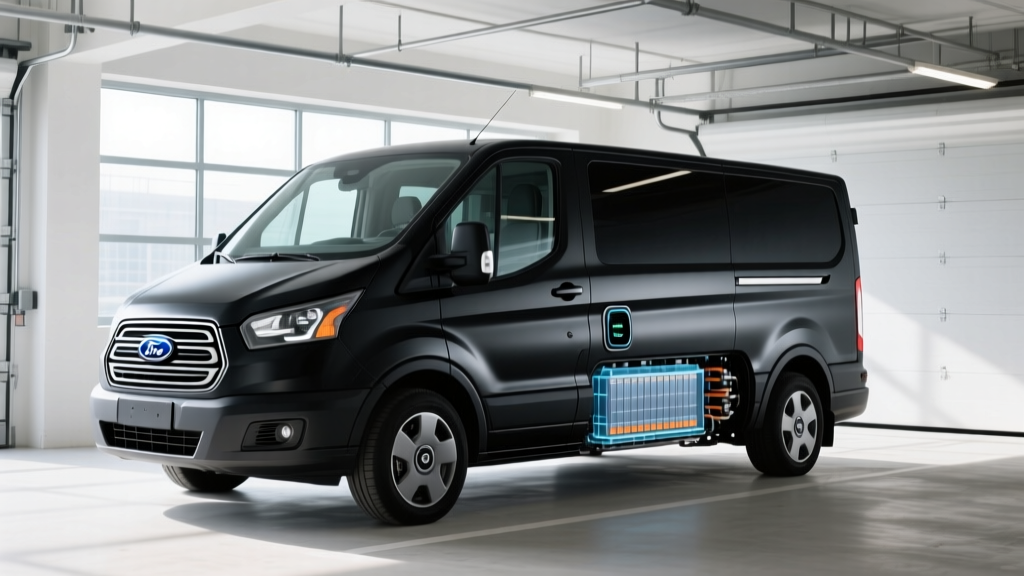
The Ford E-Transit has become a workhorse for commercial fleets and owner-operators transitioning to electric delivery vans. But the vehicle's viability over a 10- or 15-year service life hinges on one component: the high-voltage traction battery. For the extended-range variant, Ford equips the E-Transit with a 89 kWh usable lithium-ion pack using NMC (nickel-manganese-cobalt) chemistry, delivering an EPA-estimated 159 miles of range in the low-roof cargo van configuration.
That EPA figure comes with real-world caveats. Fully loaded at or near the 9,500-lb GVWR, driven at sustained highway speeds, or operated in sub-40°F temperatures, expect effective range to drop to 110–135 miles. Cold weather alone can reduce range by 15–30% due to cabin heating demands and increased internal battery resistance. Urban stop-and-go routes with frequent regenerative braking opportunities tend to yield results closer to the EPA sticker.
EPA estimate: 159 mi (low-roof cargo van)
Loaded highway driving: ~120–135 mi
Cold weather (below 32°F): ~110–130 mi
Urban delivery route (regen-heavy): ~140–155 mi
Understanding what's inside this pack, how it degrades, what the warranty actually covers, and what eventual replacement costs look like is essential before signing a purchase order — especially for fleet managers calculating total cost of ownership over 100,000+ miles.
NMC Chemistry: Why Ford Chose It for the E-Transit
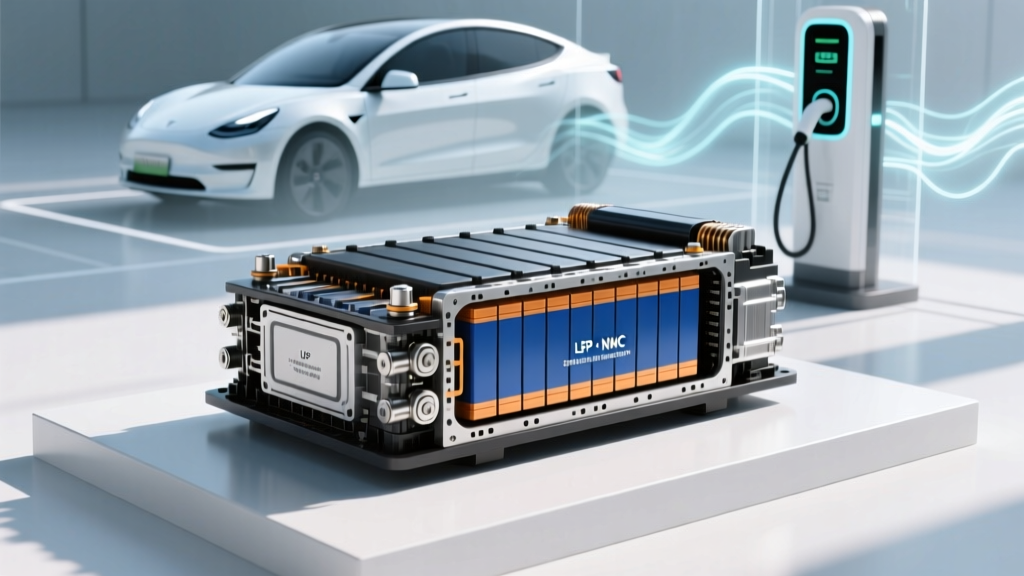
The E-Transit long range battery uses NMC (nickel-manganese-cobalt) cathode chemistry, the dominant choice for commercial EVs requiring maximum energy density in a confined package. LFP (lithium iron phosphate) has gained traction in passenger EVs — Tesla uses it in Model 3 Standard Range, and Ford itself uses LFP in the F-150 Lightning standard-range pack — but the E-Transit's packaging constraints and range requirements pushed Ford toward NMC.
Here's how the two chemistries compare across the metrics that matter for commercial van ownership:
| Attribute | NMC (E-Transit Long Range) | LFP (for reference) |
|---|---|---|
| Energy density | ~200–250 Wh/kg (cell level) | ~150–180 Wh/kg |
| Cycle life | 1,000–2,000 cycles to 80% SoH | 3,000–5,000+ cycles to 80% SoH |
| Cold-weather performance | Better low-temp discharge; preconditioning helps | More resistance below 32°F; greater range loss |
| Thermal stability | Good with active thermal management | Excellent — inherently more stable |
| Cost per kWh | Higher (~$120–140/kWh pack level) | Lower (~$80–100/kWh pack level) |
| Optimal daily SoC | 20–80% for longevity | Can charge to 100% regularly without harm |
| Best use case | Max range in limited space | Daily cycling, cost-sensitive apps |
For the E-Transit, the trade-off is clear: NMC delivers the energy density needed to push range past 150 miles in a van chassis with limited underfloor battery space. The cost is a somewhat shorter cycle life and the need for more careful state-of-charge management. Fleet operators who can charge to 80% daily and rely on depot-based Level 2 charging will see the best longevity from this chemistry.
Real-World Degradation: What the Data Shows
Battery degradation — the gradual loss of usable capacity over time — is the single biggest long-term ownership concern. For the E-Transit's NMC pack, degradation follows a pattern well-documented across the industry: an initial drop of 2–5% in the first year, followed by a slower linear decline of roughly 1–2% per year thereafter.
Based on fleet data from commercial EV operators and analysis from sources like Geotab's long-term EV battery study, here's what typical NMC degradation looks like across different mileages:
| Time / Mileage | Expected Capacity Retained | Effective Range (from 159 mi EPA) |
|---|---|---|
| Year 1 / ~15,000 mi | 95–97% | ~151–154 mi |
| Year 3 / ~45,000 mi | 91–94% | ~145–149 mi |
| Year 5 / ~75,000 mi | 87–91% | ~138–145 mi |
| Year 8 / ~120,000 mi | 82–88% | ~130–140 mi |
| Year 10 / ~150,000 mi | 78–85% | ~124–135 mi |
Note: Actual degradation varies significantly based on charging habits, climate, DC fast-charging frequency, and depth of discharge. Fleets using primarily Level 2 depot charging with 20–80% SoC windows consistently see the better end of these ranges.
One critical insight from fleet operators: DC fast charging frequency is the single biggest controllable degradation factor. Vans that DC fast charge daily (especially at 115+ kW rates) show degradation rates 1.5–2x higher than those primarily using Level 2 overnight charging. The E-Transit supports up to 115 kW peak DC fast charging, reaching 10–80% in approximately 45 minutes. That's useful for mid-day top-ups, but relying on it as the primary charging method will accelerate capacity loss.
What the Ford E-Transit Battery Warranty Actually Covers
Ford backs the E-Transit's high-voltage battery with an 8-year / 100,000-mile warranty (whichever comes first), with a capacity retention threshold of 70%. If the battery's State of Health drops below 70% of its original usable capacity within that window, Ford will repair or replace the pack at no cost.
| Coverage Item | Terms |
|---|---|
| Duration | 8 years / 100,000 miles (whichever comes first) |
| Capacity retention threshold | 70% of original usable capacity |
| What triggers a claim | SoH below 70% confirmed by Ford diagnostic tool |
| Remedy | Module-level repair or full pack replacement at Ford's discretion |
| Exclusions | Damage from accidents, flooding, unauthorized modifications; gradual degradation above 70% |
| Transferability | Yes — transfers to subsequent owners automatically |
| Electric powertrain components | 5 years / 60,000 miles (motor, inverter, onboard charger) |
The 70% threshold is significant. For the 89 kWh pack, that means a warranty claim is only valid if usable capacity drops below approximately 62.3 kWh. Based on the degradation data above, hitting this threshold within 8 years / 100,000 miles would require unusually harsh usage patterns — daily DC fast charging in extreme heat, for example, or consistently cycling the battery from 0% to 100%.
Per Ford's commercial vehicle specifications, the warranty is designed to align with typical fleet lease cycles. Most commercial vans see their first major battery service event well outside this window, if at all.
E-Transit Battery Replacement Cost: When and How Much
Let's address the concern that keeps fleet managers up at night: what happens when the battery eventually needs replacement?
First, context. The vast majority of EV batteries outlive the vehicle's useful economic life. Based on current degradation curves, an E-Transit battery retaining 78–85% capacity at 150,000 miles still provides 124–135 miles of range — sufficient for many last-mile delivery routes. Full pack replacement is rare before 200,000+ miles.
That said, here are the current cost ranges for E-Transit battery service:
| Service Type | Estimated Cost (Parts + Labor) | When Typically Needed |
|---|---|---|
| Individual module replacement (1–2 modules) | $2,500–$6,000 | If a single cell group fails; can occur at any mileage |
| Full pack replacement (OEM new) | $15,000–$22,000 | Rarely before 200,000+ mi; if SoH drops below ~60% |
| Full pack replacement (remanufactured) | $10,000–$15,000 | Emerging market option; availability growing through 2026 |
| Battery cooling system service | $800–$2,000 | Coolant flush/leak repair; part of scheduled maintenance |
| BMS (Battery Management System) diagnostics/recalibration | $300–$800 | If SoH readings seem inconsistent; dealer service |
Ford designs the E-Transit pack with modular serviceability — individual modules can be replaced rather than the entire pack. This is a meaningful cost advantage over sealed-pack designs. A fleet experiencing one degraded module at 80,000 miles faces a $3,000–$5,000 repair, not a $20,000 full-pack swap.
For perspective on total cost of ownership: a commercial van averaging 20,000 miles/year on Level 2 depot charging at $0.14/kWh spends roughly $3,500 on electricity over 8 years — versus $14,000+ on diesel for an equivalent Transit at 18 MPG and $3.80/gallon. Even factoring in a potential mid-life module replacement, the E-Transit's energy savings typically offset battery service costs several times over.
Maximizing E-Transit Battery Health: A Practical Checklist
Battery longevity isn't random — it's the result of specific, controllable habits. Here's what fleet operators and individual owners should implement from day one:
- Set charge limit to 80–90% for daily use. NMC chemistry degrades fastest at sustained 100% SoC. Use 100% only when maximum range is needed for a specific route. Ford Pro's charging management software allows fleet-level charge limit settings.
- Prioritize Level 2 (AC) charging over DC fast charging. The E-Transit's 11.4 kW onboard charger delivers a full charge in ~8 hours on a 48-amp Level 2 circuit — ideal for overnight depot charging. Reserve the 115 kW DC fast charger for mid-day emergencies or route extensions.
- Enable battery preconditioning. When navigating to a DC fast charger, the E-Transit's thermal management system pre-warms or pre-cools the pack to optimal temperature, reducing charge time and stress on cells. Always use the navigation system to route to chargers when possible.
- Avoid prolonged storage at extreme SoC. If a van will sit unused for more than a week, leave it plugged in with a 50–70% charge target. Storing at 100% or near 0% accelerates degradation.
- Minimize deep discharges. Try not to routinely run the pack below 10–15% SoC. The E-Transit has a buffer below 0% displayed, but repeatedly hitting the buffer stresses cells.
- Keep up with cooling system maintenance. The liquid thermal management system is the battery's primary defense against heat degradation. Follow Ford's coolant service intervals.
- Park in shade or covered areas in hot climates. Sustained pack temperatures above 95°F accelerate calendar degradation even when the van isn't driven.
Monitoring Battery State of Health (SoH)
Knowing your battery's current State of Health — the percentage of original capacity remaining — is essential for route planning and resale valuation. Here are the ways E-Transit owners can check SoH:
FordPass App / Ford Pro Telematics: The E-Transit's connected vehicle platform provides battery health data through the FordPass app for individual owners and Ford Pro Telematics for fleet managers. This includes current estimated range, charge status, and basic health indicators. Ford Pro's platform can flag vehicles showing accelerated degradation for dealer inspection.
Dealer Diagnostic Scan: A Ford commercial vehicle dealer can run a full BMS diagnostic that reads individual cell voltages, internal resistance, and a precise SoH percentage. Request this during routine service visits, especially before and after warranty expiration. This is the most authoritative SoH reading available.
OBD-II Diagnostic Tools: Third-party tools like OBDLink or FORScan can read BMS data from the E-Transit's CAN bus, including pack voltage, cell-level data, and estimated SoH. Fleet maintenance teams often use these for between-visit monitoring.
Range Tracking: The simplest method — track your actual range per full charge over time at consistent SoC targets. If your 80% charge consistently delivered 128 miles when new but now delivers 115 miles, that's roughly a 10% capacity loss. This isn't as precise as a BMS read but catches major trends.
Looking Ahead: Solid-State and Next-Gen Battery Tech
The battery landscape is evolving rapidly, though it's critical to separate laboratory progress from production reality for commercial vehicles.
Solid-state batteries — which replace the liquid electrolyte with a solid material for improved energy density and safety — remain in pre-production for commercial applications. Toyota, Samsung SDI, and QuantumScape have announced pilot production, but realistic availability in a commercial van platform like the E-Transit is 2030 at the earliest, more likely 2032–2035 for cost-competitive packs. These are announced and forward-looking, not available today.
Silicon-dominant anodes offer a nearer-term improvement. By replacing graphite anodes with silicon-based materials, cell-level energy density can increase 20–40% without changing cathode chemistry. Companies like Sila Nanotechnologies and Group14 are in early commercial production. An E-Transit refresh with silicon-anode NMC cells could push range past 200 miles without enlarging the pack — plausible for a mid-cycle update in the 2027–2029 timeframe, though unconfirmed by Ford.
LFP improvements continue to narrow the energy-density gap. If LFP reaches 200+ Wh/kg at the cell level — CATL and BYD are approaching this — a future E-Transit generation could switch to LFP for dramatically longer cycle life (5,000+ cycles) and lower cost, at the expense of some range or requiring a larger physical pack.
For buyers deciding today: the current NMC pack is proven technology with well-understood degradation characteristics. Waiting for next-generation chemistry means waiting 3–5+ years with no guarantee of availability in the E-Transit platform specifically.
Frequently Asked Questions
How long do EV batteries last in years and miles?
Modern NMC batteries like the one in the E-Transit typically retain 80–88% of original capacity at 8 years / 120,000 miles with reasonable care. Many EV batteries remain functional — with 75%+ capacity — past 200,000 miles. The battery doesn't "die" at a specific point; it gradually loses capacity until range becomes insufficient for the vehicle's intended use. For a delivery van with a 159-mile EPA range, even 75% retention provides ~119 miles — still viable for many urban routes.
How much does the E-Transit battery cost to replace?
A full OEM replacement pack for the 89 kWh E-Transit long range runs approximately $15,000–$22,000 including labor at 2026 pricing. However, full pack replacement is rarely needed — individual module repairs cost $2,500–$6,000 and are far more common. Remanufactured packs are emerging as a lower-cost alternative at $10,000–$15,000. Most E-Transit batteries will outlive the van's economic service life without requiring a full replacement.
What does the Ford E-Transit battery warranty cover?
Ford covers the high-voltage battery for 8 years or 100,000 miles, whichever comes first. The warranty guarantees the battery will retain at least 70% of its original usable capacity (about 62.3 kWh from the 89 kWh pack). If SoH drops below this threshold within the warranty period, Ford will repair or replace the pack. The warranty is transferable to subsequent owners and excludes damage from accidents, misuse, or unauthorized modifications.
How do I check my E-Transit's battery health?
The FordPass app and Ford Pro Telematics platform provide basic battery health data. For a precise State of Health percentage, request a BMS diagnostic scan at a Ford commercial vehicle dealer. Third-party OBD-II tools like FORScan can also read battery data between dealer visits. Tracking your actual range per charge over time provides a simple trend indicator.
Is LFP or NMC better for a commercial van?
It depends on the application. NMC offers higher energy density, meaning more range in a smaller, lighter pack — critical for the E-Transit's packaging constraints and 159-mile range target. LFP offers dramatically longer cycle life (3–5x more cycles), better thermal safety, and lower cost, but its lower energy density would require a larger, heavier pack for the same range. For a van with fixed battery space and range requirements, NMC is the practical choice today. If your routes are short and you charge daily, an LFP-equipped vehicle (like the F-150 Lightning standard range) may offer longer battery life.
Does fast charging damage the E-Transit battery?
Occasional DC fast charging is fine — the E-Transit's thermal management system actively cools the pack during high-power sessions. However, daily DC fast charging at 115 kW accelerates degradation compared to Level 2 AC charging. Fleet data suggests vehicles that primarily DC fast charge lose capacity 1.5–2x faster than those using overnight Level 2 charging. For fleet operations, installing depot Level 2 chargers (the E-Transit's 11.4 kW onboard charger adds roughly 30 miles per hour of charging) is the single most impactful investment for battery longevity.
Will the E-Transit battery qualify for the federal tax credit?
The E-Transit's eligibility for the IRS §30D Clean Vehicle Credit depends on current-year rules including MSRP caps (vans: up to $80,000), buyer income limits, and battery component/critical mineral sourcing requirements. The commercial vehicle credit (§45W) may also apply for business purchases. Tax credit rules change frequently — consult a tax professional and verify current eligibility on irs.gov before purchasing.
Sources: EPA range data via fueleconomy.gov, Ford commercial vehicle specifications via ford.com, IRS Clean Vehicle Credit rules via irs.gov. Degradation estimates based on published fleet studies and industry data. All pricing is approximate and subject to change.