For Tesla owners and prospective buyers, one question consistently dominates forums and Reddit threads: does frequent DC fast charging actually harm the battery pack? The short answer is yes — but the degree matters far more than the binary. A 2024 study by Geotab analyzing over 10,000 EVs found that vehicles DC fast-charged more than three times per week showed an average annual degradation rate of roughly 2.3%, compared to about 1.5% for those primarily using Level 2 AC charging. For Tesla specifically, the company's own fleet data shows Model 3 and Model Y packs retaining approximately 85-90% of original capacity after 150,000 miles — well within warranty thresholds.
But degradation is not solely a Supercharging story. Battery chemistry, thermal management, state-of-charge habits, and ambient climate all play critical roles. This guide breaks down exactly what the data says, how Tesla's LFP and NMC/NCA packs compare, what the warranty actually covers, and when — or if — you'll face a replacement bill.
Tesla's Two Battery Chemistries: LFP vs. NMC/NCA
Tesla currently uses two distinct lithium-ion chemistries across its lineup, and understanding which pack is in your vehicle is the single most important factor in predicting long-term degradation behavior.
NMC/NCA (Nickel Manganese Cobalt / Nickel Cobalt Aluminum) packs power the Long Range and Performance variants of the Model 3, Model Y, Model S, and Model X. These cells — primarily supplied by Panasonic (2170 and 4680 formats) — prioritize energy density, enabling the 330+ mile EPA ranges buyers expect.
LFP (Lithium Iron Phosphate) packs are used in the base Model 3 Rear-Wheel Drive and base Model Y. Supplied primarily by CATL, these prismatic cells sacrifice some energy density for dramatically longer cycle life and lower cost. Tesla recommends LFP owners charge to 100% regularly — the opposite of NMC guidance.
| Attribute | NMC/NCA (Long Range/Performance) | LFP (Base RWD) |
|---|---|---|
| Energy Density | ~260 Wh/kg (higher range per kWh) | ~170 Wh/kg (lower range per kWh) |
| Typical Usable Capacity | 75–82 kWh (Model 3/Y LR) | 57–60 kWh (Model 3 RWD) |
| Cycle Life | ~1,000–1,500 full cycles to 80% SoH | ~3,000–5,000 full cycles to 80% SoH |
| Recommended Daily SoC | 80% (per Tesla app) | 100% (per Tesla app) |
| Cold-Weather Performance | Better low-temp discharge capability | More range loss below 32°F; preconditioning critical |
| Cost to Manufacturer | Higher (cobalt/nickel commodity exposure) | Lower (iron/phosphate abundant) |
| Supercharging Sensitivity | Moderate — heat accelerates cathode wear | Lower — LFP structurally more stable under high C-rates |
The trade-off is straightforward: NMC gives you more range today; LFP gives you more calendar life tomorrow. If you're a high-mileage driver who Supercharges frequently, an LFP-equipped base Model 3 may paradoxically age more gracefully than a Long Range variant — even though the Long Range starts with more range to lose.
What the Degradation Data Actually Shows
Tesla publishes fleet-wide degradation curves in its annual Impact Report. The most recent data available indicates the following average capacity retention for Model 3 and Model Y vehicles:
- 50,000 miles: ~95–97% remaining capacity
- 100,000 miles: ~90–93% remaining capacity
- 150,000 miles: ~85–90% remaining capacity
- 200,000 miles: ~80–87% remaining capacity
Model S and Model X data shows slightly steeper curves — approximately 2–3% more loss at equivalent mileage — due to heavier vehicles generating more thermal stress during charge and discharge cycles.
Key observation from fleet data: Degradation is not linear. Most capacity loss occurs in the first 20,000–30,000 miles (an initial "formation" loss of 3–5%), after which the curve flattens considerably. A pack that retains 94% at 30,000 miles is statistically likely to retain 88–90% at 150,000 miles. This non-linear pattern means early-care Supercharging habits matter less than many owners fear — but sustained high-heat exposure over years compounds.
Independent testing by Recurrent Auto, which tracks over 15,000 EVs via telematics, corroborates these figures and adds an important variable: climate. Teslas in hot climates (Arizona, Texas, Southern California) show 1–2% more degradation at 100,000 miles than those in temperate Pacific Northwest or Northeast corridors, even when Supercharging frequency is equivalent. Tesla's liquid-cooled thermal management system mitigates this significantly compared to passively cooled packs, but physics still applies — sustained 110°F ambient temperatures stress cathode structures during 250 kW Supercharging sessions.
Does Supercharging Specifically Accelerate Wear?
DC fast charging at Tesla Superchargers — which currently deliver up to 250 kW at V3 stalls and up to 325 kW at newer V4 stalls — generates significant internal cell heat. At a 250 kW peak rate, a 75 kWh NMC pack is charging at roughly a 3.3C rate, meaning the entire battery capacity is theoretically being filled in about 18 minutes. In practice, Tesla's charge curve tapers aggressively above 60% SoC specifically to manage this thermal load.
The degradation mechanism is well-documented in battery science: high C-rate charging accelerates lithium plating on the anode, increases solid electrolyte interphase (SEI) layer growth, and causes micro-cracking in NMC cathode particles. LFP's olivine crystal structure is inherently more resistant to these failure modes, which is why LFP packs tolerate frequent Supercharging better.
However, context matters enormously:
- Occasional Supercharging (1–2x/week for road trips): Negligible incremental degradation vs. Level 2 charging.
- Frequent Supercharging (daily or near-daily): Measurable but modest — expect roughly 0.5–1.0% additional annual loss compared to exclusive Level 2 use.
- Supercharging to 100% regularly on NMC packs: This is where the real damage occurs. High SoC + high temperature + high charge rate is the worst-case combination. Tesla's own recommendation to limit daily NMC charging to 80% exists for this reason.
For LFP owners, the calculus is different. Because Tesla recommends charging LFP packs to 100% at least once per week for battery management system (BMS) calibration, and because LFP chemistry is structurally more resilient, frequent Supercharging to full is less concerning — though not entirely consequence-free.
Tesla Battery Warranty: What's Actually Covered
Tesla's battery warranty is one of the stronger guarantees in the EV industry, but its specifics are frequently misunderstood. The warranty covers the high-voltage traction battery — not the 12V auxiliary battery — against defects and excessive capacity loss.
| Model / Variant | Warranty Period | Mileage Limit | Minimum Capacity Retention |
|---|---|---|---|
| Model 3 RWD (LFP) | 8 years | 100,000 miles | 70% |
| Model 3 Long Range / Performance | 8 years | 120,000 miles | 70% |
| Model Y (all variants) | 8 years | 120,000 miles | 70% |
| Model S / Model X | 8 years | 150,000 miles | 70% |
The 70% threshold is critical. If your 82 kWh Long Range pack drops below 57.4 kWh of usable capacity within 8 years or 120,000 miles (whichever comes first), Tesla will repair or replace it at no cost. In practice, based on the fleet data above, the vast majority of Teslas never approach this threshold during the warranty period. A Model 3 Long Range at 120,000 miles typically retains 88–92% capacity — well above the 70% floor.
What the warranty does not cover: cosmetic issues, damage from accidents or flooding, modifications to the battery system, or degradation from using non-Tesla charging equipment that causes damage (though standard CCS/NACS adapters are fine). The warranty is also transferable to subsequent owners, which supports Tesla resale values.
EV Battery Replacement Cost: When and How Much
Here's the number that generates the most anxiety — and the most misinformation. Let's ground it in reality.
| Model | Battery Size | Estimated Replacement Cost (2026) | Typical Replacement Trigger |
|---|---|---|---|
| Model 3 RWD (LFP) | ~57–60 kWh | $10,000–$13,000 | Rarely needed; LFP cycle life often exceeds vehicle life |
| Model 3/Y Long Range | ~75–82 kWh | $13,000–$16,000 | Typically 200,000+ miles or 15+ years if at all |
| Model S / Model X | ~90–100 kWh | $18,000–$22,000 | Higher-mileage fleet vehicles; older 85 kWh packs more prone |
These figures include the battery pack and labor but assume Tesla service center pricing. Independent EV shops may offer refurbished pack replacements for 20–30% less. Critically, most EV batteries outlive the vehicles they're installed in. The average age of a scrapped passenger vehicle in the US is roughly 15 years; based on current degradation curves, a Tesla battery at 15 years and 180,000 miles will likely still retain 78–85% capacity — functional for daily driving even if range is reduced.
Full pack replacement is typically only necessary when individual module failures cascade (rare in modern packs) or when capacity drops below 65–70% and the owner needs original range. Module-level repairs — replacing individual cell groups rather than the entire pack — are increasingly available and cost $3,000–$6,000 depending on the failure.
Factors That Actually Determine Battery Longevity
Supercharging is one variable among many. Here's the hierarchy of degradation factors, ranked by impact based on current battery science:
- Sustained high State of Charge (NMC): Storing an NMC pack at 100% for days or weeks — especially in heat — causes more degradation than hundreds of Supercharging sessions. This is why Tesla defaults daily charge limits to 80%.
- Extreme heat exposure: Ambient temperatures above 95°F combined with high SoC accelerate electrolyte decomposition. Garage parking in hot climates measurably extends pack life.
- Deep discharge cycles: Regularly draining below 10% SoC stresses the anode. The BMS maintains a bottom buffer, but repeatedly hitting the buffer threshold is not ideal.
- DC fast charging frequency: Moderate impact — roughly 0.5–1% additional annual loss for daily Superchargers vs. L2-only users.
- Cold-weather charging without preconditioning: Charging a frozen NMC pack at high kW causes lithium plating. Tesla's navigation-based battery preconditioning (which warms the pack when you navigate to a Supercharger) exists specifically to prevent this.
Practical Battery Care Checklist
- Set daily charge limit to 80% for NMC; 100% for LFP
- Enable Tesla's battery preconditioning by navigating to Superchargers (don't just drive to one)
- Avoid leaving the car at 100% SoC for more than a few hours — schedule charges to finish right before departure
- In extreme heat, park in shade or a garage when possible
- Don't stress about occasional 100% charges for road trips — it's sustained storage at 100% that matters
- Use Scheduled Departure to precondition the battery and cabin while plugged in at home
- Check tire pressure regularly — underinflated tires increase energy draw and heat generation
How to Monitor Your Tesla's Battery Health
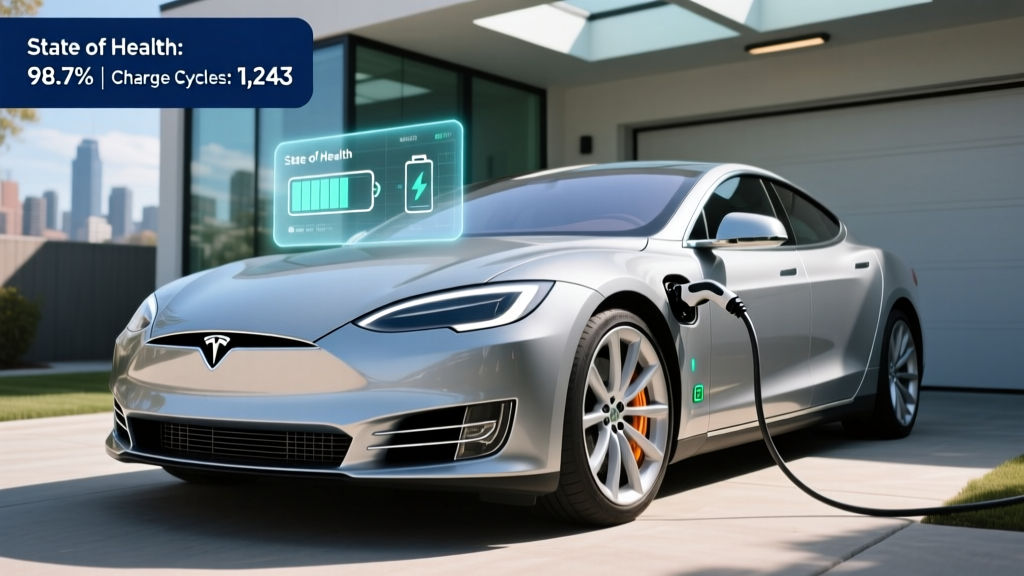
Tesla does not expose a direct State of Health (SoH) percentage in the vehicle's touchscreen or app — unlike some competitors such as Hyundai's Bluelink or Nissan's Leaf battery health bars. However, there are several reliable methods to track degradation:
Method 1: Energy screen range tracking. Charge to 100% (or your known max SoC) and note the displayed rated range. Compare this to the original EPA-rated range for your model. A 2025 Model 3 Long Range originally rated at 341 miles that shows 310 miles at 100% has roughly 91% SoH. Note that displayed range is an estimate based on recent consumption — it can fluctuate with driving style and temperature.
Method 2: Third-party telemetry apps. Services like TeslaFi, Tessie, and Stats log charge session data over time and calculate SoH by comparing energy added during known SoC intervals to the pack's original capacity. These tools are more accurate than the in-car display because they average across multiple data points.
Method 3: Service center diagnostic. Tesla service can run a full pack diagnostic that reads individual module voltages, internal resistance, and calculated SoH. This is the most authoritative reading and is typically performed during warranty claims or pre-purchase inspections on used Teslas.
Looking Ahead: Solid-State and Silicon Anode Batteries
Next-generation battery technologies promise step-change improvements in energy density and longevity — but realistic timelines matter for purchase decisions today.
Solid-state batteries replace the liquid electrolyte with a solid ceramic or polymer layer, potentially doubling energy density and virtually eliminating thermal runaway risk. Toyota, Samsung SDI, and QuantumScape have demonstrated prototype cells, but mass production at automotive scale remains years away. Current industry consensus places commercial solid-state EV availability at 2028–2030 at the earliest, with initial deployment likely in premium vehicles at significant cost premiums. Tesla has not announced a solid-state roadmap and continues investing heavily in 4680-format NMC and LFP cells.
Silicon anode technology — which replaces graphite anodes with silicon to increase lithium-ion storage capacity — is closer to market. Companies like Sila Nanotechnologies and Group14 are already supplying silicon-dominant anode materials to battery manufacturers. Expect incremental adoption in 2026–2028 model-year EVs, offering 10–20% energy density improvement rather than revolutionary leaps. Tesla's 4680 cells already incorporate some silicon in the anode.
Neither technology changes the purchase calculus for a 2026 Tesla buyer. Current LFP and NMC packs, properly maintained, will outlast most ownership periods. Waiting for solid-state means waiting at least 3–5 years for limited, expensive availability.
Frequently Asked Questions
How long do Tesla batteries last in years and miles?
Based on Tesla's fleet data and independent tracking by Recurrent Auto, the average Model 3 or Model Y battery retains 85–90% of original capacity at 150,000 miles (roughly 10–12 years for average drivers). Many packs reach 200,000+ miles before dropping below the 70% warranty threshold. Full replacement during normal ownership is uncommon.
How much does a Tesla battery cost to replace in 2026?
Replacement costs range from approximately $10,000–$13,000 for a Model 3 RWD (LFP) to $18,000–$22,000 for a Model S/X. Model 3/Y Long Range packs typically cost $13,000–$16,000. These figures include labor at Tesla service centers. Module-level repairs are cheaper ($3,000–$6,000) when applicable. Most packs never require full replacement during the vehicle's usable life.
What does the Tesla battery warranty cover?
Tesla covers the high-voltage traction battery for 8 years and 100,000–150,000 miles (depending on model) against defects and capacity loss below 70% of original. The 12V auxiliary battery is covered under a separate, shorter warranty. The warranty transfers to subsequent owners. Damage from accidents, flooding, or unauthorized modifications is excluded.
How do I check my Tesla's battery State of Health?
Tesla does not display a direct SoH percentage. You can estimate it by comparing your 100% charge rated range to the original EPA figure, use third-party apps like TeslaFi or Tessie for more precise tracking over multiple charge cycles, or request a full diagnostic from a Tesla service center.
LFP vs. NMC: which Tesla battery is better?
It depends on your priorities. LFP (in base Model 3 RWD) offers longer cycle life (3,000–5,000 cycles vs. 1,000–1,500), lower cost, and greater tolerance for daily 100% charging and frequent Supercharging — but delivers less range per kWh and worse cold-weather performance. NMC (in Long Range/Performance models) gives you 50–80 more miles of EPA range and better cold-weather usability, but requires more careful SoC management (80% daily limit) and shows slightly faster long-term degradation. For high-mileage Supercharger-dependent drivers, LFP may age better. For maximum range and all-weather capability, NMC wins.
Is it okay to Supercharge my Tesla every day?
Yes — with caveats. Daily Supercharging adds roughly 0.5–1% more annual degradation compared to Level 2 home charging. Over 8 years, this might mean the difference between 88% and 85% remaining capacity. If you have home Level 2 access, using it for daily needs and Supercharging for road trips is optimal. If you rely exclusively on Superchargers, your pack will still likely retain 83–87% capacity at the warranty mileage limit — well above the 70% threshold.
Does charging to 100% at Superchargers damage the battery?
For NMC packs, regularly charging to 100% — especially at high kW and in hot weather — accelerates cathode degradation. For occasional road trips where you need full range, it's fine. For daily use, stick to 80%. For LFP packs, Tesla recommends charging to 100% at least weekly, so Supercharging to full on LFP is within design parameters.