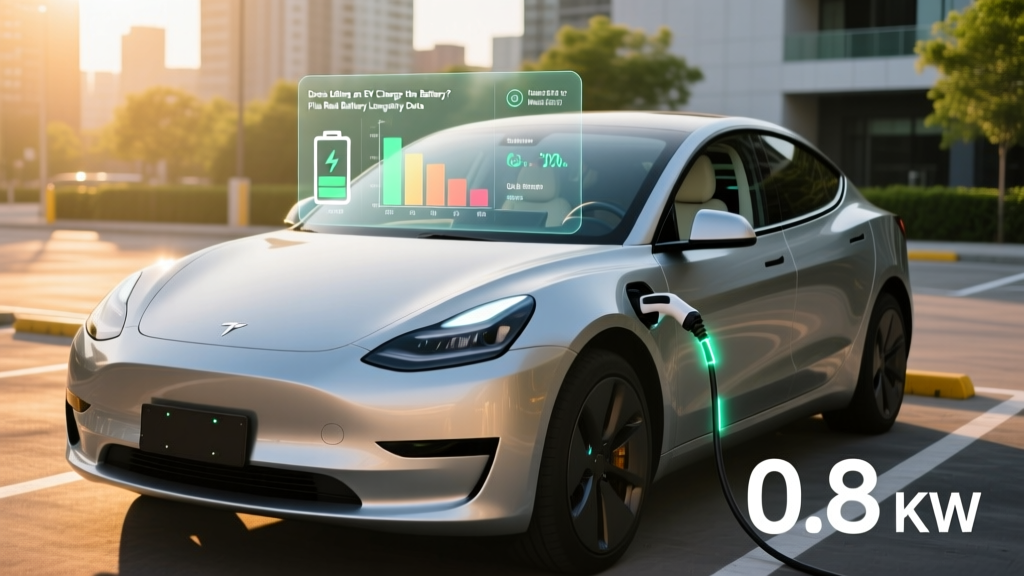
A common question from drivers transitioning from gas to electric is whether idling an EV charges the battery — a habit born from the gas-car world where the alternator tops off the 12V battery whenever the engine runs. The short answer is no, idling an EV does not meaningfully charge the high-voltage traction battery. But understanding why reveals a lot about how EV batteries actually work, how long they last, and what you can do to maximize their lifespan.
This guide goes well beyond the idling question. We break down real degradation data, compare LFP and NMC/NCA chemistries, explain warranty coverage in plain terms, and give you a concrete framework for monitoring and extending battery health. Whether you're shopping for a new EV in 2026 or five years into ownership, these are the numbers that matter.
Does Idling an EV Charge the Battery? The Physics Explained
In a conventional gas car, idling keeps the engine spinning, which turns the alternator, which charges the 12V auxiliary battery. That system has no equivalent in an EV's high-voltage architecture. Here's what actually happens when an EV is "on" but stationary:
- The traction battery is not being charged. Energy only flows into the high-voltage pack from an external source (Level 1, Level 2, or DC fast charger) or through regenerative braking when the vehicle is decelerating.
- The vehicle is consuming energy, not generating it. Climate control, seat heaters, infotainment, and battery thermal management all draw from the traction battery while parked. A Tesla Model Y, for example, can use 1–3 kW just maintaining cabin temperature in cold weather while stationary.
- The 12V auxiliary battery is being maintained by a DC-DC converter that steps down high-voltage pack energy. So idling an EV actually drains the traction battery slightly to keep the 12V system alive — the opposite of what happens in a gas car.
The one scenario where a stationary EV gains range is during preconditioning while plugged in. If your EV is connected to a Level 2 charger and you activate battery preconditioning, the charger supplies energy to warm the pack and cabin — effectively preserving range you'd otherwise use on the road. But that's charging from the grid, not from idling.
How Long Do EV Batteries Actually Last? Real Degradation Data
EV battery longevity is measured in two ways: calendar age (years) and cycle count (full charge-discharge equivalents). Most modern EV batteries are engineered to outlast the vehicle's practical lifespan, but they do lose capacity gradually. Here's what the data shows:
| Vehicle / Source | Mileage | Timeframe | Capacity Retained | Notes |
|---|---|---|---|---|
| Tesla Model S/X (2013–2020 fleet data) | 150,000 mi | ~7–9 years | ~88–90% | NMC/NCA; mostly home-charged |
| Tesla Model 3/Y (LFP variants) | 100,000 mi | ~3–4 years | ~94–96% | LFP chemistry; frequent 100% SoC |
| Nissan Leaf (2013–2017, air-cooled) | 80,000 mi | ~6–8 years | ~75–82% | No active thermal management; hot climates worst |
| Chevrolet Bolt EV/EUV (NMC) | 100,000 mi | ~4–5 years | ~90–93% | Liquid-cooled; conservative charge buffer |
| Hyundai Ioniq 5 / Kia EV6 (NMC) | 60,000 mi | ~2–3 years | ~95–97% | 800V architecture; strong thermal management |
The pattern is clear: modern liquid-cooled packs with active thermal management lose roughly 5–10% capacity over 100,000–150,000 miles. Earlier EVs without liquid cooling (notably early Nissan Leafs) degraded significantly faster, especially in hot climates. The chemistry itself matters enormously — which brings us to the LFP vs. NMC comparison.
LFP vs NMC/NCA: Which Battery Chemistry Is Better?
Two lithium-ion chemistries dominate the 2026 EV market: LFP (lithium iron phosphate) and NMC/NCA (nickel manganese cobalt / nickel cobalt aluminum). Each has distinct trade-offs, and the "better" choice depends entirely on your driving pattern.
| Attribute | LFP (Lithium Iron Phosphate) | NMC / NCA (Nickel-Based) |
|---|---|---|
| Energy Density | Lower (~160–180 Wh/kg cell-level) | Higher (~220–260 Wh/kg cell-level) |
| Cycle Life | 3,000–5,000+ cycles to 80% SoH | 1,000–2,000 cycles to 80% SoH |
| Cold-Weather Performance | Weaker; more range loss below 32°F | Better low-temp discharge and charging |
| Charging to 100% | Recommended regularly; no penalty | Best kept at 80% daily; 100% for trips only |
| Cost | Lower ($100–120/kWh pack-level, 2026) | Higher ($130–160/kWh pack-level, 2026) |
| Thermal Stability | Excellent; higher runaway threshold | Good with active management; lower threshold |
| Common In (2026 US Models) | Tesla Model 3/Y RWD, standard-range Ford, some BYD | Long-range/performance variants, Hyundai/Kia, GM Ultium, Rivian |
The practical takeaway: If you charge at home daily and want maximum longevity with minimal babysitting, LFP is the easier chemistry to live with — charge it to 100% every night and don't worry. If you need maximum range per charge, tow frequently, or live in a cold climate, NMC/NCA's higher energy density and better cold performance make it the better fit — just follow the 80% daily charge guideline.
What Does the EV Battery Warranty Actually Cover?
Federal law mandates that EV batteries carry a minimum warranty of 8 years / 100,000 miles (10 years / 150,000 miles in California Air Resources Board states). But the details vary by automaker, and the capacity-retention threshold is where the real story lives.
| Automaker | Coverage Period | Capacity Threshold | What Triggers a Claim |
|---|---|---|---|
| Tesla | 8 yr / 100,000–150,000 mi (varies by model) | 70% retention | Pack falls below 70% of original usable capacity |
| Hyundai / Kia | 10 yr / 100,000 mi | 70% retention | Measured via dealer diagnostic tool |
| GM (Ultium platform) | 8 yr / 100,000 mi | 60–70% (varies by model) | Capacity below threshold under normal use |
| Ford | 8 yr / 100,000 mi | 70% retention | Pack capacity below 70% as measured by Ford |
| Rivian | 8 yr / 175,000 mi | 70% retention | Notable for higher mileage cap |
A critical nuance: the warranty covers capacity degradation below the threshold, not gradual range loss you simply notice over time. If your pack retains 72% capacity at year 7, you won't qualify for a warranty replacement — even though you've lost nearly 30% of your original range. Most automakers will repair or replace individual modules rather than the entire pack, which is a more cost-effective approach for them and minimizes vehicle downtime for you.
For full warranty terms on your specific vehicle, always check the official warranty booklet from the manufacturer and consult fueleconomy.gov for EPA-rated range and efficiency data by model year.
How Much Does an EV Battery Replacement Cost?
This is the question that generates the most anxiety — and the most misinformation. Let's ground it in real numbers.
| Vehicle | Pack Size (kWh) | Full Pack Replacement (Parts + Labor) | Module-Level Repair |
|---|---|---|---|
| Tesla Model 3 RWD (LFP) | ~60 kWh | $8,000–$12,000 | $2,000–$4,000 |
| Tesla Model Y LR (NMC) | ~75 kWh | $12,000–$16,000 | $3,000–$5,000 |
| Ford Mustang Mach-E | 70–91 kWh | $14,000–$20,000 | $3,500–$6,000 |
| Hyundai Ioniq 5 / Kia EV6 | 58–77.4 kWh | $10,000–$18,000 | $2,500–$5,500 |
| Chevrolet Equinox EV / Blazer EV | 85–102 kWh | $15,000–$22,000 | $3,000–$6,500 |
| Rivian R1T / R1S | ~106–149 kWh | $18,000–$28,000 | $4,000–$8,000 |
Context that matters: The vast majority of EV batteries never need replacement. Data aggregated from fleet sources shows that fewer than 2–3% of modern liquid-cooled packs require full replacement within the warranty period. Most packs retain 85–90%+ capacity at 150,000 miles. The replacement costs above apply primarily to out-of-warranty scenarios, accident damage, or rare manufacturing defects in older vehicles.
Module-level repair is increasingly common: if one cell group within a multi-module pack fails, a qualified EV technician can replace just that module for a fraction of a full-pack swap. This is analogous to replacing a single fuel injector rather than an entire fuel system.
Factors That Accelerate (or Slow) Battery Degradation
Battery chemistry sets the ceiling, but your habits determine where you land within that range. Here are the five biggest factors, ranked by impact:
Battery Care Checklist: Maximize Your Pack's Lifespan
1. Minimize time at extreme State of Charge (SoC)
For NMC/NCA packs, avoid sitting at 100% SoC for extended periods. Set your daily charge limit to 80% and only charge to 100% when you're about to drive a long trip. LFP packs are the exception — manufacturers like Tesla recommend charging to 100% at least weekly to maintain cell balancing accuracy.
2. Reduce DC fast-charging frequency
Occasional DC fast charging (50–250 kW) is fine, but making it your daily routine accelerates degradation. Research from NREL and fleet data suggest that packs charged primarily on Level 2 (7–19 kW AC) degrade 1–3% less over 100,000 miles compared to packs charged predominantly on DC fast chargers. Use DC fast charging for road trips; rely on Level 2 at home for daily needs.
3. Manage temperature extremes
Batteries degrade fastest when hot (>95°F ambient) and when charged hard while cold (<32°F). Always use your EV's preconditioning feature before fast charging in cold weather — this warms the pack to its optimal charging temperature (~77–95°F). In hot climates, park in shade or a garage when possible and avoid repeated high-speed driving followed immediately by fast charging.
4. Avoid deep discharges
Regularly running the pack down to 0% (or very near it) stresses lithium-ion cells. Try to keep your SoC between 20% and 80% for NMC/NCA, or 10% and 100% for LFP. The battery management system (BMS) maintains a hidden buffer (typically 3–5 kWh) above and below the displayed 0–100%, but you still want to avoid routinely hitting the displayed limits.
5. Drive smoothly when possible
Aggressive acceleration and sustained high-speed driving (>85 mph) generate more heat in the pack. Occasional hard acceleration is fine — EVs are built for it — but sustained high-load driving in hot weather without adequate cooling intervals adds thermal stress over time.
How to Check Your EV's Battery State of Health (SoH)
State of Health (SoH) is the percentage of original capacity your battery can still hold. A brand-new pack is 100% SoH; a pack that held 75 kWh when new but now holds 67.5 kWh is at 90% SoH. Here's how to monitor it:
- In-vehicle displays: Some EVs (notably Tesla, Rivian, and newer Hyundai/Kia models) show a battery health estimate in the settings menu or service screen. Tesla's "Battery Health" test, accessible via the service menu, runs a diagnostic cycle and reports a percentage.
- OBD-II dongles and apps: Tools like OBDLink SX paired with apps such as EVNotify, Leaf Spy (for Nissan Leaf), or Scan My Tesla can read the BMS-reported SoH directly. These typically cost $30–60 for the hardware plus a free or low-cost app.
- Dealer diagnostics: Any authorized dealer can run a battery health check. This is the measurement that matters for warranty claims. Request one annually or before a long road trip for peace of mind.
- Charging-based estimation: If you know your pack's original usable capacity (e.g., 75 kWh) and you track how many kWh it takes to charge from a known SoC to another (e.g., 10% to 90%), you can estimate current capacity. Apps like Teslalogger or ABRP (A Better Route Planner) log this data automatically over time.
For NHTSA safety and recall information related to battery systems, check nhtsa.gov — battery-related recalls (such as the Chevrolet Bolt fire-risk recall of 2021–2022) are listed there with VIN lookup tools.
What's Next? Solid-State and Silicon-Anode Batteries
Two technologies are often cited as the future of EV batteries. Here's where they actually stand as of 2026:
Solid-state batteries replace the liquid electrolyte with a solid material (ceramic, sulfide, or polymer), promising higher energy density (~400–500 Wh/kg cell-level), faster charging, and improved safety. Toyota has announced a solid-state EV for limited production around 2027–2028, and QuantumScape is supplying prototype cells to Volkswagen. However, no solid-state EV is currently available for purchase in the US market. Manufacturing scale, cost (currently 2–4x conventional lithium-ion), and cycle-life durability remain unsolved challenges for mass production.
Silicon-anode batteries replace the graphite anode with silicon, which can store roughly 10x more lithium ions per gram. Companies like Sila Nanotechnologies and Group14 are already supplying silicon-composite anode materials to manufacturers. The Mercedes-Benz G-Class EV (announced) targets silicon-anode cells for higher energy density. Expect incremental adoption starting in 2026–2028 premium models, with broader availability by 2030. Silicon anodes improve energy density but don't fundamentally change the charging or longevity equation for consumers.
Realistic timeline: Neither technology will affect the buying decision for a 2026 EV shopper. Today's lithium-ion packs — both LFP and NMC — are mature, well-understood, and demonstrably long-lasting. Waiting for solid-state is not a practical strategy unless your purchase is 3–5 years out.
Frequently Asked Questions
Does idling a gas car charge its battery, and does the same apply to EVs?
Yes, idling a gas car charges the 12V battery via the alternator. No, this does not apply to EVs. An EV's high-voltage traction battery only charges from an external power source (plug) or through regenerative braking while decelerating. Idling an EV actually consumes a small amount of traction battery energy to power climate control and the DC-DC converter that maintains the 12V system.
How long do EV batteries last in years and miles?
Based on fleet data, modern liquid-cooled EV batteries typically retain 85–93% of their original capacity at 100,000–150,000 miles (roughly 8–12 years of average driving). LFP chemistries generally show even lower degradation. Most packs will outlast the vehicle's practical economic life. Complete battery failure within the first 150,000 miles is rare — fewer than 2–3% of modern packs require replacement under warranty.
How much does it cost to replace an EV battery?
Full pack replacement ranges from approximately $8,000 for a smaller LFP pack (Tesla Model 3 RWD) to $28,000 for a large pack (Rivian R1T Max). Module-level repairs are far more common and cost $2,000–$8,000 depending on the vehicle. However, most EV batteries never need replacement — this cost applies primarily to out-of-warranty scenarios or accident damage.
What does the EV battery warranty cover?
Federal minimum is 8 years / 100,000 miles (10/150,000 in CARB states). The warranty covers capacity loss below a specified threshold — typically 70% of original capacity. If your battery degrades to 68% capacity within the warranty period, the manufacturer will repair or replace it. Normal gradual degradation above the threshold is not covered.
LFP vs NMC — which battery chemistry should I choose?
Choose LFP if you want simpler daily habits (charge to 100% freely), maximum cycle life, lower cost, and you don't need the absolute longest range. Choose NMC/NCA if you need maximum range per charge, better cold-weather performance, or frequent towing. Both chemistries are proven and long-lasting with proper care.
Can I check my EV battery health myself?
Yes. Many EVs display a battery health estimate in the settings or service menu. You can also use an OBD-II dongle with apps like Scan My Tesla, Leaf Spy, or EVNotify to read BMS-reported State of Health (SoH). For the most authoritative measurement — especially for warranty purposes — request a diagnostic check from your dealer.
Does frequent DC fast charging damage my battery?
It accelerates degradation modestly but does not "damage" the battery in the catastrophic sense. Fleet data suggests packs charged primarily on DC fast chargers lose 1–3% more capacity over 100,000 miles compared to packs charged mainly on Level 2. Use DC fast charging when you need it (road trips, apartment dwellers without home charging), but default to Level 2 for daily charging when possible.