If you own or maintain a 2008 Dodge Grand Caravan, battery replacement is a familiar rite of ownership. The minivan's 12-volt lead-acid battery typically needs swapping every 3–5 years at a cost of $150–$250 installed. But as Chrysler's parent company Stellantis pivots toward electrification — and as used EVs increasingly compete with aging minivans in the family-hauler segment — understanding how modern EV traction batteries compare to that familiar 12V swap is more relevant than ever.
This guide bridges that gap. We'll cover what you need to know about the 2008 Grand Caravan's battery, then dive deep into the high-voltage lithium-ion packs that power today's electric vehicles: their chemistry, degradation behavior, warranty coverage, real replacement costs, and what emerging tech like solid-state cells might mean down the road.
The 2008 Dodge Grand Caravan Battery: What You're Replacing
The 2008 Dodge Grand Caravan uses a conventional Group 34 or Group 24F 12-volt lead-acid battery, depending on engine configuration (the 3.3L V6 and 3.8L V6 both use similar sizing). Here's what typical replacement looks like:
- Battery type: Flooded lead-acid or AGM (absorbent glass mat)
- CCA (Cold Cranking Amps): 600–700 CCA recommended
- Typical lifespan: 3–5 years (shorter in hot climates)
- Replacement cost: $120–$250 for the battery; $150–$300 installed at a shop
- Warranty: Typically 2–3 years free replacement, prorated to 5 years
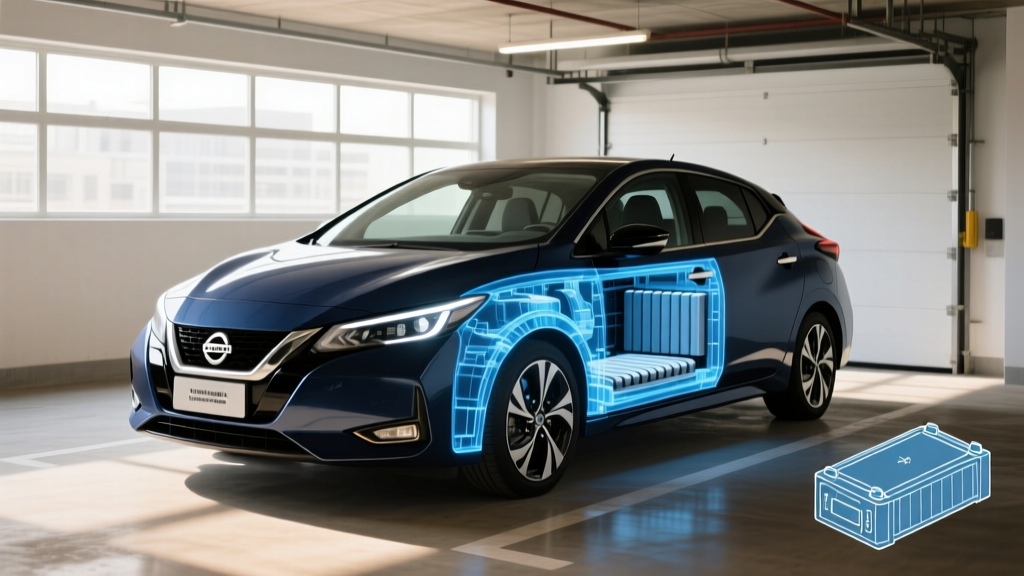
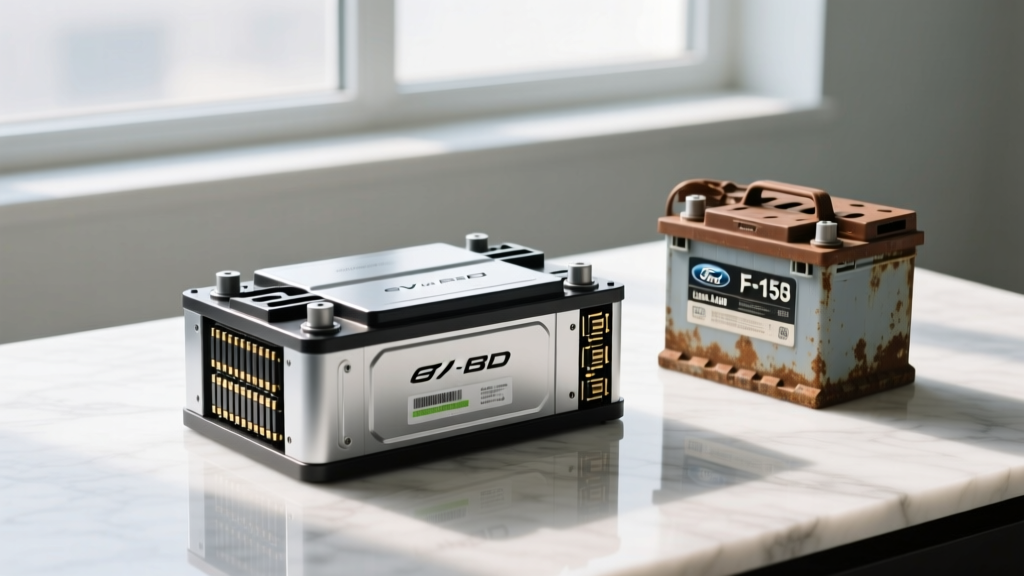
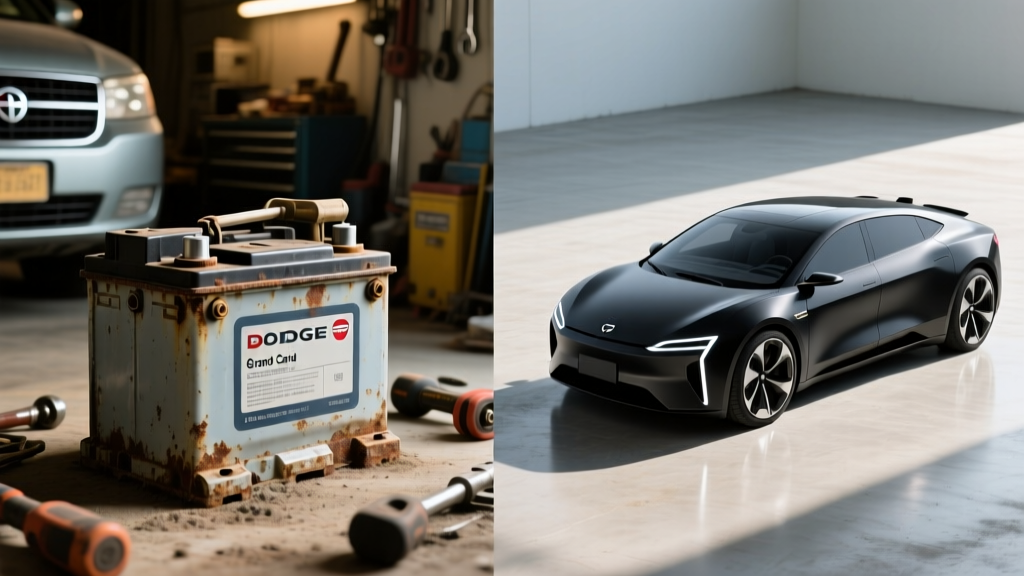
This is a starting battery — its job is to crank the engine and run accessories when the alternator isn't generating power. It is fundamentally different from the high-voltage traction battery in an electric vehicle, which stores tens of kilowatt-hours (kWh) of energy to propel the vehicle. Confusing these two is one of the most common mistakes in EV discussions.
EV Battery Chemistry: LFP vs NMC vs NCA
Modern EV traction batteries use lithium-ion cells, but not all lithium-ion chemistry is the same. The two dominant chemistries in 2026 are LFP (lithium iron phosphate) and NMC/NCA (nickel manganese cobalt / nickel cobalt aluminum). Each has distinct trade-offs that affect range, longevity, and cost.
| Attribute | LFP (Lithium Iron Phosphate) | NMC / NCA (Nickel-based) |
|---|---|---|
| Energy density | Lower (~160–180 Wh/kg cell-level) | Higher (~220–300 Wh/kg cell-level) |
| Typical pack size | 50–70 kWh (shorter-range models) | 60–120 kWh (long-range/performance) |
| Cycle life | 3,000–5,000+ cycles to 80% SoH | 1,000–2,000 cycles to 80% SoH |
| Cold-weather performance | Weaker — more range loss below 32°F | Better low-temp discharge capability |
| Charging to 100% | Recommended periodically (helps BMS calibration) | 80% daily limit preferred for longevity |
| Cost | Lower — no cobalt or nickel | Higher — commodity-sensitive metals |
| Thermal stability | Excellent — very resistant to thermal runaway | Good — requires more active thermal management |
| Common in (2026) | Tesla Model 3/Y RWD, BYD, Ford Mustang Mach-E Select | Tesla Long Range, Hyundai Ioniq 5/6, Rivian, GM Ultium |
Which is better? For daily commuting and long-term ownership, LFP's superior cycle life and lower cost make it the pragmatic choice — if you don't need maximum range. For road-trip-heavy drivers or those in cold climates, NMC's higher energy density and better cold performance justify the trade-off. Neither is universally superior; the right choice depends on your driving profile.
How Long Do EV Batteries Actually Last? Degradation Data
The single most persistent fear among EV shoppers is catastrophic battery failure. The data tells a different story: most modern EV batteries outlast the vehicles they're installed in.
Here's what real-world degradation looks like, drawn from fleet data, owner surveys, and manufacturer testing:
- Year 1–2: ~2–5% capacity loss (initial formation period)
- Year 3–5: ~1–2% loss per year (plateau phase)
- Year 8–10: Typical pack retains 85–92% original capacity
- 150,000–200,000 miles: Most NMC packs at 80–88% SoH; LFP packs often above 90%
- Tesla fleet data (2025 Impact Report): Model S/X batteries retain ~88% capacity at 150,000 miles; Model 3/Y LFP packs show <8% loss at 125,000 miles
- Geotab fleet study (2024): Average degradation across 10,000+ EVs was 2.3% per year — meaning a typical pack retains ~86% after 6 years
To put this in perspective: a 2008 Dodge Grand Caravan with 150,000 miles has likely gone through 3–5 lead-acid battery replacements. An EV with equivalent mileage is typically still on its original traction battery with 80%+ capacity remaining.
Factors That Accelerate Degradation
- ✅ Avoid habitual DC fast charging — occasional use is fine, but daily 150+ kW sessions increase thermal stress. Level 2 home charging (7–11 kW) is gentler.
- ✅ Keep State of Charge between 20–80% for NMC packs (LFP can/should charge to 100% weekly for cell balancing).
- ✅ Precondition the battery before fast charging in cold weather — most EVs do this automatically when you navigate to a charger.
- ✅ Avoid prolonged storage at 100% SoC — if leaving the car for weeks, set charge limit to 50–60%.
- ✅ Park in shade or a garage in extreme heat — sustained 100°F+ ambient temps accelerate chemical aging.
- ✅ Use the car's built-in charge limit settings — nearly every modern EV lets you cap daily charging at 80%.
- ❌ Don't let the pack sit at 0% — deep discharge can damage cells. Keep it above 10% if storing.
EV Battery Warranties: What's Actually Covered
Federal regulations mandate a minimum 8-year / 100,000-mile battery warranty for EVs sold in the US (10 years / 150,000 miles in CARB states like California, New York, and Massachusetts). Most manufacturers exceed this baseline. Here's how major brands stack up:
| Manufacturer | Coverage Period | Capacity Threshold | Notes |
|---|---|---|---|
| Tesla | 8 yr / 120,000 mi (Model 3/Y RWD); 8 yr / 150,000 mi (LR/Performance) | 70% retention | Transferable to subsequent owners |
| Hyundai / Kia | 10 yr / 100,000 mi | 70% retention | Among the longest coverage periods |
| GM (Chevrolet, Cadillac) | 8 yr / 100,000 mi | 70% retention (60% for Bolt EV/EUV) | Ultium packs modular — partial replacement possible |
| Ford | 8 yr / 100,000 mi | 70% retention | Covers battery and hybrid system components |
| Rivian | 8 yr / 175,000 mi | 70% retention | Highest mileage threshold among mainstream brands |
| BMW | 8 yr / 100,000 mi | 70% retention | Extended warranty available for purchase |
What "70% retention" means: If your 80 kWh pack degrades to below 56 kWh of usable capacity within the warranty period, the manufacturer will repair or replace it — typically with a refurbished pack, not necessarily brand-new. The warranty covers defects and abnormal degradation, not damage from accidents, flooding, or improper modifications.
Compare this to the 2008 Grand Caravan's 12V battery warranty: 2–3 years of free replacement, prorated afterward, covering a $150–$250 component. The EV traction battery warranty covers a $10,000–$25,000 component for 8–10 years.
EV Battery Replacement Cost: What It Actually Costs and When
Out-of-warranty EV battery replacement is the scenario that generates the most anxiety — and the most misleading headlines. Here's what the numbers actually look like in 2026:
| Vehicle / Pack Size | Full Pack Cost | Module-Level Repair | When Typically Needed |
|---|---|---|---|
| Tesla Model 3 RWD (60 kWh LFP) | $12,000–$16,000 | $3,000–$5,000 per module | Rarely before 200,000+ mi |
| Tesla Model Y LR (82 kWh NMC) | $14,000–$20,000 | $3,500–$6,000 per module | Rarely before 180,000+ mi |
| Hyundai Ioniq 5 (77.4 kWh NMC) | $15,000–$22,000 | $4,000–$7,000 per module | Rarely before 175,000+ mi |
| Ford F-150 Lightning Ext. Range (131 kWh NMC) | $25,000–$35,000 | $5,000–$9,000 per module | Rarely before 150,000+ mi |
| Chevrolet Equinox EV (85 kWh Ultium NMC) | $14,000–$18,000 | $3,000–$5,500 per module | Modular design favors partial repair |
The critical context most coverage omits: According to data from Geotab's fleet analysis, fewer than 2% of EVs have required a full battery replacement — and the vast majority of those were covered under warranty. The average EV battery is lasting 15–20 years before reaching 70% capacity, and many packs are outliving the rest of the vehicle.
Also important: module-level repair is increasingly standard. Rather than replacing an entire pack, technicians can identify and swap degraded modules — bringing costs down to $3,000–$9,000 instead of $15,000+. GM's Ultium platform and Hyundai's E-GMP architecture were specifically designed with modular serviceability in mind.
For comparison, a 2008 Grand Caravan's transmission replacement runs $3,500–$5,500 — and that's a failure that happens far more frequently than EV battery replacements. Engine rebuilds on high-mileage minivans can hit $4,000–$7,000. The EV battery isn't the financial landmine it's often portrayed as.
Monitoring Battery Health: How to Check State of Health (SoH)
Unlike a 12V battery where you test voltage and CCA with a multimeter, EV traction battery health is monitored by the vehicle's Battery Management System (BMS) and reported as State of Health (SoH) — a percentage of original capacity.
How to Check SoH
- In-vehicle displays: Many EVs (Tesla, Hyundai/Kia, BMW, Mercedes) show battery health metrics in the service menu or app. Tesla's app provides estimated range vs. original, which correlates to SoH.
- OBD-II diagnostic tools: Devices like the OBDLink SX paired with apps such as Leaf Spy (Nissan Leaf) or Scan My Tesla can read detailed cell-level data including individual cell voltages, pack impedance, and SoH percentage.
- Dealer diagnostics: Any authorized service center can run a full battery health report — request this when buying a used EV.
- Third-party services: Companies like Recurrent Auto provide free battery health reports by connecting to your vehicle's telematics data, comparing your degradation curve to a fleet of identical vehicles.
- Manual calculation: Charge to 100%, note the displayed range, and compare to the original EPA-rated range. A 2022 Model 3 LR originally rated at 358 miles displaying 320 miles at full charge indicates ~89% SoH (adjusting for temperature).
What's Next: Solid-State, Silicon Anode, and Future Battery Tech
Next-generation battery technologies are in active development, but none are available in production vehicles as of 2026. Here's a realistic timeline based on manufacturer announcements and industry analysis:
- Silicon-dominant anode cells: Companies like Sila Nanotechnologies and Group14 are supplying silicon-composite anodes to manufacturers now, improving energy density by 15–20% over graphite anodes. These are entering production in limited applications (e.g., Mercedes-Benz G-Class EV, select Panasonic cells) in 2025–2026, but broad adoption is expected 2027–2029.
- Semi-solid-state batteries: NIO's 150 kWh semi-solid pack (available in China since 2024) demonstrates 360+ Wh/kg cell-level density. Toyota, Samsung SDI, and QuantumScape target 2027–2029 for limited production. These offer faster charging and improved safety but remain expensive.
- Full solid-state batteries: Toyota has announced a 2027–2028 target for commercialization with claims of 750 km (~466 miles) range and 10-minute 10–80% charging. Nissan and Honda target 2028–2030. Realistic mass-market availability is 2030 or later, with initial deployment in premium segments.
- Sodium-ion batteries: CATL and BYD are producing sodium-ion packs for lower-cost, shorter-range EVs in China. Energy density is lower (~140 Wh/kg), but cost and cold-weather performance are compelling. US-market vehicles using sodium-ion are unlikely before 2028.
The practical takeaway: If you're shopping for an EV today, buy based on current lithium-ion technology. LFP and NMC packs are mature, well-warrantied, and demonstrably long-lasting. Waiting for solid-state means waiting 4+ years with no guarantee of affordable pricing or widespread availability.
The Bottom Line: 2008 Grand Caravan Battery vs. EV Battery Economics
Let's put the comparison in concrete terms. Over 15 years and 180,000 miles:
- 2008 Dodge Grand Caravan 12V battery: 3–5 replacements × $150–$250 = $450–$1,250 in battery costs alone (not counting the $8,000–$15,000+ in fuel, or potential transmission/engine work).
- Modern EV traction battery: 1 original pack, likely still at 80%+ SoH at 180,000 miles. Zero scheduled battery maintenance. Warranty covers abnormal degradation through year 8–10.
The EV battery isn't a ticking time bomb — it's the most durable, warrantied, and data-monitored component in the vehicle. The 2008 Grand Caravan's 12V battery, by contrast, is a consumable you'll replace multiple times without a second thought.
If you're considering the transition from an aging minivan to an electric vehicle, the battery should be the least of your concerns. Focus instead on charging access, real-world range for your commute, and current federal tax credit eligibility — topics where the decision-making is more nuanced.
Frequently Asked Questions
How long do EV batteries last in years and miles?
Most modern EV batteries (2020 and newer) last 15–20 years or 200,000+ miles before dropping below 70% capacity. Fleet data from Geotab shows average degradation of ~2.3% per year, meaning a typical pack retains 86% capacity after 6 years. LFP chemistry packs often exceed 90% retention at 125,000 miles.
How much does an EV battery cost to replace?
Full pack replacement ranges from $12,000–$35,000 depending on pack size, but module-level repairs cost $3,000–$9,000. Fewer than 2% of EVs have ever needed out-of-warranty battery replacement, and most failures occur early enough to be covered by the 8–10 year warranty.
What does the EV battery warranty actually cover?
Federal minimum is 8 years / 100,000 miles (10/150k in CARB states) against defects and capacity loss below 70% of original. This covers abnormal degradation but not accident damage, flooding, or unauthorized modifications. Warranties are transferable to subsequent owners.
How do I check and maximize my EV battery health?
Check SoH through the vehicle app, OBD-II diagnostic tools, dealer reports, or services like Recurrent Auto. Maximize longevity by limiting DC fast charging, keeping NMC packs at 20–80% daily (LFP can charge to 100%), preconditioning in cold weather, and avoiding prolonged storage at extreme states of charge.
LFP vs NMC — which battery chemistry is better?
LFP offers longer cycle life (3,000–5,000 cycles), lower cost, better thermal safety, and tolerates 100% charging — ideal for daily commuting. NMC delivers higher energy density (more range per kWh) and better cold-weather performance — better for road trips and cold climates. Neither is universally superior; choose based on your driving pattern.
Is the 2008 Dodge Grand Caravan's 12V battery the same as an EV battery?
No. The Grand Caravan's 12V lead-acid battery is a starting/accessory battery (0.5–1 kWh capacity). An EV traction battery is a 50–130+ kWh lithium-ion pack operating at 400–800V that propels the vehicle. EVs also have a separate 12V or 16V auxiliary battery for electronics — but the traction pack is the component discussed in this guide.