If you own a 2016 Dodge Dart and you're shopping for a replacement battery—or you're cross-shopping that Dart against a modern electric vehicle and wondering how battery costs compare—you've landed on the right deep dive. The 2016 Dart uses a conventional 12-volt lead-acid (or AGM) starter battery, a component with a very different job, lifespan, and cost profile than the high-voltage lithium-ion traction batteries found in battery-electric vehicles (BEVs). Understanding both is essential if you're budgeting for ownership or evaluating whether an EV upgrade makes financial sense.
This guide breaks down the 2016 Dodge Dart's 12V battery specs and replacement economics, then pivots to a full EV traction-battery technology primer: chemistry trade-offs (LFP vs. NMC/NCA), real-world degradation data, warranty coverage, replacement costs by model, and how to monitor and maximize battery health. Whether you're maintaining a gas sedan or planning your first EV purchase, the numbers below will ground your decision in data, not marketing.
2016 Dodge Dart Battery: Specs, Fitment, and Replacement Cost
The 2016 Dodge Dart is a conventional internal-combustion compact sedan offered with 2.0L, 2.4L, and 1.4L turbocharged engines. None of these powertrains include a high-voltage traction battery. The Dart relies on a single 12-volt lead-acid or AGM (Absorbent Glass Mat) battery to crank the engine and power accessories when the alternator isn't running.
| Spec | Detail |
|---|---|
| Group Size | 94R (H7) — verify by engine/trim |
| Cold Cranking Amps (CCA) | 700–800 CCA recommended |
| Battery Type | Flooded lead-acid or AGM |
| Voltage | 12V nominal |
| Typical Lifespan | 3–5 years (climate-dependent) |
| Replacement Cost (2026) | $140–$280 (parts); ~$20–$50 install |
| Warranty | 2–4 years free replacement, prorated after |
AGM batteries cost more upfront ($200–$280 vs. $140–$180 for flooded) but handle stop-start loads and deep discharges better, and they typically last a year or two longer in hot climates. The Dart's 1.4L MultiAir Turbo with the optional stop-start system (if equipped in certain markets) benefits from AGM specifically. Always confirm your exact group size—some 2.4L Tigershark trims use a Group 47 (H5) instead. Retailers like AutoZone, Advance Auto Parts, and Interstate Batteries carry direct-fit replacements.
EV Traction Battery vs. 12V Starter Battery: Key Differences
It's critical not to confuse a 12V auxiliary battery with the high-voltage traction battery in an EV. The 12V battery in an EV (yes, EVs have one too) handles the same low-voltage tasks: lighting, infotainment, ECU power, and closing high-voltage contactors. The traction battery is the large lithium-ion pack (typically 40–120 kWh) that actually propels the vehicle. Here's how they compare:
| Attribute | 12V (Dart / EV aux) | EV Traction Battery |
|---|---|---|
| Voltage | 12V | 300–800V nominal |
| Capacity | ~0.7–1.0 kWh | 40–120+ kWh |
| Chemistry | Lead-acid / AGM | LFP or NMC/NCA lithium-ion |
| Lifespan | 3–5 years | 10–20+ years (with degradation) |
| Replacement Cost | $140–$280 | $5,000–$20,000+ |
| Warranty | 2–4 years | 8 years / 100,000 miles (federal minimum) |
If you're reading this because your Dart won't start on a cold morning, you need a 12V replacement—not this guide's traction-battery analysis. But if you're weighing whether to keep that Dart or switch to an EV, the traction-battery economics below are what matter.
EV Battery Chemistry: LFP vs. NMC/NCA Trade-Offs
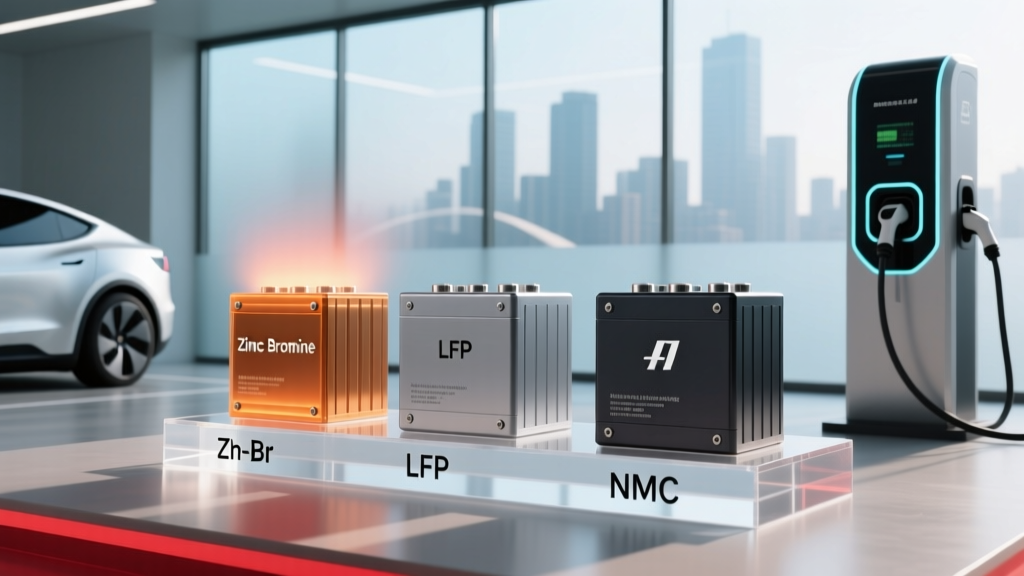
Modern EV traction batteries use one of two dominant lithium-ion chemistries: LFP (Lithium Iron Phosphate) or NMC/NCA (Nickel Manganese Cobalt / Nickel Cobalt Aluminum). Each has distinct engineering trade-offs that affect range, longevity, cost, and charging behavior.
| Factor | LFP (LiFePO₄) | NMC / NCA |
|---|---|---|
| Energy Density | Lower (~160 Wh/kg cell-level) | Higher (~230–300 Wh/kg cell-level) |
| Cycle Life | 3,000–6,000+ cycles | 1,000–2,500 cycles |
| Cost per kWh | Lower (~$80–$100/kWh pack-level in 2026) | Higher (~$110–$140/kWh pack-level) |
| Cold-Weather Performance | Weaker — slower charge, more range loss below freezing | Better low-temp charge acceptance |
| Thermal Stability / Safety | Excellent — very resistant to thermal runaway | Good but requires more active thermal management |
| State-of-Charge Calibration | Flat voltage curve — harder to estimate SoC precisely | Steeper voltage curve — easier SoC estimation |
| Daily Charging Recommendation | 100% SoC is fine (and recommended periodically for calibration) | 80% SoC for daily use; 100% only for trips |
| Common in (2026 models) | Tesla Model 3/Y RWD, BYD, Ford Mustang Mach-E Select (LFP option), Rivian Standard | Tesla Long Range/Performance, Hyundai Ioniq 5/6, BMW iX, most luxury/long-range EVs |
Which is better? It depends on your use case. If you prioritize long-term durability, lower cost, and daily commuting with home charging, LFP is the stronger pick—you can charge to 100% every night without accelerated degradation. If you need maximum range per charge, frequent road-trip fast charging, or live in a very cold climate, NMC/NCA packs deliver higher energy density and better cold-weather charge acceptance. Neither chemistry is universally "better"; the right choice depends on your driving profile.
How Long Do EV Batteries Last? Real-World Degradation Data
EV battery degradation is not a cliff—it's a gradual, mostly predictable loss of usable capacity over time and charge cycles. Most modern lithium-ion traction batteries lose capacity in two phases: a steeper initial drop (roughly 2–5% in the first year or 20,000 miles) followed by a long, slow linear decline.
| Age / Mileage | Average Capacity Retained | Notes |
|---|---|---|
| Year 1 / ~12,000 mi | 95–98% | Initial calendar + cycle loss |
| Year 3 / ~36,000 mi | 91–95% | Linear phase begins |
| Year 5 / ~60,000 mi | 88–93% | Most still well above warranty threshold |
| Year 8 / ~100,000 mi | 83–90% | Federal warranty period ends |
| Year 10 / ~120,000 mi | 80–88% | Noticeable but rarely disabling range loss |
| Year 15 / ~180,000 mi | 72–82% | Approaching end-of-vehicle-life territory |
Real-world data from Geotab's fleet study of 10,000+ EVs shows an average annual degradation rate of approximately 1.8% per year across all chemistries and climates. Tesla's own 2024 Impact Report (the most recent published data as of early 2026) shows Model 3/Y packs retaining roughly 85% capacity after 200,000 miles. LFP packs in fleet service have shown even slower degradation in some datasets, with Geotab noting LFP-equipped vehicles averaging under 1.5% annual loss.
For context: a 2026 EV with an EPA range of 300 miles that degrades at 1.8% annually will still deliver roughly 260 miles of range after 8 years—enough for the vast majority of daily driving and road trips with minimal planning adjustment.
EV Battery Warranty Coverage: What's Protected and for How Long
Under U.S. federal law, all EV traction batteries carry a minimum warranty of 8 years or 100,000 miles (whichever comes first). California Air Resources Board (CARB) states extend this to 10 years / 150,000 miles. Manufacturers set their own capacity-retention thresholds—most guarantee the battery will retain 70% of original capacity, though some are more generous.
| Manufacturer | Warranty Period | Capacity Threshold | Notes |
|---|---|---|---|
| Tesla (Model 3/Y RWD — LFP) | 8 yr / 100,000 mi | 70% | LFP pack; covers defects + capacity below threshold |
| Tesla (Model 3/Y LR — NMC) | 8 yr / 120,000 mi | 70% | Longer mileage for Long Range |
| Hyundai / Kia | 10 yr / 100,000 mi | 70% | Among the longest in the industry |
| Ford (Mach-E, F-150 Lightning) | 8 yr / 100,000 mi | 70% | LFP and NMC options depending on trim |
| GM (Ultium-based: Equinox EV, Blazer EV, Silverado EV) | 8 yr / 100,000 mi | 70% | Modular Ultium platform |
| BMW | 8 yr / 100,000 mi | 70% | Gen5 eDrive packs |
| Rivian | 8 yr / 175,000 mi (R1T/R1S) | 70% | Higher mileage cap for truck use |
What the warranty covers: Manufacturing defects, cell failures, and capacity loss below the stated threshold under normal use. What it typically excludes: Damage from accidents, flooding, or unauthorized modifications; capacity loss from consistently ignoring manufacturer charging guidelines (though this is rarely enforced). If your pack drops below 70% SoH within the warranty window, the manufacturer will repair or replace it—often with a refurbished pack that meets the threshold, not necessarily a brand-new one.
EV Battery Replacement Cost: When, Why, and How Much
The fear of a $20,000 battery replacement is the single biggest psychological barrier to EV adoption. Here's the data-driven reality: the vast majority of EV batteries outlast the useful life of the vehicle. A full pack replacement is uncommon before 200,000+ miles, and by that point most owners have moved on to a newer vehicle. When replacement is needed, costs have been declining steadily.
| Battery Size | Typical Models | Replacement Cost Range | When Typically Needed |
|---|---|---|---|
| ~50–60 kWh (Standard Range) | Chevy Equinox EV, Tesla Model 3 RWD, Nissan Leaf | $7,000–$12,000 | 200,000+ miles or 15+ years; rare under warranty |
| ~70–85 kWh (Long Range) | Tesla Model Y LR, Hyundai Ioniq 5, Ford Mach-E Extended | $10,000–$16,000 | 200,000+ miles; module-level repair often possible |
| ~90–120 kWh (Large/Truck) | Ford F-150 Lightning Ext., Rivian R1T, GMC Sierra EV | $14,000–$22,000 | Very rare; modular packs allow partial repair |
Two important nuances. First, many modern packs are modular—a technician can replace individual modules (a few kWh each) rather than the entire pack, reducing a $15,000 job to a $3,000–$5,000 repair. GM's Ultium, Tesla's structural pack, and Hyundai's E-GMP platform all support module-level service. Second, the used EV battery market is growing: refurbished packs from salvaged EVs are increasingly available at 40–60% below new-pack pricing, which matters for out-of-warranty vehicles.
Compare this to the 2016 Dodge Dart: a new 12V battery is $140–$280 every 3–5 years. Over 15 years of Dart ownership, you'll likely buy 3–4 starter batteries ($500–$1,000 total). An EV traction battery is a much larger single expense, but it's a once-in-the-vehicle's-lifetime event for most owners.
Factors That Affect EV Battery Lifespan
Not all miles are created equal when it comes to battery wear. These are the variables that meaningfully accelerate or slow degradation:
- Fast-charging frequency: Occasional DC fast charging (1–2 times per week) has minimal impact. Daily reliance on 150–350 kW DC fast charging accelerates degradation by an estimated 0.3–0.5% per year compared to Level 2 home charging. The heat generated at high charge rates stresses cells over time.
- Extreme temperatures: Sustained exposure to ambient temperatures above 95°F (35°C) accelerates calendar degradation. Very cold temperatures (below 10°F / -12°C) don't permanently damage the battery but temporarily reduce range by 20–40% and slow charge acceptance. Active thermal management (liquid cooling/heating) in modern EVs mitigates both.
- State of Charge (SoC) habits: For NMC/NCA packs, storing the battery at 100% SoC for extended periods accelerates degradation. The 20–80% daily window is the longevity sweet spot. LFP packs are more tolerant of 100% storage and actually benefit from periodic full charges for SoC calibration.
- Depth of Discharge (DoD): Shallow cycles (e.g., charging from 40% to 80%) are gentler than deep cycles (10% to 95%). You don't need to obsess over this, but avoiding running the pack to near-zero regularly helps.
- Preconditioning: Using the vehicle's battery preconditioning feature before DC fast charging (e.g., navigating to a Supercharger in a Tesla, or activating preconditioning in a Hyundai) warms the pack to optimal temperature, enabling faster charging with less cell stress.
Monitoring Battery Health: How to Check State of Health (SoH)
State of Health (SoH) is the percentage of original battery capacity remaining. A new EV has 100% SoH; a pack at 85% SoH holds 85% of its original kWh. Here's how to check it:
- In-vehicle displays: Some EVs (notably the Nissan Leaf with its 12-bar health indicator, and Tesla via the Service menu or third-party apps) show SoH directly. Many others do not expose this natively.
- OBD-II dongles + apps: Tools like OBDLink MX+ paired with apps such as EV Battery Health (Android) or LeafSpy (Nissan-specific) can read SoH from the battery management system (BMS).
- Manufacturer service centers: Any dealer or certified EV service center can pull a detailed SoH report during routine service. Request this when buying a used EV.
- Charging data analysis: By comparing the kWh delivered during a known 10%–90% Level 2 charge session to the expected value, you can estimate SoH. Example: if your 75 kWh pack accepts only 60 kWh from 10–90% (an 80% swing = 60 kWh expected on a healthy pack), SoH is approximately 100%. If it only accepts 52 kWh, SoH is roughly 87%.
For used-EV buyers, a pre-purchase battery health check is as important as a compression test was for gas cars. Insist on seeing SoH data before committing.
Emerging Battery Technologies: Solid-State and Silicon Anodes
Next-generation battery technologies are in active development, but none are available in production vehicles as of 2026. Here's a realistic timeline:
- Silicon-dominant anodes: Replacing graphite anodes with silicon can boost energy density by 20–40%. Companies like Sila Nanotechnologies and Group14 are supplying early production cells. Expect limited availability in high-performance models by 2027–2028, with broader adoption by 2030.
- Semi-solid-state batteries: Using a hybrid solid/liquid electrolyte, these offer incremental safety and energy-density gains. NIO's 150 kWh semi-solid pack (available in China since 2024) demonstrates the concept, but at very high cost. U.S. market availability remains announced/preliminary for 2028+.
- Full solid-state batteries: The long-promised leap in energy density, charge speed, and safety. Toyota, Samsung SDI, and QuantumScape target initial production in 2027–2029, but at low volumes and premium pricing. Mass-market solid-state EVs are realistically a 2030+ proposition.
None of these technologies should delay an EV purchase today. Current LFP and NMC packs already deliver 250–400 miles of range, 10–20 year lifespans, and declining costs. Waiting for solid-state is like waiting for a perfect gas engine—you'll be waiting a long time while missing out on today's capable technology.
Frequently Asked Questions
How long do EV batteries last in years and miles?
Based on fleet data from Geotab and manufacturer reports, modern EV traction batteries retain 80–90% of original capacity after 10 years or 120,000 miles, with an average degradation rate of ~1.8% per year. Most packs will function adequately for 15–20 years before capacity loss becomes practically limiting (below 70% SoH). The vehicle's body, suspension, and electronics are more likely to end the car's useful life before the battery does.
How much does an EV battery cost to replace?
As of 2026, full traction battery replacement costs range from approximately $7,000 for a 50 kWh standard-range pack to $22,000 for a 120 kWh truck pack. However, most modern packs support module-level repair ($3,000–$5,000) rather than full replacement. Critically, the vast majority of EV batteries never need replacement during the vehicle's useful life—degradation data shows most retain 80%+ capacity at 150,000 miles.
What does the EV battery warranty cover?
Federal law mandates a minimum 8-year / 100,000-mile warranty on EV traction batteries (10 years / 150,000 miles in CARB states). This covers manufacturing defects and capacity loss below a stated threshold—typically 70% of original capacity. If your pack falls below that threshold within the warranty period, the manufacturer repairs or replaces it at no cost. Damage from accidents, misuse, or unauthorized modifications is excluded.
How do I check and maximize my EV battery health?
Check SoH through your vehicle's native display (if available), an OBD-II adapter with an EV-specific app, or a dealer service report. To maximize longevity: use Level 2 home charging for daily needs, limit DC fast charging to road trips, keep NMC packs between 20–80% SoC for daily use (LFP can be charged to 100%), precondition the battery before fast charging, and avoid leaving the vehicle at very high or very low SoC for extended periods in extreme heat.
LFP vs. NMC — which battery chemistry is better?
Neither is universally superior. LFP offers longer cycle life (3,000–6,000 cycles vs. 1,000–2,500), lower cost, better thermal safety, and tolerance for daily 100% charging—but sacrifices energy density and cold-weather charge speed. NMC/NCA delivers more range per kWh, better cold performance, and easier SoC estimation—but costs more and degrades faster if routinely charged to 100%. Choose LFP for daily commuting and long-term value; choose NMC for maximum range and road-trip flexibility.
How does the Dodge Dart 2016 battery compare to an EV battery in cost over time?
A 2016 Dodge Dart requires a $140–$280 12V battery replacement every 3–5 years—roughly $500–$1,000 over 15 years of ownership. An EV traction battery costs $7,000–$22,000 to replace but typically lasts the life of the vehicle (15–20 years) without needing replacement. The EV's traction battery is a far larger single cost but a far less frequent one. Meanwhile, the Dart will consume $12,000–$18,000 in gasoline over that same 15-year period (at 25 MPG combined, 12,000 miles/year, and $3.25/gallon), a recurring cost the EV avoids entirely.