What Are Dendrites in an EV Battery?
If you've ever read about EV battery fires or premature capacity loss, you've likely encountered the word dendrite. In battery science, dendrites are microscopic, needle-like structures of metallic lithium that can form on the anode (negative electrode) during charging. They grow branch-like patterns — the name comes from the Greek word dendron, meaning tree — and under certain conditions, they can pierce the separator membrane between the anode and cathode, causing an internal short circuit.
For EV owners, dendrite formation is one of several degradation mechanisms happening inside the high-voltage traction battery pack. It's not the only one — electrolyte decomposition, solid-electrolyte interphase (SEI) layer growth, and particle cracking all contribute — but dendrites are the mechanism most associated with safety risk, which is why battery engineers spend enormous effort suppressing them through chemistry choices, thermal management, and charging protocols.
Understanding dendrites matters because the charging habits you practice directly influence whether and how quickly they form. This guide explains the science in practical terms, then covers everything you need to know about EV battery longevity, warranty protection, and replacement economics in 2026.
How Dendrites Form: The Chemistry Behind the Problem
Dendrites form when lithium ions, instead of intercalating (inserting neatly) into the anode material during charging, plate onto the anode surface as metallic lithium. This phenomenon, called lithium plating, is most likely under three conditions:
- Fast charging at low temperatures: Cold electrolyte slows ion diffusion into the anode, so lithium deposits on the surface instead.
- Charging at very high C-rates: Pushing electrons in faster than the anode chemistry can absorb them forces plating.
- Charging to very high state of charge (SoC) repeatedly: A nearly-full anode has fewer available intercalation sites, increasing surface deposition.
Once a dendrite seed forms, it tends to grow with each subsequent charge cycle. In extreme cases, a dendrite can bridge the gap to the cathode, causing a short circuit that leads to thermal runaway — the chain reaction behind battery fires. Modern EV battery management systems (BMS) are specifically designed to prevent the conditions that accelerate dendrite growth, which is why thermal preconditioning before DC fast charging is standard on most 2026 models.
LFP vs NMC/NCA: Chemistry Choices and Dendrite Resistance
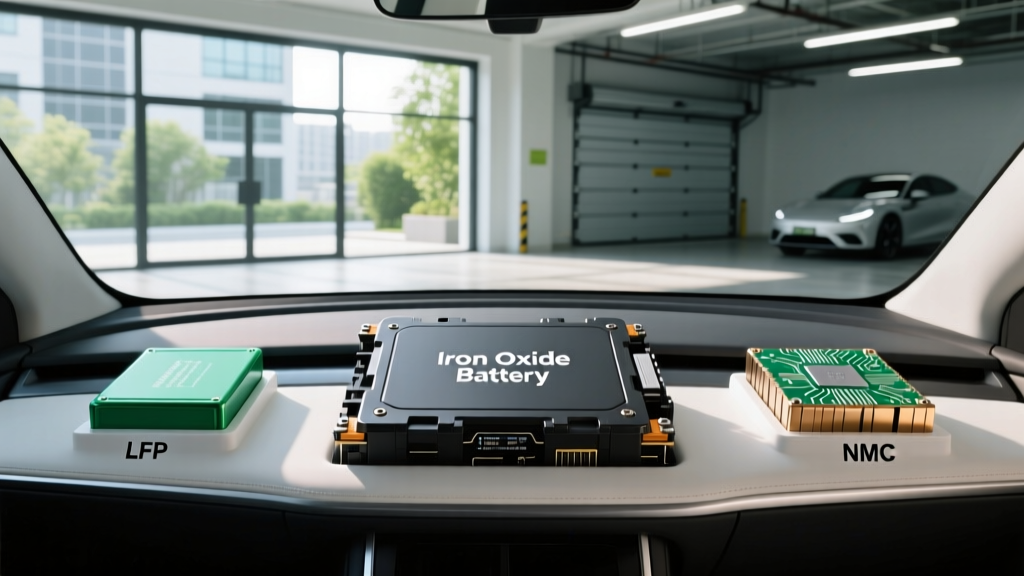
Not all EV battery chemistries are equally susceptible to dendrite formation. The two dominant cathode chemistries in the 2026 EV market — lithium iron phosphate (LFP) and nickel manganese cobalt (NMC) / nickel cobalt aluminum (NCA) — differ in their structural stability and how they manage lithium ions.
LFP cells use an olivine crystal structure that is mechanically robust and thermally stable. The anode in LFP cells operates at a slightly higher voltage relative to lithium metal, which makes lithium plating less thermodynamically favorable. This is one reason LFP batteries tolerate frequent 100% charging better than NMC — a practice that would accelerate dendrite risk in nickel-rich cells.
NMC and NCA cells offer higher energy density (more kWh per kilogram), which translates to longer range in a given pack size. However, their anodes operate closer to the lithium plating threshold, especially at high SoC and low temperatures. This is why automakers like Tesla, BMW, and Hyundai recommend charging NMC packs to 80% for daily use and reserving 100% for road trips.
| Attribute | LFP (LiFePO₄) | NMC / NCA |
|---|---|---|
| Energy Density | ~160–180 Wh/kg (cell level) | ~230–300 Wh/kg (cell level) |
| Cycle Life | 3,000–5,000+ cycles to 80% SoH | 1,000–2,500 cycles to 80% SoH |
| Cold-Weather Performance | Weaker — greater range loss below 32°F | Better low-temp ion mobility |
| Dendrite / Plating Resistance | Higher — anode voltage margin is larger | Lower — requires careful SoC management |
| Recommended Daily Charge Limit | 100% (per most OEMs) | 80% (per most OEMs) |
| Cost per kWh (pack level) | ~$90–$110 | ~$120–$150 |
| Typical Use in 2026 | Tesla Model 3 RWD, BYD models, base trims | Long-range / performance trims, luxury EVs |
Which is better? It depends on your use case. If you charge at home daily and want maximum cycle life with minimal degradation anxiety, LFP is the pragmatic choice. If you need maximum range in a single charge and don't mind managing SoC limits, NMC/NCA delivers more miles per kilogram. Neither chemistry is immune to dendrites, but LFP's wider safety margin makes it more forgiving of imperfect charging habits.
How Long Do EV Batteries Actually Last?
The short answer: longer than most buyers expect. Real-world fleet data collected through 2025 and into 2026 consistently shows that modern liquid-cooled EV battery packs retain 85–92% of their original capacity after 100,000 miles, depending on chemistry, climate, and charging behavior.
Here's what the degradation data looks like across major platforms:
| Vehicle / Platform | Chemistry | Mileage | Avg. Capacity Retained | Source / Notes |
|---|---|---|---|---|
| Tesla Model 3/Y (NMC) | NMC 2170 cells | 100,000 mi | ~88–90% | Tesla Impact Report 2024; fleet telematics |
| Tesla Model 3 RWD (LFP) | LFP prismatic | 100,000 mi | ~93–96% | Fleet data; LFP degrades slower at high SoC |
| Hyundai Ioniq 5 (NMC) | NMC 811 pouch | 80,000 mi | ~90–92% | Owner-reported; liquid-cooled pack |
| Chevrolet Bolt EV/EUV (NMC) | NMC 622 pouch | 100,000 mi | ~85–88% | Post-recall replacement packs performing better |
| Ford Mustang Mach-E (NMC) | NMC pouch | 75,000 mi | ~91–93% | Ford telematics; extended-range pack |
A few things stand out from this data. First, LFP packs are measurably outlasting NMC packs at equivalent mileage, largely because owners charge them to 100% routinely without the same plating risk. Second, liquid-cooled thermal management — standard on nearly every 2026 EV — is the single biggest factor in suppressing dendrite-friendly conditions during fast charging. Third, most EVs will reach 150,000–200,000 miles before the pack drops below 80% capacity, which is the threshold most warranties use to define "end of life."
In terms of years, the median EV battery in the 2026 fleet is lasting 12–18 years before requiring replacement, assuming typical annual mileage of 10,000–14,000 miles. Many packs will outlast the vehicle's body and interior.
What Does the EV Battery Warranty Actually Cover?
Federal law mandates a minimum battery warranty of 8 years / 100,000 miles for all EVs sold in the United States. Several states that follow California's CARB standards (including New York, Massachusetts, Oregon, and Washington) extend this to 10 years / 150,000 miles for vehicles certified to those standards.
| Manufacturer | Warranty Period | Mileage Limit | Capacity Threshold | Notes |
|---|---|---|---|---|
| Tesla (Model 3/Y NMC) | 8 years | 120,000 mi | 70% retention | Long Range & Performance trims |
| Tesla (Model 3 RWD LFP) | 8 years | 100,000 mi | 70% retention | Base RWD trim |
| Hyundai / Kia | 10 years | 100,000 mi | 70% retention | Among the longest coverage in the market |
| Ford (Mach-E, F-150 Lightning) | 8 years | 100,000 mi | 70% retention | Standard across BEV lineup |
| GM (Ultium platform) | 8 years | 100,000 mi | 70% retention | Blazer EV, Silverado EV, Equinox EV |
| BMW (Neue Klasse / iX) | 8 years | 100,000 mi | 70% retention | Cylindrical cell format starting 2025–2026 |
| Rivian | 8 years | 175,000 mi | 70% retention | Highest mileage cap among consumer EVs |
The critical detail: these warranties cover capacity degradation below the stated threshold, not just catastrophic failure. If your 82 kWh pack can only hold 55 kWh (roughly 67% of original), you have a valid warranty claim even if the car still drives. The warranty also covers defects in materials and workmanship, including internal short circuits from dendrite-related failures if they occur within the warranty period and aren't caused by owner abuse (such as ignoring BMS warnings or modifying the pack).
What the warranty does not cover: normal degradation above the threshold, damage from accidents, flooding, or unauthorized modifications. Always document your charging habits and keep service records — if you need a warranty claim, the manufacturer may request telematics data showing how the pack was used.
How Much Does an EV Battery Replacement Cost?
This is the question that generates the most anxiety, and it deserves a data-grounded answer rather than fear-mongering. Yes, EV battery packs are expensive. No, most owners will never pay for one out of pocket, because the pack typically lasts the life of the car or is covered by warranty.
That said, here are the current replacement cost ranges for out-of-warranty scenarios in 2026:
| Vehicle | Pack Size | Chemistry | Replacement Cost (Parts + Labor) | Typical Replacement Trigger |
|---|---|---|---|---|
| Tesla Model 3 RWD | ~60 kWh | LFP | $8,000–$12,000 | Rare before 200k mi |
| Tesla Model Y Long Range | ~75 kWh | NMC | $12,000–$16,000 | 150k–200k mi if degraded |
| Hyundai Ioniq 5 | ~77.4 kWh | NMC | $13,000–$18,000 | 150k+ mi |
| Ford F-150 Lightning Ext. Range | ~131 kWh | NMC | $20,000–$28,000 | 150k+ mi; largest consumer pack |
| Chevrolet Equinox EV | ~85 kWh | NMC (Ultium) | $12,000–$16,000 | 150k+ mi |
| BMW iX xDrive50 | ~111.5 kWh | NMC | $18,000–$25,000 | 150k+ mi |
Several trends are working in owners' favor. Pack-level costs have fallen from over $200/kWh in 2020 to roughly $100–$140/kWh in 2026, according to BloombergNEF battery price surveys. Module-level repair is increasingly available — rather than replacing the entire pack, specialized shops can identify and swap individual degraded modules for $2,000–$5,000. And the used-EV battery market is growing, with refurbished packs from salvaged vehicles offering a lower-cost alternative.
For context: a 2026 gasoline vehicle's powertrain (engine + transmission) can also require $5,000–$10,000 in repairs after 150,000 miles. The difference is that EV battery failures are far less common than ICE powertrain failures at equivalent mileage, according to Consumer Reports reliability data.
Factors That Accelerate Battery Degradation (and Dendrite Risk)
Dendrite formation doesn't happen in isolation — it's accelerated by the same factors that degrade overall battery health. Here's what matters most, ranked by impact:
Battery Care Checklist: Maximize Pack Life
- Avoid frequent DC fast charging above 150 kW when the battery is cold. Always let the BMS precondition the pack (most EVs do this automatically when you navigate to a charger). Cold lithium plating is the #1 dendrite risk factor.
- Keep NMC/NCA packs between 20–80% SoC for daily driving. Reserve 100% charges for trips where you need the full EPA range. LFP owners can charge to 100% daily without the same risk.
- Minimize exposure to extreme heat. Parking in shade or a garage when ambient temps exceed 95°F reduces calendar degradation. Battery temperature above 104°F (40°C) accelerates electrolyte breakdown and SEI growth.
- Don't let the pack sit at 0% or 100% for extended periods. If storing the vehicle for more than a week, aim for 50–60% SoC. Most 2026 EVs have a storage mode that manages this automatically.
- Use Level 2 home charging as your primary method. A 7–11 kW Level 2 charge generates far less thermal stress than a 150–350 kW DC session. For most owners, overnight Level 2 charging covers 100% of daily needs.
- Keep software updated. OEMs regularly refine BMS algorithms to better manage charge curves, thermal limits, and cell balancing. Over-the-air updates in 2026 models frequently improve longevity.
The single most impactful habit: precondition before fast charging and avoid fast charging in sub-freezing weather without preconditioning. Tesla, Hyundai, Ford, and GM all include automatic preconditioning when you navigate to a DC fast charger through the built-in navigation. If you use a third-party app to find chargers, precondition manually by starting the charge session 10–15 minutes after driving the car (which warms the pack through use).
How to Check Your EV's Battery Health (State of Health)
State of Health (SoH) is the percentage of original battery capacity that remains available. A new 82 kWh pack at 95% SoH can store approximately 77.9 kWh. Monitoring SoH helps you track degradation trends and identify whether you're approaching a warranty claim threshold.
Here's how to check SoH on major 2026 platforms:
- Tesla: The in-car service menu (hold the model badge on the About screen for 3 seconds, enter "service" when prompted) shows estimated SoH. Third-party tools like TeslaFi or Scan My Tesla (via OBD-II adapter) provide more granular cell-level data.
- Hyundai / Kia: The infotainment system's EV diagnostic page shows SoH percentage. The dealer can pull a detailed cell-balance report through the KDS diagnostic tool.
- Ford: The FordPass app displays estimated SoH under the vehicle health section. A dealer IDS scan provides module-level detail.
- GM (Ultium): The myChevrolet / myCadillac app shows battery health. OnStar diagnostics can generate a detailed report on request.
- Universal method: An OBD-II Bluetooth adapter paired with an app like Car Scanner or ABRP (A Better Route Planner) can read SoH from the BMS on most 2026 EVs. Expect to spend $30–$60 on the adapter.
A healthy degradation curve looks roughly linear: expect to lose 2–3% in the first year (as the SEI layer stabilizes), then roughly 1–1.5% per year or per 12,000–15,000 miles thereafter. If you see a sudden drop of 3%+ in a single month, that may indicate a cell imbalance or module fault — schedule a dealer diagnostic.
Emerging Battery Technologies: Solid-State and Silicon Anodes
The battery industry is actively developing technologies that could fundamentally reduce or eliminate dendrite formation. Here's where things stand as of 2026:
Solid-state batteries replace the liquid electrolyte with a solid ceramic, polymer, or glass separator. Because the solid material is mechanically rigid, it can physically block dendrite penetration. Companies like Toyota, Samsung SDI, and QuantumScape have demonstrated prototype cells with promising cycle life. However, no solid-state EV is commercially available in the U.S. as of 2026. Toyota has announced a 2027–2028 production target for a limited-run solid-state EV, and Samsung SDI is targeting 2027 for mass production. Realistic widespread availability is 2029–2031 at the earliest, given the manufacturing scale-up required.
Silicon-dominant anodes (from companies like Sila Nanotechnologies and Group14) replace graphite with silicon, which can absorb far more lithium ions per unit mass. This increases energy density by 20–40% and, because silicon can accommodate lithium more readily, reduces the thermodynamic driving force for plating. Mercedes-Benz's upcoming AMG models are expected to feature silicon-anode cells from Factorial Energy. These are closer to market — limited production vehicles in 2026–2027, with broader adoption by 2028–2029.
Semi-solid and gel-polymer electrolytes represent an intermediate step, offering some dendrite resistance improvement over conventional liquid electrolytes while being easier to manufacture than fully solid-state cells. NIO's 150 kWh semi-solid pack (available in China) is the most prominent example, though it has not been certified for U.S. sale.
For buyers today: these technologies are genuinely promising, but they are not a reason to delay an EV purchase. Current LFP and NMC packs already deliver 150,000–200,000+ miles of usable life with proper care, and warranty protection covers the rare early failure. Waiting for solid-state means waiting at minimum 3–5 years for limited availability, likely at a premium price point.
Frequently Asked Questions
How long do EV batteries last in years and miles?
Most 2026 EV batteries last 12–18 years or 150,000–200,000+ miles before dropping below 80% of original capacity. LFP chemistry packs tend to last longer (200,000+ miles) than NMC packs under equivalent conditions. The battery will typically outlast the vehicle's body, suspension, and interior components.
How much does an EV battery cost to replace?
Out-of-warranty replacement costs range from approximately $8,000 for a 60 kWh LFP pack to $28,000 for a 131 kWh NMC pack (such as the F-150 Lightning Extended Range), including labor. However, most owners never pay this — the battery either lasts the life of the car or is covered under the 8-year/100,000-mile minimum federal warranty. Module-level repairs cost $2,000–$5,000 and are increasingly available from independent EV shops.
What does the EV battery warranty cover?
Federal law requires a minimum 8-year/100,000-mile warranty covering capacity loss below 70% of original capacity and defects in materials/workmanship. Some manufacturers (Hyundai, Kia, Rivian) offer 10 years or up to 175,000 miles. The warranty covers both gradual degradation below the threshold and sudden failures, including internal short circuits. It does not cover damage from accidents, flooding, or unauthorized modifications.
How do I check my EV battery's State of Health?
Most 2026 EVs display SoH through the infotainment system, manufacturer app, or a hidden service menu. For more detailed cell-level data, an OBD-II Bluetooth adapter ($30–$60) paired with apps like Car Scanner or TeslaFi provides granular readings. A healthy pack loses roughly 2–3% in year one, then 1–1.5% per year. Sudden drops may indicate a fault requiring dealer diagnosis.
LFP vs NMC — which battery chemistry is better for me?
Choose LFP if you want maximum cycle life, can charge at home daily, don't need the absolute longest single-charge range, and prefer the simplicity of charging to 100% without worry. Choose NMC/NCA if you need maximum range per charge (typically 30–50 more miles in an equivalent pack size), frequently drive in cold weather, or are buying a performance-oriented trim. Both chemistries are proven, reliable, and backed by equivalent warranty coverage.
Can dendrites cause my EV battery to catch fire?
In extreme cases, dendrite penetration of the separator can cause an internal short circuit leading to thermal runaway. However, this is exceedingly rare in modern EVs with liquid-cooled packs and sophisticated BMS controls. The BMS actively monitors cell voltages and temperatures, and will limit charge rates or disable charging if conditions favor plating. The NHTSA tracks EV fire incidents, and the rate of battery-related fires per 100,000 vehicles is significantly lower than gasoline vehicle fire rates, according to data compiled by the National Fire Protection Association.
Does fast charging damage my EV battery?
DC fast charging generates more heat and higher C-rates than Level 2 charging, which can accelerate degradation over time — but the effect is smaller than most buyers fear. Tesla's fleet data shows that vehicles that fast-charge more than 50% of the time degrade only about 1–2% more over 100,000 miles compared to vehicles that primarily use Level 2. The key mitigations are thermal preconditioning (which your EV does automatically when navigating to a charger) and avoiding fast charging when the battery is below 32°F without preconditioning.