Why Cybertruck Battery Weight Matters More Than You Think
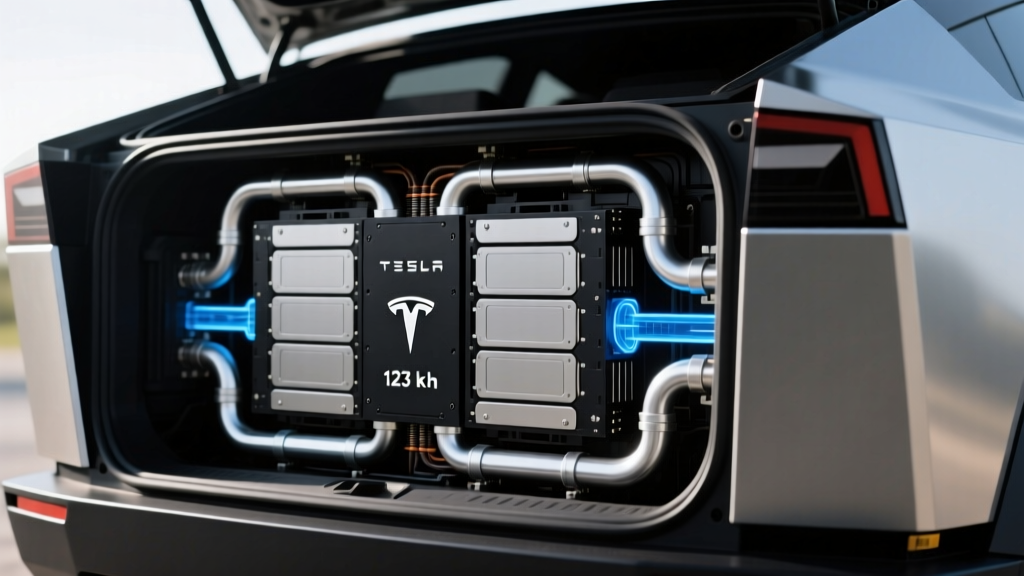
When Tesla released the Cybertruck, one specification drew outsized attention from engineers and EV analysts: the Cybertruck battery weight. At approximately 1,700 pounds (roughly 770 kg), the structural battery pack accounts for nearly a quarter of the vehicle's 6,750-pound curb weight. That mass isn't arbitrary — it's a direct consequence of packing ~123 kWh of usable energy into an NMC (nickel-manganese-cobalt) chemistry designed to move a stainless-steel, 8,500-pound-tow-capability pickup.
Understanding the Cybertruck's battery architecture illuminates broader EV battery design trade-offs: energy density versus weight, cycle life versus cost, and peak performance versus long-term degradation. This guide dissects the Cybertruck's pack alongside the battery technologies shaping every modern EV.
- Usable capacity: ~123 kWh (est. ~130 kWh gross)
- Chemistry: NMC (Nickel-Manganese-Cobalt)
- Estimated pack weight: ~1,700 lbs (770 kg)
- Architecture: 800V-class structural pack
- EPA range: 340 mi (AWD) / 320 mi (Cyberbeast)
- Real-world highway range: ~260–290 mi at 75 mph, per independent testing
LFP vs NMC vs NCA: The Chemistry Decision Behind Every EV
Every EV battery begins with a chemistry choice, and that decision cascades through range, weight, cost, and longevity. The Cybertruck uses NMC, but Tesla also relies heavily on LFP (lithium iron phosphate) for standard-range Model 3 and Model Y variants. Here's how the three dominant chemistries compare in 2026:
| Attribute | LFP (Lithium Iron Phosphate) | NMC (Nickel-Manganese-Cobalt) | NCA (Nickel-Cobalt-Aluminum) |
|---|---|---|---|
| Energy density | ~160–180 Wh/kg (cell) | ~220–260 Wh/kg (cell) | ~250–280 Wh/kg (cell) |
| Cycle life | 3,000–5,000+ cycles | 1,000–2,000 cycles | 1,000–1,500 cycles |
| Cold-weather performance | Reduced — slower charging, ~15–20% range loss | Better low-temp discharge | Good low-temp discharge |
| Cost per kWh | Lowest (~$80–95/kWh cell) | Moderate (~$110–130/kWh cell) | Moderate-High |
| Thermal stability | Excellent — high runaway threshold | Good with BMS management | Good with BMS management |
| SoC recommendation | 100% daily OK | 80–90% daily recommended | 80–90% daily recommended |
| Typical use | Standard-range, fleet, urban EVs | Long-range, performance, trucks | Performance sedans (Tesla) |
The Cybertruck's NMC pack was chosen because energy density is non-negotiable for a vehicle this heavy. Towing 8,500 pounds or hitting 60 mph in 2.6 seconds (Cyberbeast) demands maximum kWh in minimum volume. An LFP pack delivering 123 kWh would weigh over 2,200 pounds — adding 500+ lbs and further eroding efficiency.
The trade-off: NMC has a shorter cycle life and requires owners to avoid routinely charging to 100% for daily use. Tesla's battery management system (BMS) enforces this with default charge limits, but understanding the chemistry helps owners make informed decisions about long-term health.
How Long Do EV Batteries Actually Last?
The most common question from prospective EV buyers is lifespan. The data, across millions of vehicles tracked by fleet operators and researchers, is encouraging: most modern EV batteries outlast the vehicles they power.
- Year 1 / 15,000 mi: ~2–4% capacity loss (initial formation)
- Year 3 / 45,000 mi: ~5–8% total loss
- Year 5 / 75,000 mi: ~8–12% total loss
- Year 8 / 120,000 mi: ~10–15% total loss (still above warranty threshold)
- Year 10+ / 150,000+ mi: ~12–20% loss (varies widely by usage)
Sources: Recurrent Auto fleet data, Tesla Impact Reports, Geotab longitudinal studies.
Tesla's own Impact Report data shows that Model 3 and Model Y NMC packs retain approximately 85% of original capacity at 150,000 miles. The Cybertruck's larger pack operates under similar chemistry principles, though its heavier loads and higher discharge rates during towing may accelerate wear slightly.
LFP packs tell a different story. Tesla's standard-range vehicles with LFP chemistry show degradation curves that flatten after the initial 2–3% loss, with many packs projected to retain 90%+ capacity at 200,000 miles. This is why fleet operators and high-mileage drivers increasingly favor LFP.
What the Battery Warranty Actually Covers
Every EV sold in the U.S. carries a federally mandated minimum battery warranty of 8 years / 100,000 miles, but manufacturers set their own capacity-retention thresholds. Here's how major automakers stack up:
| Manufacturer | Warranty Period | Capacity Retention Threshold | What Triggers a Claim |
|---|---|---|---|
| Tesla (Cybertruck) | 8 yr / 120,000 mi | 70% | Usable capacity drops below 70% of nominal |
| Tesla (Model 3/Y LR) | 8 yr / 120,000 mi | 70% | Same threshold |
| Hyundai / Kia | 10 yr / 100,000 mi | 70% | SoH below 70% confirmed by diagnostic |
| Ford | 8 yr / 100,000 mi | 70% | Capacity below threshold via OBD scan |
| GM (Ultium) | 8 yr / 100,000 mi | 70% | Module-level diagnostics |
| Rivian | 8 yr / 175,000 mi | 70% | Capacity below threshold |
The Cybertruck's 8-year / 120,000-mile warranty with a 70% retention floor is competitive for a pickup. Rivian's 175,000-mile coverage stands out for high-mileage drivers. Crucially, these warranties cover defects and abnormal degradation — not gradual, expected capacity loss above the threshold.
What's covered: cell defects, BMS failures, module imbalance beyond repair, manufacturing flaws. What's typically excluded: damage from accidents, flooding, unauthorized modifications, or extreme abuse (repeated 100% SoC storage in high heat, for example).
EV Battery Replacement Cost: When and How Much
Out-of-warranty battery replacement remains the specter haunting EV skeptics. Let's ground the fear in data. According to Recurrent Auto's 2025 analysis, fewer than 2% of EVs in their tracked fleet of over 15,000 vehicles have required full pack replacements — and the vast majority of those were covered under warranty.
| Vehicle / Pack Size | Estimated Replacement Cost (2026) | Typical Replacement Trigger |
|---|---|---|
| Tesla Model 3 SR (LFP, ~60 kWh) | $8,000–$11,000 | Rare — LFP longevity is exceptional |
| Tesla Model Y LR (NMC, ~75 kWh) | $12,000–$16,000 | High-mileage, post-warranty |
| Tesla Cybertruck (~123 kWh) | $18,000–$25,000 | Extremely rare; structural pack complexity |
| Ford F-150 Lightning (~131 kWh ext.) | $20,000–$28,000 | Fleet use, high cycle count |
| Hyundai Ioniq 5 (~77 kWh) | $11,000–$15,000 | Post-warranty degradation |
| Chevy Bolt EV (~65 kWh) | $9,000–$14,000 | Recall-related replacements mostly covered |
The Cybertruck's structural pack — where battery cells serve as a stressed chassis member — makes replacement significantly more labor-intensive than a bolt-in module. Tesla has not published official out-of-warranty replacement pricing, but the cell cost alone (~123 kWh × $110–130/kWh) suggests $13,500–$16,000 in materials before labor, diagnostics, and structural re-bonding. Realistic total: $18,000–$25,000.
When is replacement typically needed? Almost never before 150,000 miles on modern NMC packs, and rarely before 200,000+ on LFP. The more common scenario is module-level repair — replacing individual cell groups within the pack for $3,000–$6,000 rather than the full assembly.
Factors That Accelerate (or Preserve) Battery Life
Battery degradation is not uniform. Your habits, climate, and charging patterns create vastly different outcomes for identical packs. Here's what the data shows:
- State of Charge (SoC) habits: For NMC (Cybertruck included), keep daily SoC between 20–80%. Reserve 100% charges for road trips. LFP owners can charge to 100% regularly — in fact, Tesla recommends it for accurate BMS calibration.
- DC fast-charging frequency: Occasional Supercharging has minimal impact. Daily DC fast-charging (especially above 150 kW) on a hot pack accelerates degradation by ~1–2% per year versus Level 2 home charging, per Geotab data.
- Temperature extremes: Sustained high ambient heat (above 95°F/35°C) is more damaging than cold. Preconditioning before fast charging is critical — the Cybertruck's thermal management system handles this automatically when navigation is set to a Supercharger.
- Storage at high SoC: Parking at 100% SoC for days in hot weather is the single worst thing you can do. Store at 50–60% for extended parking.
- Towing and heavy loads: The Cybertruck's 8,500-lb tow rating means high sustained discharge rates. This generates more heat in the pack. Not catastrophic, but expect slightly higher degradation if you tow frequently.
- Regen braking settings: Standard regen is fine. There's no evidence that aggressive regen harms battery life — the BMS manages charge acceptance rates.
The Cybertruck's 800V-class architecture enables peak DC fast-charging rates around 250 kW (V3 Supercharger) and potentially higher on V4 infrastructure. While impressive for 10–80% charging (~20 minutes), repeated peak-rate sessions generate substantial heat. Tesla's octovalve thermal management system mitigates this, but physics always wins: consistent Level 2 home charging at 7–11 kW remains the gentler path.
How to Monitor Battery Health (State of Health / SoH)
State of Health (SoH) is the metric that tells you what percentage of original capacity your pack retains. A new Cybertruck has an SoH of 100%; at the warranty threshold, SoH reads 70%.
In the Tesla app: Tesla does not display a direct SoH percentage in the vehicle UI. However, you can estimate SoH by comparing your actual range at 100% charge (on a rare full-charge occasion) against the original EPA-rated range. If your Cybertruck AWD showed 340 miles at 100% when new and now shows 310 miles, your SoH is approximately 91%.
Third-party tools: Apps like TeslaFi and Tessie log detailed battery data via Tesla's API, tracking estimated SoH over time with far more granularity than the in-car display. Some service centers can pull detailed SoH reports via OBD-II diagnostics.
For non-Tesla EVs: Hyundai, Kia, and Ford provide SoH readouts through dealer diagnostics. The EPA's fueleconomy.gov does not track SoH, but it provides baseline efficiency data you can compare against your real-world consumption to infer degradation.
Emerging Battery Tech: Solid-State and Silicon Anodes
Two technologies dominate forward-looking battery conversations, but neither is ready for the 2026 Cybertruck or any current-production EV:
Solid-state batteries replace the liquid electrolyte with a solid ceramic, polymer, or sulfide material. The promise: 2–3× energy density (meaning a 123 kWh Cybertruck pack could shrink to the weight and volume of today's 60 kWh packs), faster charging, and improved safety. Toyota has announced a 2027–2028 production timeline for limited solid-state deployment. Samsung SDI targets 2027. QuantumScape continues prototype validation with Volkswagen. Realistic mass-market availability: 2029–2032 at the earliest, with initial deployment likely in premium sedans, not heavy pickups.
Silicon anode technology replaces graphite anodes with silicon-dominant materials, boosting energy density by 20–40%. Companies like Sila Nanotechnologies (partnered with Mercedes-Benz for the G-Class) and Group14 (backed by Porsche) are in early production. Expect silicon-dominant anodes in select 2026–2027 models, but scaling to the volumes needed for a Cybertruck-class pack is years away.
For current Cybertruck owners and buyers: your NMC pack is the best available technology for a high-performance, high-tow electric truck today. It will reliably serve 150,000+ miles with proper care, and by the time replacement might be necessary, next-generation packs will likely offer better performance at lower cost.
Frequently Asked Questions
How much does the Cybertruck battery weigh?
The Cybertruck's structural battery pack weighs approximately 1,700 pounds (770 kg). This accounts for roughly 25% of the vehicle's 6,750-pound curb weight. The pack serves as a structural chassis member, reducing the need for separate frame components but making replacement more complex.
Is the Cybertruck battery LFP or NMC?
The Cybertruck uses NMC (nickel-manganese-cobalt) chemistry. Tesla chose NMC for its higher energy density, which is essential for a 123 kWh pack in a heavy pickup. Tesla uses LFP in standard-range Model 3 and Model Y vehicles where ultimate range is less critical.
How long will a Cybertruck battery last before needing replacement?
Based on Tesla's fleet data for similar NMC packs, expect 150,000–200,000+ miles before capacity drops below 70% of original. The 8-year / 120,000-mile warranty provides a safety net. Most owners will sell or trade the vehicle before battery replacement becomes necessary.
Does frequent Supercharging damage the Cybertruck battery?
Occasional DC fast charging has minimal impact. Daily Supercharging on a hot pack may add 1–2% extra degradation per year compared to exclusive Level 2 home charging. Tesla's preconditioning system (activate by navigating to a Supercharger) significantly mitigates thermal stress.
Can I check my Cybertruck battery health myself?
Tesla doesn't display a direct SoH percentage, but you can estimate it by comparing your 100%-charge range to the original EPA rating. Third-party apps like TeslaFi and Tessie provide more detailed tracking via Tesla's API. For a definitive reading, a Tesla service center can pull a full battery health diagnostic.
What happens if my Cybertruck battery fails out of warranty?
Full pack replacement is estimated at $18,000–$25,000 (parts and labor). However, module-level repairs — replacing individual cell groups — are far more common and cost $3,000–$6,000. Full pack failure outside the warranty window is statistically rare based on current fleet data.