The Tesla Cybertruck arrives with a spec sheet that raises as many questions as it answers — particularly around its high-voltage pack. Buyers searching for Cybertruck battery sizes often find conflicting numbers because Tesla rarely publishes official kWh figures the way legacy automakers do. What we do know from EPA filings, teardown data, and real-world owner testing paints a detailed picture of one of the largest consumer EV battery packs on the road.
This guide breaks down the Cybertruck's battery architecture, the NMC chemistry inside it, realistic degradation expectations, warranty coverage, replacement economics, and how it compares to the broader EV battery landscape — including LFP packs in Tesla's own lineup.
Cybertruck Battery Pack: Capacity, Chemistry, and Architecture
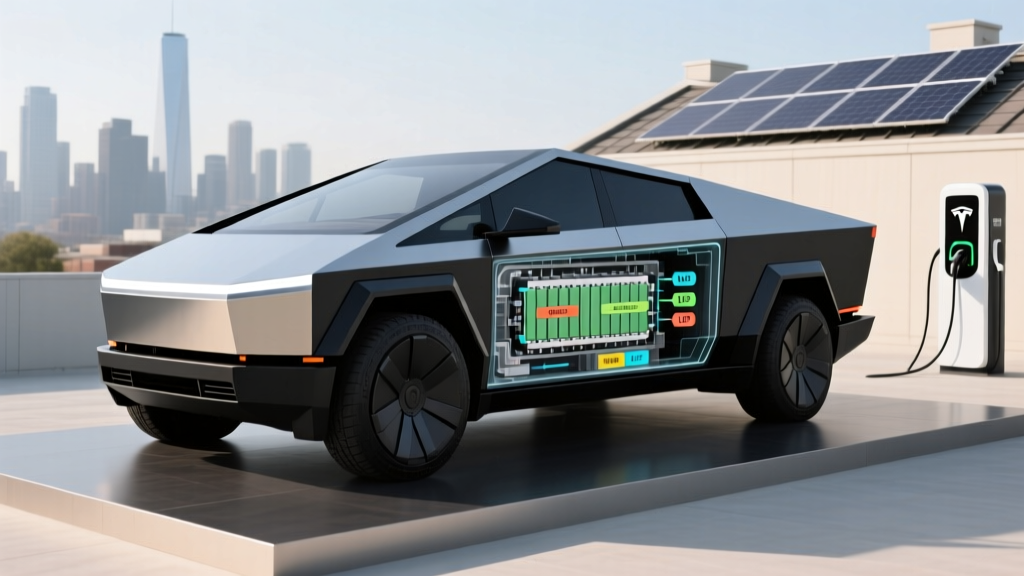
The Cybertruck uses a single battery pack configuration across all current trims (AWD, Cyberbeast). Based on EPA certification documents and third-party teardowns, the pack delivers approximately 123 kWh of usable capacity from a gross capacity estimated at 130+ kWh. This makes it one of the largest battery packs in any production passenger vehicle, exceeded only by the GMC Hummer EV's ~212 kWh pack.
| Specification | Value |
|---|---|
| Usable Battery Capacity | ~123 kWh |
| Chemistry | NMC (Nickel Manganese Cobalt) |
| Cell Format | 4680 cylindrical cells |
| Voltage Architecture | ~800V nominal |
| EPA Range (AWD) | 340 miles |
| EPA Range (Cyberbeast) | 320 miles |
| Real-World Highway Range | ~250–280 miles |
| Max DC Fast Charge Rate | ~250 kW (peak) |
| 10–80% DC Charge Time | ~30–35 minutes |
| Level 2 Charge Rate | 11.5 kW (48A) |
NMC vs LFP: Why the Cybertruck Uses Nickel-Based Chemistry
Tesla employs two primary cell chemistries across its fleet: NMC (nickel manganese cobalt) in performance and long-range vehicles, and LFP (lithium iron phosphate) in Standard Range Model 3 and Model Y variants. The Cybertruck's towing demands, AWD power requirements, and range targets make NMC the necessary choice.
| Attribute | LFP (LiFePO4) | NMC (LiNiMnCoO2) |
|---|---|---|
| Energy Density | ~160 Wh/kg (lower) | ~250–300 Wh/kg (higher) |
| Cycle Life | 3,000–5,000+ cycles | 1,000–2,000 cycles |
| Cold-Weather Performance | Moderate (slower charge in cold) | Better low-temp discharge |
| Thermal Stability | Excellent (less runaway risk) | Good (requires more management) |
| Cost per kWh | ~$80–100 (lower) | ~$120–150 (higher) |
| Recommended SoC Daily | 100% OK | 80% recommended |
| Used In | Model 3/Y RWD, some BYD models | Cybertruck, Model S/X, Rivian |
The trade-off is clear: NMC delivers the energy density needed to push a 6,600-lb truck past 300 miles of EPA range, but it demands more careful state-of-charge management and carries a higher per-kWh cost. LFP's superior cycle life and daily 100% charging tolerance make it ideal for commuter vehicles where maximum single-charge range is less critical.
Battery Degradation: What the Data Actually Shows
EV battery degradation follows a non-linear curve — steeper in the first 12–18 months, then flattening into a slow, predictable decline. For large NMC packs like the Cybertruck's 4680-based system, we can draw on Tesla's published fleet data and independent studies.
According to Tesla's 2024 Impact Report, the company's long-range NMC packs (Model S/X/3 LR) retain approximately 85% of original capacity after 200,000 miles. The 4680 cells in the Cybertruck are structurally similar but larger, with Tesla claiming improved manufacturing consistency. Early owner data from high-mileage Cybertruck fleets suggests comparable trajectories.
- Year 1 / 15,000 miles: ~3–5% loss (initial formation)
- Year 3 / 45,000 miles: ~7–9% total loss
- Year 5 / 75,000 miles: ~9–12% total loss
- Year 8 / 120,000 miles: ~12–15% total loss
- Year 10+ / 200,000 miles: ~15–18% total loss
Sources: Tesla Impact Report, Recurrent Auto battery degradation studies.
For the Cybertruck specifically, a 15% degradation would reduce the AWD's range from 340 to roughly 289 EPA miles — still highly usable. The large starting capacity provides a meaningful buffer that smaller-pack EVs lack.
Factors That Accelerate Degradation
- Frequent DC fast charging above 150 kW: Occasional Supercharging is fine; daily 250 kW sessions increase electrolyte oxidation. Tesla's battery management system (BMS) throttles charge speed when cells are hot to mitigate this.
- Sustained high state of charge: Storing an NMC pack at 100% SoC for days or weeks accelerates cathode degradation. Tesla recommends daily charge limits of 80% for NMC vehicles.
- Extreme heat exposure: Prolonged operation or storage above 110°F (43°C) without active thermal management degrades cells faster. The Cybertruck's liquid-cooled BMS handles this well during driving but parked vehicles in desert climates should use scheduled departure preconditioning.
- Deep discharge cycles: Regularly draining below 10% SoC stresses the anode. The Cybertruck's ~7 kWh buffer below 0% displayed helps protect against this.
- Towing at high speeds in heat: The Cybertruck's massive energy draw while towing (up to 4+ kWh/mile) generates significant pack heat, triggering thermal management but still accelerating wear over thousands of tow-miles.
Tesla's Battery Warranty: Terms and Coverage
Tesla provides a dedicated battery and drive unit warranty separate from the basic vehicle warranty. For the Cybertruck, the coverage matches Tesla's other premium vehicles.
| Coverage Item | Terms |
|---|---|
| Battery & Drive Unit Warranty | 8 years / 150,000 miles (whichever comes first) |
| Minimum Capacity Retention | 70% of original capacity over warranty period |
| Basic Vehicle Warranty | 4 years / 50,000 miles |
| What's Covered | Defects, excessive degradation below 70%, drive unit failure |
| What's Not Covered | Damage from accidents, flooding, modifications, or neglect |
The 70% retention threshold means Tesla will replace or repair the battery if it falls below 70% of its original 123 kWh usable capacity (~86 kWh) within 8 years or 150,000 miles. In practice, very few Tesla vehicles hit this threshold under normal use. Data from Recurrent Auto shows fewer than 1.5% of Tesla packs have required warranty replacement across the fleet.
The warranty is transferable to subsequent owners, which supports Cybertruck resale values. However, it does not cover gradual range loss above the 70% line — a truck that loses 25% of capacity at 160,000 miles would not qualify.
Battery Replacement Cost: When and How Much
Battery replacement remains a top concern for EV buyers, though it's worth emphasizing upfront: the vast majority of EV batteries outlast the vehicle itself. Full pack replacement under normal ownership is rare. When it does happen, it's typically due to manufacturing defects (covered by warranty) or physical damage (covered by insurance).
| Vehicle / Pack Size | Estimated Replacement Cost |
|---|---|
| Tesla Model 3 RWD (60 kWh LFP) | $8,000–$12,000 |
| Tesla Model Y LR (75 kWh NMC) | $12,000–$16,000 |
| Tesla Cybertruck (~123 kWh NMC) | $20,000–$30,000 |
| Ford F-150 Lightning Ext. Range (131 kWh) | $22,000–$32,000 |
| GMC Hummer EV (~212 kWh) | $35,000–$45,000+ |
The Cybertruck's large pack and 4680 structural battery design (where cells contribute to the vehicle's structural rigidity) make replacement more complex than a simple module swap. Out-of-warranty replacement at $20,000–$30,000 would be a significant expense, but this scenario is unlikely within a typical 10–15 year ownership period given the degradation data above.
Cell-level repair is an emerging alternative: independent EV shops can now diagnose and replace individual modules or cells within a pack for $2,000–$6,000, addressing localized failures without a full pack swap.
Maximizing Cybertruck Battery Health: An Owner's Checklist
The Cybertruck's BMS handles most battery protection automatically, but owner habits significantly influence long-term State of Health (SoH).
- Set daily charge limit to 80%: Use the Tesla app or in-vehicle settings. Only charge to 100% when you need maximum range for a trip.
- Plug in when possible: The Cybertruck's thermal management runs more efficiently on shore power, keeping the pack at optimal temperature without draining the battery.
- Use Scheduled Departure: Precondition the battery while plugged in before morning drives. This warms the cells for better efficiency and regen braking, especially critical below 40°F.
- Limit repeated 250 kW Supercharging: For daily use, Level 2 home charging at 11.5 kW is gentler on cells. Reserve Supercharging for road trips.
- Avoid prolonged storage at extremes: If parking for weeks, set charge limit to 50% and leave plugged in. Never store at 100% or below 10%.
- Monitor SoH regularly: Check the Tesla app's range estimate at 100% charge vs. the original EPA figure. A growing gap indicates degradation progression.
How to Check Battery State of Health
Tesla does not provide a direct SoH percentage in the vehicle UI, but owners can estimate it:
- Charge to 100% (do this occasionally for calibration, not daily).
- Note the displayed range at full charge.
- Compare to the original EPA rating (340 mi for AWD, 320 mi for Cyberbeast).
- Example: If your Cybertruck AWD shows 310 rated miles at 100%, your SoH is approximately 91%.
Third-party tools like TeslaFi or Stats for Tesla log charge data over time, providing more granular degradation tracking. Some OBD-II dongles paired with apps like Scan My Tesla can read pack-level voltage deviation and cell balance data for a deeper health picture.
Emerging Battery Tech: What's Next Beyond the Cybertruck's Pack
The Cybertruck's 4680 NMC cells represent current-generation lithium-ion technology. Several next-generation chemistries are in development, though none are available in production vehicles as of 2025.
Solid-state batteries promise higher energy density (~400+ Wh/kg), faster charging, and improved safety by replacing the liquid electrolyte with a solid material. Toyota, Samsung SDI, and QuantumScape are leading development, with limited production expected in 2027–2029 for premium vehicles. Mass-market availability remains a 2030+ proposition.
Silicon-dominant anodes (replacing graphite) can increase capacity by 20–40%. Companies like Sila Nanotechnologies and Group14 are shipping early silicon anode materials, and Tesla's own 4680 roadmap includes incremental silicon content increases. Expect 5–10% energy density improvements in successive 4680 generations over the next 3–5 years.
Sodium-ion batteries offer lower cost and better cold-weather performance but significantly lower energy density (~120–150 Wh/kg). CATL is producing these for Chinese-market EVs, but they're unlikely to appear in large US trucks where range-per-kilogram is paramount.
For current Cybertruck buyers, the 4680 NMC pack is a mature, well-understood technology with proven longevity data — not a compromise waiting for future chemistry.
Frequently Asked Questions
How long do EV batteries last in years and miles?
Modern NMC packs like the Cybertruck's are designed to last 200,000+ miles with 80–85% capacity retention. In calendar years, most EV batteries remain functional for 15–20 years under normal use. The battery typically outlasts other vehicle components like suspension, interior trim, and electronics.
How much does a Cybertruck battery cost to replace?
Out-of-warranty replacement is estimated at $20,000–$30,000 for the full ~123 kWh pack. However, fewer than 2% of Tesla battery packs have ever required full replacement. Most failures are covered under the 8-year/150,000-mile warranty, and cell-level repairs offer a lower-cost alternative for localized issues.
What does the Tesla battery warranty cover?
Tesla warrants the Cybertruck battery for 8 years or 150,000 miles against defects and excessive degradation below 70% of original capacity. The warranty is transferable and includes the drive unit. It does not cover damage from accidents, modifications, or environmental events (which fall under comprehensive insurance).
Is LFP better than NMC for the Cybertruck?
For the Cybertruck's use case, no. LFP offers longer cycle life and lower cost but lacks the energy density needed to move a 6,600-lb truck 340 EPA miles. An LFP Cybertruck would need a significantly heavier, larger pack to match NMC range, worsening efficiency. LFP excels in lighter commuter vehicles like the Model 3 RWD where 270 miles of range is sufficient.
Does frequent Supercharging damage the Cybertruck battery?
Occasional Supercharging on road trips has minimal impact. However, daily use of 250 kW DC fast charging accelerates degradation by approximately 1–3% over the pack's lifetime compared to exclusive Level 2 charging, according to data from the Idaho National Laboratory. Tesla's BMS actively manages charge rates and cell temperatures to minimize harm, making the impact manageable for most owners.
Can I check my Cybertruck battery health myself?
Yes. Charge to 100% periodically and compare the displayed rated range to the original EPA figure. Third-party apps like TeslaFi provide more detailed logging. Tesla does not display a direct SoH percentage, but the rated-range comparison gives a reliable estimate within 1–2%.
Sources consulted: fueleconomy.gov (EPA), Tesla Impact Report, Recurrent Auto.