Cybertruck Battery Range: EPA Numbers vs. Real-World Reality
The Tesla Cybertruck's battery range has been one of the most debated specs since the vehicle's launch. For the 2025–2026 model years, the Cybertruck is available in two main configurations that directly affect how far you can drive on a single charge:
| Trim | Battery (usable kWh) | Chemistry | EPA Range | Real-World Highway (~70 mph) | Cold-Weather Estimate (20°F) |
|---|---|---|---|---|---|
| AWD (Dual Motor) | ~123 kWh | NMC (4680 cells) | 340 mi | ~270–290 mi | ~220–250 mi |
| Cyberbeast (Tri Motor) | ~123 kWh | NMC (4680 cells) | 320 mi | ~255–275 mi | ~205–235 mi |
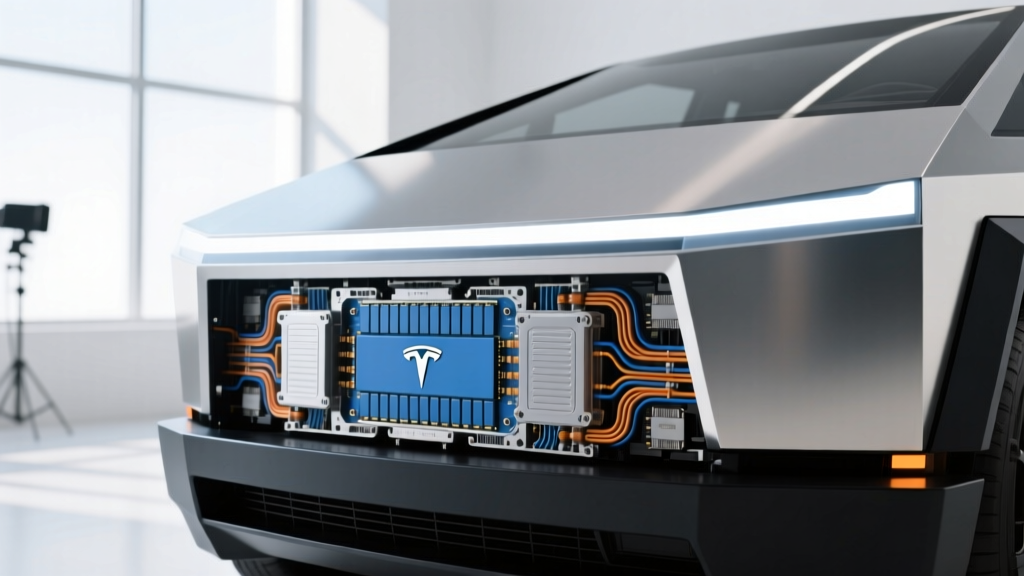
The Cybertruck uses Tesla's proprietary 4680-format cylindrical cells, arranged in a structural battery pack that serves as a stressed member of the vehicle chassis. This is the same cell format Tesla introduced in the Model Y Austin-built variants, but scaled up significantly for the truck's energy demands.
4680 Cell Chemistry: NMC vs. LFP Explained
The Cybertruck uses Nickel Manganese Cobalt (NMC) chemistry in its 4680 cells. This is not a choice — Tesla reserves Lithium Iron Phosphate (LFP) chemistry for its Standard Range / rear-wheel-drive models (Model 3, Model Y RWD) where energy density is less critical. For a heavy, high-performance truck, NMC is the only viable option in the current lineup.
Understanding the chemistry trade-offs helps explain why Tesla made this choice and what it means for your ownership experience:
| Factor | NMC (Cybertruck) | LFP (Model 3/Y RWD) |
|---|---|---|
| Energy Density | High (~240–260 Wh/kg cell-level) | Moderate (~160–180 Wh/kg) |
| Cycle Life | ~1,000–1,500 full cycles to 80% SoH | ~3,000–5,000 full cycles to 80% SoH |
| Cold-Weather Performance | Better low-temp discharge capability | More sluggish below freezing; needs preconditioning |
| Cost per kWh | Higher (nickel/cobalt commodity exposure) | Lower (iron/phosphate abundant) |
| Recommended Daily Charge Limit | 80% (charge to 100% only for trips) | 100% OK for daily use (Tesla recommends weekly 100%) |
| Thermal Stability | Good with active thermal management | Excellent — inherently more stable chemistry |
What this means for Cybertruck owners: You cannot charge to 100% daily without accelerating degradation. Set your daily charge limit to 80% and only push to 100% when you need maximum range for a road trip. This single habit is the most impactful thing you can do for long-term battery health. LFP owners don't face this constraint — it's one reason LFP is gaining share in lighter vehicles.
Battery Degradation: What the Data Actually Shows
EV battery degradation follows a well-documented curve: a steeper initial drop in the first 20,000–30,000 miles, then a long, gradual linear decline. Tesla's own 2023 Impact Report (the most recent comprehensive dataset published) showed that Model 3 and Model Y vehicles retained approximately 85% of their original battery capacity after 200,000 miles. The 4680-cell packs in the Cybertruck are expected to follow a similar pattern, though the structural pack design and larger thermal mass may offer slight advantages in thermal management.
- Year 1 / ~15,000 mi: ~3–5% capacity loss (initial formation loss)
- Year 3 / ~45,000 mi: ~7–10% total loss
- Year 5 / ~75,000 mi: ~10–13% total loss
- Year 8 / ~120,000 mi: ~13–18% total loss
- Year 10 / ~150,000 mi: ~15–22% total loss (varies widely by usage habits)
Sources: Tesla Impact Reports, tesla.com; Recurrent Auto battery health data across 15,000+ vehicles.
For the Cybertruck AWD with its 340-mile EPA range, a 15% degradation at ~120,000 miles would reduce usable range to approximately 289 miles EPA — still very livable for daily driving and road trips. The truck's massive ~123 kWh battery gives it a large buffer; even with meaningful degradation, the absolute range numbers remain competitive with many new EVs.
Several factors accelerate or slow this curve, and they matter more than most owners realize:
- Fast-charging frequency: Exclusive DC fast charging (150–250 kW) can add 1–3% additional degradation per year compared to primarily Level 2 home charging. The 4680 cell's tabless design reduces internal resistance and heat generation, partially mitigating this.
- State of charge extremes: Regularly sitting at 100% SoC or dropping below 10% stresses NMC cathodes. The 20–80% daily window is the longevity sweet spot.
- Temperature exposure: Repeated high-heat exposure (above 95°F ambient with high SoC) is more damaging than cold. The Cybertruck's active liquid thermal management system works to keep cells in the 68–95°F optimal range.
- Calendar aging: Even a parked EV degrades. A Cybertruck stored at 100% SoC in a hot garage will lose more capacity than one stored at 50% in a temperate climate.
Cybertruck Battery Warranty: What Tesla Covers
Tesla provides a battery and drive unit warranty on the Cybertruck that aligns with its other premium vehicles. The warranty covers defects in materials or workmanship and guarantees a minimum capacity retention threshold:
| Component | Warranty Period | Mileage Cap | Capacity Retention Threshold |
|---|---|---|---|
| Battery Pack (HV traction) | 8 years | 150,000 miles (whichever comes first) | 70% of original capacity |
| Drive Unit(s) | 8 years | 150,000 miles | N/A (defect coverage) |
| Vehicle Limited Warranty | 4 years | 50,000 miles | N/A (bumper-to-bumper) |
Key details owners often miss:
- The 70% threshold means Tesla will only replace or repair the battery if it degrades below 70% of its original capacity within the warranty window. A drop to 72% at 140,000 miles, while frustrating, is not a warranty claim.
- The warranty covers the battery against manufacturing defects and excessive degradation, but not damage from accidents, flooding, or misuse.
- Tesla may replace with a new or remanufactured pack — the warranty language allows either, as long as the replacement meets the 70% threshold.
- Warranty claims require Tesla to verify State of Health through their diagnostic systems. Keep records of any third-party battery health checks you perform.
For context, the U.S. Department of Energy notes that modern EV batteries are designed to outlast the typical ownership period, and federal regulations mandate a minimum of 8 years / 100,000 miles for emissions-related components on PHEVs — Tesla exceeds this baseline on mileage for the Cybertruck.
Battery Replacement Cost: When and How Much
This is the question that generates the most anxiety among prospective EV buyers. Let's put it in context: the vast majority of EV batteries are never replaced during the vehicle's useful life. Tesla's fleet data shows that complete battery pack failures (as opposed to gradual degradation) are rare, affecting well under 1% of vehicles.
That said, if you plan to keep a Cybertruck for 15+ years or 200,000+ miles, or if you buy a high-mileage used example, replacement cost is a legitimate planning factor:
| Scenario | Estimated Cost (Parts + Labor) | When It's Typically Needed |
|---|---|---|
| Full pack replacement (out of warranty) | $20,000–$35,000 | Rare before 200,000+ mi; most packs still functional at 80% SoH |
| Module-level repair (individual cell group) | $3,000–$8,000 | If specific modules fail or imbalance; 4680 structural pack may limit this option |
| 12V auxiliary battery (Li-ion) | $200–$400 | Every 4–7 years; separate from the HV traction battery |
The 4680 structural pack design presents a unique challenge: because the cells are bonded into the vehicle's structure (they're part of the chassis, not a removable module), a full pack replacement is a major service event. This design choice improves rigidity, reduces weight, and lowers manufacturing cost — but it means that out-of-warranty battery replacement will likely require a Tesla service center rather than an independent shop, at least until aftermarket solutions mature over the next decade.
Maximizing Cybertruck Battery Health: An Owner's Checklist
Whether you've taken delivery or are researching before ordering, these habits will meaningfully extend your battery's useful life and preserve resale value:
- Set daily charge limit to 80%. Use the Tesla app or in-car settings. Only charge to 100% when departing on a trip, and try to time it so the truck doesn't sit at 100% for more than a few hours.
- Don't let it sit below 10% for extended periods. If you're parking for a week or more, aim for 40–60% SoC. The car's "vampire drain" (phantom loads from Sentry Mode, connectivity) can slowly pull a low battery into a danger zone.
- Precondition before DC fast charging. Navigate to a Supercharger using the car's built-in navigation — this triggers battery preconditioning, warming the cells to the optimal temperature for fast charging (~95°F). Skipping this can slow your charge session and cause uneven cell stress.
- Use Level 2 home charging as your primary method. A home Level 2 charger (7–11.5 kW / 32–48A) is gentler on cells than daily DC fast charging and dramatically cheaper per kWh.
- Minimize prolonged high-heat exposure. If you live in Phoenix, Tucson, or similar climates, park in shade or a garage when possible. High ambient temperature combined with high SoC is the worst-case scenario for calendar aging.
- Limit repeated 0–60 launches. The Cyberbeast's ~845 hp is thrilling, but frequent high-current discharges generate heat that accelerates cell wear. Enjoy it occasionally; don't make it a daily habit.
- Keep Sentry Mode off when parked for long periods. Sentry Mode can consume 20–30 miles of range per day. If you're leaving the truck at an airport for a week, disable it.
How to Check Your Cybertruck's Battery State of Health
Monitoring your battery's State of Health (SoH) doesn't require a service appointment. Here are the methods available to Cybertruck owners:
1. Tesla App & In-Car Display: The Tesla app shows estimated range at a given state of charge, which indirectly reflects degradation. If your 80% charge shows 240 estimated miles when it used to show 260, that's a rough indicator of capacity loss. The in-car energy graph provides real-time and trip-based efficiency data.
2. Manual Calculation: Charge to 100% (do this occasionally for calibration) and note the displayed estimated range. Compare it to the original EPA-rated range. A 340-mile truck now showing 300 miles at 100% indicates roughly 12% degradation. This isn't lab-grade precise, but it's directionally accurate.
3. Third-Party OBD-II Tools: Devices like the OBDLink SX paired with apps such as Scan My Tesla can read the battery management system's (BMS) internal SoH estimate, nominal full pack capacity, and cell voltage delta. This is the most accurate owner-accessible method. Expect to spend $50–$120 on hardware.
4. Tesla Service Diagnostic: Request a battery health report during a service visit. Tesla can pull detailed cell-level data, including individual module balancing status and internal resistance measurements.
For used Cybertruck buyers, a pre-purchase battery health check is essential. Request the seller provide a screenshot of the energy graph at 100% charge and, ideally, an OBD-II SoH reading. A truck with 50,000 miles showing 92% SoH is in excellent shape; one at 85% warrants negotiation on price.
What's Next: Solid-State and Silicon Anode Batteries
The battery technology landscape is evolving, and Cybertruck owners may wonder whether waiting for next-generation batteries makes sense. Here's a grounded look at what's on the horizon:
Silicon Anode Cells: Tesla's 4680 cells already incorporate some silicon in the anode (blended with graphite), which increases energy density compared to pure graphite anodes. Pure silicon anode cells promise 20–40% more energy density but face cycle-life challenges — silicon expands ~300% during charging, causing mechanical stress. Companies like Sila Nanotechnologies and Group14 are working on solutions. Realistic timeline: limited commercial deployment in EVs by 2028–2030, mass adoption likely post-2030.
Solid-State Batteries: These replace the liquid electrolyte with a solid conductor, promising higher energy density, faster charging, and improved safety (no flammable electrolyte). Toyota, Samsung SDI, and QuantumScape have all announced solid-state programs. However, manufacturing at automotive scale remains unsolved. Realistic timeline: low-volume premium vehicles possibly by 2028–2029; cost-competitive mass production not expected before 2032–2035.
Sodium-Ion Batteries: CATL and BYD have begun deploying sodium-ion cells in Chinese-market vehicles. These are cheaper and use no lithium, nickel, or cobalt — but have lower energy density, making them unsuitable for heavy, long-range vehicles like the Cybertruck. Realistic timeline: urban/subcompact EVs and stationary storage by 2026–2028; not relevant for trucks.
The practical takeaway: the NMC 4680 pack in today's Cybertruck is not a dead-end technology. It's a mature, well-engineered system that will serve reliably for 150,000+ miles with proper care. Next-generation chemistries will arrive incrementally and won't be retrofittable into existing vehicles. Buy the truck that meets your needs today rather than waiting for a battery revolution that's still 5–10 years from your driveway.
Cybertruck Battery FAQ
How long do EV batteries last in years and miles?
Modern NMC lithium-ion batteries, like the 4680 cells in the Cybertruck, typically retain 70–85% of their original capacity after 150,000–200,000 miles or 10–15 years. "Last" is relative — the battery doesn't suddenly die; it gradually loses range. Most EV batteries outlast the vehicle's body, suspension, and interior. Complete pack failure before 200,000 miles is statistically rare (well under 1% in Tesla's fleet data).
How much does a Cybertruck battery cost to replace?
An out-of-warranty full pack replacement is estimated at $20,000–$35,000 including labor. However, most Cybertruck batteries will never need replacement — they degrade gradually and remain functional well past 200,000 miles. Within the 8-year/150,000-mile warranty period, Tesla covers replacement if capacity drops below 70%.
What does the Cybertruck battery warranty cover?
Tesla covers the battery pack and drive unit for 8 years or 150,000 miles (whichever comes first). The warranty guarantees the battery will retain at least 70% of its original capacity. It covers manufacturing defects and excessive degradation but not accident damage, flooding, or misuse. Tesla may replace with a new or remanufactured pack.
How do I check and maximize my Cybertruck's battery health?
Check health by comparing your 100% charge range to the original EPA rating, or use an OBD-II tool like Scan My Tesla for precise BMS data. Maximize health by: charging to 80% daily, avoiding prolonged storage above 90% or below 10%, preconditioning before DC fast charging, using Level 2 home charging as your primary method, and minimizing repeated hard acceleration.
LFP vs NMC — which is better for the Cybertruck and why?
For the Cybertruck, NMC is the correct and necessary choice. NMC offers higher energy density (~240–260 Wh/kg vs. ~160–180 Wh/kg for LFP), which is critical for a heavy truck needing 120+ kWh of usable capacity. An LFP pack with equivalent range would be significantly heavier, reducing payload and performance. LFP's advantages — longer cycle life, 100% daily charging tolerance, lower cost — are better suited to lighter vehicles with smaller batteries. Neither chemistry is universally "better"; they serve different vehicle classes.
Does frequent Supercharging damage the Cybertruck battery?
Exclusive DC fast charging adds roughly 1–3% more degradation per year compared to primarily Level 2 charging. The 4680 cell's tabless design reduces internal resistance and heat, partially offsetting this. For road trips, Supercharging is perfectly fine. For daily use, a home Level 2 charger is gentler and significantly cheaper (roughly $0.12–$0.18/kWh at home vs. $0.28–$0.40/kWh at Superchargers, depending on your region).
Will solid-state batteries make my Cybertruck obsolete?
Not for at least a decade. Solid-state batteries are still in pre-commercial stages for automotive applications, with mass production not expected before 2032–2035. They also won't be retrofittable into existing vehicles due to fundamentally different pack architectures. Your Cybertruck's NMC 4680 pack is a capable, durable system that will remain practical for years to come.
For official EPA range and efficiency data, see fueleconomy.gov. For Tesla's official warranty documentation, refer to your vehicle's Tesla warranty page. Federal tax credit eligibility under IRS §30D is subject to MSRP caps, buyer income limits, and battery component sourcing requirements — consult irs.gov or a tax professional before relying on credit amounts in your purchase decision.