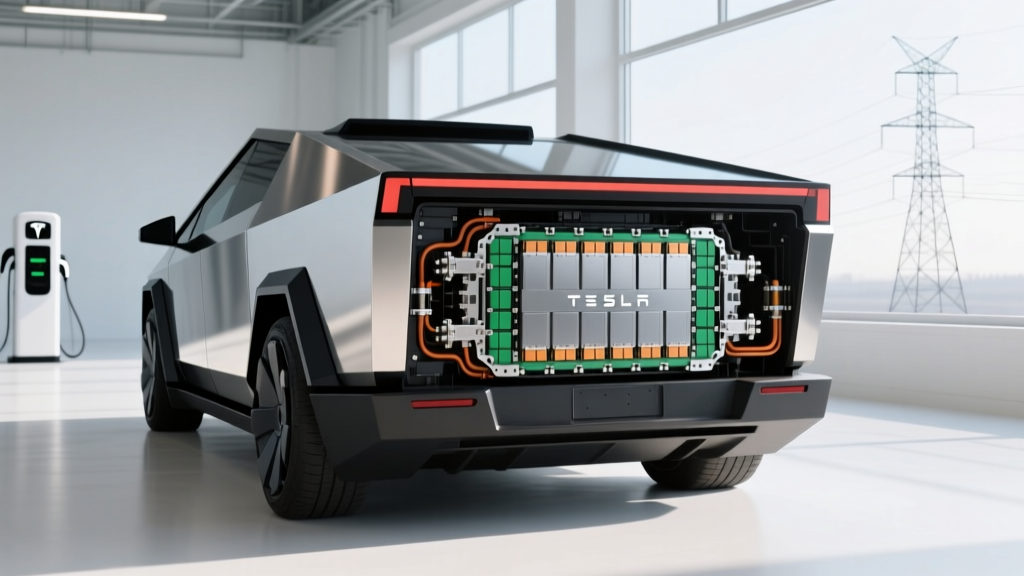
The Tesla Cybertruck's high-voltage traction battery is one of the largest and most technically interesting packs on the road. With a usable capacity around 123 kWh (approximately 150 kWh gross in the Cyberbeast and AWD trims), it has to move a 6,700+ lb stainless-steel truck while delivering 340+ miles of EPA range. But beyond the sticker numbers, buyers and owners want to know: what chemistry is inside, how fast will it degrade, what does the warranty actually cover, and what happens if the pack needs replacement?
This guide breaks down the Cybertruck battery system with real data, compares Tesla's NMC approach against the LFP chemistry used in the Model 3/Y RWD, and gives you a practical framework for maximizing pack longevity over a decade or more of ownership.
Cybertruck Battery Specifications at a Glance
| Specification | Cybertruck AWD | Cybertruck Cyberbeast |
|---|---|---|
| Battery chemistry | NMC (Nickel Manganese Cobalt) | NMC (Nickel Manganese Cobalt) |
| Gross pack capacity | ~150 kWh | ~150 kWh |
| Usable capacity | ~123 kWh | ~123 kWh |
| EPA range | 340 mi | 320 mi |
| Real-world highway range | ~270–290 mi | ~250–270 mi |
| Peak DC fast charge rate | ~250 kW | ~250 kW |
| 10–80% DC charge time | ~30 min (preconditioned) | ~30 min (preconditioned) |
| Level 2 charge rate | 11.5 kW (48A) | 11.5 kW (48A) |
| Horsepower | 600 hp | 845 hp |
| 0–60 mph | 3.9 sec | 2.6 sec |
| Battery warranty | 8 yr / 150,000 mi | 8 yr / 150,000 mi |
| Base MSRP (2025) | $79,990 | $99,990 |
Real-world range caveat: The EPA numbers assume mixed driving at moderate temperatures. In our experience and consistent with third-party highway tests, expect roughly 15–20% range reduction at sustained 75+ mph highway speeds, and an additional 15–30% loss in sub-freezing temperatures. The Cybertruck's brick-like aerodynamic profile (Cd ~0.38) penalizes highway efficiency more than a sedan like the Model S. Plan for ~270 miles of real-world highway range in the AWD and ~250 in the Cyberbeast under typical conditions.
NMC vs LFP: Why the Cybertruck Uses Nickel Manganese Cobalt
Tesla uses two primary battery chemistries across its lineup. The Cybertruck, Model S, Model X, and Long Range / Performance variants of the Model 3 and Model Y all use NMC (or NCA — Nickel Cobalt Aluminum, a close variant) cells. The Model 3 and Model Y Rear-Wheel-Drive trims use LFP (Lithium Iron Phosphate) cells. Understanding this split is critical for evaluating the Cybertruck's long-term ownership profile.
| Attribute | LFP (Lithium Iron Phosphate) | NMC (Nickel Manganese Cobalt) |
|---|---|---|
| Energy density | Lower (~160 Wh/kg cell-level) | Higher (~250–270 Wh/kg cell-level) |
| Cycle life | 3,000–5,000+ cycles | 1,000–2,000 cycles |
| Cold-weather performance | Weaker (greater range loss below freezing) | Better (more tolerant of low temps) |
| Cost per kWh | Lower (~$80–100/kWh at scale) | Higher (~$120–150/kWh at scale) |
| Recommended daily SoC | 100% (no penalty) | 80% for daily; 100% for trips only |
| Thermal stability | Excellent (higher runaway threshold) | Good (requires more active management) |
| Typical Tesla application | Model 3/Y RWD | Cybertruck, Model S/X, LR/Performance |
Why NMC for the Cybertruck? The truck needs maximum energy density to achieve 340 miles of range in an already heavy vehicle. An LFP pack of equivalent capacity would weigh several hundred pounds more and require more physical space — neither of which the Cybertruck's design can accommodate. The trade-off is a shorter cycle life and the requirement to charge to only 80% for daily use, reserving 100% for road trips.
For context, Tesla's 4680 cells used in the Cybertruck are structurally integrated into the vehicle's frame (a "structural battery pack"), meaning the cells themselves bear mechanical loads. This is a manufacturing and weight-saving innovation but also means individual cell replacement is not practical — the pack is serviced as a unit.
Cybertruck Battery Degradation: What the Data Shows
Every lithium-ion battery loses capacity over time. The question is how much, and how fast. Based on Tesla's own Impact Report data and aggregated fleet telemetry from sources like Recurrent Auto, here is what we know about NMC pack degradation in Tesla vehicles:
• Year 1 / 15,000 mi: ~3–5% capacity loss (initial formation loss)
• Year 3 / 45,000 mi: ~7–9% total loss
• Year 5 / 75,000 mi: ~9–12% total loss
• Year 8 / 120,000 mi: ~12–15% total loss
• 150,000 mi: ~14–17% total loss
Key insight: Degradation is front-loaded. Most capacity loss occurs in the first 20,000–30,000 miles, after which the curve flattens significantly. This is consistent across Tesla's NMC fleet (Model S, X, 3 LR, Y LR) and is expected to apply to the Cybertruck's 4680 NMC pack.
For the Cybertruck specifically, a 15% loss on a 123 kWh usable pack means roughly 104 kWh usable after 8 years — translating to approximately 289 miles of EPA-equivalent range from an original 340. That's still highly functional for daily use and road trips alike.
The 4680 cell format is newer than the 2170 cells in the Model 3/Y, so long-term fleet data specific to the Cybertruck is still accumulating (the truck launched in late 2023). However, the underlying NMC chemistry degradation physics are well-established, and Tesla's thermal management system — which actively heats and cools the pack — is among the best in the industry at slowing degradation.
Battery Warranty: What Tesla Covers (and What It Doesn't)
| Component | Coverage Period | Details |
|---|---|---|
| High-voltage battery | 8 years / 150,000 miles (whichever comes first) | Capacity retention ≥70% of original |
| Drive unit(s) | 8 years / 150,000 miles | Defects in materials/workmanship |
| Vehicle limited warranty | 4 years / 50,000 miles | Bumper-to-bumper (non-battery) |
Tesla's battery warranty guarantees that the Cybertruck's pack will retain at least 70% of its original capacity during the coverage period. If the pack falls below that threshold within 8 years or 150,000 miles, Tesla will repair or replace it at no cost to bring capacity back above 70%. Note: the replacement pack may be a refurbished unit — not necessarily brand new — but it will meet the 70% retention standard.
What voids the warranty? According to Tesla's warranty documentation, opening or modifying the battery pack, using the vehicle as a stationary power source beyond specified V2H/V2L limits, or damage from accidents, flooding, or fire are excluded. Normal degradation above the 70% threshold is not a warranty claim — it's expected behavior.
For comparison, this warranty is in line with the industry standard. Hyundai offers 8 years/100,000 miles on the Ioniq 5, Ford offers 8 years/100,000 miles on the F-150 Lightning, and Rivian offers 8 years/175,000 miles on the R1T. Tesla's 150,000-mile threshold is mid-pack and appropriate for a vehicle rated for heavy towing and payload use.
Battery Replacement Cost: What Cybertruck Owners Should Budget For
Let's address the concern directly: how much does it cost to replace a Cybertruck battery out of warranty? Based on current Tesla service pricing, industry estimates, and comparable large-pack replacements:
| Vehicle | Pack Size (usable) | Estimated Replacement Cost |
|---|---|---|
| Tesla Model 3 RWD (LFP) | ~57 kWh | $8,000–$12,000 |
| Tesla Model Y LR (NMC) | ~75 kWh | $12,000–$16,000 |
| Tesla Cybertruck (NMC 4680) | ~123 kWh | $18,000–$25,000 |
| Ford F-150 Lightning Ext. Range | ~131 kWh | $20,000–$28,000 |
| GMC Hummer EV | ~212 kWh | $30,000–$40,000 |
The Cybertruck's estimated $18,000–$25,000 replacement cost reflects the large pack size and the structural integration of the 4680 cells, which requires specialized labor. However, this figure requires critical context:
Battery costs continue to decline. BloombergNEF data shows pack-level lithium-ion prices have fallen from over $1,200/kWh in 2010 to approximately $120–$140/kWh in 2025. By the time a Cybertruck might need an out-of-warranty replacement (year 10–12), replacement costs could be significantly lower than today's estimates.
Factors That Accelerate (or Slow) Battery Degradation
Not all Cybertruck miles are created equal. The following factors have the greatest impact on long-term pack health:
- Daily charge limit: Set to 80% for everyday driving. Only charge to 100% when departing on a road trip within 24 hours. Prolonged storage at 100% SoC accelerates NMC degradation.
- Avoid frequent DC fast charging: Supercharging at 250 kW is convenient but generates significant heat. Occasional Supercharging is fine; daily Supercharging measurably increases degradation rate. Tesla's own fleet data shows vehicles that primarily charge on Level 2 degrade ~2–3% less over 100,000 miles than those that Supercharge daily.
- Precondition before Supercharging: Navigate to a Supercharger using the Tesla app or in-car nav — the car will automatically precondition the battery (heat it to optimal temperature) for faster charging and less thermal stress.
- Avoid extreme SoC storage: If storing the Cybertruck for more than a week, leave it plugged in at 50% SoC. Never store at 100% or below 10%.
- Cold weather charging: In sub-freezing temperatures, always precondition before charging. Charging a cold NMC pack causes lithium plating on the anode, which permanently reduces capacity.
- Minimize track/launch mode sessions: Repeated hard acceleration generates sustained high-current discharge, heating the cells beyond normal operating range.
- Keep firmware updated: Tesla regularly refines battery management algorithms via OTA updates. These updates can improve thermal management and charging profiles.
The single most impactful habit for Cybertruck NMC longevity: charge to 80% daily on a Level 2 home charger and reserve Supercharging for road trips. This mirrors the approach Tesla engineers have publicly recommended and is consistent with peer-reviewed lithium-ion aging research.
Monitoring Battery Health: How to Check SoH
Tesla does not expose a direct State of Health (SoH) percentage in the Cybertruck's interface the way some competitors (like Hyundai with its Bluelink diagnostics) do. However, there are several methods to monitor your pack:
In-car method: The Cybertruck displays estimated range at your current SoC. Track the "rated range at 100%" figure over time. If your truck showed 340 rated miles at 100% when new and now shows 310 at 100%, that's approximately a 9% degradation — normal for the first 20,000–30,000 miles.
Third-party apps: Services like Tessie, TeslaFi, and Stats (for Tesla) log detailed battery telemetry via Tesla's API, including estimated SoH, energy consumed per mile, and charge/discharge patterns. These tools provide a more granular picture than the in-car display alone.
Service center diagnostics: Tesla service centers can run a full battery health report that reads individual module voltages, internal resistance, and calculated capacity. Request this if you suspect abnormal degradation or before a warranty claim.
OBD-II tools: While Tesla's OBD-II port is limited compared to legacy automakers, tools like the OBDeleven-style Tesla-specific scanners can read pack voltage, current, and temperature data in real time, useful for enthusiasts who want granular monitoring.
Looking Ahead: Solid-State and Silicon Anode Batteries
The battery industry is actively developing next-generation chemistries that could eventually surpass NMC and LFP. Two technologies are most relevant to future Tesla vehicles:
Silicon anode cells: Replacing the graphite anode with silicon can increase energy density by 20–40%. Tesla's 4680 cells already incorporate a silicon-composite anode to a limited degree. Companies like Sila Nanotechnologies and Group14 are scaling production, with broader automotive adoption expected between 2027–2030. This is incremental evolution, not a revolution.
Solid-state batteries: These replace the liquid electrolyte with a solid material, promising higher energy density, faster charging, and improved safety. Toyota, Samsung SDI, and QuantumScape have all announced prototype solid-state cells. However, no solid-state battery is currently in mass production for any consumer EV as of 2026. Realistic timelines for cost-competitive, high-volume solid-state packs remain 2028–2032, per BloombergNEF analysis. If you're buying a Cybertruck today, you are not missing a near-term solid-state option.
The practical takeaway: NMC 4680 cells represent current best-available technology for a high-performance, high-range truck. Waiting for solid-state means waiting at minimum 3–5 years for any vehicle offering it at scale, likely at a significant price premium initially.
Frequently Asked Questions
How long do Cybertruck batteries last in years and miles?
Based on Tesla's NMC fleet data, expect the Cybertruck's battery to retain approximately 85–88% of its original capacity at 100,000 miles and roughly 82–85% at 150,000 miles. In years, that translates to strong performance through 10–12 years of typical ownership (12,000–15,000 miles/year). The pack is engineered for 200,000+ miles before reaching the 70% capacity threshold that defines end-of-life for automotive use. Even at 70% capacity, the truck remains fully drivable — it simply has reduced range.
How much does a Cybertruck battery cost to replace?
Current estimates place an out-of-warranty Cybertruck battery replacement at $18,000–$25,000 including labor, given the ~123 kWh usable pack size and structural integration of the 4680 cells. This is comparable to other large-pack EVs like the F-150 Lightning Extended Range. However, battery replacement is rare — industry data shows fewer than 1.5% of EVs need a pack swap. Tesla's 8-year/150,000-mile warranty covers capacity loss below 70%, and declining cell costs mean a replacement in 2034–2036 could cost significantly less than today's estimates.
What does the Cybertruck battery warranty cover?
Tesla covers the high-voltage battery for 8 years or 150,000 miles, whichever comes first. The warranty guarantees the pack will retain at least 70% of its original capacity. If it falls below that threshold, Tesla repairs or replaces the pack (potentially with a refurbished unit) to bring capacity above 70%. The warranty does not cover damage from accidents, modifications, misuse, or normal degradation above the 70% line. The drive units share the same 8-year/150,000-mile coverage.
How do I check and maximize Cybertruck battery health?
Monitor health by tracking the rated range displayed at 100% SoC over time, or use third-party apps like Tessie or TeslaFi for detailed SoH estimates via Tesla's API. Maximize longevity by charging to 80% daily on Level 2, limiting DC fast charging to road trips, preconditioning before Supercharging, avoiding prolonged storage at extreme SoC levels, and keeping the vehicle's firmware updated. For NMC chemistry specifically, the 20–80% daily window is the single most impactful habit for long-term capacity retention.
LFP vs NMC: Which battery chemistry is better?
Neither is universally better — they serve different use cases. LFP offers longer cycle life (3,000–5,000+ cycles), lower cost, superior thermal stability, and the ability to charge to 100% daily without penalty. Its drawbacks are lower energy density and worse cold-weather performance. NMC delivers higher energy density (critical for heavy, long-range vehicles like the Cybertruck) and better cold-weather behavior, but has a shorter cycle life and requires an 80% daily charge limit. For a truck needing 340 miles of range, NMC is the correct engineering choice. For a commuter sedan, LFP is often the smarter long-term ownership play.