The single most persistent fear among prospective EV buyers isn't range or charging speed — it's the battery. Specifically: what happens when it degrades, and what's the actual cost to replace an EV battery if something goes wrong? The short answer is that most modern traction batteries outlast the vehicles they power, and federal warranty mandates protect you for at least eight years. But when a replacement is needed — whether from a manufacturing defect that slipped past warranty, collision damage, or extreme high-mileage degradation — the price varies enormously depending on chemistry, capacity, and the model you drive.
This guide breaks down replacement costs with real figures from current 2026 models, explains the chemistry driving those costs, shows you what degradation actually looks like over time, and gives you actionable steps to monitor and maximize your battery's State of Health (SoH).
How Much Does It Cost to Replace an EV Battery?
Replacement cost is driven primarily by battery capacity (measured in kilowatt-hours, or kWh — the total energy the pack stores) and chemistry. As of early 2026, lithium-ion pack pricing has fallen to roughly $110–$140 per kWh at the cell level, but the fully installed cost including the pack, labor, programming, and cooling-system service is significantly higher. Here's what you're looking at across popular current models:
| Vehicle | Battery Capacity | Chemistry | Est. Replacement Cost |
|---|---|---|---|
| Chevrolet Equinox EV | 85 kWh | NMC | $12,000 – $15,500 |
| Tesla Model 3 RWD | 60 kWh | LFP | $9,000 – $12,000 |
| Tesla Model Y Long Range | 75 kWh | NMC | $13,000 – $17,000 |
| Hyundai Ioniq 5 (Std Range) | 63 kWh | NMC | $10,000 – $14,000 |
| Ford F-150 Lightning Ext. Range | 131 kWh | NMC | $20,000 – $28,000 |
| BMW iX xDrive50 | 111.5 kWh | NMC | $22,000 – $30,000 |
| Nissan Leaf (40 kWh) | 40 kWh | NMC | $6,500 – $9,000 |
These figures represent out-of-warranty, full-pack replacements at manufacturer-authorized service centers. Labor typically accounts for $1,500–$3,500 of the total. Independent EV shops are beginning to offer refurbished packs at 30–50% below OEM pricing, though availability remains limited to high-volume models like older Teslas and Leafs.
An important nuance: most batteries never need a full replacement. According to the U.S. Department of Energy, the average EV battery retains 90% or more of its original capacity after 100,000 miles. Full replacements are overwhelmingly driven by early manufacturing defects — which are covered under warranty — or physical damage from collisions, not gradual wear.
Battery Chemistry: LFP vs. NMC Trade-Offs
The two dominant lithium-ion chemistries in 2026 EVs are LFP (lithium iron phosphate) and NMC (nickel manganese cobalt). The chemistry in your vehicle directly affects not only replacement cost but also daily range, longevity, and how you should charge.
| Attribute | LFP (Lithium Iron Phosphate) | NMC (Nickel Manganese Cobalt) |
|---|---|---|
| Energy Density | Lower (~160 Wh/kg cell-level) | Higher (~250 Wh/kg cell-level) |
| Typical Range per kWh | Slightly less range for same pack weight | More range per pound — preferred for long-range models |
| Cycle Life | 3,000–5,000+ cycles to 80% SoH | 1,000–2,000 cycles to 80% SoH |
| Cold-Weather Performance | More range loss in freezing temps (15–30%) | Better cold performance (10–20% loss) |
| Charging to 100% | Recommended regularly for SoH calibration | Better kept at 80% daily; 100% for trips only |
| Cost per kWh | ~$80–$100 (cell level) | ~$110–$140 (cell level) |
| Cobalt Content | None — lower supply-chain risk | Contains cobalt — higher sourcing complexity |
| Found In | Tesla Model 3/Y RWD, base BYD models | Most long-range, AWD, and luxury EVs |
Which is better? Neither is universally superior — it depends on your driving pattern. If you commute daily, charge at home, and don't regularly need maximum range, LFP is the longevity champion. Its cycle life is roughly double that of NMC, and you can charge it to 100% without degradation anxiety. If you need 300+ miles of range, live in a cold climate, or frequently road-trip, NMC's higher energy density and better cold performance justify the trade-off of keeping daily charge at 80%.
How Long Do EV Batteries Actually Last?
"How long will it last?" is the most-searched battery question, and the answer has two dimensions: calendar age and cycle count. Modern thermal management systems — liquid cooling and heating — have largely eliminated the rapid degradation that plagued early EVs like the 2011–2017 Nissan Leaf (which lacked active cooling).
Real-World Degradation Data
Based on fleet data and owner-reported measurements aggregated by sources like Recurrent Auto and Geotab, here's what typical degradation looks like for liquid-cooled packs in 2026-era vehicles:
- Year 1 / 15,000 mi: 1–2% capacity loss (initial formation loss)
- Year 3 / 45,000 mi: 3–5% total loss
- Year 5 / 75,000 mi: 5–8% total loss
- Year 8 / 120,000 mi: 8–12% total loss
- Year 10 / 150,000 mi: 10–15% total loss
This means a vehicle with a 300-mile EPA range would realistically deliver around 255–270 miles after 8 years of typical use — still entirely functional for daily driving. The degradation curve is nonlinear: the steepest drop occurs in the first year, then it flattens considerably. Most owners will sell or trade the vehicle before degradation becomes a practical inconvenience.
Geotab's large-scale study of over 10,000 EVs found that the average battery lost just 2.3% of capacity per year, meaning at 10 years the average pack still retained roughly 77% of its original capacity — well above the 70% warranty threshold most manufacturers guarantee.
What Does the Battery Warranty Actually Cover?
Federal law mandates that EV batteries carry a minimum warranty of 8 years / 100,000 miles (10 years / 150,000 miles in California Air Resources Board states). This is not a bumper-to-bumper warranty — it specifically covers the high-voltage traction battery against:
- Manufacturing defects: Cell failures, BMS (battery management system) faults, cooling system leaks affecting the pack
- Excessive capacity loss: Most manufacturers define this as dropping below 70% of original capacity within the warranty period
- Safety-related failures: Thermal events, insulation breakdown
| Manufacturer | Warranty Term | Capacity Retention Threshold |
|---|---|---|
| Tesla (Model 3/Y) | 8 yr / 100,000 mi (RWD) or 120,000 mi (LR/AWD) | 70% |
| Hyundai / Kia | 10 yr / 100,000 mi | 70% |
| Ford | 8 yr / 100,000 mi | 70% |
| General Motors (Chevy/Cadillac) | 8 yr / 100,000 mi | 70% |
| BMW | 8 yr / 100,000 mi | 70% |
| Rivian | 8 yr / 120,000 mi | 70% |
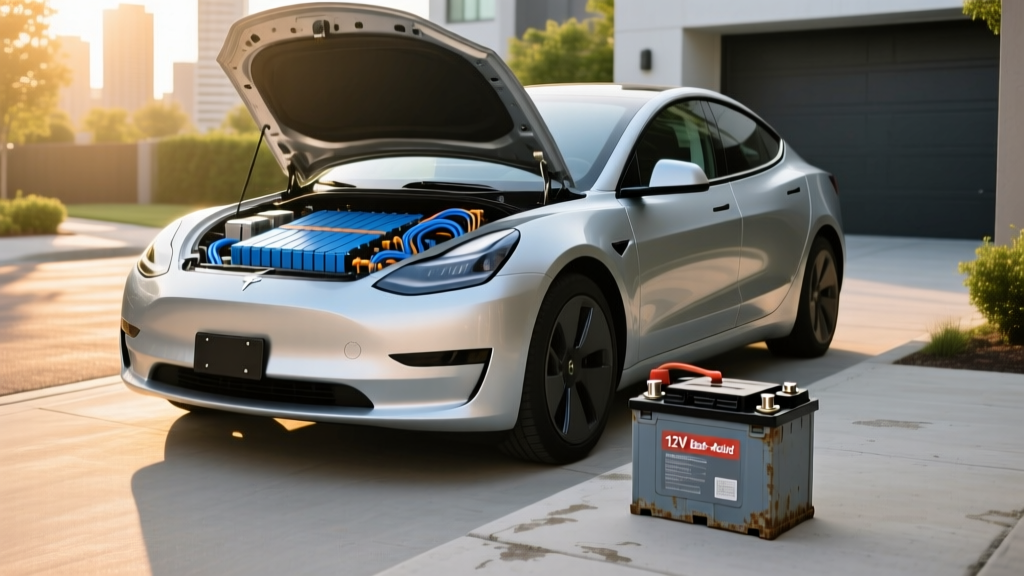
What's NOT covered: Damage from collisions, flooding, or aftermarket modifications; capacity loss from consistently ignoring charge recommendations (though this is nearly impossible for a manufacturer to prove); and the 12V auxiliary battery, which is a separate component with its own shorter warranty (typically 3 years / 36,000 miles).
A critical detail: the warranty threshold of 70% does not mean your battery will be replaced at 70%. It means the manufacturer will repair or replace the pack (or individual modules, if the design allows) to bring it back above that threshold. Module-level repair is increasingly common and significantly less expensive than a full pack swap.
Factors That Accelerate Battery Degradation
Not all miles are equal when it comes to battery wear. These are the documented factors that push degradation above the average curve:
Fast-Charging Frequency
DC fast charging (Level 3, typically 50–350 kW) generates significant heat inside the cells. Occasional fast charging on road trips has a negligible effect, but daily DC fast charging — especially at 150+ kW — can add 1–3% of additional capacity loss per year compared to Level 2 home charging. Modern vehicles mitigate this with battery preconditioning (warming or cooling the pack to the optimal temperature before charging), but the physics of high-current charging still creates stress.
Extreme Temperatures
Sustained exposure to ambient temperatures above 95°F accelerates chemical degradation inside the cells. Similarly, charging a cold battery (below 32°F) without preconditioning can cause lithium plating — a condition where metallic lithium deposits form on the anode, permanently reducing capacity. Garage parking in hot climates and preconditioning in cold climates are the simplest mitigations.
State of Charge Habits
For NMC batteries, routinely storing the vehicle at 100% SoC or letting it sit at 0% for extended periods stresses the cells. The ideal daily range for NMC is 20–80% SoC. LFP batteries are the exception here — manufacturers like Tesla and BYD recommend charging LFP packs to 100% at least once a week to allow the BMS to calibrate cell voltages accurately.
- ✅ Charge NMC to 80% daily; 100% only before long trips
- ✅ Charge LFP to 100% at least weekly for BMS calibration
- ✅ Use Level 2 home charging as your primary method
- ✅ Enable battery preconditioning before DC fast charging
- ✅ Avoid leaving the vehicle at 0% or 100% SoC for more than 24 hours
- ✅ Park in shade or a garage during sustained heat waves
- ✅ Minimize DC fast charging to 1–2 sessions per week when possible
How to Check Your Battery's State of Health (SoH)
State of Health (SoH) is the percentage of your battery's original usable capacity that remains. A new battery is 100% SoH; a battery that originally held 75 kWh but now holds 67.5 kWh is at 90% SoH. Here's how to monitor it:
In-Vehicle Displays
Some 2026 models — including Tesla (via the Service menu or third-party apps), Hyundai/Kia (in the EV settings menu), and Mercedes-Benz (via the MBUX energy display) — show a battery health percentage directly. However, many manufacturers do not surface this data natively, which is frustrating for owners who want transparency.
OBD-II Diagnostic Tools
Devices like the OBDLink SX or vLinker FS, paired with apps such as EV Bat Health or Car Scanner ELM OBD2, can read the battery management system's SoH estimate through the OBD-II port. These readings pull directly from the BMS and are generally accurate within 1–2%. This is the most reliable DIY method.
Dealer or Independent Diagnostic
Requesting a battery health report during a service visit gives you a manufacturer-certified SoH reading. This is especially useful if you're approaching the warranty capacity threshold and want documentation of any excessive degradation. Some dealers will perform this check at no charge; others bill it as a diagnostic fee ($100–$175).
Third-Party Monitoring Services
Services like Recurrent connect to your vehicle's telematics and track battery health over time, providing range degradation reports and warranty-risk alerts. These are free for most supported models and provide the kind of longitudinal data that's invaluable if you ever need to make a warranty claim.
When Is a Replacement Actually Needed?
Given the degradation data above, the honest answer is: rarely during normal ownership. The scenarios where a battery replacement becomes necessary are:
- Manufacturing defect (under warranty): A cell group fails prematurely, causing a sudden capacity drop or fault code. The manufacturer covers this entirely. This is the most common replacement scenario and it costs the owner nothing.
- Physical damage (insurance claim): A collision, flood, or ground-strike damages the pack. Comprehensive auto insurance typically covers this, though EV insurance premiums can be 15–25% higher than equivalent gas vehicles due to these repair costs.
- Extreme high-mileage degradation (out of warranty): A vehicle driven 200,000+ miles, especially one used for rideshare or frequent DC fast charging, may see SoH drop below 70% after the warranty expires. At this point, the owner faces a cost-benefit decision: replace the battery, sell the vehicle as-is, or trade it in.
- Catastrophic thermal event: Exceedingly rare in liquid-cooled packs. If it occurs, it's typically covered by warranty or insurance.
For context, a 2024 study by IIHS found that fewer than 1.5% of EVs required any battery-related service event in the first 8 years of ownership, and the vast majority of those were covered under warranty.
Emerging Battery Technology: What's on the Horizon
While current lithium-ion technology is mature and proven, several next-generation chemistries are in advanced development. These are not available in production vehicles as of 2026, but they will shape replacement costs and longevity in the coming decade:
Solid-State Batteries
Solid-state cells replace the liquid electrolyte with a solid material (ceramic, sulfide, or polymer), promising higher energy density (~400 Wh/kg), faster charging, and dramatically improved cycle life. Toyota has announced limited production for 2027–2028, and Samsung SDI is targeting 2027 for mass production. Realistically, solid-state packs won't appear in mainstream, sub-$50,000 vehicles until the early 2030s. When they do, their longer cycle life could push replacement intervals well beyond 300,000 miles.
Silicon Anode Technology
Companies like Sila Nanotechnologies and Group14 are replacing graphite anodes with silicon-dominant materials, boosting energy density by 20–40% without changing the cathode chemistry. This is closer to market — partial silicon anodes are already in some 2025–2026 cells — and will incrementally reduce the cost per kWh over the next few years.
Sodium-Ion Batteries
CATL and BYD have begun producing sodium-ion packs for lower-range, budget EVs in China. Sodium-ion is cheaper than LFP but has lower energy density, making it best suited for city cars with 150–200 miles of range. U.S. availability is expected around 2027–2028 in entry-level models.
All of these technologies point in the same direction: lower replacement costs and longer lifespans over time. If you're buying an EV today, current lithium-ion packs are more than adequate — and you'll likely sell the car before any of these next-gen batteries reach your garage.
Frequently Asked Questions
How long do EV batteries last in years and miles?
Most modern liquid-cooled EV batteries retain 85–90% of their original capacity at 100,000 miles and 80–88% at 150,000 miles. In calendar years, expect 10–15+ years of functional service before capacity loss becomes a practical inconvenience. Many EVs will be retired for other reasons (body wear, technology obsolescence) before the battery fails.
How much does an EV battery cost to replace out of warranty?
Between $6,500 and $30,000 depending on the vehicle's battery capacity and chemistry. A compact EV with a 40–60 kWh pack typically costs $6,500–$12,000, while a large truck or luxury SUV with a 100+ kWh pack runs $18,000–$30,000. Labor adds $1,500–$3,500. Module-level repairs, when available, can cut costs by 40–60%.
What does the EV battery warranty cover?
Federal law requires at least 8 years / 100,000 miles of coverage (10 years / 150,000 miles in CARB states). This covers manufacturing defects and capacity loss below 70% of original capacity. It does not cover collision damage, flood damage, or the 12V auxiliary battery. Check your owner's manual for the exact terms specific to your vehicle.
How do I check my EV battery health?
Use an OBD-II scanner with an EV-compatible app (like Car Scanner or EV Bat Health) to read SoH directly from the battery management system. Some vehicles display battery health in the infotainment system. You can also request a certified health report from your dealer during a service visit, or use a telematics service like Recurrent for ongoing monitoring.
LFP vs. NMC — which battery chemistry is better?
LFP wins on longevity (3,000–5,000+ cycles), cost, and the ability to charge to 100% daily without harm. NMC wins on energy density (more range in a lighter pack) and cold-weather performance. For daily commuters who charge at home, LFP is the practical longevity pick. For long-range drivers and cold climates, NMC remains the better choice. Both chemistries are proven and well-supported by current warranty terms.
Does fast charging damage my EV battery?
Occasional DC fast charging has a minimal effect on battery health. Daily fast charging, especially at 150+ kW without preconditioning, can add 1–3% of extra annual degradation. The key mitigations are using your vehicle's preconditioning feature before charging, relying on Level 2 home charging for daily needs, and limiting DC fast charging to road trips or when you genuinely need it.
Should I buy an extended battery warranty?
For most buyers, no. The federally mandated 8-year / 100,000-mile warranty already covers the period when manufacturing defects are most likely to surface, and degradation data shows that capacity loss beyond 8 years is gradual, not catastrophic. Extended warranties may make sense for high-mileage drivers (25,000+ miles/year) who will exhaust the mileage limit before the calendar limit, or for owners planning to keep their vehicle past 150,000 miles. Read the contract carefully — many third-party extended warranties have exclusions that limit their value.