Nissan Leaf Battery Replacement: What Owners Actually Pay
The Nissan Leaf remains one of the most widely owned electric vehicles in the U.S., with over 200,000 units sold domestically since its 2011 debut. As early-model Leafs age past the 10-year mark, a practical question dominates owner forums and service desks: what is the real cost to replace a Nissan Leaf battery, and is it worth doing?
For 2026, the answer depends heavily on which Leaf generation you own, whether you choose a new OEM pack or a refurbished unit, and whether your battery is still under Nissan's 8-year/100,000-mile warranty. This guide covers every angle — from chemistry fundamentals to State of Health monitoring — so you can make an informed decision before writing any checks.
Nissan Leaf Battery Specs and Chemistry Explained
The current-generation Nissan Leaf (2018–present, with ongoing updates) uses lithium-ion battery packs in two configurations:
- 40 kWh pack (Leaf S): EPA-estimated 149 miles of range; uses NMC (nickel manganese cobalt) chemistry
- 62 kWh pack (Leaf SV Plus / SL Plus): EPA-estimated 212–226 miles of range; also NMC chemistry
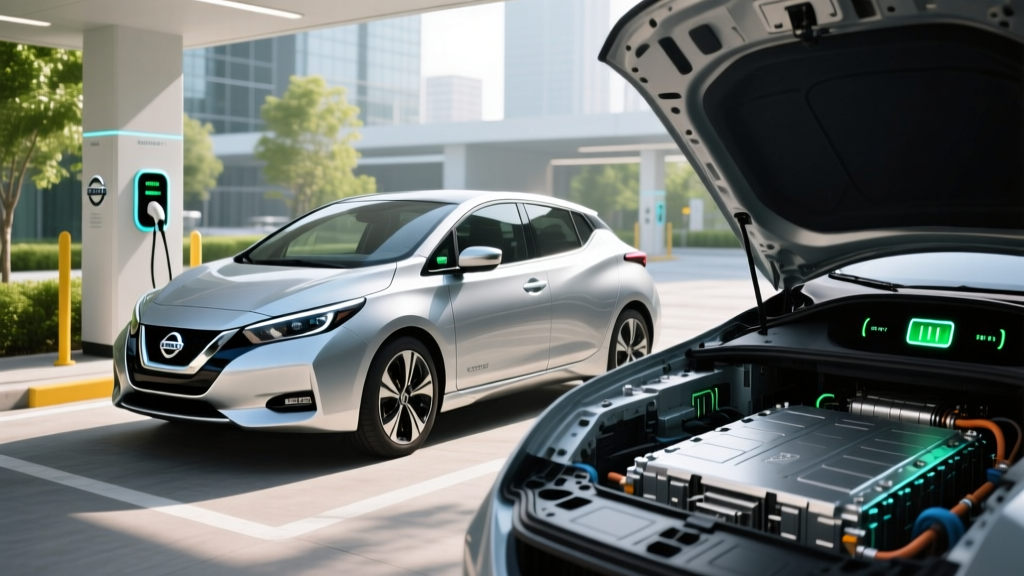
Nissan has historically used air-cooled (passive thermal management) battery packs in the Leaf, unlike the active liquid-cooling systems found in the Chevrolet Bolt, Hyundai Ioniq 5, or Tesla Model 3. This design choice has measurable consequences for long-term degradation and fast-charging behavior — topics we'll cover in detail below.
LFP vs. NMC: Understanding the Chemistry Trade-Offs
While the Nissan Leaf uses NMC chemistry, the broader EV market is increasingly adopting LFP (lithium iron phosphate) packs, particularly in base-trim models from Tesla, Ford, and Hyundai. Here's how the two chemistries compare:
| Attribute | NMC (Leaf's Chemistry) | LFP |
|---|---|---|
| Energy Density | Higher (~200–260 Wh/kg cell-level) — more range in a smaller pack | Lower (~140–180 Wh/kg) — requires larger/heavier pack for equivalent range |
| Cycle Life | ~1,000–2,000 full cycles to 80% SoH | ~3,000–5,000+ full cycles to 80% SoH |
| Cold Performance | Better low-temp conductivity; less range loss below freezing | More range loss in cold; slower charge acceptance below 32°F |
| Cost | Higher raw-material cost (cobalt, nickel) | Lower cost (iron, phosphate — no cobalt or nickel) |
| Thermal Stability | Good, but more sensitive to sustained high temps | Excellent — inherently more resistant to thermal runaway |
| Recommended SoC Range | 20–80% daily; 100% only for trips | Can be charged to 100% regularly without accelerated degradation |
Which is better? For a driver prioritizing maximum range in a compact package and cold-climate usability, NMC wins. For a driver who values longevity, lower replacement cost, and the ability to charge to 100% daily (useful for L2 home charging routines), LFP is the stronger choice. The Leaf's NMC pack delivers competitive range, but its air-cooled thermal design means owners must be more disciplined about charging habits to maximize lifespan.
How Long Do Nissan Leaf Batteries Last?
Based on aggregated fleet data, owner reports, and Nissan's own warranty benchmarks, here is what Leaf battery degradation looks like in practice:
| Milestone | 40 kWh Pack (Typical SoH) | 62 kWh Pack (Typical SoH) | Real-World Range Impact |
|---|---|---|---|
| Year 1 / 15,000 mi | 95–98% | 96–99% | Negligible; ~145 mi / ~210 mi |
| Year 3 / 45,000 mi | 88–93% | 90–95% | ~130–138 mi / ~190–205 mi |
| Year 5 / 75,000 mi | 82–89% | 85–92% | ~122–133 mi / ~180–200 mi |
| Year 8 / 100,000 mi | 72–84% | 78–88% | ~107–125 mi / ~165–190 mi |
| Year 10 / 130,000 mi | 65–80% | 72–85% | ~97–119 mi / ~153–182 mi |
Key observations:
- Degradation is not linear. The steepest capacity loss typically occurs in the first 1–2 years (2–5%), after which the curve flattens significantly.
- The 62 kWh pack tends to show slightly better long-term retention because daily driving uses a smaller percentage of total capacity, reducing per-cycle stress.
- Leafs in hot climates (Arizona, Texas, Florida) historically show 3–7% more degradation at the 5-year mark compared to those in temperate coastal regions — a direct consequence of passive air cooling.
- According to fueleconomy.gov, most modern EV batteries are designed to last the life of the vehicle, with gradual capacity loss rather than sudden failure.
What Does the Nissan Leaf Battery Warranty Cover?
Nissan provides two layers of battery warranty coverage on the Leaf, and understanding the distinction is critical before paying for an out-of-pocket replacement:
| Coverage Type | Duration | What's Covered | Threshold |
|---|---|---|---|
| Lithium-Ion Battery Capacity Coverage | 8 years / 100,000 miles (whichever comes first) | Capacity loss below the guaranteed threshold | Below 9 bars (out of 12) on the Leaf's capacity gauge — approximately 70% of original capacity |
| Lithium-Ion Battery Defect Coverage | 5 years / 60,000 miles (federal emissions-related mandate); 8 years / 100,000 miles (Nissan voluntary) | Manufacturing defects, internal component failure, electrical faults | Any confirmed defect regardless of capacity level |
What this means in practice: If your Leaf's battery drops below 9 bars on the dashboard capacity indicator within the 8-year/100,000-mile window, Nissan will repair or replace the pack at no cost. However, the replacement pack may be a refurbished unit with capacity equivalent to the threshold — not a brand-new pack at 100% capacity. Owners who reach the 9-bar threshold at, say, year 6 should file a warranty claim promptly rather than waiting.
If your Leaf is outside the warranty window, you're responsible for the full replacement cost. This is where understanding your options becomes financially significant.
Cost to Replace a Nissan Leaf Battery: 2026 Pricing Breakdown
Replacement costs vary by pack size, source, and labor rates. Here is the current pricing landscape for out-of-warranty Leaf owners:
| Option | 40 kWh Pack | 62 kWh Pack | Notes |
|---|---|---|---|
| New OEM (Nissan dealer) | $7,500–$9,000 | $9,000–$11,500 | Includes parts + labor; dealer-installed; full capacity; 12-month parts warranty |
| Certified refurbished OEM | $5,500–$7,000 | $7,000–$8,500 | Rebalanced and tested; 85–95% SoH; 6–12 month warranty typical |
| Aftermarket / independent EV shop | $4,500–$6,500 | $6,000–$8,000 | Variable quality; verify cell sourcing and warranty; may void remaining Nissan coverage |
| Module-level repair | $1,500–$3,500 | $2,000–$4,500 | Only viable if 1–3 modules are faulty; requires diagnostic scan to confirm |
Labor costs typically add $800–$1,500 depending on shop rates and region. The battery replacement procedure on a Leaf takes approximately 3–5 hours for a trained technician with proper high-voltage safety equipment.
When is replacement typically needed? Most Leaf owners never replace the full battery pack. The more common scenario is:
- Years 1–8: Covered under warranty if capacity drops below 9 bars
- Years 8–12: Gradual range loss to 90–120 miles (40 kWh) or 150–180 miles (62 kWh) — tolerable for commuting; replacement optional
- Years 12+: Below 65% SoH may make the car impractical for daily use; replacement decision becomes an economic calculation against vehicle value
A practical rule of thumb: if the replacement cost exceeds 50% of the vehicle's current market value, most owners choose to sell or trade in rather than invest in a new pack. A 2018 Leaf with 110,000 miles might have a resale value of $8,000–$11,000 — making a $9,000 OEM replacement a tough sell.
Factors That Accelerate (or Slow) Leaf Battery Degradation
The Leaf's passive air-cooling system makes owner habits more consequential than with liquid-cooled EVs. Here's what the data shows:
Habits That Accelerate Degradation
- Frequent DC fast charging: The Leaf uses CHAdeMO connectors with peak rates of ~50 kW (40 kWh) or ~100 kW (62 kWh). Repeated DCFC sessions — especially in hot weather — stress the air-cooled pack. Owners who DCFC more than 3 times per week show 2–4% additional degradation over 5 years compared to those who primarily L2 charge.
- Sustained high State of Charge: Leaving the Leaf plugged in at 100% for days (especially in heat) accelerates calendar aging. NMC chemistry prefers 20–80% for daily use.
- Deep discharges: Regularly driving to near 0% SoC stresses cell chemistry. Try to recharge before dropping below 15%.
- Prolonged heat exposure: Parking in direct sun in 95°F+ weather, combined with a high SoC, is the single worst condition for NMC longevity. The Leaf's lack of active cooling means the pack absorbs and retains ambient heat.
Habits That Maximize Battery Life
- ✅ Charge primarily on Level 2 (240V, 6.6 kW onboard charger) at home
- ✅ Set charge limit to 80% for daily commuting (use the Leaf's built-in charge timer)
- ✅ Limit DC fast charging to road trips — aim for fewer than 2 sessions per week
- ✅ Park in shade or a garage during summer months
- ✅ Avoid storing the vehicle at 100% or below 10% SoC for more than a few days
- ✅ Drive moderately in extreme heat — aggressive acceleration generates internal pack heat
- ✅ In winter, use the seat heater and steering wheel heater (if equipped) instead of blasting cabin heat to reduce battery load
How to Check Your Nissan Leaf's Battery Health (SoH)
Monitoring State of Health is straightforward on the Leaf, with several methods available:
Method 1: Dashboard Capacity Bars
The Leaf's instrument cluster displays a 12-bar capacity gauge (separate from the charge-level gauge). A new battery shows all 12 bars. As the battery degrades, bars disappear. Dropping to 9 bars (approximately 70% SoH) triggers warranty eligibility. Most owners report losing the first bar between 30,000–60,000 miles, with subsequent bars dropping more slowly.
Method 2: Leaf Spy OBD-II App
The third-party Leaf Spy app, paired with an OBD-II Bluetooth dongle (such as the OBDLink MX+), provides granular battery data including:
- Exact State of Health percentage (to one decimal place)
- Individual cell voltages (identifying weak modules)
- Battery temperature readings
- Charge/discharge cycle counts
- Hx value (a Nissan-specific internal health metric)
This is the gold standard for Leaf owners considering a used purchase or tracking long-term degradation. The app costs approximately $20 and the OBD dongle $40–$60.
Method 3: Nissan Dealer Diagnostic
Any Nissan dealer can run a battery health report using the CONSULT diagnostic tool. Request a printout showing SoH percentage and individual module voltages. This is typically free during scheduled service visits, or $50–$100 as a standalone diagnostic.
Emerging Battery Technology: What's on the Horizon
While the current Leaf uses proven NMC chemistry, the broader EV battery landscape is evolving rapidly. Here's a realistic look at what's coming — and when it might matter for replacement decisions:
Solid-State Batteries
Nissan has announced a solid-state battery pilot program targeting production by 2028–2029, with initial deployment in new vehicle models (not retrofit applications). Solid-state technology promises higher energy density, faster charging, and improved safety. However, these packs will not be backward-compatible with existing Leaf platforms. For current Leaf owners, solid-state is a next-vehicle consideration, not a replacement option.
Silicon Anode Cells
Companies like Sila Nanotechnologies and Group14 are producing silicon-dominant anode materials that boost energy density by 20–40%. These cells are entering production in select 2025–2026 vehicles (notably the Mercedes G-Class EV). Retrofit availability for the Leaf is not expected.
LFP Retrofit Potential
Some independent EV shops have experimented with LFP module swaps in older Leafs, but this remains niche, unregulated in many states, and unsupported by Nissan. For 2026, OEM NMC replacement remains the only manufacturer-supported path.
According to the U.S. Department of Energy, average lithium-ion battery pack prices fell to approximately $130/kWh in 2024 and continue declining — meaning replacement costs for a 40 kWh pack could drop below $5,000 (parts only) within the next 2–3 years as aftermarket supply matures.
Making the Financial Decision: Replace or Move On?
Here's a practical decision framework for Leaf owners facing battery replacement:
- Your Leaf is a 2022+ model with low overall mileage and the rest of the vehicle is in excellent condition
- You qualify for any remaining state or utility EV maintenance incentives (check your local programs)
- Your daily commute fits within the degraded range, but you want to restore original range for flexibility
- You plan to keep the vehicle for 5+ more years
- The replacement cost exceeds 50% of the vehicle's current market value
- Your Leaf is a 2018–2020 model with 100,000+ miles and general wear
- You need more range than even a fresh 40 kWh pack can provide (consider upgrading to a newer EV with 250+ miles EPA range)
- You want features the Leaf lacks (DC fast charging via NACS/CCS, liquid-cooled battery, heat pump)
Frequently Asked Questions
How long do Nissan Leaf batteries last in real-world use?
Most Nissan Leaf batteries retain 72–88% of original capacity at 100,000 miles (approximately 8 years). The battery doesn't "die" at a specific point — it gradually loses range. Many Leafs are still daily-driven at 130,000+ miles with 65–75% SoH, though range drops to roughly 100–120 miles (40 kWh) or 150–170 miles (62 kWh).
Does Nissan's battery warranty transfer to a second owner?
Yes. The 8-year/100,000-mile lithium-ion battery capacity warranty and defect coverage are tied to the vehicle, not the original owner. If you buy a used 2020 Leaf with 55,000 miles, you still have approximately 3 years and 45,000 miles of remaining warranty coverage. Always verify the in-service date on the original purchase paperwork.
Can I upgrade my 40 kWh Leaf to the 62 kWh battery?
Technically, some independent EV shops have performed this swap, but it is not supported by Nissan, may cause software compatibility issues, will void any remaining warranty, and costs $8,000–$12,000 including labor and reprogramming. For most owners, trading in for a Leaf Plus (which comes with the 62 kWh pack) is the simpler and more cost-effective path.
Does DC fast charging damage the Leaf battery?
Occasional DC fast charging (1–2 times per week) causes minimal measurable impact. However, the Leaf's passive air-cooling system means repeated rapid charging — especially in hot weather — elevates cell temperatures and accelerates degradation. Owners who rely on DCFC daily show 3–5% more capacity loss over 5 years compared to L2-only charging, according to fleet data aggregated by Recurrent Auto. Use DCFC for road trips and rely on home L2 charging for daily needs.
Is the Nissan Leaf battery covered under the federal EV tax credit?
The federal §30D tax credit applies to the purchase of a new qualifying EV — not to aftermarket battery replacements. If you buy a new 2026 Nissan Leaf, the vehicle itself may qualify for up to $7,500 in federal tax credit (subject to MSRP caps, buyer income limits, and battery sourcing requirements per IRS guidelines). A standalone battery replacement on an existing Leaf does not qualify for §30D. Some states and utilities offer separate EV maintenance or battery replacement incentives — check your local programs.
How much does it cost to charge a Nissan Leaf at home vs. replacing the battery?
At the U.S. average residential electricity rate of ~$0.17/kWh (2025 EIA data), fully charging a 40 kWh Leaf costs approximately $6.80, and a 62 kWh pack costs about $10.54. Over 100,000 miles of driving (at ~3.5 miles/kWh), total home charging costs run roughly $4,800–$5,000 — significantly less than a single battery replacement. This is why preserving battery health through smart charging habits has outsized financial importance.