Whether you're researching a home energy system or wondering what happens if your Tesla's high-voltage pack fails out of warranty, the phrase "cost of Tesla wall battery" covers two very different products: the stationary Powerwall and the traction batteries inside Tesla vehicles. Both use similar lithium-ion cell chemistries, but their pricing, degradation profiles, and replacement timelines diverge sharply. This guide dissects exactly what Tesla battery replacements cost in 2026, how long these batteries actually last, and what you can do to maximize their lifespan.
Understanding Tesla's Battery Chemistries: LFP vs NMC/NCA
Tesla uses two primary lithium-ion chemistries across its 2026 vehicle lineup, and the chemistry your car has directly affects replacement cost, longevity, and daily charging habits.
| Attribute | LFP (Lithium Iron Phosphate) | NMC/NCA (Nickel Manganese Cobalt / Nickel Cobalt Aluminum) |
|---|---|---|
| Vehicles (2026) | Model 3 RWD, Model Y RWD (Standard Range) | Model 3/Y Long Range & Performance, Model S, Model X, Cybertruck |
| Energy density | Lower (~160 Wh/kg cell-level) | Higher (~250–300 Wh/kg cell-level) |
| Typical pack size | 57–60 kWh usable | 75–100 kWh usable |
| Cycle life | 3,000–5,000+ full cycles | 1,000–2,000 full cycles |
| Cold-weather performance | More range loss in freezing temps (~15–25% reduction) | Better cold performance (~10–18% reduction) |
| Daily charging recommendation | 100% SoC OK; Tesla recommends periodic full charges for BMS calibration | 80% SoC daily; 100% only before long trips |
| Cost per kWh (replacement) | Lower — ~$90–$130/kWh at pack level | Higher — ~$130–$180/kWh at pack level |
| Cobalt content | None | Present (supply-chain and cost factor) |
The trade-off is straightforward: LFP packs are cheaper to replace, last more charge cycles, and tolerate daily 100% charging — but they're heavier, store less energy per kilogram, and lose more range in sub-freezing weather. NMC/NCA packs deliver more range in a lighter package but degrade faster if routinely charged to 100% or exposed to extreme heat.
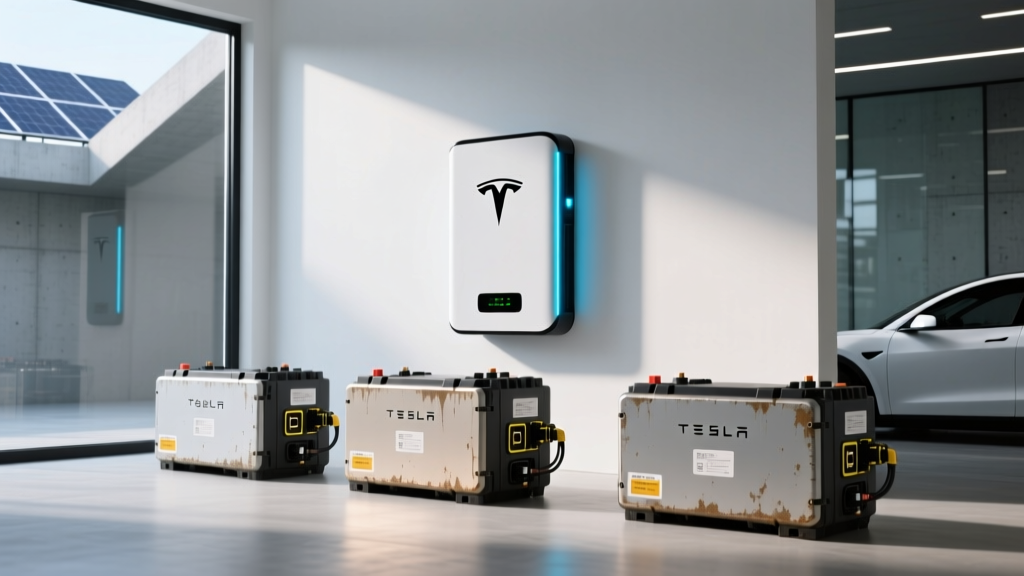
For stationary Powerwall systems, Tesla uses an NMC variant optimized for stationary cycling rather than energy density, since weight is irrelevant in a garage-mounted unit.
How Long Do Tesla EV Batteries Actually Last?
Tesla's 2024 Impact Report (the most recent with full fleet data) showed that Model 3 and Model Y batteries retain approximately 85% of their original capacity after 200,000 miles. That's 15% degradation over what is, for most American drivers averaging 13,500 miles per year according to FHWA data, roughly 15 years of driving.
Here's what the real-world degradation curve looks like based on aggregated owner data and fleet reports:
- Year 1 / 15,000 mi: ~3–5% loss (initial break-in drop)
- Year 3 / 45,000 mi: ~7–9% total loss
- Year 5 / 75,000 mi: ~9–11% total loss
- Year 8 / 120,000 mi: ~11–14% total loss
- Year 10+ / 150,000+ mi: ~13–17% total loss
The critical insight: battery failure (sudden, catastrophic loss of function) is extremely rare. What owners experience is gradual capacity loss — the same 310-mile EPA range slowly becoming 270 miles over many years. Most Tesla batteries outlive the vehicle's body, suspension, and interior.
What Does Tesla's Battery Warranty Cover?
Tesla's high-voltage battery warranty is one of the strongest in the industry, and it's structured to protect against both catastrophic failure and excessive degradation.
| Model | Warranty Duration | Mileage Limit | Minimum Capacity Retention |
|---|---|---|---|
| Model 3 RWD (LFP) | 8 years | 100,000 miles | 70% |
| Model 3 Long Range / Performance | 8 years | 120,000 miles | 70% |
| Model Y (all trims) | 8 years | 120,000 miles | 70% |
| Model S / Model X | 8 years | 150,000 miles | 70% |
| Cybertruck | 8 years | 150,000 miles | 70% |
| Powerwall 3 | 10 years | N/A (stationary) | 70% energy retention |
If your battery drops below 70% capacity within the warranty window, Tesla will replace or refurbish it at no cost. The warranty also covers manufacturing defects, sudden failure, and issues with the battery management system (BMS). It does not cover damage from accidents, flooding, unauthorized modifications, or using the vehicle as a stationary power source beyond Tesla's approved features.
For the Powerwall, the 10-year warranty covers throughput up to a specified energy limit (typically 36.5 MWh cumulative over the warranty period for Powerwall 3), which is generous enough for typical daily cycling with solar or time-of-use arbitrage.
Tesla Battery Replacement Costs: EV Packs and Powerwall
If you're outside warranty coverage — whether through mileage, age, or a second-hand purchase — here's what replacement actually costs in 2026.
| Battery / Product | Pack Size | Chemistry | Estimated Replacement Cost (Parts + Labor) |
|---|---|---|---|
| Model 3 RWD | ~57 kWh | LFP | $5,000 – $8,000 |
| Model 3 Long Range | ~79 kWh | NMC | $10,000 – $14,000 |
| Model Y Long Range / Performance | ~79 kWh | NMC | $10,000 – $15,000 |
| Model S (2024+) | ~100 kWh | NMC/NCA | $14,000 – $20,000 |
| Model X (2024+) | ~100 kWh | NMC/NCA | $15,000 – $22,000 |
| Cybertruck AWD / Cyberbeast | ~123 kWh | NMC (4680 cells) | $18,000 – $25,000 (estimated) |
| Powerwall 3 (installed) | 13.5 kWh | NMC | $9,200 – $12,800 |
| Powerwall 2 (legacy, if available) | 13.5 kWh | NMC | $7,500 – $10,500 |
A few critical notes on these figures:
- Labor adds $1,000–$3,000 depending on the service center and whether the subframe must be dropped.
- Refurbished packs are increasingly common and can reduce costs by 20–35%. Tesla's own service centers often install remanufactured units.
- Cell-level repair is emerging as a lower-cost alternative: some independent EV shops can replace individual modules within a pack for $2,000–$5,000, though this is not available through Tesla directly.
- Powerwall installation costs vary significantly by region, electrical panel condition, and whether a backup gateway (for whole-home backup) is included. The $9,200–$12,800 range assumes a straightforward install with an existing 200A panel.
Factors That Accelerate (or Preserve) Battery Health
Battery degradation isn't just a function of time — how you use and store your Tesla matters enormously.
- Limit DC fast charging: Occasional Supercharging is fine, but daily use of 150–250 kW DC fast chargers accelerates degradation. Studies from Geotab's fleet data show vehicles fast-charging more than 3x/week degrade roughly 1–2% faster over 5 years than those primarily using Level 2.
- Avoid sustained 100% SoC (NMC/NCA): Set your daily charge limit to 80%. Only charge to 100% when departing on a trip within hours.
- LFP owners: charge to 100% at least weekly. This keeps the BMS calibrated and is chemically safe for LFP.
- Minimize extreme-temperature exposure: Park in shade or a garage when possible. Tesla's thermal management system is excellent, but a car sitting at 110°F in a Phoenix parking lot still experiences calendar degradation.
- Use Scheduled Departure: This preconditioning feature warms or cools the battery while still plugged in, reducing stress during your initial drive.
- Don't store at 0% or 100% for extended periods: If leaving your Tesla for weeks, set the charge limit to 50% and leave it plugged in.
- Avoid repeated hard acceleration from low SoC: High current draw from a low state of charge stresses cells more than the same draw at 70% SoC.
The single biggest controllable factor is heat. Lithium-ion cells degrade fastest when exposed to sustained temperatures above 35°C (95°F) at high states of charge. Tesla's liquid cooling system mitigates this significantly, but it can't eliminate physics.
How to Monitor Your Tesla's Battery Health (SoH)
Tesla doesn't display a simple "battery health percentage" on the in-car screen the way some competitors do, but there are reliable methods to assess your pack's State of Health:
Method 1: The Range Calculation
Charge your Tesla to 100% and note the displayed range. Compare it to the original EPA-rated range for your specific model and year. For example, if your 2023 Model 3 Long Range originally showed 333 miles at 100% and now shows 296 miles, that's approximately 89% capacity retention — or 11% degradation.
Caveat: The displayed range is affected by temperature, recent driving patterns, and BMS calibration. For an accurate reading, charge to 100% after the car has been sitting for a few hours (allowing the BMS to balance), and do this when ambient temperature is moderate (60–75°F).
Method 2: Third-Party Apps
Apps like Tessie, Stats, and TeslaFi log detailed battery data via Tesla's API and can estimate SoH more precisely by tracking energy added vs. distance traveled over hundreds of charge cycles. These tools also flag unusual degradation patterns that might indicate a module imbalance worth a service visit.
Method 3: Tesla Service Diagnostic
During any service visit, Tesla technicians can run a full battery health diagnostic that measures individual module voltages, internal resistance, and capacity. You can request this specifically — it typically takes 30–60 minutes and is sometimes covered if you're within warranty and reporting a concern.
Powerwall Monitoring
Powerwall owners can track battery health directly in the Tesla app, which displays energy throughput, current capacity relative to original, and cycle count. The Powerwall's stationary use case — without the vibration, temperature swings, and high-C-rate demands of a vehicle — generally results in slower degradation.
Emerging Battery Tech: What's Coming (and When)
Several next-generation battery technologies promise to reshape replacement economics, but realistic timelines matter.
Solid-state batteries replace the liquid electrolyte with a solid material, offering higher energy density, faster charging, and improved safety. Toyota has announced a limited 2027–2028 production timeline for solid-state EVs, and QuantumScape (backed by Volkswagen) continues prototype testing. However, mass production at automotive scale remains unproven. Expect solid-state batteries to reach Tesla-class vehicles no earlier than 2029–2031, and replacement costs will initially be higher than current lithium-ion.
Silicon-anode batteries (used in limited form in some current cells, including aspects of Tesla's 4680 design) increase energy density by replacing graphite anodes with silicon. This technology is already shipping in production vehicles but is still being refined for long-term cycle stability. Expect incremental improvements through 2028.
Sodium-ion batteries are entering production in China (CATL, BYD) for lower-cost, lower-range EVs. These could eventually reduce replacement costs for entry-level models, though Tesla has not announced sodium-ion adoption for US-market vehicles.
None of these technologies are currently available as retrofit replacements for existing Tesla vehicles. When they do arrive, they'll debut in new models, not as service parts for 2020–2026 cars.
Frequently Asked Questions
How long do Tesla EV batteries last in years and miles?
Based on Tesla's fleet data, most Model 3 and Model Y batteries retain 85% or more of their original capacity at 200,000 miles — roughly 15 years of average US driving. Complete battery failure before 300,000 miles is rare. The battery is designed to outlast the vehicle's useful economic life.
How much does it cost to replace a Tesla battery out of warranty?
Between $5,000 and $25,000 depending on the model and pack size. A Model 3 RWD with an LFP pack sits at the low end ($5,000–$8,000), while a Model S or Cybertruck with a 100+ kWh NMC/4680 pack can reach $20,000–$25,000. Refurbished packs reduce cost by 20–35%.
What does the Tesla battery warranty cover?
Tesla covers the high-voltage battery for 8 years and 100,000–150,000 miles (depending on model) against defects and capacity loss below 70%. The warranty includes parts, labor, and a replacement or refurbished pack. It does not cover accident damage, flood damage, or unauthorized modifications.
How do I check my Tesla's battery health?
Charge to 100% and compare the displayed range to the original EPA rating for your model year. For more precision, use third-party apps like TeslaFi or Tessie that track energy data over time, or request a diagnostic at a Tesla Service Center.
LFP vs NMC — which Tesla battery is better?
It depends on your priorities. LFP (Model 3/Y RWD) offers longer cycle life, lower replacement cost, and the convenience of daily 100% charging — but sacrifices some range and cold-weather performance. NMC (Long Range/Performance trims) delivers more range and better cold performance but requires more careful charging habits (80% daily limit) and costs more to replace. For most commuters, LFP is the more practical and durable choice.
Does the Tesla Powerwall battery need replacement?
Under normal residential use, a Powerwall 3 is designed to last its full 10-year warranty period with at least 70% capacity retention. Most units will function well beyond 10 years with gradual capacity loss. Replacement cost (installed) is approximately $9,200–$12,800 in 2026.
Is it worth buying a used Tesla with high mileage given battery replacement cost?
Often yes. A Tesla with 100,000+ miles typically still has 85–90% battery capacity. If priced $5,000–$10,000 below a low-mileage equivalent, the used car effectively "pre-funds" a future battery replacement that may never be needed. Always check the displayed range at 100% charge and verify remaining warranty coverage.
For current Tesla warranty terms and specifications, refer to the Tesla New Vehicle Limited Warranty page. For independent data on EV battery longevity and degradation, Geotab's battery degradation study remains one of the most comprehensive fleet-based analyses available.