If you have been following battery-headlines lately, you have probably seen the term CO₂ battery surface in research papers and startup press releases. The promise is tantalizing: a traction battery that uses carbon dioxide as a functional material, potentially slashing reliance on scarce minerals while delivering competitive energy density. But how close is this technology to showing up in your next EV? And more importantly, how does it stack up against the two chemistries that dominate every showroom floor today — lithium iron phosphate (LFP) and nickel-manganese-cobalt (NMC/NCA)?
This guide cuts through the hype. We will compare CO₂ battery concepts against proven LFP and NMC platforms, walk through real degradation data, warranty terms, replacement costs, and the daily habits that determine whether your pack lasts 150,000 miles or 300,000 miles. If you are shopping for an EV in 2026 or trying to maximize the life of the one you own, this is the chemistry briefing you need.
What Is a CO₂ Battery and Why Does It Matter for EVs?
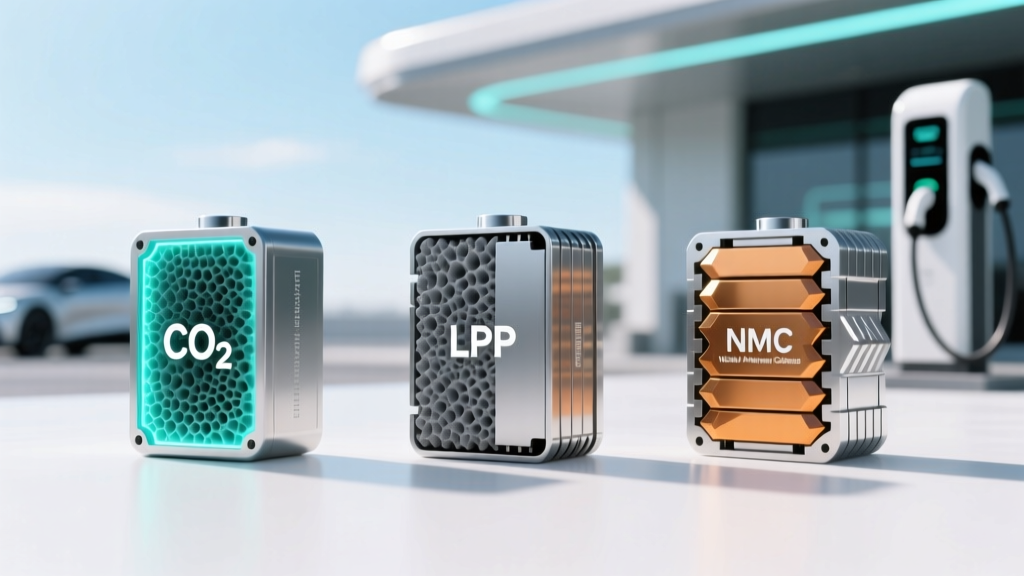
A "CO₂ battery" is not a single, standardized chemistry the way LFP or NMC are. The term broadly covers battery systems that incorporate carbon dioxide either as a cathode reactant (as in lithium–CO₂ or metal–CO₂ cells) or as a carbon-derived material processed into anode or cathode structures. Research groups at institutions like MIT and several well-funded startups have demonstrated lab-scale cells where CO₂ is electrochemically reduced during discharge, effectively turning a greenhouse gas into a functional battery component.
The appeal is straightforward: CO₂ is abundant, essentially free as a feedstock, and using it could reduce the mining footprint associated with cobalt, nickel, and even lithium. Some prototypes claim energy densities approaching 500–700 Wh/kg at the cell level — far beyond today's best NMC cells at roughly 250–300 Wh/kg.
But here is the reality check: no CO₂-based traction battery is commercially available in any production EV as of 2026. Cycle life in lab settings remains limited (often a few hundred cycles before significant capacity fade), coulombic efficiency lags behind lithium-ion benchmarks, and the engineering challenges of sealing, pressure management, and scalable manufacturing are unsolved at automotive scale. Treat every CO₂ battery headline as early-stage research — promising, but likely 8–15 years from appearing in a vehicle you can buy.
The Chemistries You Can Actually Buy: LFP vs NMC/NCA
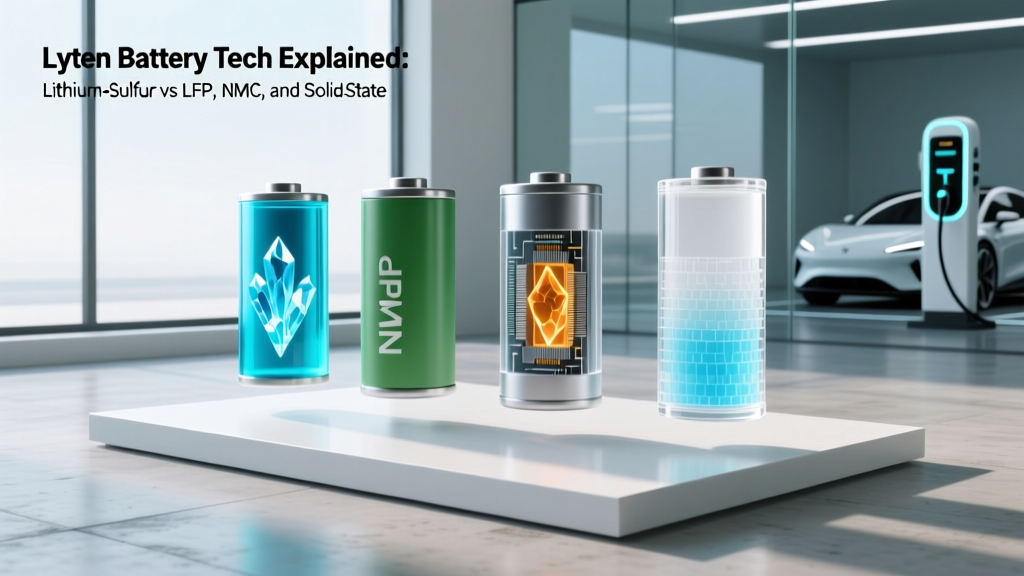
While CO₂ batteries remain in the lab, two lithium-ion families power virtually every EV sold in the United States today. Understanding their trade-offs is essential for making a smart purchase.
| Attribute | LFP (Lithium Iron Phosphate) | NMC/NCA (Nickel-based) |
|---|---|---|
| Energy Density (cell-level) | ~160–200 Wh/kg | ~250–300 Wh/kg |
| Typical Cycle Life | 3,000–6,000+ cycles | 1,000–2,500 cycles |
| Cold-Weather Performance | Moderate — greater range loss below 20°F | Better low-temp discharge, but still 15–30% range loss |
| Thermal Stability | Excellent — very low thermal runaway risk | Good, but requires robust BMS and cooling |
| Cost per kWh (pack-level, 2026) | ~$90–$110 | ~$120–$150 |
| Cobalt/Nickel Content | None | Significant (reducing over time) |
| Recommended Daily SoC | Can charge to 100% regularly | Best kept 20–80% for longevity |
| Notable 2026 Vehicles | Tesla Model 3 RWD, Model Y RWD, Ford Mustang Mach-E Select (LFP option), BYD models | Tesla Model 3/Y Long Range, Hyundai Ioniq 5, BMW i4, Rivian R1T/R1S, most long-range trims |
LFP: The Durability Champion
LFP's headline advantage is cycle life. A well-managed LFP pack can endure 3,000 to over 6,000 full charge-discharge cycles before reaching 80% of its original capacity. For context, 3,000 cycles on a 250-mile-range EV equals roughly 750,000 miles of driving — far more than the vehicle itself will likely see. LFP also tolerates regular 100% charging, which simplifies daily ownership: you do not need to babysit your charge limit. Tesla explicitly recommends periodic 100% charges for LFP-equipped vehicles to keep the battery management system (BMS) calibrated.
The trade-off is lower energy density. An LFP pack storing the same kWh as an NMC pack will be heavier and physically larger, which is why LFP is most common in standard-range and rear-wheel-drive trims where ultimate range is not the priority.
NMC/NCA: The Range Maximizer
If you need 320+ miles of EPA range, NMC or NCA chemistry is still the ticket. Higher energy density means more kWh in a smaller, lighter package, directly translating to longer range or more interior space. The Hyundai Ioniq 5 Long Range, for example, packs a 77.4 kWh NMC battery into a midsize crossover with an EPA-estimated 305 miles of range.
However, NMC cells degrade faster when routinely charged to 100% or deeply discharged to near 0%. Most manufacturers recommend an 80% daily charge limit for NMC vehicles, reserving 100% for road trips. Cold-weather performance is marginally better than LFP, though all lithium-ion chemistries suffer increased internal resistance and slower charging in sub-freezing temperatures.
Real-World Degradation: What the Data Actually Shows
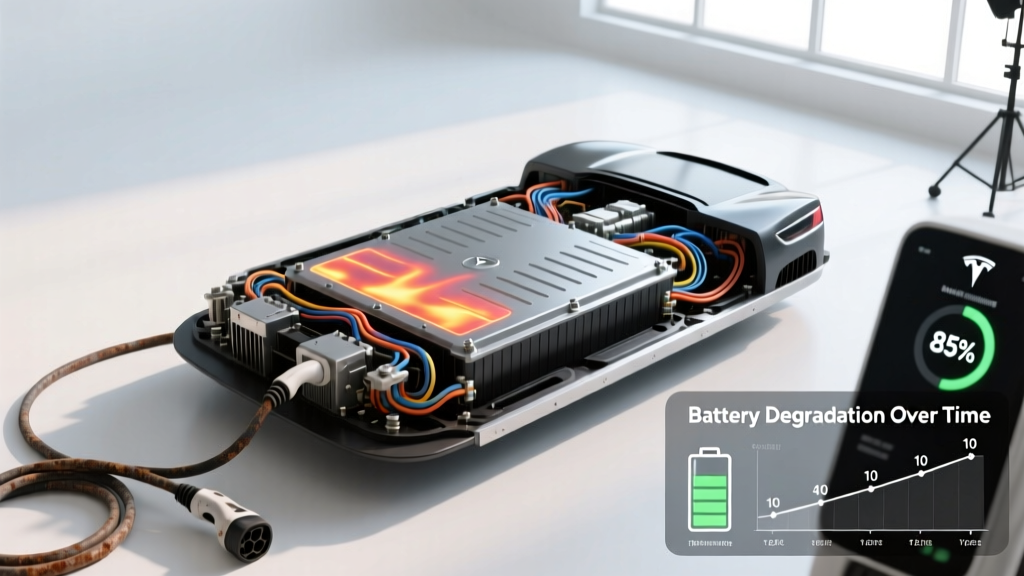
The fear that EV batteries "wear out like phone batteries" is one of the most persistent myths in the space. Fleet data tells a different story. According to long-term studies aggregated by sources like Geotab's EV Battery Health dashboard, the average EV battery loses approximately 1.8% to 2.3% of its capacity per year under normal use. That translates to roughly 83–90% state of health (SoH) after eight years — well within warranty thresholds.
Typical Degradation Curve (Fleet Average, Moderate Climate):
- Year 1: 2–3% loss (initial formation settling)
- Years 2–5: ~1.5–2% annual loss (steady-state)
- Years 6–10: ~1–1.5% annual loss (deceleration)
- 10-year projected SoH: 80–88% (chemistry and use-dependent)
Note: Degradation is not linear. Most packs experience a slightly steeper drop in the first year as the solid electrolyte interphase (SEI) layer stabilizes, then enter a long, slow decline. A sudden acceleration in degradation late in life is rare but possible — usually tied to cell imbalance or thermal damage.
LFP packs tend to sit at the lower end of that degradation range (often 90%+ SoH at 100,000 miles), while NMC packs under heavy fast-charging regimes may trend toward the higher end. The Tesla Model 3 fleet, for instance, has shown median degradation of roughly 12% at 150,000 miles across both chemistries, per data shared in Tesla's Impact Reports.
What the Battery Warranty Actually Covers
Federal law in the United States mandates that EV batteries carry a minimum warranty of 8 years or 100,000 miles (whichever comes first). California Air Resources Board (CARB) states extend that to 10 years or 150,000 miles. Most manufacturers meet or exceed these minimums.
| Manufacturer | Warranty Term | Capacity Retention Threshold | Notes |
|---|---|---|---|
| Tesla (Model 3/Y RWD, LFP) | 8 yr / 100,000 mi | 70% | Long Range/Performance: 8 yr / 120,000 mi |
| Hyundai / Kia | 10 yr / 100,000 mi | 70% | Among the most generous terms |
| Ford (Mach-E, F-150 Lightning) | 8 yr / 100,000 mi | 70% | Covers battery and hybrid/electric components |
| BMW (i4, iX) | 8 yr / 100,000 mi | 70% | Transferable to second owner |
| Rivian (R1T/R1S) | 8 yr / 175,000 mi | 70% | Higher mileage cap reflects truck use case |
| Chevrolet (Equinox EV, Blazer EV) | 8 yr / 100,000 mi | 60% | Lower threshold — read the fine print |
The critical detail is the capacity retention threshold. Most warranties guarantee the battery will retain at least 70% of its original capacity over the warranty period. If your 75 kWh pack drops below 52.5 kWh of usable capacity within 8 years or 100,000 miles, the manufacturer must repair or replace it — typically by swapping in a refurbished pack that meets the threshold, not necessarily a brand-new one.
Warranties cover defects and abnormal degradation. They do not cover damage from accidents, flooding, improper modifications, or (in most cases) using the vehicle as a stationary power source beyond manufacturer-approved V2H/V2G features.
EV Battery Replacement Cost: The Real Numbers
This is where anxiety spikes, but context matters enormously. The vast majority of EV batteries never need replacement during the vehicle's useful life. Out-of-warranty replacements are rare and typically occur only after collision damage, manufacturing defects that manifest late, or extreme abuse. That said, if you plan to keep an EV for 15+ years or are buying a used EV out of warranty, here is what replacement looks like.
| Vehicle / Pack Size | Battery Capacity | Estimated Parts Cost | Estimated Labor | Total Range |
|---|---|---|---|---|
| Tesla Model 3 RWD (LFP) | ~60 kWh | $8,000–$12,000 | $1,500–$2,500 | $9,500–$14,500 |
| Hyundai Ioniq 5 Long Range | 77.4 kWh | $12,000–$16,000 | $2,000–$3,000 | $14,000–$19,000 |
| Ford F-150 Lightning Ext. Range | 131 kWh | $18,000–$25,000 | $2,500–$4,000 | $20,500–$29,000 |
| Chevrolet Bolt EV (older, NMC) | 65 kWh | $9,000–$14,000 | $1,500–$2,500 | $10,500–$16,500 |
| Rivian R1T (Large Pack) | ~135 kWh | $20,000–$28,000 | $3,000–$4,500 | $23,000–$32,500 |
Prices have been trending downward. Pack-level costs for NMC fell below $130/kWh in 2025 for the first time at scale, and LFP packs are now routinely under $100/kWh at the cell level. Refurbished and remanufactured packs from third-party suppliers are increasingly available for popular models, often at 30–50% below OEM new-pack pricing. As of 2026, companies like Redwood Materials and Cirba Solutions are scaling battery recycling operations that will further compress replacement costs over the next decade.
Five Factors That Determine How Long Your EV Battery Lasts
Chemistry sets the ceiling, but your habits determine where you land on the degradation curve. Here are the five factors with the largest measurable impact on battery longevity.
Battery Care Checklist for Maximum Lifespan
- Limit DC fast charging to road trips. Frequent use of 150+ kW DC fast charging accelerates degradation. Studies show packs that fast-charge more than three times per week can degrade 1.5–2x faster than those primarily charged on Level 2. For daily use, a home Level 2 charger at 7–11 kW is ideal.
- Avoid extreme states of charge. For NMC/NCA: keep daily SoC between 20% and 80%. For LFP: regular 100% charges are fine and even recommended for BMS calibration. For all chemistries: avoid leaving the vehicle at 0% or 100% for extended periods (days to weeks).
- Manage temperature extremes. Battery degradation accelerates above 95°F (35°C) ambient and below 15°F (-9°C). If you live in a hot climate, park in shade or a garage when possible. Precondition the battery before fast charging in cold weather — most EVs do this automatically when you navigate to a charger.
- Use scheduled charging. Rather than plugging in and immediately charging to 80%, set your vehicle to finish charging shortly before you leave. This minimizes time spent at high SoC, which is when degradation reactions are most active.
- Drive moderately when the battery is hot. Repeated hard acceleration from a high SoC generates compounding heat stress. On a track day or long mountain pass, let the pack cool between intense efforts.
How to Check and Monitor Your Battery's State of Health
State of Health (SoH) is the percentage of your battery's original usable capacity that remains available. A new 75 kWh pack at 92% SoH effectively holds about 69 kWh. Monitoring SoH helps you track degradation, plan for warranty claims, and assess value when buying or selling a used EV.
Built-In Methods
Some manufacturers surface SoH directly in the vehicle's infotainment system or mobile app. Hyundai and Kia include a battery health readout in their EV menus. Tesla does not display SoH natively, but you can estimate it by comparing your current maximum range at 100% charge to the original EPA figure. For example, if your Model 3 Long Range originally showed 341 miles at 100% and now shows 310 miles, that suggests roughly 91% SoH (accounting for the fact that displayed range also varies with driving style and temperature).
Third-Party Diagnostics
Services like Recurrent and AVILOO offer battery health reports that analyze your charging and driving data to produce an independent SoH estimate. These reports are increasingly accepted by used-EV marketplaces and can add confidence to a private-party sale. Some dealers now include a battery health certificate with certified pre-owned EVs.
OBD-II Tools
For the technically inclined, OBD-II dongles paired with apps like Scan My Tesla (for Tesla vehicles) or LeafSpy (for Nissan Leaf) can read individual cell voltages, pack temperature, and estimated capacity. These tools provide granular data but require some interpretation skill.
Beyond Today: Solid-State, Silicon Anodes, and the Road Ahead
While CO₂ batteries remain a long-horizon concept, two nearer-term technologies are advancing through pilot production and may reach consumer vehicles by the late 2020s or early 2030s.
Solid-state batteries replace the liquid electrolyte in current lithium-ion cells with a solid ceramic, glass, or polymer conductor. The potential benefits are substantial: energy densities of 400–500 Wh/kg (roughly double today's NMC), faster charging without lithium plating risk, and dramatically improved thermal safety. Toyota has announced plans for a solid-state EV with a projected 600+ mile range, targeting limited production around 2027–2028. Samsung SDI and QuantumScape are also advancing solid-state cells through automotive qualification. However, manufacturing yield, cost, and scalability remain significant hurdles — treat any pre-2028 solid-state vehicle as announced and preliminary, not available.
Silicon-dominant anodes are closer to market. Companies like Sila Nanotechnologies and Group14 Technologies are supplying silicon-carbon composite anode materials that increase energy density by 20–40% compared to traditional graphite anodes. These materials are already appearing in some premium consumer electronics and are expected to enter EV production packs by 2027–2028, offering incremental range and charging-speed improvements without requiring entirely new cell architectures.
Neither technology invalidates the EVs on sale today. Current LFP and NMC packs are mature, well-understood, and backed by robust warranties. The advances coming will improve range and charging convenience, but they will not make today's EVs obsolete — much like the transition from early lithium-ion to modern cells did not strand owners of 2015-era EVs.
Frequently Asked Questions
How long do EV batteries last in years and miles?
Based on fleet data, the average EV battery retains 80–90% of its original capacity after 8–10 years or 150,000–200,000 miles. Many packs exceed this — Tesla has reported Model S/X packs retaining roughly 88% capacity at 150,000 miles. LFP packs generally outlast NMC in cycle-life terms. Complete failure before 200,000 miles is statistically rare outside of manufacturing defects (which warranties cover).
How much does it cost to replace an EV battery?
Out-of-warranty replacement costs range from roughly $10,000 for a smaller pack (60 kWh class) to $25,000–$32,000 for large truck packs (130+ kWh), including parts and labor. However, the majority of EV batteries never require replacement during the vehicle's life. Prices continue to decline as cell costs fall and the refurbished-pack market grows.
What does the EV battery warranty cover?
Federal law mandates a minimum 8-year/100,000-mile warranty on EV batteries (10 years/150,000 miles in CARB states). The warranty covers capacity loss below a specified threshold (typically 70% of original capacity) and manufacturing defects. It does not cover physical damage from accidents, misuse, or unauthorized modifications.
How do I check my EV battery's state of health?
Methods vary by vehicle. Some brands (Hyundai, Kia) display SoH in the infotainment system. For others, you can estimate SoH by comparing current max range at 100% charge to the original EPA figure. Third-party services like Recurrent offer independent battery health reports, and OBD-II tools can pull detailed cell-level data for technically inclined owners.
LFP vs NMC — which is better for me?
Choose LFP if you prioritize longevity, want the simplicity of regular 100% charging, drive a standard-range commute, and want to minimize supply-chain ethical concerns (no cobalt or nickel). Choose NMC/NCA if you need maximum range (320+ miles), frequently take road trips, or need the best cold-weather performance available today. Neither is universally "better" — the right choice depends on your driving pattern and priorities.
Will a CO₂ battery EV be available soon?
Not in the near term. CO₂-based battery systems remain in the research and early prototype stage as of 2026. Key challenges including cycle life, efficiency, and scalable manufacturing must be resolved before automotive qualification. Realistic timelines place commercial availability in the mid-to-late 2030s at the earliest. For now, LFP and NMC remain the proven, warrantied options.