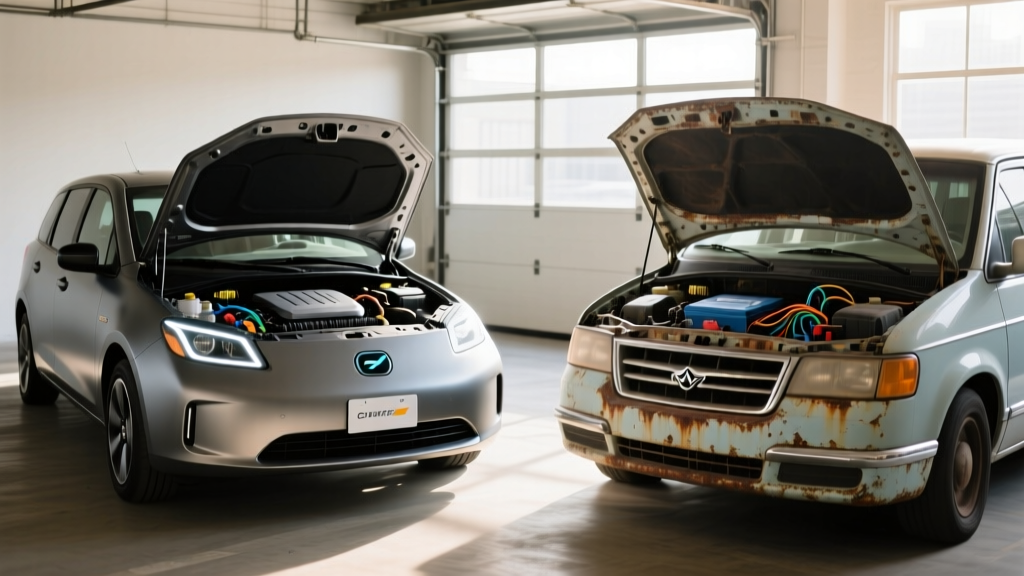
If you're researching a Chrysler Town and Country 2013 battery, you're likely looking at a straightforward 12-volt lead-acid replacement — a $150–$250 Group 34 or H7 AGM battery that any auto parts store can swap in fifteen minutes. But if that search has led you to electric vehicles, the battery conversation changes dramatically. An EV's high-voltage traction battery is the single most expensive component in the vehicle, and understanding its chemistry, lifespan, warranty, and replacement economics is essential before you buy.
This guide breaks down everything EV buyers and owners need to know about battery technology in 2026 — from LFP vs. NMC chemistry trade-offs to real-world degradation data — while using the humble minivan battery as a baseline comparison for just how far electrified powertrains have come.
Two Very Different Batteries: 12V Auxiliary vs. High-Voltage Traction
Before diving into EV-specific technology, it's critical to distinguish the two battery types in any electrified vehicle:
- 12V auxiliary battery: The same type found in a 2013 Chrysler Town & Country. It powers lights, infotainment, door locks, and ECU boot-up. In EVs, it runs accessory systems but does not propel the car. Replacement cost: $150–$300. Lifespan: 3–5 years.
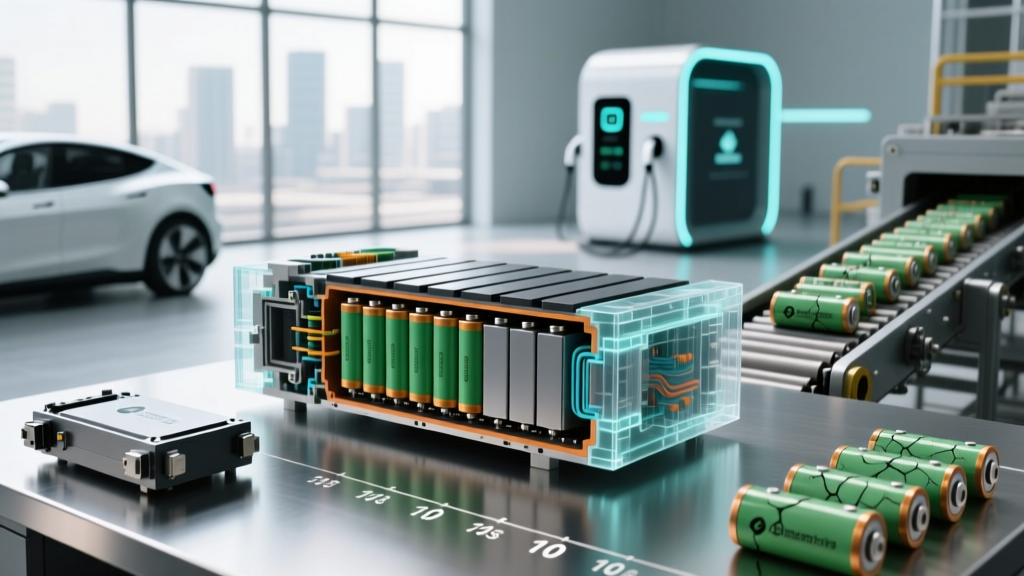
- High-voltage traction battery: The large lithium-ion (or LFP) pack that stores energy for the electric motor. Capacities range from ~40 kWh (Nissan Leaf) to 130+ kWh (GMC Hummer EV, Ford F-150 Lightning Extended Range). This is the battery that defines an EV's range, performance, and long-term value.
When EV owners and buyers talk about "the battery," they mean the traction pack. That's what we'll focus on for the rest of this guide.
Battery Chemistry in 2026: LFP vs. NMC/NCA Explained
Not all lithium-ion batteries are the same. The two dominant chemistries in 2026 EVs are LFP (lithium iron phosphate) and NMC/NCA (nickel manganese cobalt / nickel cobalt aluminum). Each has distinct trade-offs that affect range, longevity, cost, and daily usability.
| Attribute | LFP (Lithium Iron Phosphate) | NMC / NCA (Nickel-Based) |
|---|---|---|
| Energy Density | Lower (~160–180 Wh/kg cell-level) | Higher (~250–300 Wh/kg cell-level) |
| Typical Range Impact | Slightly less range for same pack weight | More range per kg — preferred for long-range models |
| Cycle Life | 3,000–5,000+ full cycles | 1,000–2,000 full cycles |
| Cold-Weather Performance | Reduced — greater range loss below freezing; preconditioning essential | Better low-temp discharge; less range penalty |
| Cost (per kWh) | Lower — no cobalt or nickel | Higher — commodity-linked to nickel/cobalt prices |
| Charging to 100% SoC | Recommended periodically for BMS calibration | 80% daily recommended; 100% for trips only |
| Safety / Thermal Runaway | More stable — higher thermal runaway threshold | Good, but requires more active thermal management |
| Common 2026 Applications | Tesla Model 3/Y RWD, Ford Mustang Mach-E Select, base Chevy Equinox EV | Hyundai Ioniq 5 Long Range, Tesla Long Range/Performance, Rivian, BMW iX |
Which is better? There's no universal winner. LFP excels for cost-conscious buyers who charge at home daily and don't need maximum range — its superior cycle life means it will likely outlast the vehicle. NMC is the choice for long-range models (300+ miles EPA) and cold-climate drivers who need better winter performance. According to IEA Global EV Outlook data, LFP market share has climbed past 40% globally as of 2025, driven by Tesla, BYD, and Ford's adoption in base trims.
How Long Do EV Batteries Last? Real Degradation Data
The most common fear among EV shoppers: "Will I need a $20,000 battery replacement in five years?" The data says almost certainly not.
Modern EV batteries are engineered with conservative buffers — typically 5–10% of gross capacity is hidden from the user to prevent the cells from reaching true 0% or 100% state of charge, which accelerates degradation. Combined with liquid thermal management systems, this means most packs lose capacity slowly and predictably.
- Year 1: ~2–4% loss (initial formation loss)
- Years 2–5: ~0.5–1.0% additional loss per year
- Years 6–8: Degradation rate slows further; most packs retain 85–92% of original capacity
- Year 10 / 150,000 miles: Median retention ~82–88% based on Geotab's fleet study of 6,300+ EVs
- 200,000+ miles: Many NMC packs still above 75–80%; LFP packs often above 90%
For context, a 2026 Hyundai Ioniq 5 with its 77.4 kWh (usable) NMC pack rated at 305 miles EPA would retain approximately 260–275 miles of range at the 8-year mark — still very usable for daily driving and road trips with DC fast-charging stops.
The 12V battery in your 2013 Town & Country, by comparison, will likely need replacement every 3–5 years at $150–$250 per swap — meaning you'll spend $600–$1,250 on auxiliary batteries over the same 10-year period, while the EV's traction pack soldiers on.
What the Battery Warranty Actually Covers
Federal law mandates that EV battery warranties cover a minimum of 8 years / 100,000 miles (10 years / 150,000 miles in California and states that follow CARB standards). Most manufacturers set a capacity retention threshold of 70% — meaning the warranty applies if your battery drops below 70% of its original usable capacity within the warranty period.
| Manufacturer | Warranty Period | Mileage Limit | Capacity Threshold |
|---|---|---|---|
| Tesla (Model 3/Y RWD — LFP) | 8 years | 100,000 miles | 70% |
| Tesla (Long Range / Performance — NMC) | 8 years | 120,000 miles | 70% |
| Hyundai / Kia | 8 years | 100,000 miles | 70% |
| Ford (Mach-E, F-150 Lightning) | 8 years | 100,000 miles | 70% |
| GM (Ultium-based: Equinox EV, Blazer EV, Silverado EV) | 8 years | 100,000 miles | 70% |
| Rivian | 8 years | 175,000 miles | 70% |
| BMW | 8 years | 100,000 miles | 70% |
Key nuance: The warranty covers capacity degradation below the threshold, not cosmetic issues or damage from accidents. If your 85 kWh pack drops to 58 kWh (below 70%) at year 6, the manufacturer will repair or replace it — typically with a refurbished pack, not a brand-new one. The U.S. Department of Energy's EV technology page provides additional context on federal battery requirements.
EV Battery Replacement Cost: What It Actually Takes
Here's where the fear-mongering usually starts — but context matters. Most EV batteries never need replacement during typical ownership. When they do, it's usually after 15+ years or 200,000+ miles, and costs have been declining steadily.
| Vehicle / Pack Size | Battery Capacity (Usable) | Estimated Replacement Cost (Parts + Labor) |
|---|---|---|
| Nissan Leaf (40 kWh pack) | ~38 kWh | $6,500–$9,000 |
| Tesla Model 3 RWD (LFP) | ~57 kWh | $10,000–$14,000 |
| Hyundai Ioniq 5 (Long Range) | ~77.4 kWh | $13,000–$18,000 |
| Ford F-150 Lightning (Extended Range) | ~131 kWh | $20,000–$28,000 |
| GMC Hummer EV | ~212 kWh | $30,000–$40,000+ |
These figures represent out-of-warranty costs. In practice, the vast majority of replacements happen under warranty at no cost to the owner. According to data from Consumer Reports' EV reliability surveys, fewer than 5% of EVs require a traction battery replacement within the first 10 years — and most of those are covered.
Compare this to a decade of 12V battery replacements on a conventional minivan: $600–$1,250 in parts alone, plus the inconvenience of being stranded when a lead-acid battery fails without warning. An EV's traction battery is a known, warrantied, slowly-degrading component — not a ticking time bomb.
Factors That Accelerate (or Preserve) Battery Life
Battery degradation isn't purely a function of time. Your habits matter — sometimes significantly.
- Limit DC fast charging: Occasional road-trip use is fine, but daily 150+ kW DC fast charging accelerates degradation. Aim for Level 2 home charging as your primary routine.
- Avoid extreme SoC states: For NMC batteries, keep daily charging between 20–80%. LFP batteries tolerate (and benefit from) periodic 100% charges for BMS calibration.
- Precondition in cold weather: Use your EV's preconditioning feature (usually via the app) before driving and before DC fast charging. A cold battery charges slower and experiences more stress.
- Minimize prolonged storage at 100% or 0%: If leaving your EV for a week+ without driving, set the charge limit to ~50%.
- Use thermal management: Most modern EVs actively cool/heat the battery. Don't disable preconditioning to "save energy" — the battery protection is worth more than the marginal kWh.
- Avoid frequent deep discharges: Running the battery to near 0% regularly stresses cells more than shallow cycles (e.g., 60% → 30% → 60%).
The biggest real-world factor? Heat. EVs in hot climates (Arizona, Texas, Southern California) tend to degrade slightly faster than those in temperate zones. Liquid-cooled packs — standard on virtually all 2026 EVs — mitigate this significantly compared to the passive-air-cooled packs in early EVs like the first-generation Nissan Leaf.
Checking Your Battery's State of Health (SoH)
State of Health (SoH) is the percentage of original capacity your battery currently retains. Unlike a gas car's compression test, you can check this without a mechanic:
- In-vehicle display: Many 2026 EVs (Hyundai, Kia, BMW, Mercedes) show SoH or battery health percentage directly in the settings menu. Tesla provides a rated-range comparison that indirectly reflects SoH.
- OBD-II diagnostic apps: Tools like LeafSpy (Nissan), Scan My Tesla, or Car Scanner ELM OBD2 (universal) can read detailed cell-level data including individual cell voltage variance, total capacity, and SoH percentage.
- Dealer diagnostic report: Request a battery health check during service visits. The dealer can pull a manufacturer-grade SoH report — useful before buying a used EV.
- Manual calculation: Charge to 100% (or a known SoC), note the displayed range, and compare it to the original EPA rating adjusted for the current SoC. For example, if your 305-mile Ioniq 5 shows 270 rated miles at 100%, your SoH is approximately 88%.
Pro tip for used-EV buyers: Always request a battery health report before purchase. A 3-year-old EV with 95% SoH is an excellent value; one at 82% at 40,000 miles may indicate heavy DC fast-charging use or a potential warranty claim.
What's Next: Solid-State and Silicon-Anode Batteries
Emerging battery technologies promise step-change improvements, but realistic timelines matter — these are not available in any production vehicle you can buy today.
- Solid-state batteries: Replace the liquid electrolyte with a solid conductor, promising 30–50% higher energy density, faster charging, and improved safety. Toyota, Samsung SDI, and QuantumScape have demonstrated prototypes, but volume production is expected no earlier than 2028–2030, initially in limited, premium applications. Cost parity with current lithium-ion is unlikely before 2032+.
- Silicon-anode batteries: Replace graphite anodes with silicon to increase energy density by 20–40%. Companies like Sila Nanotechnologies and Group14 are in early commercial production for consumer electronics, with automotive-scale deployment expected around 2027–2029. Mercedes-Benz's partnership with Sila targets the next-generation G-Class EV.
- Sodium-ion batteries: Lower-cost alternative to lithium for budget EVs and stationary storage. CATL and BYD have begun production for Chinese-market micro-EVs; U.S. availability is likely 2028+ and initially limited to low-range urban vehicles.
If you're buying an EV in 2026, today's LFP and NMC batteries are mature, well-warrantied, and proven at scale across millions of vehicles. Waiting for solid-state means waiting years — and paying a premium when it first arrives.
Frequently Asked Questions
How long do EV batteries last in years and miles?
Most modern EV batteries retain 82–92% of original capacity at 10 years / 150,000 miles. With proper care, a 200,000-mile lifespan with usable range is the norm, not the exception. LFP chemistries often exceed this due to higher cycle life (3,000–5,000+ cycles).
How much does an EV battery cost to replace?
Out-of-warranty replacement costs range from ~$6,500 for a small pack (Nissan Leaf) to $28,000+ for a large pack (F-150 Lightning Extended Range). However, fewer than 5% of EVs need replacement within 10 years, and most are covered by the 8-year/100,000-mile federal minimum warranty.
What does the EV battery warranty cover?
Federal law requires 8 years / 100,000 miles of coverage (10/150,000 in CARB states). The warranty guarantees the battery will retain at least 70% of its original usable capacity. If it drops below that threshold, the manufacturer repairs or replaces the pack at no cost.
How do I check my EV's battery health?
Use the in-vehicle battery health display (available on most 2026 models), an OBD-II diagnostic app like LeafSpy or Car Scanner, or request a dealer diagnostic report. For used-EV purchases, always verify SoH before committing.
LFP vs. NMC — which battery chemistry should I choose?
Choose LFP if you prioritize longevity, lower cost, and primarily charge at home (and don't need 300+ miles of range). Choose NMC if you need maximum range, frequently drive in freezing weather, or want the longest single-charge road-trip capability. Both chemistries will comfortably outlast a typical ownership period.
Does fast charging damage my EV battery?
Occasional DC fast charging (road trips, a few times per month) has minimal impact. Daily DC fast charging at 150+ kW does accelerate degradation measurably — studies show ~1–2% additional loss over 5 years compared to Level 2-only charging. If DC fast charging is your only option, it's still far better than not driving electric; just expect slightly more degradation over time.
How does a 2013 Chrysler Town & Country 12V battery compare to an EV traction battery?
They serve completely different purposes. The Town & Country's 12V lead-acid battery (~$150–$250, Group 34/H7 AGM) powers accessories and engine starting — it lasts 3–5 years and costs little to replace. An EV's traction battery (40–212 kWh, $6,500–$40,000) propels the vehicle, lasts 15+ years with gradual degradation, and is covered by an 8-year federal warranty. The 12V battery in an EV is similarly small and inexpensive — every EV still has one for accessory systems.