Why Iron Flow Batteries Are Entering the EV Conversation
If you've been following energy-storage news from China, you've likely seen headlines about iron flow batteries — specifically, large-scale installations by companies like ESS Inc. and Chinese manufacturers deploying vanadium and iron-based flow systems for grid storage. The natural question for EV shoppers: could this technology end up in your next electric vehicle, and how does Chinese iron flow battery lifespan compare to the lithium-ion packs powering today's EVs?
The short answer is that iron flow batteries excel in stationary grid storage, where their extraordinary cycle life (some Chinese installations claim 15,000–20,000 cycles with minimal degradation) and low material costs make them attractive. But putting them in a vehicle is a different engineering challenge entirely. Flow batteries are heavy, volumetrically inefficient, and require liquid electrolyte tanks and pumping systems — all of which work against the energy-density requirements of a passenger car.
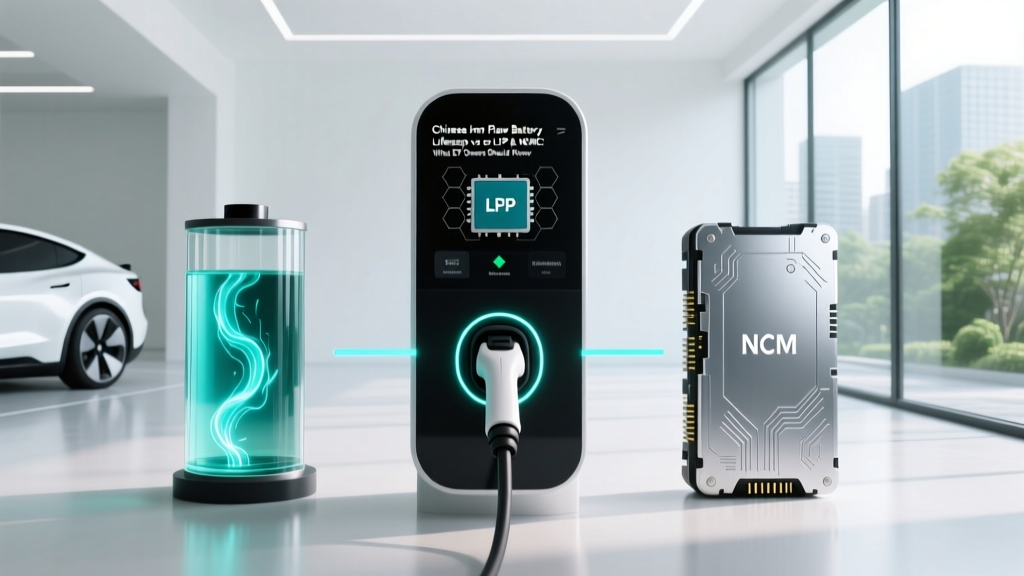
Still, understanding how iron flow technology stacks up against today's dominant EV chemistries — lithium iron phosphate (LFP) and nickel manganese cobalt (NMC/NCA) — helps you make a smarter purchase decision right now and anticipate what's coming next.
EV Battery Chemistry 101: LFP vs. NMC/NCA
Every EV sold in the U.S. today uses a lithium-ion variant. The two dominant cathode chemistries are LFP and NMC (or NCA, used by Tesla and Panasonic). Each has distinct trade-offs that affect range, longevity, cold-weather performance, and price.
| Attribute | LFP (Lithium Iron Phosphate) | NMC/NCA (Nickel-based) |
|---|---|---|
| Energy Density | Lower (~160 Wh/kg cell-level) | Higher (~250–300 Wh/kg cell-level) |
| Typical Cycle Life | 3,000–5,000+ cycles to 80% SoH | 1,500–2,500 cycles to 80% SoH |
| Cold-Weather Performance | Moderate; greater range loss below freezing | Better low-temp discharge capability |
| Cost per kWh | Lower (~$80–100/kWh at pack level, 2025–2026) | Higher (~$120–150/kWh at pack level) |
| Thermal Stability | Excellent; very low thermal-runaway risk | Good but requires more active management |
| Recommended Charge Habit | Can charge to 100% regularly | Best kept at 80% daily; 100% for trips only |
| Notable EV Users (2026) | Tesla Model 3 RWD, BYD Seal, Ford Mustang Mach-E Select | Tesla Model Y LR, Hyundai Ioniq 5, BMW iX |
The key takeaway: LFP trades some range-per-kilogram for dramatically longer cycle life and lower cost. If you plan to keep your EV for 10+ years or put on high mileage, LFP's longevity advantage is meaningful. NMC gives you more range in a lighter, more compact pack — the reason it dominates long-range and performance trims.
Chinese Iron Flow Battery Lifespan: The Grid-Storage Reality
Chinese iron flow battery systems — developed by companies such as Rongke Power (vanadium-based) and newer iron-flow startups — are designed for 4-to-12-hour grid-scale energy storage. Their standout specification is cycle life: manufacturers report 15,000 to over 20,000 full charge-discharge cycles with less than 5% capacity loss, translating to 20–25+ years of daily cycling in a utility application.
This is possible because flow batteries store energy in liquid electrolytes housed in external tanks, and the electrochemical reaction is fully reversible with minimal electrode wear. The electrolyte itself doesn't degrade the way solid lithium-ion cathodes do — it can theoretically be replaced or reconditioned.
However, the energy density of iron flow systems sits around 15–25 Wh/kg at the system level (including tanks, pumps, and plumbing). Compare that to LFP at roughly 160 Wh/kg at the cell level, or NMC at 250+ Wh/kg. An iron flow pack large enough to give a midsize SUV 250 miles of range would weigh several tons and occupy far more space than the vehicle itself. This is why flow batteries remain confined to stationary applications — containerized grid storage, microgrids, and industrial backup — and are not candidates for passenger EV powertrains.
How Long Do EV Batteries Actually Last?
The fear that EV batteries need replacing every few years is one of the most persistent myths in the market. Real-world degradation data tells a very different story.
According to aggregated fleet data and studies from sources like Geotab's long-term battery health analysis, the average lithium-ion EV battery loses approximately 1.8% to 2.3% of its capacity per year under typical use. That translates to roughly 85–90% State of Health (SoH) after 8 years — well above the 70% threshold that most warranties guarantee.
| Age / Mileage | Average SoH (LFP) | Average SoH (NMC) |
|---|---|---|
| Year 1 / ~12,000 mi | ~97–98% | ~96–97% |
| Year 3 / ~36,000 mi | ~94–96% | ~92–94% |
| Year 5 / ~60,000 mi | ~91–94% | ~88–91% |
| Year 8 / ~96,000 mi | ~87–91% | ~84–88% |
| Year 10 / ~120,000 mi | ~85–89% | ~81–86% |
Tesla's own Impact Report has shown that Model 3/Y batteries retain approximately 85% of their original capacity at 150,000 miles. Hyundai and Kia back their EV batteries with 10-year/100,000-mile warranties. The data consistently shows that most EV batteries will outlast the vehicle's economic life.
The non-linear degradation curve matters too: most batteries experience a slightly steeper drop in the first year or two (the so-called "break-in" loss), then settle into a slow, linear decline. Catastrophic failure — where a battery suddenly loses significant capacity — is rare and typically covered under warranty.
What Does the EV Battery Warranty Cover?
Federal law in the U.S. mandates that EV batteries carry a minimum warranty of 8 years / 100,000 miles (whichever comes first). California and states that follow CARB standards extend this to 10 years / 150,000 miles. Most manufacturers meet or exceed these minimums.
| Manufacturer | Warranty Term | Capacity Retention Threshold |
|---|---|---|
| Tesla (Model 3/Y RWD – LFP) | 8 yr / 100,000 mi | 70% minimum |
| Tesla (Model Y LR/AWD – NMC) | 8 yr / 120,000 mi | 70% minimum |
| Hyundai / Kia | 10 yr / 100,000 mi | 70% minimum |
| Ford (Mustang Mach-E, F-150 Lightning) | 8 yr / 100,000 mi | 70% minimum |
| BMW | 8 yr / 100,000 mi | 70% minimum |
| GM (Ultium-based) | 8 yr / 100,000 mi | 70% minimum |
| BYD (Blade LFP) | 8 yr / 100,000 mi (varies by market) | 70% minimum |
The key detail is the capacity retention threshold: if your battery drops below 70% of its original capacity within the warranty period, the manufacturer must repair or replace it at no cost. In practice, very few owners hit this threshold under normal use. The warranty also covers defects and premature cell failures, not just gradual degradation.
One important caveat: warranty coverage typically requires that the vehicle has been maintained per the manufacturer's schedule and hasn't been subjected to abuse (e.g., repeated 100% fast-charging on NMC packs, flood damage, or unauthorized modifications). Always keep service records.
How Much Does an EV Battery Replacement Cost?
If your battery does fail outside of warranty — or you're buying a used EV and want to budget for worst-case scenarios — replacement costs vary significantly by model and pack size.
| Vehicle | Battery Size (kWh) | Chemistry | Estimated Cost (Parts + Labor) |
|---|---|---|---|
| Tesla Model 3 RWD | ~60 kWh | LFP | $10,000–$13,000 |
| Tesla Model Y Long Range | ~75 kWh | NMC | $13,000–$16,000 |
| Hyundai Ioniq 5 | 77.4 kWh | NMC | $12,000–$18,000 |
| Ford Mustang Mach-E ER | 91 kWh | NMC | $18,000–$24,000 |
| Ford F-150 Lightning ER | 131 kWh | NMC | $25,000–$32,000 |
| Chevrolet Equinox EV | ~85 kWh | NMC (Ultium) | $14,000–$19,000 |
| BMW iX xDrive50 | ~111 kWh | NMC | $22,000–$30,000 |
Context matters here. These costs are comparable to a major engine or transmission replacement on a gas vehicle — something that also falls outside typical powertrain warranties after 5–10 years. And the trend is downward: pack-level prices have fallen roughly 50% since 2020 and continue to decline as manufacturing scales. By the time most 2026 EVs need an out-of-warranty battery (likely 2036+), replacement costs will be substantially lower.
Additionally, a growing ecosystem of battery refurbishment and module-level repair services means that not every failure requires a full pack swap. Individual modules can often be replaced for $2,000–$5,000, depending on the pack architecture.
Factors That Affect EV Battery Lifespan
Not all miles are created equal when it comes to battery wear. The following factors have the most measurable impact on long-term State of Health:
- Fast-charging frequency: Occasional DC fast charging is fine. But daily use of 150+ kW chargers — especially without battery preconditioning — accelerates degradation. Data suggests that vehicles fast-charged more than 3 times per week show roughly 1–2% additional capacity loss over 5 years compared to primarily Level 2 charging.
- State of Charge (SoC) habits: For NMC batteries, regularly sitting at 100% SoC stresses the cathode. The 20–80% daily window is ideal. LFP batteries are more tolerant of 100% SoC and manufacturers often recommend periodic full charges for calibration.
- Extreme temperatures: Sustained exposure to high ambient heat (above 95°F / 35°C) is more damaging than cold. Batteries parked for weeks in Phoenix summers without thermal management active will degrade faster. Cold weather reduces range temporarily but doesn't cause permanent damage unless charging occurs at freezing temperatures without preconditioning.
- Depth of discharge: Shallow cycles (e.g., charging from 40% to 70%) are gentler than deep cycles (10% to 100%). This is why fleet vehicles that operate in a narrow SoC band often show excellent longevity.
- Calendar aging: Even a garage-kept EV with low mileage will lose some capacity over time. Calendar aging typically accounts for 0.5–1% loss per year independent of cycling.
How to Check and Maximize Battery Health
Most modern EVs provide some form of battery health data through the infotainment screen or companion app. Here's how to monitor SoH across popular brands:
Tesla: The car doesn't display a direct SoH percentage, but you can estimate it by comparing your current range at 100% charge (for LFP) or at a known SoC to the original EPA-rated range. Third-party tools like TeslaFi or the car's built-in energy graph provide more granular data.
Hyundai/Kia: The EV menu in the infotainment system includes a battery health indicator. The Bluelink/Kia Connect app also reports SoC and charging status.
General Motors (Ultium): The myChevrolet/myCadillac app provides battery status, and OnStar diagnostics can pull more detailed SoH data on request.
OBD-II diagnostics: For any EV, an OBD-II scanner paired with apps like LeafSpy (Nissan), ABRP (A Better Route Planner with OBD integration), or manufacturer-specific tools can read cell voltage variance, pack temperature, and estimated SoH.
For a definitive assessment — especially when buying a used EV — request a battery health report from a certified dealer. This typically costs $100–$200 and provides cell-level data that's far more informative than a dashboard percentage.
- Charge at home on Level 2 (7–11 kW) for daily use; save DC fast charging for road trips.
- Set NMC charge limit to 80% for daily driving. LFP owners: 100% is fine, but do it once a week rather than daily if possible.
- Enable battery preconditioning when navigating to a fast charger — this warms the pack to optimal temperature before high-power charging begins.
- Avoid leaving the car at 0% or 100% SoC for extended periods (more than a few days).
- If you live in a hot climate, park in shade or a garage when possible, and keep the vehicle plugged in so the thermal management system can operate.
Emerging Battery Tech: Solid-State, Silicon Anode, and Beyond
While iron flow batteries will stay in the grid-storage domain, several next-generation technologies are approaching commercialization for EVs:
Solid-state batteries: Companies like Toyota, QuantumScape (backed by Volkswagen), and Samsung SDI are targeting solid-state packs that promise 30–50% higher energy density, faster charging, and improved safety. Toyota has announced limited production for 2027–2028, but at very high initial cost and limited volume. Widespread availability at mainstream price points is not expected before 2030–2032.
Silicon-dominant anodes: Replacing graphite anodes with silicon can boost energy density by 20–40%. Sila Nanotechnologies and Group14 are supplying early production cells, and you'll see silicon-anode batteries in select 2026–2027 models. The challenge has been cycle life — silicon expands significantly during charging — but recent formulations have addressed much of this.
Sodium-ion batteries: CATL and BYD in China are already producing sodium-ion cells for lower-cost, shorter-range EVs and energy storage. Energy density is lower than LFP (~120–140 Wh/kg), but raw material costs are far cheaper. These may appear in U.S.-market budget EVs by 2028–2029.
All of these are forward-looking and should be evaluated as announced timelines, not guarantees. For a 2026 purchase, LFP and NMC remain your proven, well-understood options with robust warranty backing.
Frequently Asked Questions
How long do EV batteries last in years and miles?
Based on fleet degradation data, most modern EV batteries retain 85–90% of their original capacity after 8 years or 100,000 miles. Many will last 15–20 years and 200,000+ miles before dropping below 70% SoH — the point at which you might notice meaningful range reduction but the car is still fully drivable.
How much does it cost to replace an EV battery?
Out-of-warranty replacement costs range from approximately $10,000 for a smaller LFP pack (e.g., Tesla Model 3 RWD) to $25,000–$32,000 for a large NMC pack (e.g., F-150 Lightning Extended Range). Module-level repairs can cost $2,000–$5,000. Prices continue to decline year over year.
What does the EV battery warranty cover?
Federal minimum is 8 years / 100,000 miles. The warranty covers capacity loss below 70% of original, manufacturing defects, and premature cell failure. CARB states extend coverage to 10 years / 150,000 miles. Abuse, unauthorized modifications, and flood damage are typically excluded.
LFP vs. NMC — which is better for my situation?
Choose LFP if you prioritize longevity, lower cost, and plan to keep the vehicle 8+ years. LFP tolerates 100% charging better and has 3,000–5,000+ cycle life. Choose NMC if you need maximum range per charge, better cold-weather performance, or are buying a long-range/performance trim. NMC requires more careful SoC management for optimal lifespan.
Will Chinese iron flow batteries ever be used in EVs?
Not in any foreseeable timeline. Iron flow batteries offer exceptional cycle life (15,000–20,000+ cycles) for grid storage, but their energy density (15–25 Wh/kg system-level) is far too low for vehicle use. A flow battery pack providing 250 miles of EV range would weigh several tons. This technology will remain in stationary storage applications.
How do I check my EV battery's State of Health?
Use the vehicle's built-in battery health display (varies by brand), third-party apps like TeslaFi or LeafSpy with an OBD-II adapter, or request a formal battery health report from a certified dealer ($100–$200). Comparing your current full-charge range to the original EPA rating gives a rough SoH estimate.
Does fast charging damage my EV battery?
Occasional DC fast charging causes negligible harm. The concern is with frequent, repeated high-power charging (3+ times per week) without preconditioning, which can add 1–2% extra degradation over 5 years. Modern battery management systems actively protect the pack, but Level 2 home charging remains the gentlest option for daily use.