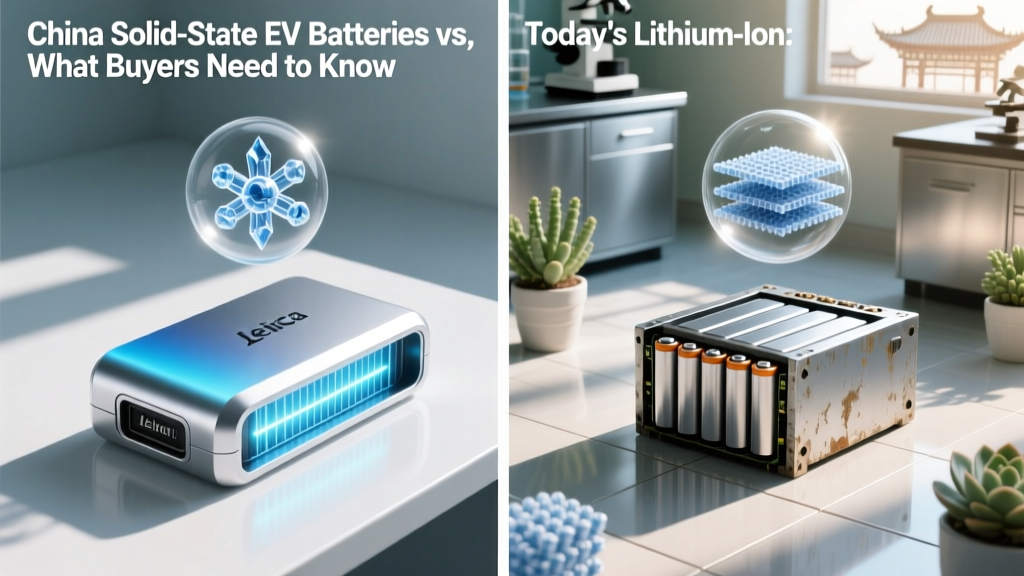
Why China's Solid-State Battery Push Matters for EV Buyers
If you've followed EV battery headlines in 2025 and 2026, you've likely seen a wave of announcements from Chinese manufacturers — CATL, BYD, Gotion, and newer entrants like QingTao Energy and WeLion — claiming breakthroughs in solid-state battery technology. Some prototypes boast energy densities above 350 Wh/kg, ranges exceeding 600 miles, and charging times under 10 minutes. The question most buyers actually need answered is simpler: what does this mean for the car I'm buying today, and how long will its current-generation battery last?
This guide breaks down where China solid-state EV batteries actually stand in their development timeline, how they compare to the LFP and NMC chemistries powering today's EVs, and — critically — the real data on degradation, warranty coverage, replacement costs, and the daily habits that determine how long your battery pack will serve you.
LFP vs. NMC/NCA: The Chemistry Trade-Offs That Matter
Every EV sold in the U.S. today uses one of two dominant lithium-ion chemistries for its high-voltage traction battery: LFP (lithium iron phosphate) or NMC/NCA (nickel manganese cobalt / nickel cobalt aluminum). Understanding the trade-offs between these chemistries is essential before evaluating what solid-state technology promises to change.
| Attribute | LFP (Lithium Iron Phosphate) | NMC / NCA (Nickel-Based) |
|---|---|---|
| Energy Density | ~160–180 Wh/kg (cell level) | ~220–300 Wh/kg (cell level) |
| Cycle Life | 3,000–5,000+ cycles to 80% capacity | 1,000–2,000 cycles to 80% capacity |
| Cold-Weather Performance | Moderate — greater range loss below 32°F; slower charging without preconditioning | Better low-temp conductivity; still loses ~20–30% range in deep cold |
| Cost per kWh | ~$70–90/kWh (cell, 2025–2026 pricing) | ~$100–130/kWh (cell, 2025–2026 pricing) |
| Thermal Stability / Safety | Excellent — higher thermal runaway threshold (~270°C) | Good with BMS management; lower thermal runaway threshold (~210°C) |
| Recommended SoC Range | Can charge to 100% regularly; periodic full charges help BMS calibration | Daily limit of 80–90% recommended; 100% for trips only |
| Common in (2026 U.S. models) | Tesla Model 3/Y RWD, base Ford Mustang Mach-E, some BYD exports | Tesla Long Range, Hyundai Ioniq 5/6, Rivian, GM Ultium, Porsche Taycan |
Which is better? It depends on your use case. If you prioritize maximum range per charge and need the lightest possible pack — for towing, road-tripping, or performance driving — NMC/NCA remains the stronger choice. If you want a battery that will outlast the vehicle itself, can tolerate daily 100% charging, and costs less upfront, LFP is increasingly the pragmatic pick for daily commuters and urban drivers. Tesla's shift to LFP in standard-range Model 3 and Model Y variants reflects this calculus.
How Long Do EV Batteries Actually Last?
The short answer: longer than most buyers assume. The high-voltage traction battery in a modern EV is engineered to outlast the typical ownership period of the vehicle. Data from fleet operators, manufacturer reports, and independent testing consistently shows that well-managed lithium-ion packs retain 85–93% of original capacity after 100,000 miles.
- Tesla Model 3/Y (NMC, 2018–2023 fleets): Average ~12% capacity loss at 150,000 miles, per Tesla's 2024 Impact Report. Most packs retain ~88% at 100,000 miles.
- Nissan LEAF (passive-cooled NMC, 2011–2017): Early 24 kWh and 30 kWh packs showed 20–30% degradation by 80,000–100,000 miles — a cautionary tale about thermal management. The 2018+ LEAF with active liquid cooling improved markedly.
- Chevrolet Bolt EV/EUV (NMC, liquid-cooled): Owners report 5–8% loss at 60,000 miles; the robust thermal management system has yielded some of the best longevity data in the segment.
- Hyundai Ioniq 5 (NMC, 77.4 kWh): Limited long-term fleet data as of 2026, but Hyundai's 800V architecture and active thermal management suggest degradation curves comparable to the Bolt EV.
- LFP packs (Tesla SR, BYD Blade): BYD's Blade LFP cells have demonstrated less than 5% capacity loss over 3,000 lab cycles (simulating ~750,000+ miles). Real-world fleet data from Chinese ride-hail services shows ~8–10% loss at 200,000 km (~124,000 miles).
The degradation curve is not linear. Most lithium-ion packs experience a steeper drop in the first 10,000–20,000 miles (typically 2–5%) as the solid electrolyte interphase (SEI) layer stabilizes, then settle into a very slow, nearly linear decline for the remainder of their life. A well-maintained NMC pack reaching 200,000 miles with 75–80% capacity retention is realistic; an LFP pack doing the same with 85%+ is equally plausible.
Battery Warranty Terms: What's Actually Covered
Federal law mandates that EV battery warranties cover a minimum of 8 years or 100,000 miles (whichever comes first) for emissions-related components, and most manufacturers match or exceed this for the traction battery specifically. California Air Resources Board (CARB) states require 10 years / 150,000 miles coverage.
| Manufacturer | Coverage Period | Capacity Threshold | Notes |
|---|---|---|---|
| Tesla | 8 yr / 100,000–120,000 mi (varies by model) | 70% retention | Model 3/Y: 100k mi; Model S/X: 150k mi |
| Hyundai / Kia | 10 yr / 100,000 mi | 70% retention | Among the longest standard coverage |
| GM (Chevrolet, Cadillac) | 8 yr / 100,000 mi | 60–70% retention (model-dependent) | Ultium platform; Bolt recall replaced many packs |
| Ford | 8 yr / 100,000 mi | 70% retention | Covers battery and hybrid/electric components |
| Rivian | 8 yr / 175,000 mi (R1T/R1S) | 70% retention | Higher mileage threshold reflects truck use case |
| BMW | 8 yr / 100,000 mi | 70% retention | BMW also offers a battery certificate program |
The key number to watch is the capacity retention threshold — typically 70%. If your pack drops below 70% of its original usable capacity within the warranty period, the manufacturer will repair or replace it (often with a refurbished unit of equivalent capacity). Normal degradation above that threshold is considered expected wear and is not covered.
EV Battery Replacement Costs: The Numbers and the Context
Battery replacement is the single biggest fear among prospective EV buyers — and the most frequently exaggerated cost in EV coverage. Here's the reality: the vast majority of EV batteries never need full replacement during the vehicle's usable life. When replacement is needed, it's typically due to a manufacturing defect (covered under warranty) or physical damage (covered by insurance), not end-of-life degradation.
| Vehicle / Pack Size | Battery Capacity | Estimated Pack Cost | Installed (Parts + Labor) |
|---|---|---|---|
| Tesla Model 3 RWD | ~60 kWh (LFP) | $5,000–$7,000 | $7,000–$10,000 |
| Tesla Model Y LR / Model 3 LR | ~75–82 kWh (NMC) | $8,000–$12,000 | $12,000–$16,000 |
| Hyundai Ioniq 5 / Kia EV6 | ~77.4 kWh (NMC) | $8,000–$11,000 | $11,000–$15,000 |
| Ford F-150 Lightning (Extended) | ~131 kWh (NMC) | $15,000–$22,000 | $20,000–$30,000 |
| Chevrolet Silverado EV / GMC Hummer EV | ~200+ kWh (Ultium NMC) | $22,000–$35,000 | $28,000–$42,000 |
These costs are trending downward. According to BloombergNEF's annual battery price survey, average pack prices fell below $115/kWh in 2025 and are projected to approach $90–100/kWh by 2027. Module-level repairs — replacing individual cell modules rather than the entire pack — can cost $1,500–$5,000 and resolve many localized failures.
Factors That Accelerate (or Preserve) Battery Life
Battery degradation is driven by chemistry, temperature, and usage patterns. Here are the factors that matter most, ranked by impact:
- Avoid sustained high SoC (NMC/NCA): Don't leave an NMC pack at 100% for extended periods. Set your daily charge limit to 80–90%. LFP packs can and should be charged to 100% regularly — their chemistry benefits from it, and periodic full charges help the battery management system (BMS) calibrate cell balancing.
- Minimize DC fast charging when possible: Frequent use of 150+ kW DC fast charging generates significant heat. Occasional road-trip fast charging is fine — the thermal management system handles it — but daily reliance on DCFC (e.g., for ride-share drivers) accelerates degradation. Home Level 2 charging at 7–11 kW is the gentlest method.
- Precondition before fast charging: Most modern EVs automatically precondition the battery when you navigate to a DC fast charger. This warms (or cools) the cells to the optimal temperature window (~30–40°C) for accepting high-power charge. Always use the car's built-in navigation to the charger to trigger preconditioning.
- Don't let SoC sit at 0%: Storing an EV at very low state of charge for weeks can cause copper dissolution in the anode, leading to permanent capacity loss. If storing for more than a week, leave the pack at 40–60% SoC.
- Extreme cold is manageable; extreme heat is worse: Cold temperatures temporarily reduce range and slow charging but don't cause permanent damage. Sustained high ambient heat (above 95°F / 35°C) combined with high SoC is more damaging over time. Garage parking in hot climates helps significantly.
- Use the car regularly: Lithium-ion cells prefer moderate, regular cycling over long periods of inactivity. A daily-driven EV with Level 2 home charging is often healthier than one that sits for weeks at a time.
Monitoring Battery Health: How to Check State of Health (SoH)
State of Health (SoH) is expressed as a percentage of the battery's current maximum capacity relative to its original capacity when new. A pack with 92% SoH can still store 92% of the kWh it could on day one.
How to check SoH:
- In-vehicle displays: Tesla provides a battery health percentage in the Service menu (Software 2024.38+). Hyundai/Kia shows SoH in the EV diagnostics menu on newer models. BMW's iDrive includes a battery health indicator.
- OBD-II diagnostic apps: Tools like Leaf Spy (Nissan LEAF), ABRP (A Better Route Planner) with OBD dongle, and Car Scanner can read SoH data directly from the BMS via the OBD-II port. These provide more granular data including individual cell voltages, pack temperature, and charge/discharge cycle counts.
- Dealer diagnostics: Any authorized service center can run a full battery health report. Request this during routine service visits or before purchasing a used EV.
- Third-party services: Companies like Recurrent (now part of Cox Automotive) and Geotab offer fleet-level battery health analytics; some provide consumer-facing reports for enrolled vehicles.
As a practical benchmark, if your SoH drops below 85% within the first 50,000 miles, that's worth a dealer diagnostic check — it may indicate a defective module. Normal SoH at 100,000 miles for a well-maintained NMC pack is 85–92%; for LFP, 90–95%.
China Solid-State EV Batteries: Where the Technology Actually Stands
China's dominance in lithium-ion battery manufacturing — CATL and BYD together supply roughly 55% of global EV battery capacity — gives its solid-state research enormous scale advantages. Here's where the major players stand as of early 2026:
- CATL: Unveiled its "Condensed Matter Battery" in 2023 with claimed 500 Wh/kg energy density, targeting aviation applications first. Its automotive solid-state cell is in pilot production with an announced mass-production target of 2027–2028. CATL has acknowledged that cost remains a significant barrier to widespread automotive adoption.
- BYD: Has been more cautious in public timelines. BYD's current focus is scaling its Blade LFP cell (a structural, prismatic design that maximizes pack-level energy density without changing chemistry). Solid-state R&D is confirmed but no production timeline has been publicly committed.
- QingTao Energy: Partnered with SAIC Motor (MG's parent company) to produce semi-solid-state cells. The IM Motors L6 sedan, sold in China, uses a "semi-solid-state" pack from QingTao with reported energy density of ~300 Wh/kg. This is a hybrid approach — the electrolyte is partially solid, partially gel — and represents the current state of commercially deployed "solid-state" technology.
- WeLion (Weilai/New Energy): Supplies NIO with a 150 kWh semi-solid-state pack that enables the ET7 sedan to achieve over 1,000 km (621 miles) on the CLTC cycle. The pack uses a solid-liquid hybrid electrolyte. It is available through NIO's battery-swap network in China but is not exported to the U.S. market.
- Gotion High-Tech: Volkswagen-backed; announced a solid-state prototype cell at 350 Wh/kg in 2024 with a target production timeline of 2027–2028.
What "semi-solid-state" actually means: True solid-state batteries replace the liquid electrolyte entirely with a solid material (ceramic, sulfide, or polymer). The cells currently in limited Chinese production use a hybrid approach — a gel or polymer electrolyte with some solid-state characteristics. This improves safety and energy density incrementally but does not deliver the step-change performance that full solid-state promises.
Realistic timeline for U.S. market availability: Based on current development trajectories, expect the first U.S.-market vehicles with genuine solid-state or advanced semi-solid-state packs no earlier than 2028–2030, likely in premium segments first (Toyota has targeted 2027–2028 for its solid-state debut in Japan; Samsung SDI targets 2027 for mass production). Cost parity with current NMC is not expected until the early 2030s.
Silicon Anode and Other Near-Term Battery Innovations
While solid-state garners the headlines, silicon anode technology is the nearer-term innovation likely to reach U.S. EVs first. By blending silicon into the graphite anode (currently 5–10% silicon content, with targets of 20–50%), manufacturers can increase energy density by 15–30% without changing the electrolyte or cell architecture.
Group14 Technologies (backed by Porsche), Sila Nanotechnologies (partnered with Mercedes-Benz and Panasonic), and Enovix are all scaling silicon anode production. Mercedes-Benz's next-generation EQ models and Porsche's future EVs are expected to incorporate silicon-dominant anodes by 2027–2028, potentially adding 30–50 miles of range to equivalent pack sizes.
Other near-term advances include:
- Sodium-ion batteries: CATL began limited production of sodium-ion cells in 2025. Lower energy density than lithium-ion (~140–160 Wh/kg) but cheaper, better cold performance, and no lithium or cobalt required. Likely headed for budget city cars and energy storage before premium EVs.
- Cell-to-pack (CTP) and cell-to-chassis (CTC) designs: BYD's Blade, Tesla's structural 4680, and CATL's Qilin packs eliminate module-level packaging, increasing pack-level energy density by 15–25% without changing cell chemistry.
- LMFP (lithium manganese iron phosphate): An evolution of LFP that adds manganese for ~15% higher energy density while retaining LFP's cost and safety advantages. CATL and Gotion are scaling LMFP production for 2026–2027 model-year vehicles.
Frequently Asked Questions
How long do EV batteries last in years and miles?
Most modern EV traction batteries are designed to last 15–20 years or 200,000+ miles while retaining 70–85% of their original capacity. Real-world fleet data from Tesla, Chevrolet Bolt, and BYD vehicles consistently shows less than 15% degradation at 150,000 miles for liquid-cooled packs. LFP chemistries typically outlast NMC in cycle count, though NMC offers higher energy density.
How much does an EV battery cost to replace?
Out-of-warranty replacement costs range from approximately $7,000–$10,000 for a Tesla Model 3 LFP pack to $28,000–$42,000 for a large truck pack like the GMC Hummer EV's 200+ kWh Ultium battery. However, most batteries never need replacement — warranty coverage handles defects, insurance covers physical damage, and gradual degradation rarely renders a pack unusable. Module-level repairs cost $1,500–$5,000 and address many issues without full pack replacement.
What does the EV battery warranty cover?
Manufacturer warranties typically cover the traction battery for 8 years/100,000 miles (10 years/150,000 miles in CARB states) against capacity loss below a defined threshold — usually 70% of original capacity. The warranty covers defects in materials and workmanship, including module failures and BMS malfunctions. It does not cover damage from accidents, flooding, or unauthorized modifications. Normal gradual degradation above the threshold is expected wear.
How do I check and maximize my EV battery health?
Check SoH through your vehicle's built-in diagnostics menu, an OBD-II app like Car Scanner or Leaf Spy, or a dealer diagnostic report. To maximize longevity: set NMC daily charge limits to 80–90%, charge LFP to 100% regularly, rely on Level 2 home charging over frequent DC fast charging, precondition before fast charging, avoid storing at 0% or 100% SoC for extended periods, and park in shade or a garage in hot climates.
LFP vs NMC — which battery chemistry is better?
Neither is universally better. LFP wins on cost (~$70–90/kWh vs. $100–130/kWh), cycle life (3,000–5,000+ cycles vs. 1,000–2,000), thermal safety, and tolerance for daily 100% charging. NMC/NCA wins on energy density (220–300 Wh/kg vs. 160–180 Wh/kg), cold-weather performance, and weight efficiency — critical for long-range, performance, and towing applications. Choose LFP for daily commuting and value; choose NMC for maximum range and versatility.
When will solid-state EV batteries be available in the U.S.?
Based on announced timelines from Toyota, Samsung SDI, CATL, and others, expect initial solid-state or advanced semi-solid-state EVs in the U.S. market no earlier than 2028–2030, likely in premium vehicles first. Cost-competitive mass adoption is not projected until the early 2030s. China's semi-solid-state cells (QingTao, WeLion) are already in limited Chinese-market vehicles but are not available in U.S.-spec models.