Why China's EV Battery Shipbuilding Matters for American EV Buyers
Every time you plug in a Tesla Model 3, a Ford Mustang Mach-E, or a Chevrolet Equinox EV, there is a strong chance the battery cells inside were manufactured in China and shipped across the Pacific. As of 2026, China controls roughly 75-80% of global lithium-ion battery cell production, with CATL and BYD alone accounting for over half of worldwide output. The term "china ev battery shipbuilding" has become shorthand in supply-chain circles for the massive maritime logistics network — from Shanghai and Ningbo ports to Long Beach and Savannah — that delivers millions of battery cells and modules to Western automakers every quarter.
For US-based EV shoppers and owners, this dominance is not an abstract geopolitical issue. It directly affects what chemistry your EV uses, how much you pay, whether you qualify for the §30D federal tax credit, and how long your battery will last. This guide breaks down the battery technology flowing through these supply chains, with hard numbers on degradation, warranty coverage, replacement costs, and care practices.
LFP vs NMC: The Two Chemistries Shipping from Chinese Ports
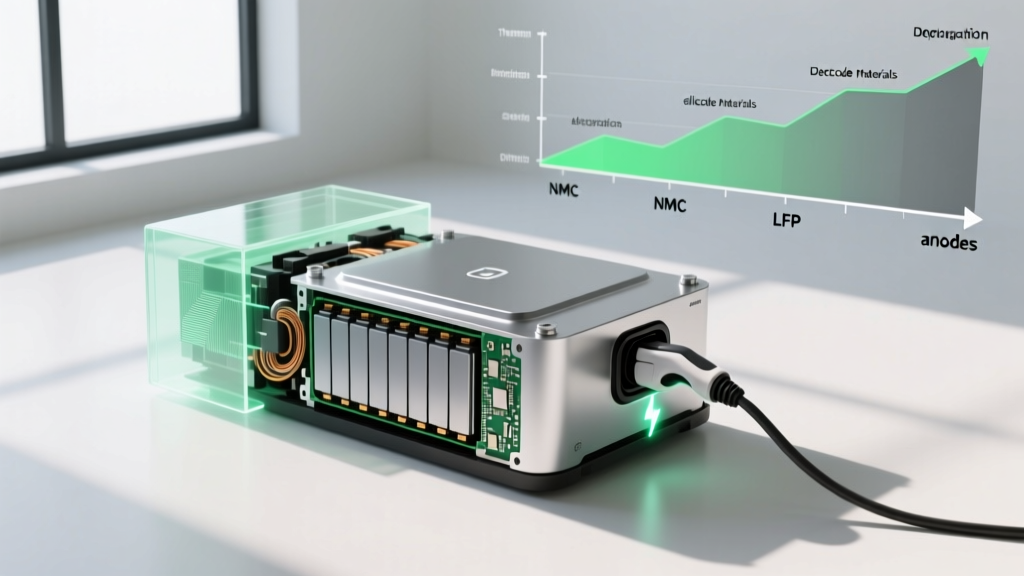
The two dominant EV battery chemistries in 2026 are LFP (lithium iron phosphate) and NMC (nickel manganese cobalt), with NCA (nickel cobalt aluminum) used primarily by Tesla and a few others. China's manufacturing base has driven LFP adoption globally, as CATL and BYD perfected the chemistry at scale.
| Attribute | LFP (LiFePO4) | NMC / NCA |
|---|---|---|
| Energy density (Wh/kg, cell level) | 160-200 | 230-300 |
| Typical cycle life (to 80% SoH) | 2,000-4,000+ cycles | 1,000-2,000 cycles |
| Cold-weather range retention (20°F) | ~60-70% of EPA | ~65-75% of EPA |
| Thermal stability / fire risk | Excellent — no thermal runaway below ~500°F | Good — requires active thermal management |
| Cost per kWh (cell, 2026 est.) | $60-$80 | $90-$120 |
| Recommended charge habit | OK to charge to 100% regularly | Best kept 20-80% daily; 100% for trips |
| Cobalt / nickel content | None | Significant — supply-chain and ethical concerns |
| Common in (2026 US models) | Tesla Model 3 RWD, Model Y RWD, Ford Mustang Mach-E Select (base), Chevy Equinox EV | Tesla Long Range, Hyundai Ioniq 5/6, BMW iX, Rivian R1S/R1T, VW ID.4 AWD |
Which is better? It depends on your use case. LFP wins on longevity, cost, and safety — ideal for daily commuting and owners who plan to keep their EV 10+ years. NMC wins on energy density and cold-weather performance — better for road-trippers and cold-climate buyers who need maximum range per kWh. Neither is universally superior; the right choice depends on your driving patterns and climate.
How Long Do EV Batteries Actually Last? Degradation Data
The single most common question from prospective EV buyers: "Will I need a new battery, and when?" The data from 2026 model-year fleets and long-term owner reports is reassuring — most EV batteries outlast the vehicles they power.
Typical EV Battery Degradation Curve (Aggregated Owner Data, 2020-2026 models):
- Year 1: 2-4% capacity loss (initial formation loss)
- Years 2-3: ~1-2% per year (linear, gradual)
- Years 4-5: ~1-2% per year
- Year 8 average retained capacity: 85-92% (LFP typically on the higher end)
- Year 10 projected: 80-88% retained capacity for most models
Source: Aggregated data from Geotab fleet telematics and owner-reported databases. Individual results vary based on climate, charging habits, and chemistry.
Real-world examples: Tesla's 2025 Impact Report noted that Model 3/Y batteries retain an average of ~88% capacity at 150,000 miles. Chevrolet Bolt EUV owners have reported 90%+ State of Health (SoH) at 100,000 miles. Early Nissan Leaf models (passive air cooling) showed steeper degradation, but modern liquid-cooled packs from CATL, BYD, LG, and SK On perform significantly better.
When does replacement become necessary? In practice, very few EVs need a full battery replacement within the first 10-12 years. A battery is generally considered "end of life" for automotive use when it drops below 70% capacity — and most 2022+ models with liquid cooling are not projected to hit that threshold until 200,000+ miles under normal use.
Battery Warranty Terms: What's Actually Covered
Federal law mandates a minimum 8-year/100,000-mile warranty on EV battery packs (10 years/150,000 miles in CARB states like California). Most automakers meet or exceed this baseline. Here is how major 2026 model-year warranties compare:
| Automaker | Warranty Period | Mileage Limit | Capacity Threshold |
|---|---|---|---|
| Tesla (Model 3/Y RWD — LFP) | 8 years | 120,000 miles | Below 70% |
| Tesla (Model 3/Y LR/AWD — NMC) | 8 years | 120,000 miles | Below 70% |
| Hyundai / Kia (Ioniq 5, EV6, EV9) | 10 years | 100,000 miles | Below 70% |
| Ford (Mach-E, F-150 Lightning) | 8 years | 100,000 miles | Below 70% |
| GM (Chevy Equinox EV, Blazer EV) | 8 years | 100,000 miles | Below 70% (60% for LFP on some trims) |
| Rivian (R1S, R1T) | 8 years | 175,000 miles | Below 70% |
| BMW (i4, iX) | 8 years | 100,000 miles | Below 70% |
| Volkswagen (ID.4) | 8 years | 100,000 miles | Below 70% |
Key detail: The 70% threshold means the manufacturer will repair or replace the battery only if it degrades beyond 30% capacity loss within the warranty period. Given that most modern packs retain 85-92% at the 8-year mark, warranty claims remain uncommon for liquid-cooled batteries.
EV Battery Replacement Costs: The Real Numbers
When a battery does need replacement — typically due to physical damage, manufacturing defect, or extreme degradation well past the warranty period — costs are substantial but declining. Here is what 2026 pricing looks like:
| Vehicle / Battery Size | Chemistry | Estimated Pack Cost (Parts) | Estimated Labor | Total Range |
|---|---|---|---|---|
| Tesla Model 3 RWD (~57 kWh usable) | LFP | $5,500 - $8,000 | $1,500 - $2,500 | $7,000 - $10,500 |
| Tesla Model Y LR (~75 kWh usable) | NMC | $8,000 - $12,000 | $1,500 - $2,500 | $9,500 - $14,500 |
| Hyundai Ioniq 5 (~77 kWh usable) | NMC | $9,000 - $13,000 | $2,000 - $3,000 | $11,000 - $16,000 |
| Ford F-150 Lightning Ext. Range (~131 kWh) | NMC | $15,000 - $22,000 | $2,500 - $4,000 | $17,500 - $26,000 |
| Chevy Equinox EV (~85 kWh usable) | NMC (Ultium) | $8,500 - $12,000 | $2,000 - $3,000 | $10,500 - $15,000 |
| Rivian R1T Large Pack (~128 kWh) | NMC | $14,000 - $20,000 | $2,500 - $4,000 | $16,500 - $24,000 |
Context that matters: Cell-level pricing has fallen to roughly $60-120/kWh depending on chemistry, but pack-level costs include the enclosure, thermal management system, BMS (battery management system), wiring, and labor. Independent EV shops are increasingly offering module-level repairs (replacing individual degraded modules rather than the full pack) for $3,000-$7,000 on many models — a more realistic cost for out-of-warranty vehicles.
Factors That Accelerate Battery Degradation
Not all miles are equal when it comes to battery wear. These factors have the most measurable impact on long-term State of Health:
Battery Care Checklist for Maximum Longevity
- Avoid sustained high SoC on NMC: Daily charging to 100% on NMC/NCA batteries accelerates degradation. Set your charge limit to 80% for daily use; reserve 100% for road trips. LFP batteries are more tolerant of 100% charges and manufacturers often recommend periodic full charges for BMS calibration.
- Minimize DC fast charging frequency: Occasional DC fast charging (1-2x/week) has minimal impact, but daily use of 150+ kW chargers — especially without preconditioning — adds measurable wear. Data from Geotab shows fleets that DC fast charge daily see ~1-2% additional annual degradation vs. Level 2-only charging.
- Precondition before fast charging: Most 2026 EVs automatically precondition the battery when you navigate to a DC fast charger. This warms the cells to optimal temperature (~77-95°F), enabling faster charging and reducing lithium plating risk. If your EV has this feature, always use navigation to the charger rather than driving there manually.
- Extreme heat is worse than extreme cold: Sustained ambient temperatures above 95°F, especially combined with high SoC, accelerate chemical degradation. Parking in shade or a garage in hot climates measurably extends battery life. Cold weather reduces range temporarily but does not cause permanent damage in liquid-cooled packs.
- Don't store at 0% or 100%: If your EV will sit unused for weeks, aim for ~50% SoC. Storing at very high or very low states of charge causes calendar aging that is independent of cycle count.
- Use Level 2 for daily charging: A home Level 2 charger (7-11 kW) is the gentlest regular charging method and the most convenient. It adds 25-45 miles of range per hour, fully replenishing most EVs overnight.
How to Check Your EV Battery's State of Health (SoH)
State of Health (SoH) is a percentage indicating how much capacity your battery retains compared to when it was new. A 92% SoH means your battery holds 92% of its original kWh capacity.
How to check SoH by brand (2026 models):
- Tesla: No native SoH display in the app. Use third-party tools like TeslaFi or Scan My Tesla with an OBD-II adapter to read BMS data directly. Alternatively, compare your displayed range at 100% SoC to the original EPA rating — a rough but useful proxy.
- Hyundai/Kia: The infotainment system includes a battery health indicator under EV settings. Some models display SoH percentage directly.
- GM (Ultium platform): The myChevrolet/myCadillac app provides a battery health estimate. Dealership diagnostic tools can pull detailed module-level data.
- Ford: The FordPass app provides a battery health indicator. For precise SoH, a dealership can run a diagnostic using Ford's IDS tool.
- Universal method: An OBD-II Bluetooth adapter paired with apps like Car Scanner or ABRP (A Better Route Planner) can read BMS-reported SoH on most 2020+ EVs for under $50 in hardware.
For buyers considering a used EV, a SoH reading is as important as a vehicle history report. A 3-year-old EV with 95% SoH has been well cared for; one at 87% may have been frequently DC fast-charged or stored at high SoC in a hot climate.
The Supply Chain: How Chinese Battery Cells Reach US EVs
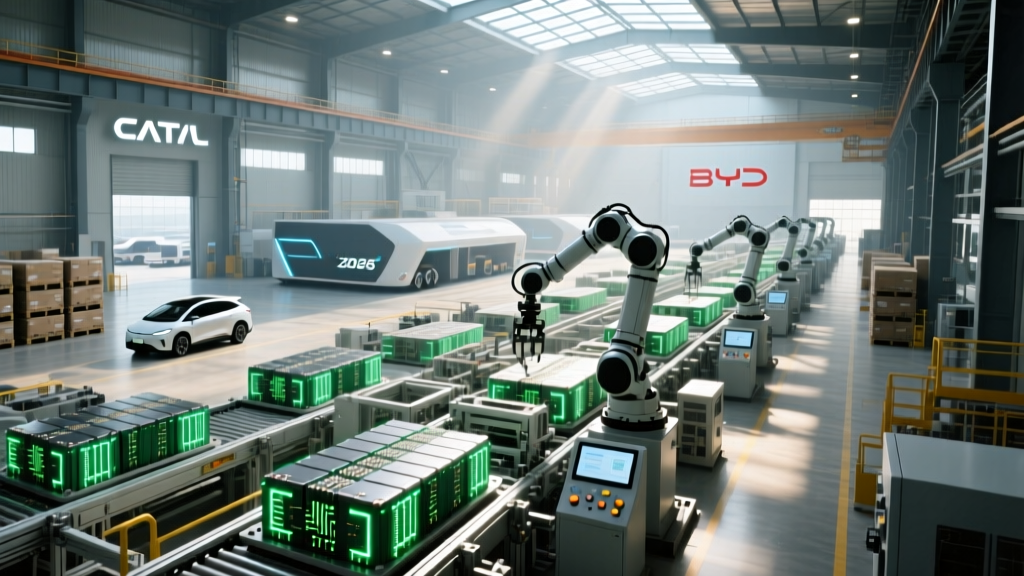
China's dominance in EV battery manufacturing is a function of scale, vertical integration, and a decade-long head start in refining critical minerals. CATL (Contemporary Amperex Technology Co., Limited) operates gigafactories producing over 500 GWh annually — enough for roughly 7-8 million EVs. BYD, uniquely, manufactures both batteries and complete vehicles, and began exporting LFP-powered EVs globally in 2024-2025.
The "shipbuilding" dimension refers to the massive maritime logistics chain that moves battery cells, modules, and complete packs from Chinese manufacturing hubs to assembly plants in North America and Europe. Key shipping routes run from the ports of Shanghai, Ningbo-Zhoushan, and Shenzhen to US ports including Long Beach/Los Angeles, Savannah, and Houston. In 2025, an estimated 40-50% of all lithium-ion cells imported to the United States originated in China, even when sold under Korean (LG, SK On) or Japanese (Panasonic) brand names through joint ventures or contract manufacturing.
This supply chain has direct implications for the §30D federal tax credit. Under current IRS rules, the $7,500 credit requires that battery components and critical minerals meet domestic-content and free-trade-agreement sourcing thresholds. Vehicles with battery cells or modules from a "foreign entity of concern" (FEOC) — which includes many Chinese manufacturers — are disqualified. This has pushed automakers to source from LG, SK On, Samsung SDI, and Panasonic cells manufactured in US, Korean, or Japanese plants, even as the underlying mineral supply chain remains heavily Chinese-influenced.
For buyers: Always verify tax credit eligibility on the specific trim and build date you are purchasing. A model that qualifies in January may lose eligibility if the manufacturer changes cell suppliers mid-year. The fueleconomy.gov tax credit page maintains a current list of eligible vehicles.
Emerging Battery Technology: What's Coming (and When)
Several next-generation battery technologies are in development, but realistic timelines matter:
- Solid-state batteries: Promise 30-50% higher energy density and faster charging with improved safety. Toyota, Samsung SDI, and QuantumScape have announced pilot production, but mass-market availability at scale is not expected before 2028-2030. Early solid-state EVs will likely debut in premium models at $70,000+ MSRP before reaching mainstream pricing.
- Silicon anode cells: Replacing graphite anodes with silicon can boost energy density by 20-40%. Sila Nanotechnologies and Group14 Technologies are supplying early production cells, with limited deployment in 2026-2027 models (notably the Mercedes G-Class EV and select Porsche variants). Durability and cycle-life challenges are being resolved but remain a constraint for mass adoption.
- Sodium-ion batteries: CATL and BYD have begun mass-producing sodium-ion cells for lower-cost, shorter-range applications. These use no lithium, cobalt, or nickel, and perform well in cold weather, but have ~30-40% lower energy density than LFP. Expect initial deployment in Chinese-market micro-EVs and energy storage before any US passenger vehicles.
- LFP improvements: CATL's "Shenxing" LFP cells, introduced in 2024-2025, support 4C charging rates (10-80% in ~10 minutes) and are beginning to appear in European and potentially US-market vehicles by 2027. This narrows the charging-speed gap between LFP and NMC significantly.
None of these technologies are available in 2026 US-market EVs at scale. If you are buying now, LFP and NMC remain the proven, well-understood chemistries with extensive real-world track records.
Frequently Asked Questions
How long do EV batteries last in years and miles?
Most 2022+ EV batteries with liquid cooling are projected to retain 80-88% capacity at 10 years or 150,000-200,000 miles under normal use. Many will outlast the vehicles they are installed in. LFP batteries typically show slower degradation than NMC over the same period.
How much does an EV battery cost to replace?
Full pack replacement costs range from roughly $7,000 for a smaller LFP pack (Tesla Model 3 RWD) to $26,000 for a large NMC pack (F-150 Lightning Extended Range). Module-level repairs at independent shops can cost $3,000-$7,000. However, the vast majority of EVs never need a battery replacement within their useful life.
What does the EV battery warranty cover?
Federal law requires a minimum 8-year/100,000-mile warranty covering defects and capacity loss below 70% of original capacity. Some automakers (Hyundai, Kia, Rivian) offer longer periods or higher mileage limits. The warranty covers repair or replacement of the battery pack — not gradual, normal degradation above the threshold.
How do I check and maximize my EV battery health?
Check SoH through your vehicle's infotainment system, manufacturer app, or an OBD-II adapter with a compatible app. To maximize longevity: charge NMC batteries to 80% daily, minimize DC fast charging frequency, precondition before fast charging, avoid storing at extreme SoC levels, and park in shade in hot climates. LFP owners can charge to 100% more freely but should still avoid extreme heat storage.
LFP vs NMC — which chemistry is better for me?
Choose LFP if you prioritize longevity (2,000-4,000+ cycle life), lower cost, cobalt-free sourcing, and the convenience of regular 100% charging. Choose NMC if you need maximum range per kWh, better cold-weather performance, or are buying a Long Range / AWD model where NMC's higher energy density is necessary to meet the EPA range target. Neither is universally superior — the right choice depends on your climate, driving patterns, and ownership timeline.
Does China's battery dominance affect my EV's tax credit eligibility?
Potentially, yes. Under current IRS §30D rules, vehicles containing battery components from a "foreign entity of concern" (FEOC) — which includes most Chinese manufacturers — are excluded from the federal tax credit. Automakers have been restructuring supply chains to comply, but eligibility can change by model year and trim. Always verify on fueleconomy.gov before purchasing.