If you've landed here searching for a Chevy Traverse 2014 battery, you likely need to replace the 12-volt starting battery in your midsize SUV — a straightforward $150–$250 swap at any auto parts store. But the word "battery" means something very different in the electric-vehicle world, and the confusion is understandable. A modern EV traction battery stores 60–100+ kilowatt-hours (kWh) of energy, costs $5,000–$20,000 to replace, and is engineered to outlast the vehicle itself.
This guide uses that search as a starting point to explain what EV batteries actually are, how they differ from the 12V lead-acid battery under your Traverse's hood, and everything prospective EV buyers need to know about chemistry, degradation, warranties, replacement costs, and care. Whether you're considering trading that 2014 Traverse for a 2026 Chevrolet Equinox EV or just want to understand the technology, the data below will cut through the noise.
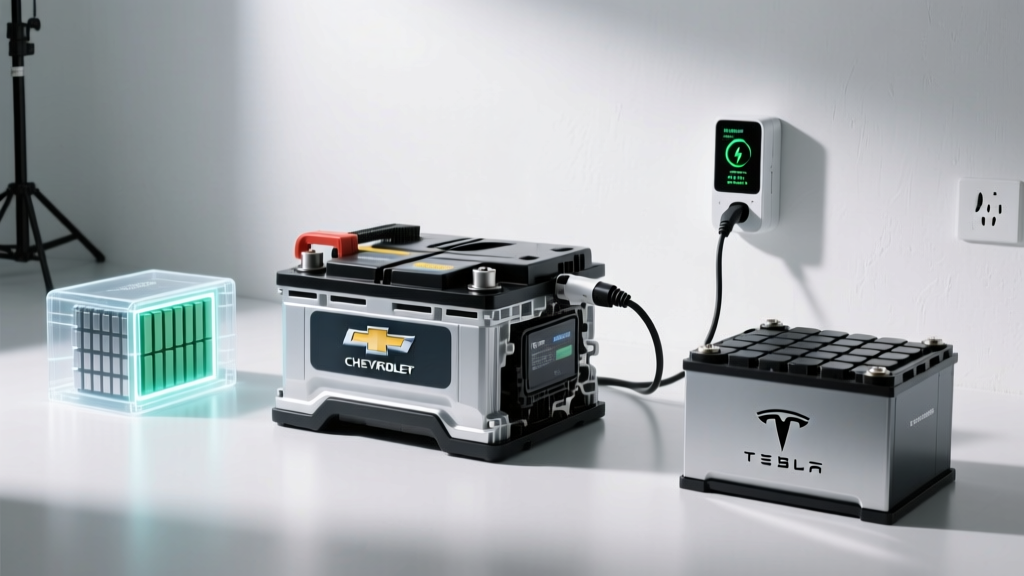
The 2014 Chevy Traverse Battery vs. an EV Traction Battery
The 2014 Chevrolet Traverse uses a conventional Group 48 (H6) 12-volt lead-acid battery — typically an AGM (absorbent glass mat) type rated around 70 amp-hours and 760 cold-cranking amps. Its sole job is to crank the 3.6L V6 engine and power accessories when the engine is off. It weighs roughly 45 pounds, stores less than 1 kWh of usable energy, and lasts 3–5 years before replacement.
An EV traction battery is a fundamentally different machine. Take the 2026 Chevrolet Equinox EV as an example: its Ultium-platform battery pack stores approximately 85 kWh of usable energy in an NMC (nickel-manganese-cobalt) lithium-ion configuration, weighs roughly 950 pounds, and powers a 288-horsepower electric motor for an EPA-estimated 319 miles of range. It is liquid-cooled, actively managed by a thermal system, and warrantied for 8 years or 100,000 miles.
| Attribute | 2014 Chevy Traverse 12V Battery | 2026 Chevy Equinox EV Traction Battery |
|---|---|---|
| Type | Lead-acid AGM | Lithium-ion NMC (Ultium platform) |
| Voltage | 12V | ~400V nominal |
| Energy capacity | ~0.84 kWh | ~85 kWh usable |
| Weight | ~45 lbs | ~950 lbs |
| Purpose | Engine cranking, accessories | Vehicle propulsion, regen storage |
| Typical lifespan | 3–5 years | 15–20+ years (to 70% capacity) |
| Replacement cost | $150–$250 | $8,000–$14,000 (out of warranty) |
| Warranty | 1–3 years (pro-rated) | 8 years / 100,000 miles |
Note: EVs also carry a small 12V auxiliary battery (often lithium iron phosphate in newer models) to run computers, lights, and door locks — but the traction battery is what stores the energy for driving.
EV Battery Chemistry: LFP vs. NMC/NCA Explained
Not all lithium-ion batteries are the same. The two dominant chemistries in 2026 EVs are NMC/NCA (nickel-manganese-cobalt / nickel-cobalt-aluminum) and LFP (lithium iron phosphate). The chemistry determines energy density, lifespan, cold-weather behavior, and cost.
| Factor | LFP (Lithium Iron Phosphate) | NMC / NCA |
|---|---|---|
| Energy density | Lower (~160 Wh/kg cell-level) — heavier pack for same range | Higher (~250–300 Wh/kg) — lighter, more compact |
| Cycle life | 3,000–5,000+ full cycles to 80% capacity | 1,000–2,000 full cycles to 80% capacity |
| Cold-weather performance | More range loss below freezing (~30–40% loss at 20°F) | Better cold performance (~20–30% loss at 20°F) |
| Fast-charge tolerance | Handles frequent 100% charges well; less degradation at high SoC | Degrades faster if routinely charged to 100%; 80% daily recommended |
| Cost | Lower — no cobalt or nickel; ~$100/kWh pack-level in 2026 | Higher — commodity-sensitive; ~$130–$150/kWh pack-level |
| Thermal stability | Excellent — very resistant to thermal runaway | Good but requires more active thermal management |
| Typical applications (2026) | Tesla Model 3/Y RWD, Ford Mustang Mach-E Select, Chevy Equinox EV base trims | Long-range/performance trims, luxury EVs, trucks |
Which is better? There is no universal winner. LFP excels for daily commuting, high-mileage drivers, and owners who want to charge to 100% without worry. NMC/NCA is the right choice when maximum range per pound matters — long road trips, towing, or cold-climate driving where energy density and cold performance are priorities. Many automakers now offer both chemistries across their lineups, letting buyers choose based on their driving pattern.
How Long Do EV Batteries Actually Last?
The short answer: most EV batteries will outlast the vehicle they're installed in. Real-world fleet data consistently shows that modern lithium-ion packs lose capacity slowly and predictably, not suddenly.
Typical EV Battery Degradation Curve (Fleet Data Averages)
| Age / Mileage | Average Capacity Retained | What This Means |
|---|---|---|
| Year 1 / 15,000 mi | ~95–97% | Initial "break-in" drop, then plateau |
| Year 3 / 45,000 mi | ~91–94% | Gradual linear decline |
| Year 5 / 75,000 mi | ~87–91% | Still well above warranty threshold |
| Year 8 / 100,000 mi | ~83–88% | Typical end-of-warranty expectation |
| Year 12 / 150,000 mi | ~78–84% | Noticeable range reduction but fully usable |
| Year 15+ / 200,000 mi | ~72–80% | Approaching end-of-vehicle life for many cars |
Sources: Geotab fleet data study (6,300+ EVs), Recurrent Auto battery health reports. Individual results vary by chemistry, climate, and charging habits.
A 2026 EV with an EPA range of 320 miles retaining 85% capacity after 8 years still delivers roughly 270 miles — more than adequate for the vast majority of drivers. The fear of suddenly being stranded by a "dead" battery is not supported by data. Degradation is a slow, linear process, and the battery management system (BMS) includes a buffer (typically 5–10% of gross capacity hidden from the user) that protects against deep discharge damage.
EV Battery Warranty Terms: What's Covered
Federal law mandates that EV battery warranties cover at least 8 years / 100,000 miles. California-emissions states (CARB states) often see extended coverage of 10 years / 150,000 miles. Here's how major manufacturers structure their warranties in 2026:
| Manufacturer | Warranty Period | Capacity Retention Threshold | What Triggers a Claim |
|---|---|---|---|
| Chevrolet (Ultium) | 8 yr / 100,000 mi | Below 70% | SoH drops below 70% as measured by dealer diagnostic tool |
| Tesla | 8 yr / 100,000–120,000 mi (varies by model) | Below 70% | Battery retains less than 70% of original capacity |
| Hyundai / Kia | 10 yr / 100,000 mi | Below 70% | Capacity below 70% verified by diagnostic scan |
| Ford | 8 yr / 100,000 mi | Below 70% | SoH below 70% per Ford diagnostic |
| BMW | 8 yr / 100,000 mi | Below 70% | Net usable capacity below 70% of original |
Key detail: The warranty threshold is almost universally 70% of original capacity — meaning the manufacturer will repair or replace the battery only if it degrades beyond 30% loss within the warranty window. Given the degradation data above, very few batteries actually fall below this threshold under normal use. Warranty claims remain rare, and most are related to manufacturing defects in individual cells or modules rather than normal wear.
The warranty covers defects and excessive degradation. It does not cover damage from accidents, flooding, or unauthorized modifications. Always check your specific owner's manual for exclusions.
EV Battery Replacement Cost: When and How Much
This is the question that generates the most anxiety — and the most misinformation. Let's ground it in data.
| Vehicle Class | Battery Size (usable kWh) | Out-of-Warranty Replacement Range | Typical Need Timeline |
|---|---|---|---|
| Compact EV (e.g., Chevy Bolt EV successor) | 60–65 kWh | $5,000–$8,000 | Rarely needed; most vehicles retired before pack fails |
| Midsize SUV (e.g., Equinox EV, Model Y) | 75–90 kWh | $8,000–$14,000 | 15+ years; many packs reach second-life/repurposing first |
| Full-size truck (e.g., Silverado EV, F-150 Lightning) | 100–200+ kWh | $12,000–$22,000 | 15+ years; modular packs allow partial replacement |
| Luxury sedan (e.g., Lucid Air, Mercedes EQS) | 90–118 kWh | $14,000–$20,000 | Uncommon within vehicle lifespan |
Several critical context points:
- Most EVs never need a full battery replacement. Unlike the 12V battery in your 2014 Traverse that you'll replace 2–3 times over the vehicle's life, the traction battery is designed as a lifetime component. Data from Recurrent Auto shows that fewer than 1.5% of EVs in their 15,000-vehicle study needed a battery replacement for degradation.
- Modular replacement is increasingly common. Ultium-platform vehicles (Chevy, GMC, Cadillac) and many others use modular battery packs. If one module degrades or fails, a technician can replace just that module for a fraction of the full-pack cost — often $1,500–$3,000 per module.
- Pack prices continue to fall. BloombergNEF reports average lithium-ion pack prices at approximately $130/kWh in 2025, down from $1,200/kWh in 2010. By the time a 2026 EV might need a replacement (2040+), costs will likely be substantially lower.
- Used/refurbished packs are an option. For older EVs, refurbished battery packs from salvaged vehicles can cost 40–60% less than new OEM packs.
Factors That Affect EV Battery Lifespan
Battery degradation is influenced by how you charge, drive, and store your EV. Here are the factors ranked by impact:
High-Impact Factors
- Extreme heat exposure: Sustained ambient temperatures above 95°F accelerate chemical degradation. Garage parking and preconditioning help. This is the single biggest longevity risk.
- Routine charging to 100% (NMC/NCA): Keeping an NMC battery at 100% state of charge (SoC) for extended periods stresses the cells. Set daily charge limit to 80% and reserve 100% for road trips.
- Frequent DC fast charging in extreme heat: Repeated 150–350 kW sessions generate significant heat. Modern BMS systems precondition and throttle charge rates to protect the pack, but daily fast-charging in Arizona summers will accelerate wear modestly.
Moderate-Impact Factors
- Deep discharge (below 10% SoC): Letting the battery sit at very low SoC for days can cause copper dissolution in the anode. Plug in when you get home rather than letting it sit near empty.
- Cold-weather fast charging without preconditioning: Charging a frozen battery at high power can cause lithium plating. Most 2026 EVs automatically precondition when you navigate to a charger — use the built-in navigation for this reason.
Low-Impact Factors
- Mileage alone: Calendar aging (time) matters as much as cycle count. A 10-year-old EV with 40,000 miles may show similar degradation to one with 100,000 miles.
- Regenerative braking intensity: Modern systems manage regen current within safe C-rates. No evidence that strong regen meaningfully affects longevity.
How to Check and Monitor Battery Health (SoH)
State of Health (SoH) is the percentage of original capacity your battery can still store. A new battery is 100% SoH; one that can hold only 75 kWh of its original 85 kWh is at ~88% SoH.
How to check SoH in 2026 EVs:
- In-vehicle display: Many EVs (Tesla, Hyundai, Kia, BMW) now show SoH or a battery health indicator in the settings menu. Check under "Battery" or "Service" in your infotainment system.
- OBD-II diagnostic apps: Tools like OBDeleven, Leaf Spy (for Nissan), or manufacturer-specific apps can read SoH directly from the BMS. An OBD-II dongle ($30–$60) paired with a smartphone app gives you dealer-level data.
- Dealer diagnostic scan: Any authorized dealer can run a battery health report. Request this during routine service, especially before a warranty expires.
- Third-party services: Companies like Recurrent Auto offer free battery health reports by connecting to your EV's telematics data. This provides a SoH score compared to similar vehicles in your climate zone.
Buying a used EV? Always request a battery health report before purchase. A 2020 model with 92% SoH has plenty of life left; one at 78% may approach the warranty threshold and deserves a dealer inspection.
Future Battery Technology: What's Coming (and When)
Several next-generation battery technologies are in development. None are available in production vehicles as of 2026, but timelines are becoming clearer:
Solid-state batteries replace the liquid electrolyte with a solid ceramic or polymer separator, promising higher energy density (~400+ Wh/kg cell-level), faster charging, and improved safety. Toyota has announced a solid-state EV for 2027–2028 with a targeted 466-mile range and 10-minute fast charge. Samsung SDI, QuantumScape (backed by Volkswagen), and Nissan are also pursuing solid-state production in the 2028–2030 window. Expect initial deployment in luxury/flagship models at premium pricing before trickling down to mainstream vehicles by the early 2030s.
Silicon-dominant anodes replace graphite with silicon to increase energy storage per unit weight. Companies like Sila Nanotechnologies (partnered with Mercedes-Benz and Panasonic) and Group14 (partnered with Porsche) are targeting 2026–2028 production. Early implementations use silicon-graphite blends (5–10% silicon) with incremental gains; dominant-silicon anodes remain a few years out.
Sodium-ion batteries use abundant, inexpensive sodium instead of lithium. CATL has begun production in China for low-range city EVs. Energy density is lower than LFP (~120–140 Wh/kg), making sodium-ion best suited for budget urban vehicles. US-market availability is not expected before 2028.
All timelines above are manufacturer-announced targets and should be treated as forward-looking estimates. Production delays are common in battery technology transitions.
From a 2014 Traverse to an EV: Practical Takeaways
If you currently drive a 2014 Chevy Traverse and are considering an EV:
- Your 12V battery replacement ($150–$250 every 3–5 years) is a maintenance item EVs also have — but the EV's traction battery is a fundamentally different, far more durable component.
- Battery replacement fear should not block an EV purchase. Fewer than 1.5% of EVs need a traction battery replacement, and the 8-year/100,000-mile warranty provides a long safety net.
- Choose LFP chemistry if you commute daily, charge at home, and want a low-maintenance battery you can charge to 100% without worry.
- Choose NMC/NCA chemistry if you need maximum range, drive in cold climates, or tow frequently.
- Set your daily charge limit to 80% (for NMC) and avoid letting the battery sit below 10% or above 95% for extended periods.
- Check the IRS §30D clean vehicle credit — current 2026 rules include MSRP caps ($55,000 for cars, $80,000 for SUVs/trucks), buyer income limits ($150K single / $300K joint), and battery-sourcing requirements. The credit can transfer to the dealer as a point-of-sale discount. Eligibility varies by vehicle and buyer; consult a tax professional.
Frequently Asked Questions
How long do EV batteries last in years and miles?
Most modern EV batteries retain 80–88% of their original capacity at 100,000 miles (roughly 8 years). Fleet data from Geotab and Recurrent Auto shows that with normal use, a battery can provide 15–20 years of service before dropping to 70% capacity — the typical warranty threshold. Many EV batteries will outlast the vehicle itself.
How much does an EV battery cost to replace?
Out-of-warranty replacement costs range from approximately $5,000 for a compact EV pack (60 kWh) to $22,000 for a large truck pack (200+ kWh). However, fewer than 1.5% of EVs actually need a full replacement. Modular designs also allow partial replacements at $1,500–$3,000 per module. Pack prices continue to decline year over year.
What does the EV battery warranty cover?
Federal law requires a minimum of 8 years / 100,000 miles of battery coverage. Most manufacturers warrant that the battery will retain at least 70% of its original capacity during that period. If SoH drops below 70%, the manufacturer will repair or replace the pack at no cost. The warranty covers manufacturing defects and abnormal degradation but not accident damage, flooding, or unauthorized modifications.
How do I check my EV's battery health?
Check the in-vehicle battery health display (available on most 2026 EVs), use an OBD-II dongle with a battery diagnostic app, request a dealer diagnostic scan during service, or sign up for a free third-party report from services like Recurrent Auto. Always request a battery health report when buying a used EV.
LFP vs. NMC — which battery chemistry is better for me?
LFP is better for daily commuters who charge at home, want to charge to 100% without degradation worry, and prioritize longevity (3,000–5,000 cycles). NMC/NCA is better for drivers who need maximum range, frequently drive in cold weather (better cold performance), or tow heavy loads. Neither is universally superior — the right choice depends on your driving pattern and climate.
Is the battery in a 2014 Chevy Traverse the same as an EV battery?
No. The 2014 Traverse uses a 12-volt lead-acid AGM starting battery (~0.84 kWh, ~45 lbs, $150–$250 to replace every 3–5 years). An EV traction battery stores 60–200+ kWh, weighs 600–1,800 lbs, costs $5,000–$22,000, and is designed to last 15–20 years. They share the word "battery" but are entirely different technologies.