The Chevrolet Bolt EV and Bolt EUV have long been darlings of the affordable electric-vehicle segment, offering over 250 miles of EPA-rated range at a price point that undercuts most competitors. But as General Motors transitions its battery strategy toward lithium iron phosphate (LFP) chemistry, Bolt shoppers and owners are asking: what does an LFP battery actually mean for daily driving, longevity, and total cost of ownership?
This guide breaks down everything you need to know about the Chevy Bolt's battery — including the shift toward LFP chemistry, real degradation data, warranty coverage, replacement costs, and practical steps to maximize battery health over the life of the vehicle.
Understanding the Chevy Bolt's Battery: From NMC to LFP
The original Chevrolet Bolt EV (2017–2023) shipped with an LG Energy Solution nickel-manganese-cobalt (NMC) lithium-ion battery pack. The 2020+ refresh carried a 65 kWh usable NMC pack delivering 259 miles EPA in the Bolt EV and 247 miles EPA in the Bolt EUV, per fueleconomy.gov.
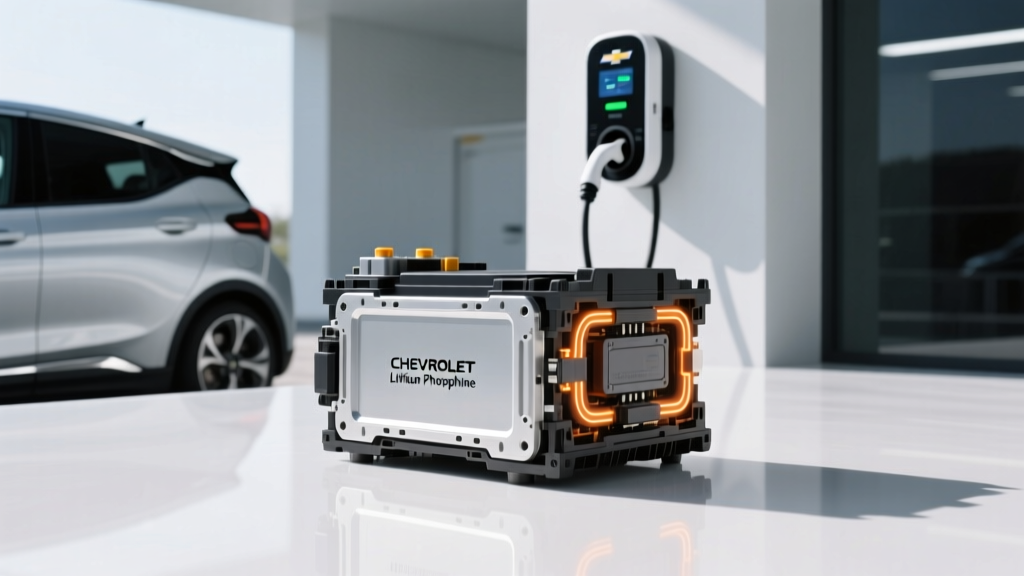
However, the next-generation Bolt — announced for the 2026 model year on GM's Ultium platform — is widely expected to adopt LFP (lithium iron phosphate) battery chemistry for its standard-range variants. GM CEO Mary Barra confirmed the company's intent to offer LFP batteries in more affordable EV models, aligning with a broader industry shift already adopted by Tesla (Model 3/Y Standard Range), Ford (base Mustang Mach-E), and several Chinese-market EVs.
Why the shift? It comes down to cost, longevity, and supply-chain resilience. Let's compare the two chemistries head to head.
| Attribute | LFP (Lithium Iron Phosphate) | NMC (Nickel Manganese Cobalt) |
|---|---|---|
| Energy Density | Lower (~160 Wh/kg cell-level) | Higher (~220–260 Wh/kg cell-level) |
| Range per kWh | Slightly less range for same pack weight | More range for same pack weight |
| Cycle Life | 3,000–5,000+ full cycles | 1,000–2,000 full cycles |
| Calendar Life | Excellent; slower degradation over time | Good; moderate degradation over time |
| Cold-Weather Performance | Weaker below 32°F; greater range loss | Better cold-weather retention |
| Charging Speed | Typically slower peak DC rates | Higher peak DC fast-charge rates |
| Cost | ~20–30% cheaper per kWh (no cobalt/nickel) | More expensive; subject to commodity volatility |
| Thermal Stability | Superior; much lower thermal runaway risk | Good, but requires more robust BMS cooling |
| Recommended SoC | Can charge to 100% daily without penalty | Best kept 20–80% for daily use |
The key takeaway for Bolt buyers: If the next-gen Bolt ships with an LFP pack, you'll likely see a modest reduction in maximum range or a slightly heavier battery pack to compensate. But you'll gain dramatically in cycle life, can charge to 100% without guilt, and benefit from a lower vehicle price. For most daily commuters driving under 60 miles round-trip, this is a favorable trade.
How Long Do EV Batteries Actually Last?
This is the number-one question from prospective EV buyers, and the answer is more reassuring than the internet rumor mill suggests.
Most modern EV batteries are designed to outlast the useful life of the vehicle itself. Based on aggregated fleet data and manufacturer testing:
- NMC batteries (like the current Bolt's LG pack) typically lose 5–10% capacity over 100,000 miles, with degradation slowing significantly after the initial break-in period.
- LFP batteries degrade even more slowly — often 3–7% over 100,000 miles, with some fleet data showing under 5% loss at 150,000 miles.
- A study by Geotab analyzing 6,300+ EVs found average annual degradation of approximately 2.3% per year across all chemistries — meaning a typical pack retains ~77% capacity after 10 years.
Degradation Reality Check: The current-gen Bolt EV's 65 kWh NMC pack, based on real-world owner reports aggregated on forums like Bolt EV Forum and Recurrent Auto data, shows an average capacity loss of roughly 6–8% at 80,000 miles. That translates to the original 259-mile EPA range dropping to approximately 238–243 miles — still very usable. An LFP-equipped next-gen Bolt would be expected to lose even less.
The critical insight: degradation is non-linear. Most batteries experience a steeper drop in the first 20,000–30,000 miles (roughly 2–4%), then plateau into a very gradual decline. Catastrophic failure outside of manufacturing defects is exceedingly rare.
Chevy Bolt Battery Warranty: What's Covered
GM provides one of the more straightforward battery warranties in the industry. For the Bolt EV and Bolt EUV:
| Component | Coverage Period | Details |
|---|---|---|
| High-Voltage Battery | 8 years / 100,000 miles | Capacity retention above 60% (some model years specify 70%) |
| Electric Powertrain | 8 years / 100,000 miles | Motor, inverter, reduction gear |
| Battery Defect | 8 years / 100,000 miles | Manufacturing defects, premature cell failure |
| California-Emission States | 10 years / 150,000 miles | Extended coverage in CARB states (CA, CT, ME, MD, MA, NJ, NY, OR, RI, VT, WA, CO) |
What triggers a warranty claim? If your Bolt's battery drops below the stated retention threshold (typically 60–70% of original capacity) within the warranty period, GM will repair or replace the pack at no cost. In practice, very few Bolts hit this threshold under normal use — the NMC pack has proven robust, and an LFP pack would be even more durable.
Note: The warranty covers the high-voltage traction battery, not the 12V auxiliary battery (a standard lead-accent or AGM unit that powers accessories and typically needs replacement every 3–5 years, just like in a gas car).
EV Battery Replacement Cost: What to Budget
While most Bolt owners will never need an out-of-warranty battery replacement, it's worth understanding the cost landscape — especially for buyers considering used Bolts approaching or past the 100,000-mile warranty boundary.
| Vehicle / Pack Size | Estimated Replacement Cost | Notes |
|---|---|---|
| Chevy Bolt EV (65 kWh NMC) | $14,000–$18,000 | Full pack replacement; module-level repair may reduce cost |
| Chevy Bolt EUV (65 kWh NMC) | $14,000–$18,000 | Same pack architecture |
| Tesla Model 3 (75 kWh NMC) | $13,000–$16,000 | Varies by service center |
| Nissan Leaf (40–62 kWh) | $6,500–$9,000 | Air-cooled; higher degradation risk |
| Ford Mustang Mach-E (88 kWh) | $18,000–$22,000 | Larger pack; higher cost |
Context matters here. A $15,000 battery replacement sounds alarming until you consider: (1) it's rarely needed — most packs last 200,000+ miles with usable capacity; (2) battery prices per kWh have fallen ~90% since 2010 and continue declining; (3) by the time a Bolt's pack needs replacement out of warranty, the vehicle's residual value will be modest regardless. For comparison, a gas car's engine or transmission replacement can cost $4,000–$8,000 and is far more common at high mileage.
Additionally, many dealerships and third-party shops now offer module-level repairs — replacing individual faulty cell modules rather than the entire pack — for $2,000–$5,000, a significant cost reduction.
Maximizing Your Bolt's Battery Health: A Practical Checklist
Whether your Bolt has an NMC pack or the next-gen LFP chemistry, these habits will help preserve capacity and extend useful life:
- Avoid habitual DC fast charging. Occasional road-trip fast charging is fine, but daily use of 50+ kW DC chargers accelerates degradation. Level 2 home charging (7–11 kW) is the sweet spot for battery longevity.
- For NMC packs: keep daily SoC between 20–80%. Set your Bolt's charge limit to ~80% for daily use and only charge to 100% before long trips. LFP owners can charge to 100% regularly — in fact, periodic 100% charges help the BMS recalibrate.
- Minimize extreme-temperature exposure. Park in a garage when possible. In sub-20°F weather, use preconditioning (plugged in) before driving to warm the battery. In extreme heat, avoid leaving the car at high SoC in direct sunlight for extended periods.
- Use regenerative braking wisely. The Bolt's regen system reduces brake wear and doesn't harm the battery. In cold weather, regen may be temporarily limited until the pack warms — this is normal and protective.
- Keep software updated. GM periodically releases BMS (battery management system) updates that optimize charging curves and thermal management. Ensure your Bolt is running current firmware.
- Don't store at 0% or 100% for weeks. If leaving the Bolt parked for extended periods, aim for ~50% SoC and plug in to a Level 1 or Level 2 charger set to maintain that level.
How to Check Your Bolt's Battery Health (State of Health)
Monitoring your battery's State of Health (SoH) — the percentage of original capacity remaining — is straightforward on the Bolt, though GM doesn't surface a precise SoH percentage in the infotainment system the way some competitors do.
Methods available to Bolt owners:
- OBD-II scanner with EV capability: Tools like the OBDLink SX paired with apps such as Engie or LeafSpy (adapted for GM) can pull BMS data including estimated SoH, cell voltage variance, and pack temperature.
- Dealer diagnostic check: A Chevrolet dealer can run a battery health report during service visits. Request this specifically — it's often included free under warranty.
- Range tracking: Monitor your Bolt's estimated range at full charge over time. A 259-mile Bolt consistently showing 245 miles at 100% after 40,000 miles suggests roughly 5% degradation — normal and healthy.
- Third-party services: Companies like Recurrent offer battery health reports based on connected-car data, useful for used-Bolt buyers verifying pack condition before purchase.
When to be concerned: If you notice a sudden drop in range (more than 10% over a few thousand miles), significantly uneven cell voltages, or a dashboard battery warning light, schedule a dealer diagnostic immediately. These can indicate a failing module rather than normal degradation.
Looking Ahead: Solid-State and Silicon-Anode Batteries
While LFP and NMC represent today's production-ready chemistries, the next frontier of EV battery technology is generating significant attention:
Solid-state batteries replace the liquid electrolyte with a solid conductor, promising higher energy density, faster charging, and improved safety. Toyota, QuantumScape, and Samsung SDI have demonstrated prototypes, but commercial-scale production is not expected before 2028–2030 at the earliest, with initial deployment likely in premium vehicles at high cost. GM has not announced solid-state plans for the Bolt lineup.
Silicon-anode batteries (used by companies like Sila Nanotechnologies and Amprius) replace graphite anodes with silicon to boost energy density by 20–40%. These are entering limited production in 2025–2026 for select luxury and performance vehicles but are years away from affordable models like the Bolt.
Bottom line: For 2026 buyers, LFP and NMC are the relevant chemistries. Future technologies will trickle down eventually, but current-gen batteries are already durable enough to last the vehicle's lifetime for most owners.
Frequently Asked Questions
Does the Chevy Bolt currently have an LFP battery?
No. All Bolt EV and Bolt EUV models produced through 2023 use NMC lithium-ion packs supplied by LG Energy Solution. The next-generation Bolt (expected for the 2026 model year on GM's Ultium platform) is anticipated to offer LFP chemistry, but GM has not published final specifications as of this writing. We'll update this article when official specs are released.
Is LFP better than NMC for the Chevy Bolt?
It depends on your priorities. LFP offers superior cycle life (3,000–5,000+ cycles vs. 1,000–2,000), lower cost, better thermal safety, and the ability to charge to 100% daily. The trade-off is lower energy density — meaning either less range or a heavier pack — and weaker cold-weather performance. For a budget-friendly commuter like the Bolt, LFP is an excellent fit for most buyers.
How much will it cost to replace a Chevy Bolt battery out of warranty?
Based on current parts and labor estimates, a full pack replacement for the 65 kWh Bolt runs $14,000–$18,000. However, module-level repairs can reduce this to $2,000–$5,000 if only specific cells have failed. Most Bolt batteries will never need replacement — data shows typical packs retaining 90%+ capacity at 100,000 miles.
What does the Chevy Bolt battery warranty cover?
GM covers the high-voltage battery for 8 years or 100,000 miles (10 years/150,000 miles in CARB states). The warranty guarantees capacity retention above 60–70% (varies by model year). If the pack degrades below the threshold, GM repairs or replaces it at no cost. The 12V auxiliary battery is not covered under this warranty.
How do I check my Bolt's battery State of Health?
Use an OBD-II EV scanner with BMS-reading capability, request a dealer diagnostic report, or track your full-charge range over time for a practical estimate. Third-party services like Recurrent also provide battery health assessments based on connected data.
Does fast charging hurt the Bolt's battery?
Occasional DC fast charging (road trips) has minimal impact. However, daily reliance on DC fast charging accelerates degradation due to sustained high temperatures and charge rates. For daily use, Level 2 home charging at 7–11 kW is significantly gentler on the pack and is the recommended approach for maximizing battery lifespan.
Can I charge an LFP Bolt to 100% every day?
Yes — this is one of LFP's key advantages. Unlike NMC chemistry, which benefits from staying in the 20–80% range for daily use, LFP batteries tolerate and even benefit from regular 100% charges. In fact, periodic full charges help the battery management system maintain accurate SoC calibration on LFP packs.
Sources: U.S. EPA fueleconomy.gov, Chevrolet Electric Vehicle specifications, Geotab EV Battery Health Study, Recurrent Auto Battery Data.
Note: Federal tax credit eligibility under IRS §30D is subject to MSRP caps, buyer income limits, and battery-sourcing requirements that change annually. Consult IRS.gov or a tax professional for current-year qualification details.