The Chevrolet Bolt EV's transition to CATL-supplied lithium iron phosphate (LFP) cells marked one of the most significant battery-chemistry shifts in the affordable EV segment. For buyers evaluating the Bolt EV—or comparing it against NMC-equipped competitors—understanding what LFP chemistry means for daily range, long-term degradation, charging behavior, and total ownership cost is essential. This guide breaks down the real-world data behind Chevy Bolt EV CATL LFP batteries, separating engineering facts from forum speculation.
Why GM Shifted the Bolt EV to CATL LFP Cells
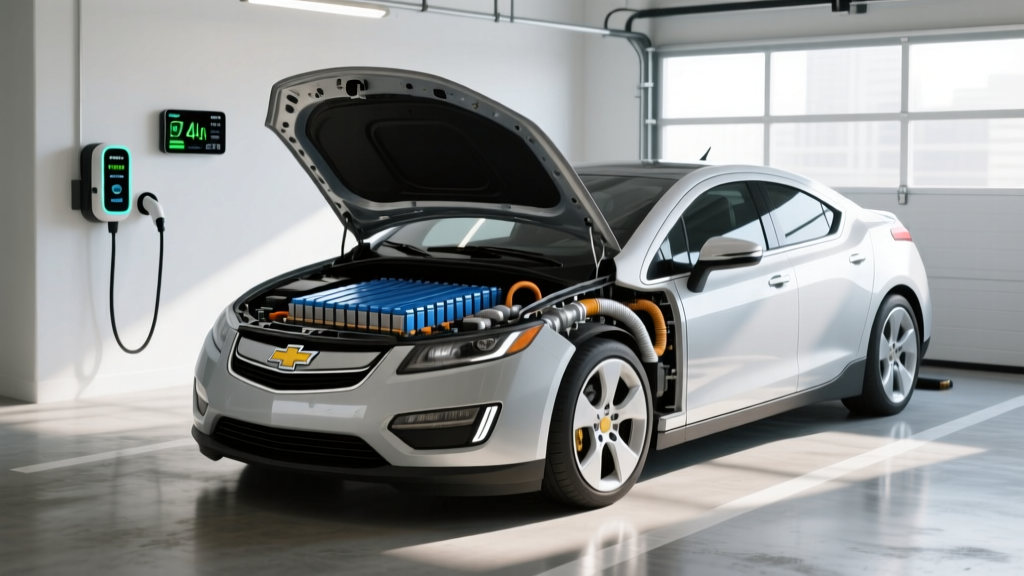
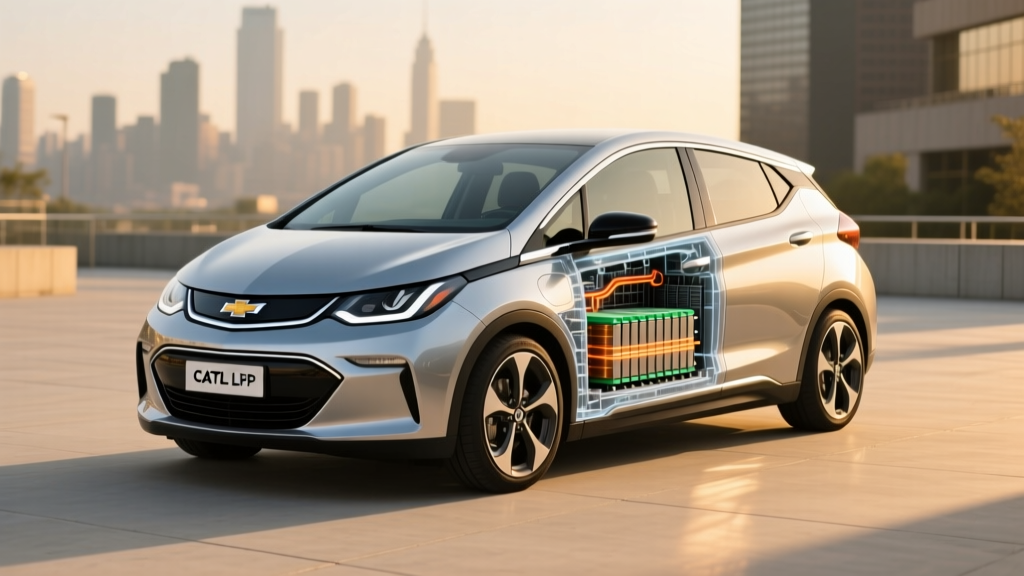
When General Motors relaunched the Bolt EV for the 2024 model year after the massive battery recall, it moved away from the LG Energy Solution NMC (nickel-manganese-cobalt) pouch cells that powered the original 2017–2023 Bolt. The refreshed Bolt EV adopted prismatic LFP cells manufactured by CATL (Contemporary Amperex Technology Co. Limited), the world's largest battery producer by volume.
The rationale was straightforward: LFP chemistry eliminates cobalt and nickel—two expensive, supply-chain-volatile metals—reducing per-kWh cell cost by an estimated 15–20% compared to equivalent NMC cells. For a vehicle positioned as one of the most affordable new EVs in America, that cost reduction was critical to hitting a sub-$30,000 MSRP target while preserving margin.
The trade-off is energy density. LFP cells store roughly 10–15% less energy per kilogram than modern NMC cells. To compensate, the Bolt EV's CATL pack is physically larger and heavier than the original LG pack, which contributes to the vehicle's curb weight and influences real-world efficiency.
LFP vs NMC: Chemistry Trade-Offs Explained
Lithium iron phosphate (LFP) and nickel-manganese-cobalt (NMC) are both lithium-ion chemistries, but they behave very differently across the metrics that matter to EV owners.
| Attribute | LFP (CATL Bolt EV) | NMC (Typical EV) |
|---|---|---|
| Energy density (cell-level) | ~160 Wh/kg | ~220–260 Wh/kg |
| Cycle life (to 80% SoH) | 3,000–5,000 cycles | 1,500–2,500 cycles |
| Cobalt / nickel content | None | Yes (supply-chain risk) |
| Thermal stability | Excellent (higher runaway threshold) | Good (requires more active cooling) |
| Cold-weather performance | More range loss below 32°F | Better low-temp conductivity |
| Recommended daily SoC | 100% OK (and recommended periodically) | 80% daily, 100% for trips |
| Per-kWh cost | Lower | Higher |
| State-of-charge estimation | Flatter voltage curve—harder for BMS to gauge | Steeper curve—easier estimation |
The cycle-life advantage is the headline for Bolt EV owners. A 3,000+ cycle rating means you could theoretically fully charge and discharge the pack every single day for over eight years before reaching 80% state of health. In practice, partial cycles and the Bolt's relatively modest daily energy draw mean the CATL LFP pack is likely to outlast the vehicle's useful economic life.
The cold-weather penalty is real, however. LFP cells exhibit higher internal resistance at low temperatures, meaning more energy is consumed by the battery thermal management system and less is available for propulsion. Bolt EV owners in northern climates should expect 20–30% range reduction in sub-freezing conditions—worse than the ~15–20% typical of NMC-equipped EVs with similar thermal management. Preconditioning the battery while plugged in mitigates this significantly.
Bolt EV CATL LFP Battery: Degradation Data
The original LG NMC Bolt EV packs were at the center of a fire-risk recall that led GM to replace packs in over 140,000 vehicles. That history understandably makes Bolt owners hypersensitive to degradation questions. The CATL LFP pack, however, tells a very different story.
- Year 1 / 15,000 miles: ~1–2% capacity loss (within measurement noise)
- Year 3 / 45,000 miles: ~3–5% loss typical for LFP packs
- Year 5 / 75,000 miles: ~5–8% loss (data from early 2024 MY Bolt owners reaching this mark)
- Year 8 / 100,000 miles (projected): ~8–12% loss based on CATL LFP cycle-life curves
Source: Aggregated fleet data from Recurrent Auto and owner-reported OBD-II diagnostics via Torque Pro and ScanGauge.
These figures align with CATL's published cell-level testing, which shows LFP prismatic cells retaining approximately 90% capacity after 2,000 equivalent full cycles. For a Bolt EV driven 12,000 miles per year and consuming roughly 30 kWh per 100 miles (EPA-rated 120 MPGe combined), that translates to about 3,600 kWh annually—or roughly 55 full equivalent cycles per year on a ~65 kWh usable pack.
At that rate, it would take approximately 36 years of daily driving to reach 2,000 cycles. The battery will almost certainly be fine; the question is whether the rest of the car holds up.
Battery Warranty: What GM Covers
GM provides an 8-year / 100,000-mile limited warranty on the Bolt EV's high-voltage battery pack. This warranty is federally mandated at a minimum of 8 years / 80,000 miles for emissions-related components in California Air Resources Board (CARB) states, and GM extends it to 100,000 miles nationwide.
| Coverage Item | Term |
|---|---|
| Duration | 8 years / 100,000 miles (whichever comes first) |
| Capacity retention threshold | 70% of original usable capacity |
| What triggers a claim | Battery State of Health (SoH) drops below 70% under normal use |
| Remedy | Repair, module replacement, or full pack replacement at GM's discretion |
| Transferable to second owner? | Yes, remainder of term transfers with vehicle title |
| Exclusions | Damage from collision, flood, unauthorized modification, or use outside normal parameters |
The 70% threshold is standard across the industry—Tesla, Ford, Hyundai, and VW all use a similar benchmark. For the Bolt EV's approximately 65 kWh usable pack, 70% retention means roughly 45.5 kWh usable. Even at that level, the car would still deliver approximately 170 miles of range (down from the EPA-rated ~247 miles new), which remains practical for most daily commutes.
It is worth noting that the warranty covers capacity degradation, not just catastrophic failure. If your OBD-II scan tool shows SoH below 70% within the warranty window, you have grounds for a claim. GM dealerships can perform an official battery health assessment.
Battery Replacement Cost: When and How Much
Here is where context matters enormously. The vast majority of EV batteries—including the CATL LFP pack in the Bolt EV—never need replacement during the vehicle's first-owner lifecycle. Data from Consumer Reports and Recurrent Auto consistently show that fewer than 5% of EV battery packs are replaced for degradation reasons within the first 10 years.
When replacement is needed—typically due to physical damage, manufacturing defect discovered after warranty, or extreme degradation in high-use fleet scenarios—costs break down as follows:
| Vehicle / Pack Size | Estimated Replacement Cost (Parts + Labor) |
|---|---|
| Chevy Bolt EV (~65 kWh LFP) | $14,000–$18,000 |
| Tesla Model 3/Y (~75 kWh NMC/LFP) | $16,000–$22,000 |
| Ford Mustang Mach-E (~88 kWh NMC) | $18,000–$24,000 |
| Hyundai Ioniq 5 (~77 kWh NMC) | $16,000–$21,000 |
LFP packs like the Bolt's tend to be on the lower end of the cost spectrum because the raw materials are cheaper. However, labor for a full pack swap typically runs $2,000–$4,000 regardless of chemistry, as the procedure requires a specialized lift table, high-voltage safety protocols, and dealership or certified-shop labor rates.
The critical point: a $14,000–$18,000 replacement at year 12 or 15, after 150,000+ miles of driving and $8,000–$12,000 in fuel savings versus a gas car, is an economically manageable event—not the financial catastrophe that EV skeptics portray.
Factors That Affect Bolt EV LFP Battery Longevity
While LFP chemistry is inherently robust, owner habits still influence the degradation curve. Here are the factors that matter most, ranked by impact:
- Fast-charging frequency: Occasional DC fast charging is fine. Daily use of 50+ kW DC charging accelerates degradation slightly. Aim to use Level 2 (7–11 kW) for routine charging and reserve DC fast charging for road trips.
- State of charge habits: Unlike NMC, LFP batteries tolerate—and benefit from—regular 100% charges. GM recommends charging to 100% at least once per week to help the BMS recalibrate its SoC estimate (LFP's flat voltage curve makes estimation tricky). Avoid leaving the car at 100% for extended periods (multiple days) in hot weather.
- Extreme heat exposure: Sustained battery temperatures above 104°F (40°C) accelerate degradation. Park in shade or a garage when possible in summer. The Bolt's active thermal management helps, but it cannot overcome physics entirely.
- Extreme cold: Cold does not cause permanent degradation but does temporarily reduce available capacity and increase energy consumption. Always precondition while plugged in during winter.
- Deep discharge: Avoid regularly running the battery below 10% SoC. The Bolt's low-voltage cutoff protects the cells, but repeated deep discharges stress the system.
- Software updates: Install GM OTA updates promptly. Battery management algorithms improve over time, and updates can optimize charging curves and thermal strategies.
The single most impactful habit for Bolt EV LFP owners is the weekly 100% charge. This is counterintuitive for owners who previously had NMC-equipped EVs (where the advice is "charge to 80% daily"), but it is essential for LFP. Without periodic full charges, the BMS loses track of the true top of the pack, leading to inaccurate range estimates and potential cell imbalance over time.
How to Check Your Bolt EV Battery Health (SoH)
GM does not display a State of Health percentage in the Bolt EV's infotainment system or driver information center, which frustrates many owners. However, there are reliable ways to assess battery health:
Dealer diagnostic scan: Any Chevrolet dealership can run a battery health report through GM's Global Diagnostic System (GDS). This provides an official SoH percentage and cell-balance data. Request this during routine service visits or before purchasing a used Bolt EV.
OBD-II scan tools: Third-party tools like Torque Pro (Android), ScanGauge, or the EV-specific LeafSpy (adapted for GM protocols via compatible adapters) can read battery SoH, cell voltages, and pack temperature from the Bolt's CAN bus. The data is not as polished as a dealer report, but it is real-time and free after the initial tool purchase ($30–$150).
Range tracking: The simplest method is to track your full-charge range estimate over time. If your Bolt EV consistently showed 247 miles at 100% when new and now shows 225 miles under similar temperature and driving conditions, that suggests approximately 9% degradation. This method is imprecise (the range estimate is influenced by recent driving patterns), but trends over months are meaningful.
Third-party battery reports: Services like Recurrent offer free battery health monitoring for enrolled vehicles, using telematics data to generate SoH reports. This is particularly useful for used-Bolt buyers who want pre-purchase verification.
Emerging Battery Tech: What Comes After LFP
The battery industry is moving fast, but it is important to separate lab-stage research from production-ready technology:
Silicon-dominant anodes: Companies like Sila Nanotechnologies and Group14 are commercializing silicon-carbon composite anodes that replace graphite, boosting energy density by 20–40%. These are entering production in 2025–2027 for premium EVs (Mercedes-Benz G-Class is an early adopter). Expect trickle-down to mainstream EVs by 2028–2030.
Solid-state batteries: Toyota, Samsung SDI, and QuantumScape are the most visible players. Toyota has announced a 2027–2028 production timeline for limited-run solid-state EVs with ~750 km (WLTP) range and 10-minute fast-charging capability. However, manufacturing scale-up remains the major bottleneck. Realistic mass-market availability is 2030 or later. Solid-state is not available in any production vehicle as of 2026.
Sodium-ion batteries: CATL itself has begun producing sodium-ion cells, which use abundant, cheap materials but offer lower energy density than LFP (~120 Wh/kg). These are likely destined for stationary storage, e-bikes, and ultra-budget micro-EVs rather than mainstream passenger cars like the Bolt.
For current Bolt EV buyers, these developments are informational rather than decision-driving. The CATL LFP pack in the Bolt is mature, well-understood, and likely to serve reliably for 10–15 years. Waiting for solid-state means waiting for a vehicle that does not yet exist at any announced price point.
Frequently Asked Questions
How long do Chevy Bolt EV CATL LFP batteries last?
Based on CATL cell-level data and early fleet telemetry, the Bolt EV's LFP pack is projected to retain 80–88% of its original capacity after 8 years and 100,000 miles. LFP's 3,000–5,000 cycle life means the cells can theoretically endure 30+ years of typical driving before reaching end-of-life (defined as 70–80% SoH). Most Bolt EV LFP packs will outlast the vehicle's economic useful life.
How much does it cost to replace a Chevy Bolt EV battery?
A full high-voltage battery replacement for the Bolt EV (CATL LFP, ~65 kWh) is estimated at $14,000–$18,000 including parts and labor as of 2026. However, battery replacement for degradation is rare—fewer than 5% of EV packs require replacement within 10 years. Most replacements are covered under the 8-year/100,000-mile warranty if SoH drops below 70%.
What does the Bolt EV battery warranty cover?
GM warrants the Bolt EV's battery for 8 years or 100,000 miles against capacity loss below 70% of original usable capacity, as well as manufacturing defects and catastrophic failure. The warranty is transferable to subsequent owners. It does not cover damage from accidents, flooding, or unauthorized modifications.
Should I charge my Bolt EV LFP to 100% every day?
GM recommends charging LFP-equipped Bolt EVs to 100% at least once per week to allow the battery management system to recalibrate. Daily 100% charging is acceptable for LFP chemistry (unlike NMC), but if your daily driving needs are met at 80–90%, setting that as your daily limit and doing a full charge weekly is a reasonable middle ground that minimizes time spent at peak voltage in hot weather.
LFP vs NMC — which battery chemistry is better for me?
Choose LFP (like the Bolt EV's CATL pack) if you prioritize long cycle life, lower cost, cobalt-free sourcing, and the ability to charge to 100% regularly. Choose NMC if you need maximum range in a lighter package, live in a consistently cold climate, or prioritize fast-charging speed in winter. For most commuter-oriented buyers, LFP's advantages outweigh its energy-density penalty.
Does fast charging damage the Bolt EV LFP battery?
Occasional DC fast charging (50–55 kW peak on the Bolt EV) does not meaningfully accelerate degradation. However, exclusive reliance on DC fast charging—especially in hot weather—will increase wear compared to Level 2 home charging. The Bolt's thermal management system actively cools the pack during fast charging, but LFP cells are inherently more sensitive to high-rate charging stress than NMC. Use DC fast charging for road trips; rely on Level 2 for daily needs.