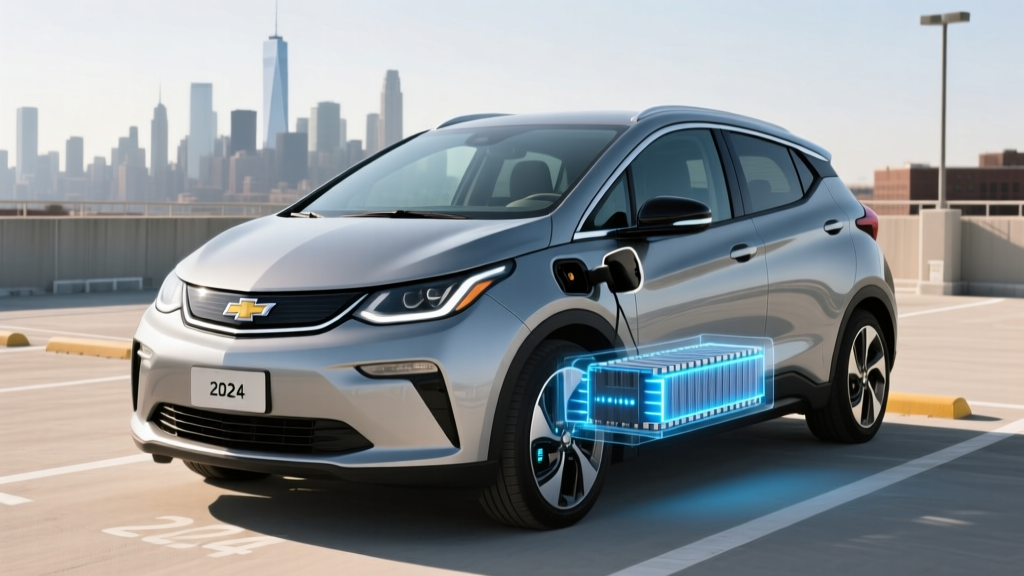
If you own a Chevy Bolt EV or are considering one on the used market, the high-voltage traction battery is likely your biggest question mark. How long does it last? What does degradation actually look like after 80,000 miles? And what happens if it needs replacing out of warranty?
The Bolt EV (produced through 2023) and its successor, the refreshed Bolt EV and Bolt EUV line, use lithium-ion NMC (nickel manganese cobalt) battery packs ranging from 60 kWh to 65 kWh usable capacity. These packs have proven to be among the more durable in the mainstream EV segment — but they're not immune to the physics of electrochemical aging. This guide breaks down everything you need to know with real data, not marketing claims.
Chevy Bolt EV Battery Specs and Chemistry Explained
The Chevy Bolt EV's traction battery is a liquid-cooled lithium-ion pack using NMC cathode chemistry — specifically, LG Energy Solution-supplied NMC cells in a pouch format. Here are the key specifications by generation:
| Generation | Model Years | Usable Capacity | Chemistry | Cell Format | Supplier | EPA Range |
|---|---|---|---|---|---|---|
| 1st Gen (Bolt EV) | 2017–2019 | 60 kWh | NMC 622 | Pouch | LG Chem | 238 mi |
| 2nd Gen (Bolt EV/EUV) | 2020–2023 | 65 kWh | NMC 622/712 | Pouch | LG Energy Solution | 259 mi (EV) / 247 mi (EUV) |
NMC chemistry offers a strong balance of energy density and cycle life, which is why GM selected it for the Bolt platform. However, it sits differently on the trade-off spectrum compared to LFP (lithium iron phosphate) chemistry that's gained traction in competitors like the base Tesla Model 3 and some BYD models.
LFP vs NMC: Which Chemistry Is Better?
Neither chemistry is universally superior — the right choice depends on your priorities. Here's how they compare across the dimensions that matter to EV owners:
| Factor | NMC (Bolt EV) | LFP (e.g., Tesla Model 3 RWD) |
|---|---|---|
| Energy Density | Higher (~250 Wh/kg cell-level) | Lower (~170 Wh/kg cell-level) |
| Range per kg of battery | Better — enables 259 mi in a compact hatch | Requires larger/heavier pack for same range |
| Cycle Life | ~1,000–1,500 full cycles to 80% SoH | ~3,000–5,000 full cycles to 80% SoH |
| Cold-Weather Performance | Better low-temp discharge and charge acceptance | More range loss and slower charging below freezing |
| 100% SoC Daily Charging | Not recommended — accelerates degradation | Can be charged to 100% daily with minimal impact |
| Cost per kWh | Higher (cobalt and nickel content) | Lower (iron and phosphate are cheaper commodities) |
| Thermal Stability | Good, but lower runaway threshold than LFP | Excellent — higher thermal runaway threshold |
Bottom line: NMC gives the Bolt EV its impressive range in a compact package. If GM had used LFP, the Bolt would either need a heavier pack (reducing efficiency) or offer less range. For a small hatchback where packaging and weight matter, NMC was the pragmatic choice. LFP excels in longevity and daily-charge convenience, which is why it's spreading in larger sedans and SUVs where the weight penalty is easier to absorb.
Real-World Bolt EV Battery Degradation: What the Data Shows
Battery degradation is the gradual loss of usable capacity over time and charge cycles. For Bolt EV owners, this translates to slightly less range as the pack ages. The good news: real-world data from high-mileage Bolt owners and fleet studies shows this loss is modest and predictable.
Typical Chevy Bolt EV Battery Degradation Curve (based on aggregated owner reports and fleet data):
- Year 1 / 15,000 mi: ~2–4% capacity loss (initial formation period)
- Year 3 / 45,000 mi: ~6–9% total capacity loss
- Year 5 / 75,000 mi: ~8–12% total capacity loss
- Year 8 / 120,000 mi: ~10–15% total capacity loss
- Year 10 / 150,000 mi: ~12–18% total capacity loss
Sources: Recurrent Auto battery data, owner forums, and GM warranty claim rates.
Let's translate that to real range. A 2022 Bolt EV with an EPA-rated 259 miles and ~10% degradation at 75,000 miles would see its effective range drop to approximately 233 miles under the same EPA test conditions. In real-world highway driving at 70 mph — where you typically get 85–90% of EPA range anyway — that owner might see 198–210 miles of practical range instead of the original 220–233 miles.
The Bolt EV's liquid thermal management system is a key factor here. Unlike passively cooled packs (such as the older Nissan Leaf), the Bolt's active cooling and heating keep cells in their optimal temperature window, significantly slowing calendar and cycle degradation. Owners in moderate climates like coastal California report the lowest degradation rates, while those in extreme-heat regions like Arizona see slightly higher losses.
It's worth noting that GM's own internal data, referenced in their battery durability filings with NHTSA, shows fewer than 1% of Bolt EV batteries requiring full replacement due to capacity loss within the warranty period — a strong reliability signal.
Chevy Bolt EV Battery Warranty: What's Covered and for How Long
GM backs the Bolt EV's high-voltage battery with a warranty that meets and slightly exceeds the federal minimum for EV components. Here are the specifics:
| Parameter | Coverage Detail |
|---|---|
| Duration | 8 years or 100,000 miles (whichever comes first) |
| CARB States | 10 years / 150,000 miles in states adopting California emissions standards |
| Capacity Retention Threshold | Below 60% of original capacity |
| What's Covered | Capacity loss below threshold, cell/module defects, BMS failures, thermal management defects |
| What's NOT Covered | Damage from accidents, flooding, unauthorized modifications, or external impact |
| Transferable | Yes — warranty transfers to subsequent owners automatically |
The 60% capacity retention threshold is important context. If your Bolt EV originally delivered 259 miles of EPA range, GM would only warrant the battery if it drops below approximately 155 miles of equivalent range. In practice, based on the degradation data above, almost no Bolt EV batteries reach this threshold within the warranty period under normal use. Most owners at 100,000 miles still retain 85–90% of original capacity.
GM's warranty threshold is less generous than some competitors. Tesla sets its threshold at 70% retention over 8 years/120,000 miles for the Model 3 Long Range, while Hyundai offers a lifetime battery warranty on some models (with a 65% threshold). However, the Bolt's actual degradation performance makes the threshold difference largely academic for most owners.
Bolt EV Battery Replacement Cost: What to Expect
This is the question that generates the most anxiety — and the most misinformation. Let's separate the actual numbers from the fear.
| Component | Estimated Cost |
|---|---|
| New OEM Battery Pack (65 kWh) | $12,000 – $16,000 (parts) |
| Labor (GM Dealer) | $1,500 – $3,000 |
| Total Dealer Replacement | $13,500 – $19,000 |
| Remanufactured/Refurbished Pack | $7,000 – $10,000 (parts) |
| Independent Shop Labor | $800 – $1,500 |
| Total Independent Replacement | $7,800 – $11,500 |
| Individual Module Replacement (if applicable) | $1,500 – $4,000 per module + labor |
Those numbers look steep — but context matters enormously. First, the vast majority of Bolt EV batteries never need replacement. Based on Recurrent's fleet analysis of over 15,000 EVs, fewer than 1.5% of EV batteries are replaced outside of warranty claims across all brands. The Bolt EV, with its active thermal management, performs at or better than that average.
Second, battery costs continue declining. When the Bolt EV launched in 2017, pack-level costs were approximately $200/kWh. By 2026, industry-wide pack costs have fallen to roughly $110–$130/kWh for NMC cells, and refurbished packs from salvaged Bolts offer a viable lower-cost option for out-of-warranty replacements.
Third, module-level repair is sometimes possible. The Bolt EV's battery pack contains multiple modules, and if degradation is uneven or a single module fails, some independent EV shops can replace individual modules rather than the entire pack — bringing costs down to the $2,000–$5,000 range.
When is replacement typically needed? Based on current data, a Bolt EV battery might warrant replacement around 200,000–250,000 miles if capacity drops to a point where daily usability is compromised (below ~70% remaining capacity). Many Bolts will be retired for other mechanical or cosmetic reasons before the battery reaches this point.
Factors That Accelerate (or Slow) Bolt EV Battery Aging
Not all Bolt EV batteries age at the same rate. Your charging habits, climate, and driving patterns significantly influence how quickly capacity declines. Here's what the electrochemistry tells us:
Habits That Accelerate Degradation
- Frequent DC fast charging above 50 kW: The Bolt EV's peak charge rate is 55 kW on newer models (50 kW on 2017–2019). Repeated high-rate charging generates heat and stresses cells. Occasional road-trip fast charging is fine; daily fast charging will accelerate wear.
- Routinely charging to 100%: NMC cells experience the most stress at the top and bottom of their state-of-charge window. Consistently charging to 100% and leaving the car parked at full charge — especially in heat — is one of the fastest ways to degrade an NMC pack.
- Deep discharges to near 0%: Regularly running the battery below 10% SoC stresses the anode. The Bolt's buffer (approximately 5–7% below the displayed 0%) provides some protection, but habitually arriving at 0% isn't ideal.
- Prolonged exposure to extreme heat: Parking outdoors in 100°F+ weather for extended periods accelerates calendar degradation even when the car isn't driven. The Bolt's thermal management helps, but it only operates when the vehicle is on or plugged in.
- Storing at high SoC in heat: Leaving the Bolt at 90–100% charge in a hot garage for weeks is a worst-case scenario for NMC longevity.
Practices That Maximize Battery Life
- Charge to 80% for daily use: Use the Bolt's charge-limit setting (available via the infotainment system or the myChevrolet app) to set a daily target of 80%. Save 100% charges for road trips.
- Use Level 2 (240V) home charging as your primary method: Level 2 charging at 7.2–11.5 kW generates far less heat than DC fast charging and is ideal for NMC longevity.
- Plug in during extreme temperatures: When plugged in, the Bolt's thermal management can precondition the battery, keeping it in the optimal 60–80°F range even when ambient temps are extreme.
- Keep the battery between 20–80% SoC for routine use: This is the NMC "comfort zone" and dramatically slows cycle degradation.
- Drive it regularly: Batteries age even when sitting (calendar degradation). Regular use with moderate cycling actually keeps cells healthier than prolonged storage.
- Use preconditioning before fast charging: The Bolt's battery preconditioning feature (activated via navigation to a charge station) warms or cools the pack to optimize charge acceptance and reduce thermal stress.
How to Check Your Bolt EV Battery Health (State of Health)
State of Health (SoH) is a percentage indicating how much capacity your battery retains compared to when it was new. A SoH of 92% means your pack holds 92% of its original kWh capacity. Here's how to monitor it on a Bolt EV:
Method 1: OBD-II Scanner with EV-Capable App
The most accurate DIY method is using an OBD-II Bluetooth adapter (such as an OBDLink SX or MX+) paired with an EV-specific app like MyGreenVolt or Torque Pro with Bolt-specific PIDs. These tools can read the battery management system's internal SoH estimate, individual cell voltages, pack temperature, and actual kWh capacity. Expect to spend $40–$80 on the adapter and $0–$10 on the app.
Method 2: Dealer Diagnostic Report
Any GM dealer can pull a full battery health report during a service visit. This reads the same BMS data but in a GM-formatted report. Request this during routine service — it's typically free or included in a diagnostic fee of $100–$150 if done standalone.
Method 3: Range Tracking Over Time
The simplest (though least precise) approach is tracking your Bolt's full-charge range estimate over months and years. If your 2022 Bolt EV originally showed 259 miles at 100% and now shows 235 miles at 100% under similar temperature conditions, that suggests roughly 9% degradation. Note: the dashboard range estimate (often called the "guess-o-meter") varies with temperature and recent driving, so compare same-season readings for accuracy.
Method 4: Third-Party Battery Health Reports
Services like Recurrent Auto offer battery health reports that compare your pack's degradation to a fleet of similar vehicles. Some used-EV listing platforms now include battery health scores. If you're buying a used Bolt EV, asking the seller for a recent OBD-II SoH reading is a reasonable request.
The Bolt EV Recall Context: What Happened and What It Means for Your Battery
No discussion of the Bolt EV battery is complete without addressing the 2021–2022 battery recall. GM recalled all 2017–2022 Bolt EV and Bolt EUV vehicles due to a manufacturing defect in certain LG Energy Solution cells that could cause internal short circuits and, in rare cases, battery fires. The defect was traced to torn separator membranes and folded anodes in a small number of cells produced during specific manufacturing windows.
GM's remedy involved replacing complete battery packs in affected vehicles with newly manufactured packs that did not contain the defective cells. By late 2022, the recall repair program was largely complete. If you're buying a used Bolt EV, verify that the recall repair was performed — check the VIN at nhtsa.gov/recalls. A Bolt that received its recall replacement pack effectively has a newer battery, which is a net positive for longevity.
Post-recall Bolt packs have shown normal degradation rates consistent with the data cited earlier in this guide. The recall was a manufacturing quality issue, not an inherent chemistry or design flaw.
Looking Ahead: Future Battery Tech and the Bolt Platform
GM's Ultium battery platform — using NMC pouch cells in a modular skateboard architecture — has replaced the Bolt's dedicated battery architecture in newer GM EVs like the Equinox EV and Blazer EV. Ultium packs offer more flexible cell-to-pack configurations and are designed for easier module-level serviceability.
Looking further ahead, several emerging technologies could reshape EV battery longevity and cost:
- Silicon-dominant anodes: Companies like Sila Nanotechnologies and Group14 are commercializing silicon-carbon anode materials that increase energy density by 20–40%. GM has announced a partnership with SES AI to develop lithium-metal anode cells, with pilot production targeted for the late 2020s. These could significantly boost range without increasing pack size.
- Solid-state batteries: Toyota, Samsung SDI, and QuantumScape are targeting solid-state production in the 2028–2030 window. Solid-state cells promise higher energy density, faster charging, and improved safety — but remain in pre-commercial stages. Realistic mass-market availability is 2030+ at the earliest, with initial deployment likely in premium vehicles.
- LFP evolution: LFP chemistry continues improving in energy density. CATL's latest LFP cells approach 200 Wh/kg, narrowing the gap with NMC. Future Bolt-sized vehicles could plausibly use LFP without a significant range penalty.
For current Bolt EV owners, these technologies are forward-looking and won't affect your existing vehicle. But they signal that replacement packs — should you ever need one in the 2030s — may be cheaper and more energy-dense than today's options.
Frequently Asked Questions
How long do Chevy Bolt EV batteries last in years and miles?
Based on fleet data and owner reports, most Bolt EV batteries retain 82–90% of their original capacity at 100,000 miles and 80–88% at 150,000 miles. In practical terms, a Bolt EV battery should provide reliable daily service for 150,000–200,000+ miles before capacity loss becomes a usability concern. That translates to 12–15 years for an average driver covering 12,000–15,000 miles annually.
How much does a Chevy Bolt EV battery cost to replace?
A full OEM battery pack replacement at a GM dealer runs approximately $13,500–$19,000 including parts and labor as of 2026. Independent shops using refurbished packs can reduce this to $7,800–$11,500. Module-level repair, when applicable, costs $2,000–$5,000. However, fewer than 2% of Bolt EV batteries require full replacement based on current fleet data.
What does the Bolt EV battery warranty actually cover?
GM covers the battery for 8 years/100,000 miles (10 years/150,000 miles in CARB states) against capacity loss below 60% of original capacity, manufacturing defects, and BMS failures. The warranty is fully transferable to subsequent owners. It does not cover damage from accidents, flooding, or unauthorized modifications.
Should I charge my Bolt EV to 100% every day?
No. For daily driving, set the charge limit to 80% using the Bolt's built-in charge target setting. NMC batteries degrade fastest at the extremes of their state-of-charge range. Reserve 100% charges for days when you need the full 259 miles of range for a road trip. This single habit can add years of useful life to your pack.
Does DC fast charging damage the Bolt EV battery?
Occasional DC fast charging is fine and won't meaningfully affect long-term health. However, making DC fast charging your primary charging method — especially in hot weather — will accelerate degradation compared to Level 2 home charging. The Bolt's peak charge rate of 50–55 kW is modest by modern standards, which actually limits thermal stress during fast charging. Aim to do the majority of your charging on Level 2 at home or work.
Is the Bolt EV battery the same as the 12V battery?
No. The Bolt EV has two separate batteries: the high-voltage traction battery (60–65 kWh) that powers the electric motor and provides driving range, and a standard 12V auxiliary battery that runs the vehicle's electronics, lights, and computers. The 12V battery is a conventional lead-accent or AGM unit that may need replacement every 3–5 years, just like in any car. When people discuss "EV battery replacement cost," they're referring to the high-voltage traction battery — not the $150–$250 12V unit.
Can I upgrade my Bolt EV's battery to a larger capacity?
No. There is no factory or aftermarket path to install a larger battery in the Bolt EV. The pack is structurally integrated into the vehicle floor, and the BMS, thermal management, and power electronics are calibrated for the specific 60/65 kWh pack. Your only option is a like-for-like replacement when needed.
The Chevy Bolt EV's battery has proven to be a durable, well-managed component thanks to its active liquid thermal management system and conservative buffer strategy. While replacement costs are real, the data shows that the overwhelming majority of Bolt owners will never face an out-of-pocket battery replacement. By following basic NMC care practices — 80% daily charge limit, Level 2 as your primary charging method, and plugging in during temperature extremes — you can maximize your pack's lifespan and keep your Bolt delivering reliable range for well past 150,000 miles.