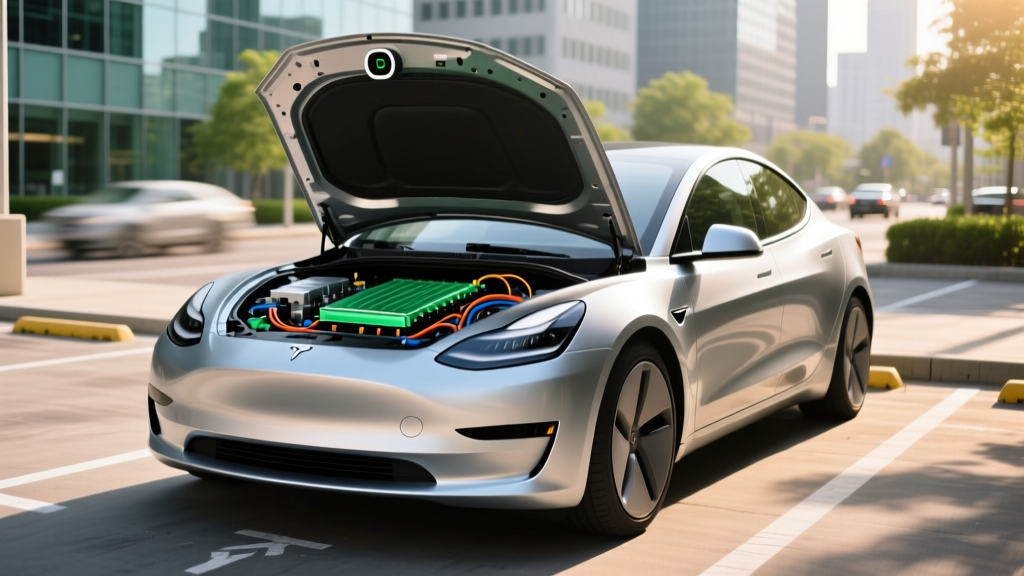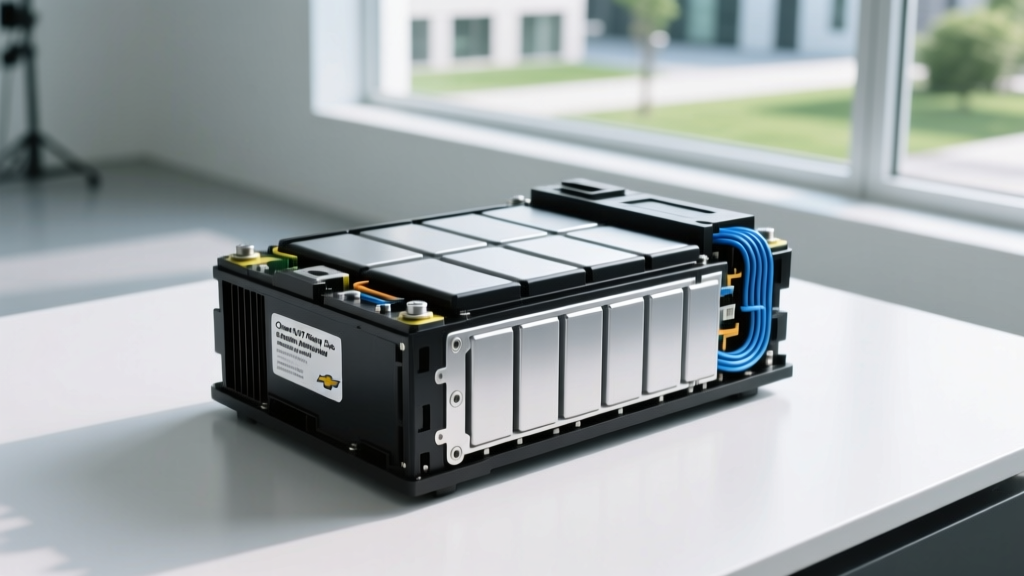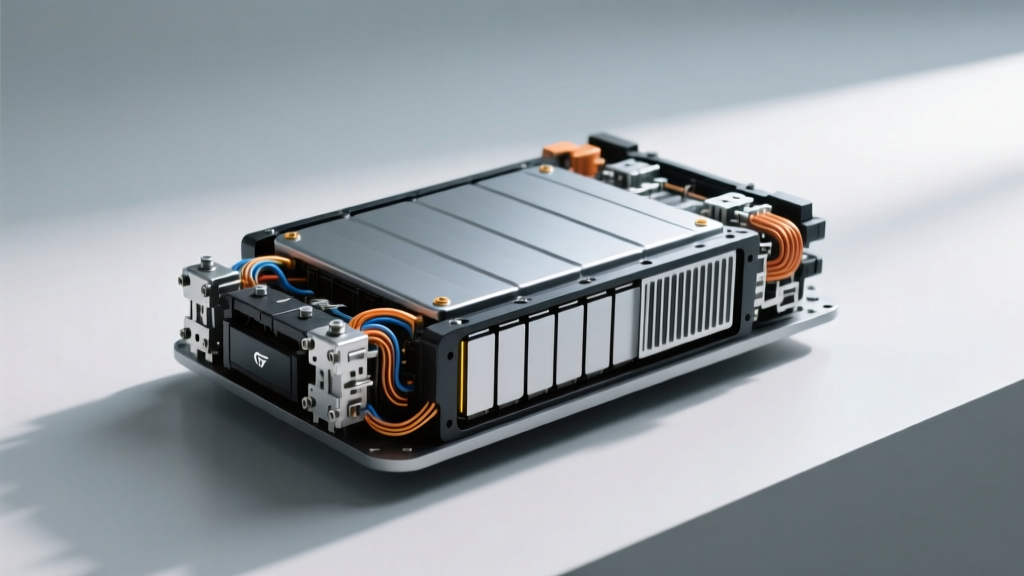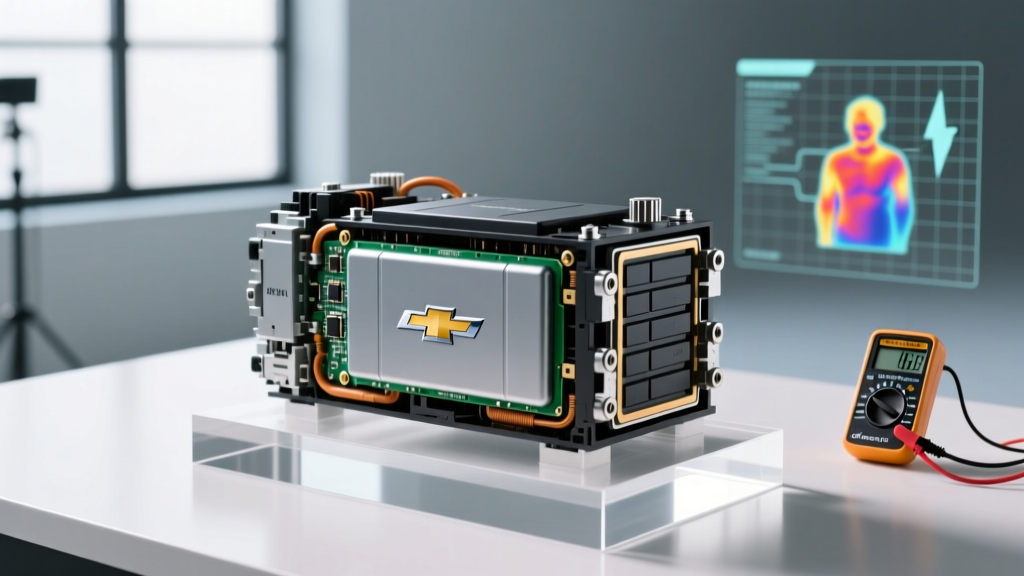
The Chevrolet Bolt EV and Bolt EUV remain two of the most accessible used electric vehicles on the market, but for buyers and current owners, one question dominates: how long will the Chevrolet Bolt EV battery actually last, and what happens when it doesn't? This guide examines the Bolt's 65 kWh lithium-ion pack in detail — its NMC chemistry, documented degradation patterns, warranty protections, replacement economics, and the daily habits that determine whether your pack reaches 200,000 miles or needs attention sooner.
Chevrolet Bolt EV Battery: Core Specifications
Before evaluating longevity, let's establish exactly what sits under the Bolt's floor. The 2022–2023 Chevrolet Bolt EV (and the longer-wheelbase Bolt EUV) uses a single high-voltage traction battery pack with the following specifications:
| Specification | Detail |
|---|---|
| Usable capacity | ~65 kWh (65.0 kWh usable of ~66 kWh gross) |
| Chemistry | NMC (Nickel Manganese Cobalt) — LG Energy Solution cells |
| Cell format | Pouch cells, 288 total (96 groups of 3 in parallel) |
| EPA range (Bolt EV) | 259 miles |
| EPA range (Bolt EUV) | 247 miles |
| Thermal management | Active liquid cooling and heating |
| Max DC fast-charge rate | 55 kW peak (CCS connector) |
| Level 2 AC charge rate | 11.5 kW (48A) |
| Battery warranty | 8 years / 100,000 miles |
A critical note on the DC fast-charging spec: the Bolt's 55 kW peak rate is modest by 2026 standards, where many competitors pull 150–350 kW. A 10–80% DC fast charge takes roughly 50–60 minutes at a capable station. This is a trade-off of the older platform, but it has an unexpected upside for battery longevity — slower charging generates less heat, which is a primary driver of cell degradation.
Real-world range note: The EPA 259-mile figure assumes mixed driving at moderate temperatures. Expect approximately 220–240 miles on sustained highway trips at 70+ mph, and as low as 170–195 miles in sub-freezing winter conditions where cabin heating and reduced battery efficiency compound losses. Source: fueleconomy.gov.
NMC Chemistry in the Bolt: What It Means for Longevity
The Bolt EV uses NMC (nickel manganese cobalt oxide) pouch cells manufactured by LG Energy Solution. Understanding this chemistry — and how it compares to the LFP (lithium iron phosphate) packs now appearing in newer vehicles like the Tesla Model 3 Standard Range and certain BYD models — is essential for setting realistic expectations.
| Attribute | NMC (Bolt EV) | LFP (e.g., Tesla Model 3 RWD) |
|---|---|---|
| Energy density | Higher (~160–220 Wh/kg cell-level) — enables 259 mi in a compact pack | Lower (~140–170 Wh/kg) — needs larger/heavier pack for equivalent range |
| Cycle life | ~1,000–2,000 full equivalent cycles before 80% capacity | ~3,000–5,000+ full equivalent cycles before 80% capacity |
| Cold-weather performance | Better low-temp discharge and charge acceptance | Reduced range and slower charging in freezing temps; requires more aggressive preconditioning |
| Recommended daily SoC | 80% for daily use; 100% only when needed for trips | 100% regularly is acceptable; manufacturer often recommends periodic full charges for BMS calibration |
| Cost per kWh (cell-level) | Higher (cobalt and nickel are costlier commodities) | Lower (iron and phosphate are abundant and inexpensive) |
| Thermal stability | Good with active management; more sensitive to sustained high-SoC + high-temp conditions | Excellent inherent thermal stability; lower runaway risk |
Which is better? Neither is universally superior — it depends on use case. NMC delivers more range in a smaller, lighter package and performs better in cold climates, which is why GM chose it for the Bolt. LFP sacrifices energy density for dramatically longer cycle life and lower cost, making it ideal for standard-range vehicles where weight and volume are less constrained. For a Bolt owner, the NMC pack is well-suited to the car's design; the key is understanding its care requirements.
Real-World Degradation: What the Data Shows
Battery degradation — the gradual, irreversible loss of usable capacity — is the single most important factor in long-term EV ownership. Here's what documented data and owner reporting tell us about the Chevrolet Bolt EV battery specifically:
Typical Bolt EV degradation curve (NMC, liquid-cooled):
- Year 1 / 15,000 mi: ~2–4% capacity loss (initial formation loss, steepest part of the curve)
- Year 3 / 45,000 mi: ~5–8% total loss from new
- Year 5 / 75,000 mi: ~7–10% total loss
- Year 8 / 100,000 mi: ~9–14% total loss (warranty threshold territory)
- Year 10+ / 150,000+ mi: ~12–18% total loss for well-maintained packs
Sources: Recurrent Auto battery health data aggregated across thousands of EVs; owner-reported data on Bolt EV forums; GM warranty claim thresholds. Individual results vary significantly based on climate, charging habits, and DC fast-charge frequency.
The Bolt's degradation profile is broadly typical for liquid-cooled NMC packs of its era. A 10% loss at 75,000 miles means your 259-mile EPA range becomes roughly 233 miles — still highly usable for daily driving and most road trips. The degradation curve flattens considerably after the initial 2–3 years, meaning the pack doesn't suddenly "fall off a cliff." Most Bolt EV batteries on the road today, including early 2017–2019 models now approaching 100,000+ miles, remain functional with capacity retention above the warranty threshold.
Important context on the 2021–2022 Bolt battery recall: GM recalled all 2017–2022 Bolt EVs and EUVs due to a manufacturing defect in certain LG cells that could cause internal short circuits and, in rare cases, fire. GM replaced affected battery modules and updated the battery management software. If you're considering a used Bolt, confirm that the recall remedy was completed — check the VIN at nhtsa.gov/recalls.
Battery Warranty: What GM Covers and What It Doesn't
The Chevrolet Bolt EV battery is covered under GM's Battery and Drive Unit Limited Warranty. Here are the precise terms:
| Warranty Element | Coverage Detail |
|---|---|
| Duration | 8 years or 100,000 miles, whichever comes first (10 years / 150,000 miles in CARB states: CA, CT, ME, MA, NJ, NY, OR, RI, VT, WA) |
| Capacity retention threshold | 60% of original capacity (GM will repair/replace if usable capacity drops below 60%) |
| What's covered | Battery pack, modules, BMS, associated wiring, cooling system, drive unit components |
| What's NOT covered | Damage from accidents, misuse, unauthorized modifications, flooding, or failure to follow maintenance guidelines |
| Transferability | Warranty transfers to subsequent owners automatically — no fee or registration required |
| Remedy | GM may replace individual modules rather than the full pack, restoring capacity above the threshold |
The 60% retention threshold is notably lower than some competitors. Hyundai and Kia, for example, warranty their EV batteries to 70% capacity over the same 8-year/100,000-mile term. In practice, however, very few Bolt packs actually fall below 60% within the warranty period under normal use. The threshold matters most for high-mileage drivers, fleet vehicles, or packs in extreme climates.
Replacement Cost: What Bolt Owners Actually Pay
If your Bolt EV battery fails outside of warranty coverage — or if you're buying an older Bolt and want to budget for a worst-case scenario — here's what replacement involves:
| Scenario | Estimated Cost (2026) | Notes |
|---|---|---|
| Full pack replacement (OEM new) | $14,000–$17,000 | Includes parts and labor at a GM dealer; pack alone is ~$12,000–$14,000 |
| Module-level repair (1–3 modules) | $2,500–$6,000 | Only the degraded or failed modules are replaced; requires dealer diagnostic |
| Remanufactured / refurbished pack | $8,000–$11,000 | Third-party suppliers; availability varies; may have shorter warranty |
| Independent EV shop replacement | $9,000–$13,000 | Aftermarket or refurbished pack installed by a qualified EV specialist |
When is replacement typically needed? Based on current degradation data, the vast majority of Bolt EV batteries do not require full replacement during the vehicle's useful life. A well-maintained pack should deliver 150,000–200,000+ miles before capacity loss becomes functionally limiting (i.e., range drops below what the owner needs for daily use). At that point, the car's residual value is typically $5,000–$9,000, which makes a $15,000 OEM replacement economically questionable — this is when module-level repair, a refurbished pack, or vehicle replacement becomes the pragmatic choice.
The fear of a sudden $16,000 battery bill is the most common barrier to used EV adoption, but it's worth framing with data: catastrophic, sudden battery failure is extremely rare. Degradation is gradual, and module-level repairs address most out-of-warranty issues at a fraction of full-pack cost.
Maximizing Bolt EV Battery Health: A Care Checklist
NMC chemistry is more sensitive to care habits than LFP. The following practices, consistently applied, can meaningfully extend your Bolt's battery lifespan:
- Set a daily charge limit of 80%. The Bolt's infotainment system lets you set a target charge level. Use it. Sustained storage at 100% SoC accelerates NMC degradation more than any other single factor.
- Charge to 100% only when you'll drive immediately. If you need full range for a road trip, time the charge so the car reaches 100% shortly before departure — don't let it sit at full for days.
- Avoid letting the pack sit below 10% for extended periods. Very low SoC stresses cells differently but still accelerates degradation. Plug in when you get home, even if only to bring it back to 20–30%.
- Minimize DC fast charging when possible. The Bolt's 55 kW peak rate is relatively gentle, but frequent DCFC sessions — especially in hot weather — still generate more heat than Level 2 charging. Use DCFC for road trips; rely on Level 2 for daily needs.
- Precondition the battery in cold weather. Use the Bolt's scheduled departure feature or manually activate preconditioning while plugged in. This warms the pack before driving, reducing stress and improving regen effectiveness.
- Park in shade or a garage during summer. Sustained high ambient temperatures combined with high SoC is the worst-case degradation scenario for NMC. A shaded parking spot can reduce pack temperature by 10–15°F.
- Don't obsess over avoiding fast charging entirely. Occasional DCFC use is fine. The difference between never fast-charging and fast-charging twice a month on road trips is marginal over the pack's life.
Monitoring State of Health (SoH): How to Check Your Bolt's Battery
The Bolt EV does not display a State of Health (SoH) percentage directly on its dashboard — unlike some competitors (the Nissan Leaf, for example, shows capacity bars). Here's how Bolt owners can assess battery health:
1. OBD-II diagnostic tools: A Bluetooth OBD-II adapter paired with an app like Torque Pro, EVNotify, or MyChevy's built-in diagnostics can read the battery's reported capacity versus original. This is the most accurate owner-accessible method. Expect readings within ±2% of actual SoH.
2. Dealer diagnostic check: A Chevrolet dealer can run a full battery health report using GM's GDS2 diagnostic system. This provides module-level voltage balance data and precise capacity measurements. Some dealers perform this for free during routine service; others charge a diagnostic fee of $100–$150.
3. Range-based estimation: Track your energy consumption (kWh/100 mi) and full-charge range over time using the trip computer. If your Bolt consistently shows 230 miles at a full charge after 50,000 miles, that suggests roughly 89% SoH — consistent with normal degradation. This method is imprecise (temperature, tire pressure, and driving style affect it), but useful for spotting anomalies.
4. Third-party battery health reports: Services like Recurrent Auto offer free battery health monitoring for participating EV owners, providing monthly SoH reports benchmarked against fleet data. This is particularly valuable for used-Bolt buyers who want documented history.
Factors That Accelerate Battery Degradation
Not all Bolts age equally. These factors have the largest documented impact on NMC pack longevity:
High average State of Charge: A Bolt consistently charged to 100% and parked for hours or days will degrade measurably faster than one kept between 20–80%. The effect is amplified in hot climates — a Bolt in Phoenix charged to 100% daily will lose capacity significantly faster than one in Seattle at 80%.
Frequent DC fast charging: Every DCFC session pushes high current through the cells, generating heat. The Bolt's liquid cooling mitigates this, but daily DCFC reliance (common for apartment dwellers without home charging) will accelerate wear versus exclusive Level 2 charging.
Extreme temperature exposure: Both prolonged heat and extreme cold stress NMC cells. Sustained pack temperatures above 95°F or below 10°F without preconditioning increase degradation rates. The Bolt's active thermal management helps, but it can't fully overcome parking in direct sun at 110°F ambient.
High-mileage, high-cycle use: A Bolt driven 30,000+ miles per year with daily full discharge-recharge cycles will accumulate cycle-related wear faster than one driven 10,000 miles annually. However, cycle wear is relatively minor compared to calendar and SoC-related degradation for most owners.
Looking Ahead: Solid-State and Next-Gen Battery Tech
If you're evaluating a Bolt purchase today and wondering whether to wait for better battery technology, here's a realistic timeline:
Solid-state batteries — which replace the liquid electrolyte with a solid conductor, promising higher energy density, faster charging, and improved safety — remain in limited pilot production as of 2026. Toyota, Samsung SDI, and QuantumScape have demonstrated prototype cells, but mass-market vehicle integration is not expected before 2028–2030 at the earliest, and likely in premium vehicles first at significant cost premiums.
Silicon-dominant anodes (replacing graphite anodes to boost energy density by 20–40%) are entering early commercial production through companies like Sila Nanotechnologies and are expected in some EV models by 2027–2028. These will improve range without changing the fundamental NMC or NCA cathode chemistry.
Sodium-ion batteries — cheaper than both LFP and NMC but with lower energy density — are being deployed in some Chinese-market EVs and may reach the US in budget-oriented models by 2027–2028.
None of these technologies are available in any vehicle you can buy today. For a Bolt buyer in 2026, the existing NMC pack is a known, well-understood quantity with predictable degradation characteristics — which has its own value versus unproven next-gen chemistry.
Frequently Asked Questions
How long do Chevrolet Bolt EV batteries last in years and miles?
Based on aggregated fleet data and owner reports, a well-maintained Bolt EV battery should deliver 150,000–200,000+ miles before capacity loss becomes practically limiting. In years, most packs remain functional for 12–15+ years under normal use patterns. The battery degrades gradually — there is no sudden failure point — and the 8-year/100,000-mile warranty covers the period of highest risk.
How much does a Chevrolet Bolt EV battery cost to replace?
A full OEM pack replacement runs $14,000–$17,000 at a GM dealer (parts and labor) as of 2026. However, most out-of-warranty issues can be addressed with module-level repairs at $2,500–$6,000. Refurbished packs are available from third-party suppliers for $8,000–$11,000. Full replacement is rarely necessary — most packs outlast the car's economic value.
What does the Bolt EV battery warranty actually cover?
GM covers the battery pack and associated components for 8 years/100,000 miles (10 years/150,000 miles in CARB states) against capacity loss below 60% of original. The warranty is fully transferable to subsequent owners. If capacity falls below the threshold, GM may replace individual modules rather than the full pack to restore capacity above 60%.
How do I check the battery health on my Bolt EV?
The Bolt doesn't display SoH on the dash. Use an OBD-II adapter with an EV diagnostic app (Torque Pro, EVNotify) for the most accurate reading. A Chevy dealer can run a full module-level health report. You can also track range and efficiency trends over time via the trip computer as a rough indicator. Free services like Recurrent Auto provide ongoing monitoring if you enroll.
Is NMC or LFP better for an EV battery?
NMC (used in the Bolt) offers higher energy density and better cold-weather performance but shorter cycle life and a recommended 80% daily charge limit. LFP offers longer cycle life, lower cost, and can be charged to 100% regularly, but has lower energy density and weaker cold-weather range. Neither is universally better — NMC is better for maximizing range in a compact vehicle; LFP is better for longevity and cost in standard-range applications.
Does the Bolt EV battery recall affect long-term reliability?
The 2021–2022 recall addressed a specific manufacturing defect in certain LG-produced cells that could cause internal short circuits. GM replaced affected modules and updated the BMS software. Bolts that received the recall remedy have no elevated risk versus other EVs. Always verify recall completion via the VIN at nhtsa.gov before purchasing a used Bolt.
Should I buy a used Chevrolet Bolt EV in 2026?
The Bolt EV remains one of the best-value used EVs available, with 2022–2023 models (post-recall remedy) offering 259 miles of range, proven reliability, and low operating costs. Budget $500–$1,000 annually for potential out-of-warranty maintenance on older models. Prioritize vehicles with documented recall completion, Level 2 home charging access, and a pre-purchase battery health check via OBD-II or dealer diagnostic.