The Changan Nevo A06 made headlines by becoming one of the first mass-market sedans to ship with a sodium-ion traction battery — a chemistry that promises lower cost, better cold-weather performance, and freedom from lithium supply constraints. But for buyers outside China (and increasingly, curious shoppers watching global EV trends), the big question is whether sodium-ion is ready for daily ownership or still a science project. This guide breaks down the Nevo A06's sodium battery in the context of everything we know about EV battery longevity, degradation, warranty coverage, and replacement economics in 2026.
What Is the Changan Nevo A06 Sodium-Ion Battery?
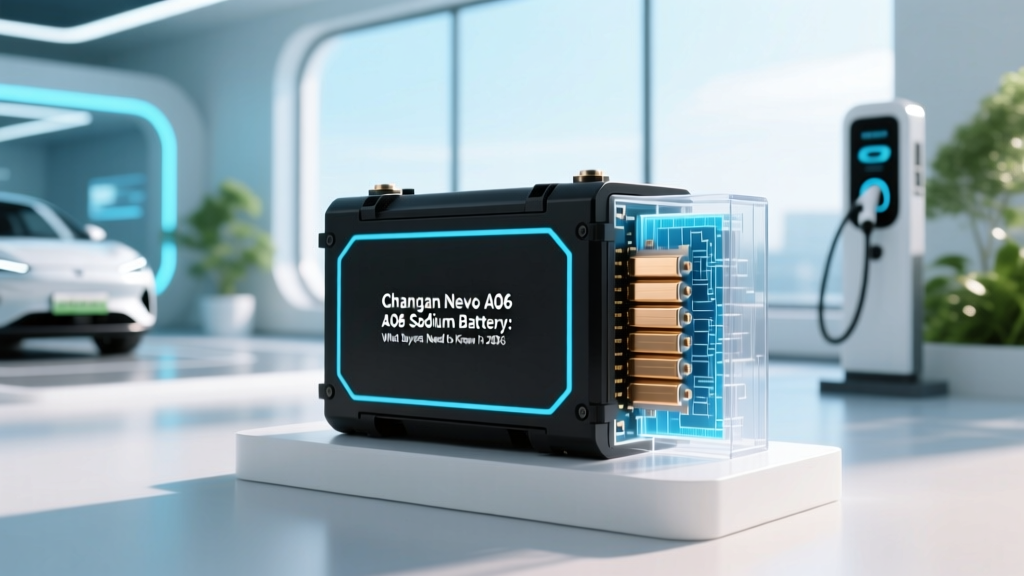
The Nevo A06 is a compact plug-in hybrid/extended-range electric sedan sold under Changan's Nevo (Qiyuan) sub-brand in China. Certain trims offer a sodium-ion (Na-ion) battery pack alongside conventional lithium iron phosphate (LFP) options. Sodium-ion cells use sodium — abundant, cheap, and geopolitically unproblematic — as the charge carrier instead of lithium.
The trade-off is energy density. Current-generation sodium-ion packs from suppliers like CATL and HiNa Battery deliver roughly 140–160 Wh/kg at the cell level, compared to 160–180 Wh/kg for LFP and 250–300 Wh/kg for nickel-manganese-cobalt (NMC/NCA). That means a sodium pack must be physically larger or heavier to store the same kilowatt-hours (kWh) of energy. For the Nevo A06's PHEV/EREV architecture, where the battery supplements a gasoline range-extender, this penalty is manageable: the pack is smaller (typically 18–28 kWh usable), so the density gap translates to a modest weight increase rather than a range dealbreaker.
| Attribute | Sodium-Ion (Na-ion) | LFP (LiFePO₄) | NMC/NCA |
|---|---|---|---|
| Cell energy density | 140–160 Wh/kg | 160–180 Wh/kg | 250–300 Wh/kg |
| Cycle life (to 80% SoH) | 3,000–5,000 | 3,000–6,000 | 1,500–2,500 |
| Cold performance (capacity at −20 °C) | ~90% | ~70–75% | ~75–80% |
| Fast-charge tolerance | Good (low dendrite risk) | Good | Moderate (thermal mgmt critical) |
| Raw-material cost index | Low (no Li, Co, Ni) | Medium (Li, Fe, P) | High (Li, Ni, Co) |
| Typical application | City EVs, PHEVs, storage | Standard-range BEVs, PHEVs | Long-range BEVs, performance |
The standout advantage of sodium-ion is cold-weather retention. Where LFP packs can lose 25–30% of usable capacity at −20 °C, sodium-ion cells retain roughly 90% — a meaningful edge for buyers in northern climates. Sodium cells also tolerate deeper discharge without damage and can be stored at 0 V for shipping safety, reducing logistics risk.
LFP vs NMC vs Sodium: Which Chemistry Is Better?
There is no single "best" chemistry — the right answer depends on your driving pattern, climate, and budget.
- Choose NMC/NCA if you need maximum range in a single-charge BEV (300+ miles EPA) and accept higher cost and faster degradation.
- Choose LFP if you want a durable, lower-cost pack for daily commuting and can charge to 100% regularly without degradation anxiety.
- Choose sodium-ion if you live in a cold climate, prioritize cycle longevity, and are buying a PHEV or city-range BEV where the energy-density penalty is tolerable.
For the Nevo A06 specifically, the sodium option makes sense because the car's extended-range powertrain compensates for any range shortfall with its onboard generator. You get cold-resilient electric driving for daily commutes plus gasoline backup for road trips.
How Long Do EV Batteries Actually Last?
Modern EV traction batteries are engineered to outlast most owners' time with the vehicle. Real-world fleet data from fueleconomy.gov and manufacturer reports show the following degradation benchmarks:
Typical capacity retention over time (fleet averages):
- Year 1 / 15,000 mi: ~97–98% State of Health (SoH)
- Year 3 / 45,000 mi: ~93–95% SoH
- Year 5 / 75,000 mi: ~89–92% SoH
- Year 8 / 120,000 mi: ~83–88% SoH
- Year 10 / 150,000 mi: ~78–85% SoH
Sodium-ion and LFP chemistries tend to sit at the upper end of these ranges (or exceed them) due to higher cycle counts, while NMC packs cluster toward the lower end. CATL has published data showing its first-generation sodium cells retaining above 80% capacity after 4,000 full charge-discharge cycles — enough for well over 500,000 miles in a PHEV application where each cycle covers only a short electric-only distance.
The critical takeaway: most EV batteries will retain 80%+ of original capacity at 150,000 miles. Catastrophic failure (sudden death) is rare; gradual capacity loss is the norm.
Battery Warranty: What's Covered and for How Long?
In the United States, federal law mandates a minimum 8-year/100,000-mile warranty on EV and PHEV traction batteries (10 years/150,000 miles in California Air Resources Board states). Most manufacturers exceed this baseline. For the Changan Nevo A06 sold in China, Changan offers an 8-year/150,000 km warranty on the sodium-ion pack with a capacity-retention threshold of 70% — consistent with global norms.
| Manufacturer / Model | Warranty Term | Capacity Threshold | Chemistry |
|---|---|---|---|
| Changan Nevo A06 (Na-ion) | 8 yr / 150,000 km | 70% SoH | Sodium-ion |
| Tesla Model 3 RWD | 8 yr / 100,000 mi | 70% SoH | LFP |
| Tesla Model Y LR | 8 yr / 120,000 mi | 70% SoH | NMC |
| Hyundai Ioniq 5 | 10 yr / 100,000 mi | 70% SoH | NMC |
| Ford F-150 Lightning | 8 yr / 100,000 mi | 70% SoH | NMC |
| BYD Seal | 8 yr / 150,000 km | 70% SoH | LFP (Blade) |
Key warranty caveats: warranties cover defects and excessive degradation, not damage from accidents, flooding, or improper charging equipment. If your pack drops below the threshold (e.g., 70% of original kWh capacity) within the warranty period, the manufacturer will repair, replace, or refurbish it at no cost. Always keep records of charging habits and service visits to support a claim.
EV Battery Replacement Cost: What to Budget
Out-of-warranty battery replacement remains a legitimate concern, though it's needed far less often than media coverage suggests. Here are current replacement cost ranges for common pack sizes:
| Pack Size | Chemistry | Replacement Cost Range | Typical Models |
|---|---|---|---|
| 18–30 kWh | Sodium-ion / LFP | $4,000–$7,500 | PHEVs, Nevo A06, city EVs |
| 50–65 kWh | LFP | $8,000–$13,000 | Tesla Model 3 RWD, BYD Dolphin |
| 70–85 kWh | NMC | $12,000–$18,000 | Tesla Model Y LR, Ioniq 5 |
| 90–110 kWh | NMC/NCA | $16,000–$25,000 | Tesla Model S, F-150 Lightning ER |
| 120–135 kWh | NMC | $22,000–$32,000 | GMC Hummer EV, Silverado EV |
Sodium-ion packs sit at the lower end of the cost spectrum because sodium, iron, and manganese precursors are substantially cheaper than lithium and cobalt. As CATL and HiNa scale production through 2026–2028, per-kWh costs for sodium cells are expected to drop below $60/kWh — potentially making replacement packs for PHEVs like the Nevo A06 affordable enough to treat as routine maintenance rather than a total-loss event.
When is replacement typically needed? Data from warranty providers and fleet operators shows most replacements occur between years 10–15 or 150,000–200,000+ miles, and many packs are never replaced because the vehicle is retired first.
Factors That Accelerate (or Preserve) Battery Life
Not all miles age a battery equally. The following factors have the largest measurable impact on long-term State of Health:
Battery Care Checklist for Maximum Longevity
- Avoid sustained 100% SoC: For NMC packs, keep daily charge between 20–80%. LFP and sodium-ion tolerate 100% better but still benefit from occasional partial charges.
- Minimize DC fast charging: Occasional road-trip fast charges are fine; daily reliance on 150+ kW DC charging accelerates degradation by ~1–2% per year vs. Level 2 home charging.
- Precondition in cold weather: Warming the battery before driving and charging (most EVs do this automatically when navigation is set to a charger) reduces lithium plating risk and improves charge acceptance.
- Avoid extreme heat storage: Parking a fully charged EV in 100°F+ heat for weeks is the single most damaging habit. If storing, set SoC to ~50% and park in shade.
- Use regenerative braking wisely: Aggressive regen in cold weather can stress a cold battery; many EVs automatically limit regen until the pack warms up.
- Keep firmware updated: Manufacturers regularly refine battery management system (BMS) algorithms to improve longevity via over-the-air updates.
Sodium-ion batteries are inherently more tolerant of several abuse modes: they resist dendrite formation during fast charging, handle deep discharge without damage, and lose less capacity in cold weather. This makes them particularly forgiving for owners who can't always follow ideal charging habits.
How to Monitor Your Battery's State of Health
State of Health (SoH) is the percentage of original capacity your battery can still hold. A new pack is 100% SoH; at 70% SoH, a 60 kWh battery holds only 42 kWh. Here's how to check it:
- In-vehicle BMS display: Many EVs (Tesla, Hyundai, BMW) show SoH or a "battery health" metric in the service menu or app. Check your owner's manual for access instructions.
- OBD-II diagnostic tools: Devices like the OBDLink MX+ paired with apps such as EV Health or ABRP can read SoH directly from the BMS via the OBD-II port.
- Dealer diagnostic scan: Request a battery health report during scheduled service. Dealers can pull detailed cell-voltage balance data and capacity tests.
- Manual calculation: Charge to 100%, note the displayed range, and compare to the original EPA-rated range. Adjust for temperature and driving style. A consistent 15% drop in displayed range at full charge roughly correlates to ~85% SoH.
For the Nevo A06, Changan's connected-car app provides a battery health indicator accessible from the vehicle status screen. Independent OBD-II tools with Changan/CAN protocol support can also pull raw SoH data.
Emerging Battery Tech: Solid-State, Silicon Anode, and Beyond
Sodium-ion is not the only chemistry reshaping the EV landscape. Several next-generation technologies are in various stages of development:
Solid-state batteries replace the liquid electrolyte with a solid ceramic or polymer, promising energy densities above 400 Wh/kg and improved safety. Toyota, Samsung SDI, and QuantumScape have demonstrated prototype cells, but mass production for consumer vehicles is not expected before 2028–2030. Early deployments will likely appear in premium models at significant cost premiums.
Silicon-anode lithium-ion cells (from companies like Sila Nanotechnologies and Group14) boost energy density by 20–40% over conventional graphite anodes. These are beginning to appear in 2025–2026 model-year vehicles and represent a more near-term improvement than solid-state.
Sodium-ion itself is evolving: Second-generation cells targeting 180–200 Wh/kg are in development, which would narrow the gap with LFP and open sodium to longer-range BEV applications by 2028–2029.
None of these technologies are available in production vehicles you can buy today. Treat any marketing claims about solid-state availability before 2028 with skepticism. For 2026 buyers, the realistic choices remain LFP, NMC/NCA, and — in select markets — sodium-ion.
Frequently Asked Questions
How long do EV batteries last in years and miles?
Most modern EV batteries retain 80%+ of original capacity at 150,000 miles or 10+ years. Sodium-ion and LFP chemistries typically outperform NMC in longevity. Catastrophic failure is rare; gradual capacity loss is normal and expected.
How much does an EV battery cost to replace?
Replacement costs range from $4,000–$7,500 for small PHEV packs (like the Nevo A06's sodium-ion battery) to $16,000–$32,000 for large long-range BEV packs. Most batteries are never replaced because they outlast the vehicle's useful life. Warranty coverage typically spans 8–10 years.
What does the battery warranty cover?
EV battery warranties cover manufacturing defects and capacity loss below a stated threshold (typically 70% of original capacity) within the warranty period (usually 8 years / 100,000–150,000 miles). They do not cover damage from accidents, floods, or unauthorized modifications.
How do I check and maximize my battery's health?
Monitor SoH through your vehicle's app, OBD-II diagnostic tools, or dealer scans. Maximize longevity by avoiding sustained 100% charge (especially for NMC), minimizing daily DC fast charging, preconditioning in cold weather, and avoiding prolonged storage at high SoC in extreme heat.
LFP vs NMC — which is better and why?
LFP is better for cost, longevity, and safety; it tolerates 100% daily charging and offers 3,000–6,000 cycles. NMC is better for maximum range and performance, offering 250–300 Wh/kg energy density but shorter cycle life (1,500–2,500 cycles) and higher cost. Choose LFP for daily commuting and NMC for long-range road trips.
Is sodium-ion safe compared to lithium batteries?
Sodium-ion cells are at least as safe as LFP and generally safer than NMC. They are less prone to thermal runaway, can be stored and shipped at 0 V (eliminating fire risk during logistics), and resist dendrite formation. No chemistry is fireproof, but sodium-ion ranks among the safest options available.
Will the Changan Nevo A06 sodium battery be available in the US?
As of early 2026, Changan does not sell vehicles in the United States. The Nevo A06 is available in China and select export markets. US availability would depend on tariff policy, homologation, and Changan's strategic decisions — none of which are confirmed. US buyers interested in sodium-ion technology should watch for announcements from manufacturers with existing US operations.