Sodium-ion batteries have moved from lab curiosity to production reality. CATL, the world's largest battery manufacturer by volume, began shipping its first-generation sodium-ion cells in commercial applications in 2024 and has since expanded into light electric vehicles and energy storage. For EV shoppers in 2026, the question is no longer whether sodium-ion will arrive — it's whether it matters for your next vehicle purchase.
This guide breaks down CATL's sodium-ion technology alongside the two dominant lithium-ion chemistries (LFP and NMC/NCA), with hard numbers on energy density, degradation curves, warranty coverage, and real-world replacement costs. If you're weighing a budget EV with a CATL sodium-ion pack against an LFP-equipped Tesla Model 3 or an NMC-powered Hyundai Ioniq 5, the chemistry under the floorboard affects range, longevity, cold-weather usability, and eventual resale value.
Understanding EV Battery Chemistries: Sodium-Ion, LFP, and NMC/NCA
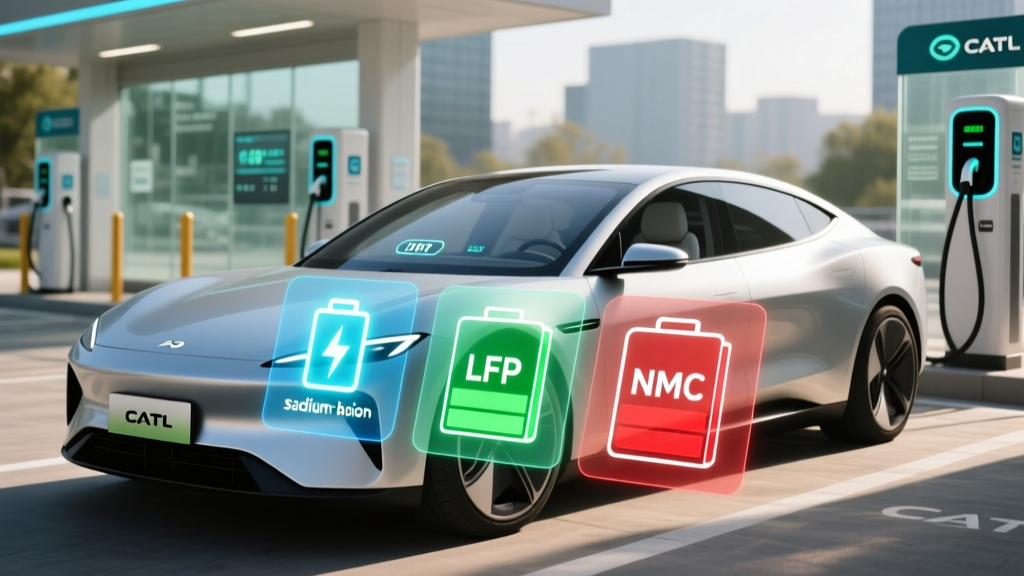
Every EV battery cell uses a cathode, anode, electrolyte, and separator. The cathode chemistry largely defines the pack's characteristics. Here's how the three main options compare:
LFP (Lithium Iron Phosphate — LiFePO₄): Used in Tesla Model 3/Y Standard Range, Ford Mustang Mach-E Select, and most BYD models. LFP trades some energy density for exceptional cycle life, thermal stability, and lower raw-material cost (no cobalt, no nickel). Tesla recommends LFP owners charge to 100% regularly — a flexibility NMC owners don't have.
NMC/NCA (Nickel Manganese Cobalt / Nickel Cobalt Aluminum): Found in long-range and performance variants (Tesla Model 3 Long Range, Hyundai Ioniq 5, BMW iX, Rivian R1T). Higher energy density means more range per kilogram, but the chemistry is more sensitive to high states of charge, heat, and deep discharge. Recommended daily charge limit is typically 80%.
Sodium-Ion (Na-ion — CATL first-gen and AB battery systems): Sodium replaces lithium as the charge carrier. CATL's first-generation cells deliver roughly 160 Wh/kg at the cell level — below LFP's ~170-180 Wh/kg and well short of NMC's ~250-300 Wh/kg. The trade-off: sodium is abundant and cheap, cold-weather performance is significantly better, and cycle life is competitive with LFP. CATL's "AB battery" system pairs sodium-ion and LFP cells in a single pack, using a battery-management system (BMS) to balance the two chemistries and mitigate sodium-ion's energy-density weakness.
| Attribute | Sodium-Ion (CATL Gen 1) | LFP | NMC/NCA |
|---|---|---|---|
| Cell Energy Density | ~160 Wh/kg | ~170–180 Wh/kg | ~250–300 Wh/kg |
| Cost per kWh (cell-level) | ~$50–65 (est.) | ~$70–85 | ~$100–130 |
| Cycle Life (to 80% SoH) | 3,000–5,000 cycles | 3,000–6,000 cycles | 1,000–2,500 cycles |
| Cold Performance (−20°C capacity retention) | ~90% | ~70–75% | ~75–80% |
| Thermal Stability | Excellent | Excellent | Good (requires active cooling) |
| Critical Mineral Dependency | None (sodium, iron, manganese) | Low (lithium, iron) | High (lithium, nickel, cobalt) |
| Recommended Daily SoC | Up to 100% | Up to 100% | 80% (100% for trips only) |
| Typical Use Case | Budget EVs, city cars, cold climates | Standard-range EVs, fleet vehicles | Long-range, performance EVs |
The cost advantage is sodium-ion's headline number. At roughly $50–65 per kWh at the cell level (versus $70–85 for LFP and $100–130 for NMC), a 60 kWh sodium-ion pack could save an automaker $1,200–3,900 at the cell level alone. Those savings translate directly to lower MSRPs on entry-level EVs — a critical factor for the sub-$30,000 electric vehicle segment.
Degradation Data: What Real-World Numbers Show
Battery degradation — the gradual loss of usable capacity over time — remains the top concern for EV buyers considering long-term ownership or used purchases. Here's what the data actually shows:
NMC/NCA packs typically lose 10–15% capacity over the first 100,000 miles (or roughly 5–7 years of average driving at 13,500 miles/year). Tesla's 2023 Impact Report showed its fleet averaging about 12% degradation at 150,000 miles. Hyundai/Kia NMC packs in the Ioniq 5 and EV6 have demonstrated roughly 8–12% loss at 80,000 miles based on owner-reported fueleconomy.gov data and third-party testing.
LFP packs degrade more slowly, especially when the chemistry is kept within moderate temperatures. Tesla's LFP Model 3 fleet data shows approximately 5–8% loss at 100,000 miles. BYD's Blade Battery (LFP) has demonstrated under 10% degradation at 200,000 miles in fleet-taxi applications in China — a strong indicator of the chemistry's durability under high-cycle conditions.
Sodium-ion packs (CATL first-gen) show promising early data. CATL's published test results claim over 3,000 charge cycles to 80% State of Health (SoH) — roughly equivalent to 450,000+ miles if each cycle averages 150 miles. Independent long-term fleet data is still limited as of early 2026, since most sodium-ion-equipped vehicles have been on the road for under two years. However, the fundamental electrochemistry (no lithium plating risk, stable SEI layer formation) supports these projections.
Typical Degradation Curve (Capacity Retention vs. Miles)
| Mileage | NMC/NCA (avg) | LFP (avg) | Sodium-Ion (CATL est.) |
|---|---|---|---|
| New | 100% | 100% | 100% |
| 25,000 mi | 96–97% | 97–98% | 98%+ |
| 50,000 mi | 93–95% | 95–97% | 97%+ |
| 100,000 mi | 88–92% | 92–95% | 95%+ |
| 150,000 mi | 85–90% | 90–93% | 93%+ (projected) |
| 200,000 mi | 80–87% | 88–92% | 90%+ (projected) |
Sources: Tesla Impact Report, Geotab fleet battery data, CATL published cycle-life tests. Sodium-ion projections based on 3,000+ cycle lab data; real-world fleet confirmation pending.
The pattern is consistent: all three chemistries experience steeper degradation in the first 10,000–20,000 miles (the "break-in" phase), then settle into a slow, linear decline. The practical implication is that a 10% capacity loss on a 300-mile EPA range EV still leaves 270 miles — more than adequate for 95% of daily driving.
EV Battery Warranty Terms: What's Actually Covered
Federal law mandates a minimum 8-year/100,000-mile warranty on EV battery packs for emissions-related compliance, but most automakers match or exceed this. The critical detail is the capacity retention threshold — the minimum SoH at which the manufacturer considers the battery "failed."
| Manufacturer / Model | Warranty Period | Capacity Threshold | Chemistry |
|---|---|---|---|
| Tesla Model 3 RWD | 8 yr / 100,000 mi | 70% retention | LFP |
| Tesla Model 3 Long Range | 8 yr / 120,000 mi | 70% retention | NMC |
| Hyundai Ioniq 5 | 10 yr / 100,000 mi | 70% retention | NMC |
| Ford Mustang Mach-E | 8 yr / 100,000 mi | 70% retention | NMC |
| BYD Atto 3 (global) | 8 yr / 100,000 mi | 70% retention | LFP (Blade) |
| CATL Na-ion equipped (est.) | 8 yr / 100,000 mi | 70–75% retention | Sodium-Ion |
The 70% threshold is industry standard. If your battery drops below 70% of original capacity within the warranty period, the manufacturer will repair or replace it — typically with a refurbished pack, not a brand-new one. In practice, very few EV batteries reach this threshold under normal use. NHTSA complaint databases show battery replacement claims are overwhelmingly related to manufacturing defects (bad cells, BMS failures, coolant leaks) rather than gradual degradation.
For sodium-ion packs specifically, CATL's AB battery system warranty terms will depend on the automaker integrating the pack. Expect the standard 8-year/100,000-mile minimum, with some Chinese-market OEMs potentially offering longer coverage given the chemistry's projected longevity.
Battery Replacement Costs: When and How Much
Here's the question that generates the most anxiety — and the most misinformation. Let's ground it in actual numbers.
When is replacement typically needed? For most EVs, the answer is: it isn't. Data from Geotab's fleet battery study covering over 10,000 EVs shows that the vast majority of batteries outlast the vehicle itself. Pack replacement due to degradation (not accident damage or manufacturing defect) is rare before 200,000 miles. The vehicles most likely to need a battery replacement are high-mileage fleet vehicles, rideshare cars, and early-generation EVs with less sophisticated thermal management.
| Vehicle / Pack Size | Chemistry | Replacement Cost (parts + labor) | Notes |
|---|---|---|---|
| Tesla Model 3 RWD (60 kWh) | LFP | $10,000–$13,000 | Refurbished pack common |
| Tesla Model 3 LR (82 kWh) | NMC | $14,000–$18,000 | Structural pack, higher labor |
| Hyundai Ioniq 5 (77.4 kWh) | NMC | $13,000–$17,000 | E-GMP platform |
| Ford F-150 Lightning Ext. (131 kWh) | NMC | $22,000–$30,000 | Largest consumer pack |
| Chevrolet Bolt EV (65 kWh) | NMC | $9,000–$14,000 | Post-recall replacement packs |
| Budget EV with CATL Na-ion (50 kWh est.) | Sodium-Ion | $5,000–$8,000 (est.) | Lower cell cost, simpler BMS |
The sodium-ion cost advantage is dramatic at the pack level. With cell costs potentially 30–40% below LFP and no cobalt or nickel price volatility, a 50 kWh sodium-ion replacement pack could cost $5,000–8,000 — roughly half what an equivalent NMC pack costs today. This matters most for budget EV buyers who may not have the financial cushion for a $15,000+ out-of-warranty repair.
That said: the probability of needing this replacement during normal ownership is low. Most EV batteries retain 80–90% capacity at 150,000 miles, and the vehicle's residual value will likely be near zero by the time the pack truly fails from age alone.
Factors That Accelerate Battery Degradation
Battery chemistry sets the ceiling, but owner habits determine where you land within that range. These factors have the largest measured impact on long-term State of Health:
- DC Fast Charging Frequency: Daily use of 150+ kW DC fast charging accelerates degradation by an estimated 1–3% over 100,000 miles compared to predominantly Level 2 home charging. The heat generated during high-C-rate charging stresses cell internals. Recommendation: use DC fast charging for road trips, not daily commuting.
- Extreme Temperature Exposure: Sustained ambient temperatures above 95°F (35°C) or below 10°F (−12°C) accelerate calendar aging. Vehicles with active liquid thermal management (Tesla, Hyundai E-GMP, Ford) fare significantly better than passively cooled packs (early Nissan Leaf). Sodium-ion's cold-weather advantage (~90% capacity at −20°C vs. ~70% for LFP) is a meaningful benefit for northern-climate owners.
- State of Charge Habits: For NMC/NCA, storing the vehicle above 90% SoC or below 10% SoC for extended periods accelerates degradation. LFP and sodium-ion tolerate 100% storage far better. If you have NMC, charge to 80% daily and only go to 100% before long trips.
- Depth of Discharge: Shallow cycles (e.g., 30–70% SoC) are gentler than deep cycles (5–95%). This is why fleet vehicles that opportunity-charge throughout the day often show less degradation than vehicles that run to near-empty daily.
- Calendar Aging: Even a parked EV battery degrades. A vehicle stored at 50% SoC in moderate temperatures will lose roughly 1–2% capacity per year from calendar aging alone. High SoC + high temperature storage is the worst combination.
How to Check and Monitor Battery Health (SoH)
State of Health (SoH) is the percentage of original capacity your battery currently holds. A new EV has 100% SoH; a battery at 85% SoH has lost 15% of its original capacity. Here's how to check it:
OEM Apps and In-Vehicle Displays: Most modern EVs provide a battery health indicator through the infotainment system or companion app. Tesla's service menu (accessible via the software screen) shows estimated range at 100% SoC, which you can compare to the original EPA figure. Hyundai's Bluelink app provides a battery health percentage. BYD's DiLink system includes a SoH readout.
OBD-II Diagnostic Tools: Third-party apps like OBDeleven, Leaf Spy (for Nissan), and Scan My Tesla can read the BMS-reported SoH directly. These tools connect to the OBD-II port and pull the same data the manufacturer's service department uses. Expect to pay $30–60 for the hardware and $10–20/year for the app subscription.
Charging Data Analysis: If you track how many kWh your charger delivers during a 10%→90% session and compare it to the pack's rated usable capacity, you can estimate SoH. For example, if your 77.4 kWh Ioniq 5 pack accepts only 66 kWh during a 10%→90% charge (80% of the window), your estimated usable capacity is ~82.5 kWh, suggesting ~93% SoH.
Third-Party Battery Health Reports: Companies like Recurrent Auto and AVILOO offer battery health certification services, particularly useful when buying a used EV. These reports pull historical charging data and compare your pack's degradation curve to a fleet baseline. A certified SoH report can add $500–1,500 to a used EV's resale value.
Emerging Technologies: Solid-State, Silicon Anodes, and Beyond
Sodium-ion isn't the only battery technology advancing. Here's where other next-generation chemistries stand as of 2026:
Solid-State Batteries: Toyota, Samsung SDI, and QuantumScape are all targeting 2027–2028 production timelines for solid-state cells. These promise 350–500 Wh/kg energy density (roughly double today's NMC), faster charging, and improved safety. However, manufacturing costs remain 3–5× higher than current lithium-ion, and production yields are not yet commercially viable. Expect solid-state in limited-production premium vehicles first (likely Toyota/Lexus) around 2028, with mass-market availability no earlier than 2030–2032.
Silicon Anode Technology: Companies like Sila Nanotechnologies and Group14 are replacing graphite anodes with silicon-dominant composites, boosting energy density by 20–40%. Mercedes-Benz's next-generation EQ models are expected to incorporate silicon anode cells. This is an incremental improvement to existing lithium-ion chemistry, not a replacement — expect it to appear in 2026–2027 model-year vehicles.
Sodium-Ion Roadmap: CATL has announced a second-generation sodium-ion cell targeting 200 Wh/kg, which would close the gap with LFP entirely. If achieved, sodium-ion becomes viable for mid-range vehicles (250–300 mile EPA range), not just city cars. Timeline: likely 2027–2028 for Gen 2 production. CATL has also discussed sodium-ion integration into its CTP (Cell-to-Pack) and CTC (Cell-to-Chassis) architectures, which would further reduce pack-level costs.
The realistic near-term outlook: LFP and NMC will remain dominant through 2028, sodium-ion will capture the budget EV and energy-storage segments, and solid-state will debut in low-volume premium applications. For buyers purchasing in 2026, today's chemistries are mature, well-understood, and backed by substantial warranty coverage.
CATL Sodium-Ion: Who Should Care and Why
CATL's sodium-ion battery is most relevant if you fall into one of these buyer profiles:
Budget EV shoppers: If you're targeting a sub-$30,000 electric vehicle, sodium-ion's lower cell cost directly enables that price point. Chinese-market vehicles like the Chery iCAR and JAC Yiwei already use CATL sodium-ion packs, and as these platforms reach export markets, the cost savings will be passed to buyers.
Cold-climate owners: If you live where winter temperatures regularly drop below 20°F (−7°C), sodium-ion's ~90% capacity retention at −20°C is a genuine advantage. An LFP-equipped EV that loses 30% of its range in January might retain 90%+ with a sodium-ion pack — turning a 250-mile EPA range into 225 real-world winter miles instead of 175.
Fleet and rideshare operators: High-cycle applications (daily charging, 50,000+ miles/year) benefit from sodium-ion's 3,000–5,000 cycle life and tolerance for 100% SoC charging. The lower replacement cost also reduces total cost of ownership risk.
Not ideal for: Long-range seekers who need 300+ EPA miles from a single charge. Sodium-ion's lower energy density means heavier, bulkier packs for the same range — or accepting shorter range. If your commute is 150+ miles one-way or you regularly road-trip, NMC or LFP in a larger pack remains the better choice.
Frequently Asked Questions
How long do EV batteries actually last?
Most EV batteries retain 80–90% of original capacity at 150,000 miles (roughly 10–12 years of average driving). LFP and sodium-ion chemistries typically outlast NMC/NCA under equivalent conditions. Complete pack failure from degradation alone is rare before 200,000 miles. The vehicle's body, suspension, and electronics often fail before the battery does.
How much does it cost to replace an EV battery?
Replacement costs range from roughly $5,000 for a small sodium-ion pack to $30,000 for a large NMC pack (like the F-150 Lightning's 131 kWh unit). Typical mid-size EV replacements (Tesla Model 3, Ioniq 5) cost $10,000–$18,000 including labor. Most replacements occur due to manufacturing defects or accident damage under warranty, not gradual degradation — and the vast majority of owners never need one.
What does the EV battery warranty actually cover?
Federal law requires a minimum 8-year/100,000-mile battery warranty. Coverage applies if the battery drops below the manufacturer's capacity threshold (typically 70% SoH) or suffers a defect. The warranty covers parts and labor for repair or replacement, usually with a refurbished pack. It does not cover damage from accidents, flooding, or unauthorized modifications.
How do I check my EV battery's State of Health?
Check through your vehicle's companion app, in-vehicle service menu, or an OBD-II diagnostic tool like OBDeleven or Scan My Tesla. Compare the current estimated range at 100% SoC to the original EPA rating. Third-party services like Recurrent Auto provide certified battery health reports, useful for used-EV purchases.
LFP vs NMC — which battery chemistry is better?
Neither is universally better. Choose LFP if you want longer cycle life, can charge to 100% daily, prioritize cost, and don't need maximum range per kilogram. Choose NMC/NCA if you need the longest possible range from a given pack size and don't mind limiting daily charge to 80%. Sodium-ion is emerging as a third option for budget and cold-climate applications, with lower cost and better cold performance than either lithium chemistry.
Is CATL's sodium-ion battery available in US-market EVs?
As of early 2026, no US-market EV uses CATL sodium-ion cells as the primary traction battery. CATL's sodium-ion packs are in production for Chinese-market vehicles (Chery, JAC, and others) and energy storage systems. US availability depends on automaker integration decisions and IRS §30D tax credit battery-sourcing rules, which currently favor North American-manufactured cells. Watch for announcements from budget EV startups and Chinese OEMs expanding into North America.