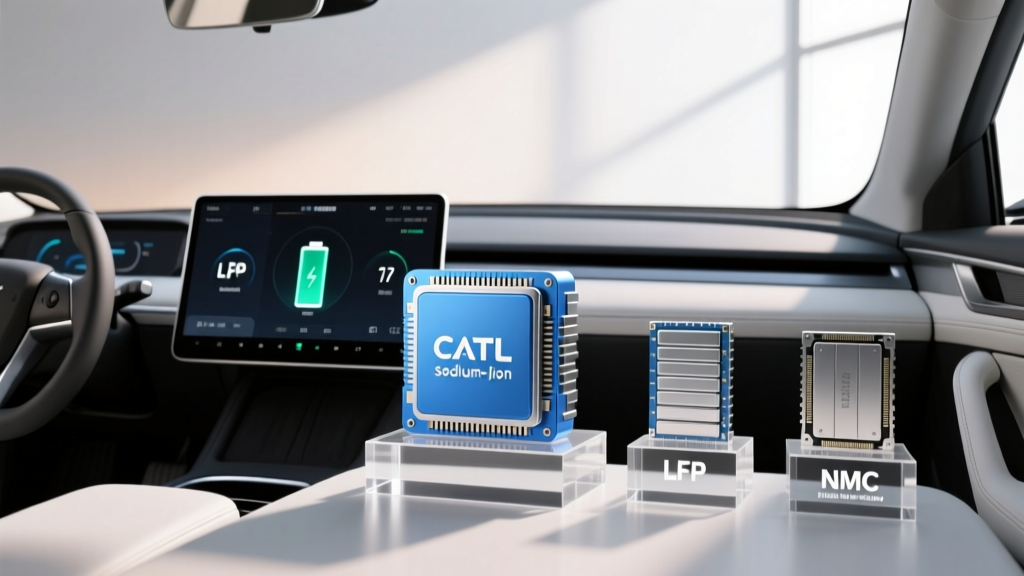
The EV battery conversation used to be simple: pick NMC for range or LFP for longevity. In 2026, CATL's mass-produced sodium-ion (Na-ion) cells have added a third option — one that trades some energy density for dramatically better cold-weather performance, faster charging, and lower raw-material cost. If you are shopping for an EV or trying to understand what powers the latest entry-level models from Chinese and European automakers, sodium-ion chemistry demands your attention.
This guide breaks down CATL's sodium-ion technology alongside the LFP and NMC chemistries that still dominate most EVs sold in the U.S., covering degradation data, warranty terms, replacement costs, and practical battery-care strategies.
Understanding EV Battery Chemistries: Na-Ion, LFP, and NMC Explained
Every EV traction battery stores energy in lithium-ion or, increasingly, sodium-ion cells. The cathode material and cell design determine the trade-offs between energy density (how far you can drive per kWh), cycle life (how many charge-discharge cycles before meaningful degradation), thermal stability, and cost.
NMC (Nickel Manganese Cobalt) and its close cousin NCA (Nickel Cobalt Aluminum) pack the most energy per kilogram, making them the default for long-range EVs like the Tesla Model 3 Long Range (79 kWh usable, NMC) and Hyundai Ioniq 5 (77.4 kWh, NMC). The trade-off: higher cost due to nickel and cobalt, somewhat shorter cycle life, and greater thermal-sensitivity.
LFP (Lithium Iron Phosphate) sacrifices roughly 15–20% energy density compared to NMC but gains substantially longer cycle life (3,000–5,000+ cycles vs. 1,500–2,500 for NMC), superior thermal stability, and zero cobalt. The Tesla Model 3 RWD (57.5 kWh, LFP) and standard-range Ford Mustang Mach-E both use LFP packs. You can also charge LFP to 100% daily without accelerating degradation the way you would with NMC.
CATL Sodium-Ion (Na-ion) replaces lithium with abundant sodium in the cathode and uses a Prussian-blue-analog or layered-oxide structure. CATL's second-generation cells, announced in 2023 and entering volume production through 2025–2026, deliver roughly 160 Wh/kg at the cell level — below LFP's ~170–180 Wh/kg and well below NMC's 250+ Wh/kg — but they excel where both lithium chemistries struggle: sub-zero temperatures and ultra-fast charging.
| Attribute | NMC / NCA | LFP | CATL Na-Ion (Gen 2) |
|---|---|---|---|
| Energy Density (cell) | 250–300 Wh/kg | 170–180 Wh/kg | ~160 Wh/kg |
| Cycle Life (to 80% SoH) | 1,500–2,500 | 3,000–5,000+ | 3,000–4,000 (est.) |
| Cold Performance (−20°C capacity retention) | ~60–70% | ~55–65% | ~90% |
| Fast-Charge Tolerance (10–80%) | 18–25 min (250 kW peak) | 20–30 min (170–200 kW peak) | ~15 min (higher C-rate tolerant) |
| Thermal Runaway Risk | Moderate | Low | Very Low |
| Raw-Material Cost Index | High (Ni, Co) | Moderate (Fe, P) | Low (Na, Fe, Mn) |
| Typical Use Case | Long-range / performance EVs | Standard-range / daily-driver EVs | Budget city EVs, cold-climate fleets |
CATL Sodium-Ion Batteries: Where They Fit in the 2026 EV Market
CATL's sodium-ion cells are not a drop-in replacement for a 350-mile flagship sedan. At ~160 Wh/kg, a 60 kWh Na-ion pack weighs roughly 375 kg of cells alone — about 15% heavier than an equivalent LFP pack. That weight penalty limits Na-ion to vehicles where range expectations are modest (150–250 miles EPA) and where the battery's other strengths matter more.
As of early 2026, CATL sodium-ion packs appear primarily in:
- Chinese-market city EVs — the Chery iCAR and select BYD sub-compacts use first- and second-gen CATL Na-ion cells for 200–300 km CLTC range models priced under ¥100,000.
- European micro-EVs and commercial vans — several Stellantis and Volkswagen Group budget platforms have announced Na-ion variants for 2026–2027 model years, targeting urban delivery and commuter segments.
- Hybrid AB-battery packs — CATL's "AB" architecture pairs Na-ion and LFP cells within a single pack, using Na-ion for cold-start power delivery and LFP for bulk energy storage. This approach debuted in select 2025 Chinese-market EVs and is expanding.
For U.S. buyers, sodium-ion EVs are not yet widely available at dealerships. However, if you are evaluating imported models, fleet vehicles, or planning a purchase in the 2027–2028 window, understanding Na-ion's strengths helps you weigh whether a lower-range, lower-cost, cold-weather-capable EV fits your driving pattern.
How Long Do EV Batteries Actually Last? Degradation Data by Chemistry
Battery degradation is measured as loss of State of Health (SoH) — the percentage of original capacity remaining. A new 75 kWh pack at 95% SoH holds 71.25 kWh of usable energy.
Real-world fleet data and manufacturer testing show consistent patterns across chemistries:
| Chemistry | Avg. Degradation at 100k mi | Avg. Degradation at 150k mi | Expected Life to 70% SoH |
|---|---|---|---|
| NMC (Tesla Model 3 LR, Hyundai Ioniq 5) | ~8–12% | ~12–18% | 200,000–250,000 mi |
| LFP (Tesla Model 3 RWD, MG4) | ~5–8% | ~8–12% | 300,000+ mi |
| Na-Ion (CATL Gen 2, fleet estimates) | ~6–10% | ~10–14% | 250,000–300,000 mi |
A few critical nuances:
- Early degradation is steeper. Most lithium-ion packs lose 2–4% in the first 20,000 miles, then the curve flattens significantly. This "break-in" loss is normal and not indicative of a failing battery.
- Calendar aging matters. A garage-kept EV driven 5,000 miles/year still degrades from time and temperature exposure. Expect ~1–2% annual calendar loss regardless of mileage.
- Cold-climate Na-ion advantage. Because sodium-ion cells experience far less lithium-plating risk at low temperatures, degradation in sub-zero climates may be 30–40% lower than equivalent LFP packs — a significant factor for buyers in Minnesota, Montana, or New England.
According to fueleconomy.gov, the U.S. Department of Energy notes that most modern EV batteries are designed to outlast the vehicle's typical first-ownership period, with degradation curves that plateau well before the car reaches end-of-life.
What Does the EV Battery Warranty Cover?
Federal law mandates that EV battery warranties cover a minimum of 8 years / 100,000 miles (10 years / 150,000 miles in CARB states like California, New York, and Massachusetts). Most manufacturers exceed these minimums.
| Manufacturer / Model | Warranty Term | Capacity Retention Threshold | Chemistry |
|---|---|---|---|
| Tesla Model 3 RWD | 8 yr / 100,000 mi | 70% SoH | LFP |
| Tesla Model 3 Long Range | 8 yr / 120,000 mi | 70% SoH | NMC |
| Hyundai Ioniq 5 | 10 yr / 100,000 mi | 70% SoH | NMC |
| Ford Mustang Mach-E | 8 yr / 100,000 mi | 70% SoH | NMC / LFP |
| Chevrolet Equinox EV | 8 yr / 100,000 mi | 60% SoH | NMC (Ultium) |
| CATL Na-Ion (Chinese-market EVs) | 8 yr / 150,000 km (~93k mi) | 70% SoH | Na-Ion |
Key warranty details buyers often miss:
- The threshold is not 100%. A battery at 71% SoH is technically still "within warranty spec" even though you have lost nearly a third of your original range.
- Warranties cover defects and excessive degradation, not damage from accidents, flooding, or improper charging equipment.
- Transferability varies. Tesla, Hyundai, and Ford warranties transfer to subsequent owners automatically. Always confirm before buying used.
How Much Does an EV Battery Replacement Cost?
Out-of-warranty battery replacement is the single largest potential repair cost for an EV. However, the data shows most EV batteries never need replacement during typical ownership.
| Vehicle / Pack Size | Chemistry | Replacement Cost Range | Typical Need Trigger |
|---|---|---|---|
| Tesla Model 3 RWD (57.5 kWh) | LFP | $8,000–$12,000 | Accident damage; rare degradation failure |
| Tesla Model 3 LR (79 kWh) | NMC | $12,000–$16,000 | High-mileage fleet use (200k+ mi) |
| Hyundai Ioniq 5 (77.4 kWh) | NMC | $11,000–$15,000 | Warranty-expired degradation |
| Chevrolet Bolt EV (65 kWh) | NMC | $14,000–$16,000 | Post-recall replacement (older models) |
| Ford F-150 Lightning Ext. Range (131 kWh) | NMC | $20,000–$30,000 | Commercial fleet high-cycle use |
| Budget Na-Ion pack (40–50 kWh) | Na-Ion | $5,000–$8,000 (est.) | Lower cell cost; limited data |
Important context: according to data compiled by NHTSA and independent fleet studies, fewer than 2–3% of EV batteries require full replacement outside of warranty coverage. Most degradation-related replacements occur under the manufacturer's 8–10 year warranty at zero cost to the owner. The fear of a surprise $20,000 bill is largely overstated for first and second owners.
Factors That Accelerate EV Battery Degradation
Not all miles age a battery equally. The following factors have the largest measurable impact on long-term State of Health:
Battery Care Checklist: Maximize Your Pack's Lifespan
- Limit DC fast charging to road trips. Daily use of 150–350 kW DC fast chargers can accelerate degradation by 1–3% over 100,000 miles compared to Level 2 home charging. The heat generated at high charge rates stresses cell chemistry, particularly NMC.
- Avoid sustained 100% or 0% State of Charge. For NMC batteries, keep daily SoC between 20–80%. LFP and Na-ion tolerate 100% daily charges better, but storing any battery at 0% for extended periods causes copper-dissolution damage.
- Precondition before fast charging. Most EVs automatically precondition the battery when you navigate to a DC fast charger. This warms the cells to ~30–35°C, reducing lithium plating risk and enabling the full charge curve. In cold weather, preconditioning can cut 10–80% charge time by 5–10 minutes.
- Minimize extreme-temperature exposure. Parking in shade or a garage when ambient temperatures exceed 95°F reduces calendar aging. In sub-zero climates, garage parking and preconditioning before driving protect both range and long-term SoH.
- Use regenerative braking moderately in cold weather. Aggressive regen on a cold battery forces high-current discharge into cells that are not yet at optimal temperature, increasing stress. Many EVs automatically limit regen when the battery is cold — let the car manage this.
How to Check and Monitor Your EV's Battery Health
State of Health (SoH) is not always displayed on the dashboard, but you can access it through several methods:
- Manufacturer apps. Tesla, Hyundai, Ford, and GM provide battery health indicators in their companion apps or service menus. Tesla's "Battery Health" test (accessible via the service menu on 2023+ vehicles) runs a controlled discharge cycle and reports SoH as a percentage.
- OBD-II scanners with EV support. Tools like the OBDeleven, Carista, or dedicated EV scanners (e.g., the $60–$120 OBDLink MX+) can read battery management system (BMS) data including SoH, cell voltage variance, and cumulative charge throughput.
- Third-party services. Companies like Geotab and Recurrent Analytics offer battery health reports based on telematics data — particularly useful when buying a used EV. A Recurrent report shows degradation history, charging habits, and projected range at current SoH.
- Manual range tracking. Charge to a consistent SoC (e.g., 80%) under similar temperature conditions and note the displayed range. If your 80% charge shows 210 miles today versus 240 miles when new, your SoH is approximately 87.5%. This method is imprecise but directionally useful.
When to Be Concerned
A sudden drop in displayed range (>5% in a single month), frequent "reduced power" warnings, or individual cell voltage variance exceeding 200 mV (readable via OBD-II) all warrant a dealer diagnostic visit. These symptoms may indicate a defective module rather than normal degradation, and are typically covered under warranty.
Emerging Battery Technologies: Solid-State, Silicon Anode, and Beyond
Sodium-ion is one of several next-generation chemistries reshaping EV batteries. Here is where the most anticipated technologies stand as of 2026:
- Solid-state batteries — Toyota, Samsung SDI, and QuantumScape have demonstrated prototype cells with 400–500 Wh/kg energy density and 10-minute fast-charge capability. However, manufacturing yield and cost remain barriers. Toyota has announced solid-state production for select 2028–2029 models, but volume availability for mainstream EVs is not expected before 2030. These are forward-looking projections, not currently purchasable technology.
- Silicon-dominant anodes — Companies like Sila Nanotechnologies and Group14 replace graphite anodes with silicon composites, boosting energy density 20–40% without changing the cathode. The Mercedes G-Class 580e (2025+) uses a silicon-anode NMC pack from Factorial Energy. Expect broader adoption in 2027–2028 performance and long-range EVs.
- Sodium-ion + LFP hybrid packs — CATL's AB-battery approach is likely a bridge technology. As Na-ion energy density improves toward 200 Wh/kg in Gen 3 cells (projected 2028–2029), standalone Na-ion packs could serve 250–300 mile EVs at significantly lower cost than LFP.
For buyers today, the practical decision remains between NMC (maximum range, higher cost), LFP (longevity and daily-charge flexibility, moderate range), and — for those in cold climates or budget segments — keeping sodium-ion on the radar as availability expands.
LFP vs NMC vs Na-Ion: Which Battery Chemistry Should You Choose?
Choose NMC If:
- You need 300+ miles of EPA range and are willing to manage SoC between 20–80% for daily driving.
- You prioritize performance (higher energy density enables lighter packs and better weight distribution).
- You live in a moderate climate where extreme cold is infrequent.
Choose LFP If:
- You want to charge to 100% daily without degradation anxiety.
- You plan to keep the vehicle 10+ years or 200,000+ miles.
- 250–280 miles of EPA range meets your needs and you value long-term cost savings over maximum range.
Watch Sodium-Ion If:
- You live in a cold climate (regular sub-20°F winters) where LFP and NMC range loss is a recurring frustration.
- You are shopping in the budget EV segment and can accept 150–250 miles of range.
- You are evaluating fleet or commercial vehicles where low cell cost and high cycle life drive total-cost-of-ownership calculations.
Frequently Asked Questions
How long do EV batteries last in years and miles?
Most modern EV batteries — whether NMC, LFP, or emerging Na-ion — are engineered to retain 70–80% of original capacity at 150,000–200,000 miles or 10–15 years of typical use. LFP packs routinely exceed 300,000 miles before reaching the 70% SoH threshold. Full battery replacement before 200,000 miles is statistically rare (under 3% of vehicles per fleet data).
How much does it cost to replace an EV battery?
Out-of-warranty replacement costs range from approximately $8,000 for a 57 kWh LFP pack (Tesla Model 3 RWD) to $30,000 for a 131 kWh NMC pack (F-150 Lightning Extended Range). However, the vast majority of replacements occur under the manufacturer's 8–10 year / 100,000–150,000 mile warranty at no cost to the owner. CATL sodium-ion packs are estimated at $5,000–$8,000 for 40–50 kWh packs due to lower raw-material costs, though U.S. replacement data is limited.
What does the EV battery warranty actually cover?
Federal law requires a minimum 8-year / 100,000-mile warranty on EV batteries (10 years / 150,000 miles in CARB states). Coverage includes defects in materials or workmanship and capacity loss below a specified threshold — typically 70% SoH for most manufacturers, though Chevrolet sets the threshold at 60%. Warranties do not cover damage from collisions, floods, or use of non-certified charging equipment.
How do I check my EV battery's State of Health?
You can check SoH through your manufacturer's app or service menu (Tesla, Hyundai, and Ford provide this directly), through an OBD-II scanner with EV capability ($60–$120 for tools like OBDLink MX+), or via third-party battery health reports from services like Recurrent Analytics. For a quick estimate, track your displayed range at a consistent State of Charge over time.
Is LFP better than NMC?
Neither is universally better — they serve different priorities. LFP offers longer cycle life (3,000–5,000+ cycles), the ability to charge to 100% daily, lower cost, and better thermal stability, but with 15–20% less energy density. NMC delivers more range per kilogram and is preferred for 300+ mile vehicles, but requires more careful SoC management (20–80% daily) and carries higher raw-material cost. For most daily commuters who charge at home, LFP is the more practical choice in 2026.
Are CATL sodium-ion batteries available in U.S. EVs?
As of early 2026, CATL sodium-ion batteries are not widely available in U.S.-market EVs. They are primarily deployed in Chinese-market city EVs and some European commercial platforms. However, CATL has indicated plans to supply Na-ion cells to global automakers, and U.S. availability in budget and fleet segments is expected to grow in the 2027–2029 timeframe.
Does frequent DC fast charging damage my EV battery?
Exclusive reliance on DC fast charging (150–350 kW) can accelerate degradation by approximately 1–3% over 100,000 miles compared to primarily using Level 2 home charging. The heat generated at high charge rates stresses cell chemistry, particularly in NMC packs. For daily charging, Level 2 at 7–11 kW is optimal for long-term battery health. Reserve DC fast charging for road trips and occasions when you genuinely need a quick top-up.
Sources: U.S. Department of Energy / fueleconomy.gov; NHTSA; manufacturer warranty documentation (Tesla, Hyundai, Ford, GM); CATL technology day announcements (2023–2025). Tax credit eligibility for EVs varies by model year, buyer income, and battery-sourcing requirements under IRS §30D — consult irs.gov or a tax professional before purchasing.