Sodium-ion batteries have moved from lab curiosity to production reality, and CATL — the world's largest battery manufacturer — is leading the charge. In 2024, CATL began shipping first-generation sodium-ion cells in Chinese-market EVs like the Chery iCAR, and by early 2026, the company has confirmed second-generation sodium cells entering volume production with improved energy density. For EV buyers outside China, the question is practical: what does sodium-ion chemistry actually deliver, and how does it stack up against the LFP and NMC packs powering most EVs sold in North America and Europe today?
This guide breaks down CATL sodium batteries alongside LFP and NMC chemistries, covering energy density, cold-weather performance, degradation data, warranty norms, replacement costs, and what sodium-ion means for future EV pricing. We'll also cover how to monitor and maximize the health of whatever battery chemistry your EV uses.
What Are CATL Sodium-Ion Batteries?
Sodium-ion batteries operate on the same rocking-chair principle as lithium-ion cells — ions shuttle between cathode and anode during charge and discharge — but substitute sodium (Na) for lithium (Li) as the charge carrier. Sodium is roughly 1,000 times more abundant in the Earth's crust than lithium, is mined on every continent, and does not require cobalt or nickel in the cathode formulation.
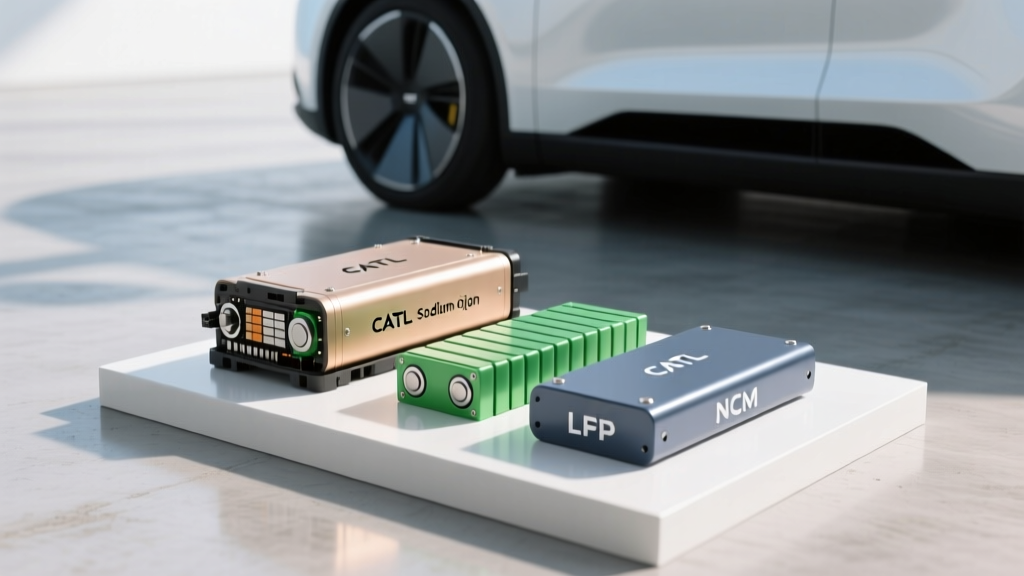
CATL announced its first-generation sodium-ion cell in July 2021, targeting 160 Wh/kg at the cell level. By late 2023, CATL confirmed that its AB battery pack architecture — which interleaves sodium-ion and LFP cells in a single pack managed by a unified BMS — had entered production. The Chery iCAR (a small city EV sold in China) became one of the first vehicles to ship with CATL sodium-ion cells in 2024.
As of 2026, CATL's second-generation sodium cells reportedly target 200 Wh/kg at the cell level, narrowing the gap with entry-level LFP cells (~170–200 Wh/kg cell-level, depending on format and manufacturer). However, sodium-ion packs remain heavier and bulkier than equivalent NMC packs, limiting their near-term application to smaller, urban-focused EVs, energy storage systems, and potentially plug-in hybrids where pack size is less constrained.
Chemistry Comparison: Sodium-Ion vs LFP vs NMC (2026 Cell-Level Data)
| Attribute | Sodium-Ion (CATL Gen 2) | LFP | NMC 811 |
|---|---|---|---|
| Cell energy density | ~200 Wh/kg | 170–200 Wh/kg | 250–300 Wh/kg |
| Pack energy density | ~130–150 Wh/kg | ~140–160 Wh/kg | ~180–210 Wh/kg |
| Cycle life (to 80% SoH) | 3,000–5,000 cycles | 3,000–6,000 cycles | 1,000–2,500 cycles |
| Cold performance (capacity at −20°C) | ~90% retention | ~60–70% retention | ~70–80% retention |
| Fast-charge capability | ~15 min 10–80% (est.) | ~18–25 min 10–80% | ~18–25 min 10–80% |
| Cobalt / nickel required | No | No | Yes (both) |
| Raw material cost trend | Low / stable | Low / moderate | Higher / volatile |
| Typical EV application | City cars, micro EVs, PHEVs | Standard-range sedans & SUVs | Long-range / performance EVs |
LFP vs NMC vs Sodium-Ion: The Trade-Offs Explained
Choosing a battery chemistry is always a multi-variable optimization. No single chemistry wins on every metric.
NMC (Nickel Manganese Cobalt) and NCA (Nickel Cobalt Aluminum) remain the go-to for long-range EVs. The Tesla Model 3 Long Range (2026, 82 kWh usable, NMC/NCA blend, EPA 363 miles) and Hyundai Ioniq 6 Long Range (77.4 kWh, NMC, EPA 361 miles) both rely on the high energy density of nickel-rich cathodes. The trade-off: NMC cells degrade faster under sustained high SoC and high temperature, and their supply chain depends on cobalt and nickel mining with well-documented geopolitical and ethical concerns.
LFP (Lithium Iron Phosphate) dominates the standard-range segment. The Tesla Model 3 RWD (2026, 60 kWh usable, LFP, EPA 272 miles) and the base Ford Mustang Mach-E Select (LFP, 75.7 kWh, EPA 250 miles) both use LFP packs. LFP offers superior cycle life (often 4,000+ cycles to 80% capacity), can be safely charged to 100% daily without accelerated degradation, and avoids cobalt entirely. The downside: LFP cells lose significant capacity in cold weather — expect 30–40% range reduction at −20°C (−4°F) without preconditioning — and their lower energy density means heavier, larger packs for the same kWh.
Sodium-ion occupies a niche below LFP. Its standout advantage is cold-weather performance: CATL's sodium cells retain approximately 90% of rated capacity at −20°C, compared to roughly 60–70% for LFP under the same conditions. This makes sodium-ion particularly attractive for markets with harsh winters. Sodium cells also tolerate full discharge to 0V during storage and transport without damage — a safety and logistics advantage over lithium-ion cells, which must maintain a partial charge to prevent copper current-collector dissolution.
The limitation is energy density. At ~130–150 Wh/kg at the pack level, a sodium-ion pack delivering 60 kWh would weigh roughly 400–460 kg, compared to ~375–430 kg for an equivalent LFP pack and ~285–335 kg for NMC. That weight penalty makes sodium-ion impractical for a 350-mile long-range EV but viable for a 150–200-mile city car or as the lower-cost half of CATL's AB hybrid pack.
How Long Do EV Batteries Actually Last?
The short answer: most EV traction batteries outlast the vehicles they're installed in. But the data is more nuanced than "they last forever."
Based on fleet data from Tesla's 2025 Impact Report, Tesla Model 3/Y packs retain approximately 85% of original capacity at 200,000 miles — a figure consistent across NMC and LFP variants, though LFP packs show a flatter degradation curve (less initial drop, more linear decline). Geotab's analysis of over 10,000 EVs across multiple brands found an average annual degradation rate of 1.8% per year for liquid-cooled packs, meaning a typical EV retains roughly 82–85% capacity after 10 years of average use (12,000–15,000 miles/year).
Typical Degradation Curve: Liquid-Cooled EV Batteries
Based on aggregated fleet data (Geotab, Tesla Impact Report, Recurrent Auto):
- Year 1: 2–4% capacity loss (initial formation loss, steepest part of the curve)
- Years 2–5: ~1.5–2.0% loss per year (linear phase)
- Years 6–10: ~1.0–1.5% loss per year (plateau phase)
- Year 10 typical SoH: 82–88% of original capacity
- Year 15 typical SoH: 75–82% of original capacity
Key finding: Very few modern liquid-cooled packs reach 70% SoH (the typical warranty threshold) within the warranty period. Premature failures (cell defects, BMS faults) are covered under warranty and are statistically rare — under 1% of packs in major fleet studies.
For sodium-ion, long-term fleet data is not yet available at scale. Lab testing by CATL and independent researchers suggests cycle life of 3,000–5,000 cycles to 80% SoH, which would translate to roughly 600,000–1,000,000 miles of driving for a 200-mile-range EV — far exceeding the vehicle's mechanical lifespan. Real-world validation will accumulate as first-generation sodium EVs age through 2026–2028.
EV Battery Warranty Terms: What's Covered and What Isn't
Federal law in the United States mandates that EV batteries carry a minimum warranty of 8 years / 100,000 miles (in California Air Resources Board states, the requirement extends to 10 years / 150,000 miles). Most automakers exceed these minimums.
| Automaker | Warranty Period | Capacity Retention Threshold | Notes |
|---|---|---|---|
| Tesla (Model 3/Y RWD, LFP) | 8 yr / 120,000 mi | 70% SoH | Transferable to subsequent owners |
| Tesla (Model 3/Y LR, NMC) | 8 yr / 120,000 mi | 70% SoH | Same threshold despite chemistry |
| Hyundai / Kia | 10 yr / 100,000 mi | 70% SoH | Among the longest coverage periods |
| Ford (Mach-E, F-150 Lightning) | 8 yr / 100,000 mi | 70% SoH | Components covered separately |
| GM (Ultium-based EVs) | 8 yr / 100,000 mi | 70% SoH | Includes BMS and thermal management |
| Rivian | 8 yr / 175,000 mi | 70% SoH | Higher mileage cap for adventure use |
| BMW | 8 yr / 100,000 mi | 70% SoH | Includes module-level replacement option |
What the warranty covers: Capacity loss below the stated threshold (typically 70% of original usable kWh), manufacturing defects in cells, modules, or the battery management system (BMS), and failures of the thermal management system that affect battery function.
What it typically does not cover: Damage from collisions, flooding, or improper modification; capacity loss from consistent abuse (e.g., exclusively DC fast-charging at maximum rate in extreme heat, though this is difficult for manufacturers to prove); or gradual range reduction that remains above the 70% threshold. Cosmetic concerns, 12V auxiliary battery replacement, and charging port issues are handled under separate warranties.
How Much Does an EV Battery Replacement Cost?
Out-of-warranty battery replacement is the single most cited fear among prospective EV buyers. The reality: most EVs will never need a full pack replacement, but if they do, costs have declined significantly.
| Vehicle (2024–2026 Model Year) | Pack Size | Chemistry | Replacement Cost (Parts + Labor) |
|---|---|---|---|
| Tesla Model 3 RWD | 60 kWh | LFP | $8,000–$12,000 |
| Tesla Model Y Long Range | 82 kWh | NMC/NCA | $12,000–$16,000 |
| Hyundai Ioniq 5 | 77.4 kWh | NMC | $11,000–$15,000 |
| Ford Mustang Mach-E ER | 91 kWh | NMC | $14,000–$20,000 |
| Chevrolet Bolt EV/EUV | 65 kWh | NMC | $9,000–$14,000 |
| BMW iX xDrive50 | 111.5 kWh | NMC | $18,000–$25,000 |
| Rivian R1T (Large Pack) | 135 kWh | NMC | $20,000–$28,000 |
Several factors are driving costs down. Cell prices have fallen from over $200/kWh in 2020 to approximately $80–100/kWh for LFP and $110–130/kWh for NMC in 2026, according to BloombergNEF data. Additionally, many repair networks now offer module-level replacement — swapping individual defective modules rather than the entire pack — for $2,000–$6,000 depending on the number of modules needed.
For context, the average age of a scrapped vehicle in the U.S. is roughly 12 years, and the average mileage at scrappage is approximately 165,000 miles. Given that most EV batteries retain 75–85% capacity at that age, a full pack replacement is statistically unlikely during a typical ownership cycle.
What Factors Affect EV Battery Lifespan?
Battery degradation is driven by five primary factors, ranked by impact:
- Temperature extremes. Sustained exposure to ambient temperatures above 35°C (95°F) accelerates electrolyte decomposition and solid-electrolyte interphase (SEI) growth on the anode. Cold temperatures below −10°C (14°F) can cause lithium plating during charging if the pack is not preconditioned. Liquid-cooled packs (standard on virtually all 2026 EVs except some micro-EVs) mitigate this substantially.
- State of charge habits. NMC/NCA cells degrade fastest when held at 100% SoC for extended periods. Tesla, Ford, and GM all recommend setting daily charge limits to 80% for NMC packs and reserving 100% charges for road trips. LFP cells tolerate 100% SoC far better — Tesla recommends periodic 100% charges for LFP packs to enable accurate BMS cell-balancing. Sodium-ion cells also tolerate full SoC well, similar to LFP.
- DC fast-charging frequency. Recurrent Auto's 2025 study of 12,500 EVs found that vehicles fast-charging more than 90% of the time showed approximately 3–5% additional degradation over 3 years compared to vehicles primarily charging on Level 2. The effect is real but smaller than many EV owners fear — modern BMS systems manage charge curves and cell temperatures during DC sessions to limit damage.
- Depth of discharge. Regularly draining a pack to 0% stresses cells more than shallow cycling. Keeping SoC between 20% and 80% for NMC (or 10% and 100% for LFP/sodium) is optimal for longevity.
- Calendar aging. Even a parked EV battery degrades over time. A pack stored at 50% SoC in moderate temperatures will lose roughly 1–2% capacity per year from calendar aging alone. Storing at 100% SoC in heat accelerates this to 3–5% per year.
Battery Care Checklist for Maximum Longevity
- Set daily charge limit to 80% for NMC/NCA packs; 100% is fine for LFP and sodium-ion
- Precondition the battery before DC fast charging (most EVs do this automatically when a charger is set as the navigation destination)
- Avoid leaving the vehicle at 100% SoC for more than a few hours — schedule charging to finish just before departure
- In extreme heat, park in shade or a garage when possible to reduce passive thermal load
- In extreme cold, plug in when parked so the thermal management system can maintain pack temperature using grid power
- Don't stress about occasional DC fast charging — the 3–5% long-term degradation penalty is minor compared to the convenience
- If storing the vehicle for 30+ days, set SoC to approximately 50% and leave it plugged in if possible (the BMS will maintain optimal storage voltage)
How to Check and Monitor Battery Health (SoH)
State of Health (SoH) represents the battery's current maximum capacity as a percentage of its original factory capacity. A new EV has 100% SoH; a pack that held 75 kWh when new but now holds 63.75 kWh is at 85% SoH.
Built-in methods:
- Tesla: The Tesla app displays estimated range at 100% charge, which you can compare to the original EPA range to approximate SoH. For a more precise reading, third-party services like TeslaFi or Tessie log detailed battery data via the vehicle's API.
- Hyundai/Kia: The infotainment system's EV diagnostic screen shows battery health percentage (on 2023+ models). The Battery Management System logs are also accessible via OBD-II scanners that support Hyundai's EV protocol.
- GM (Ultium): The myChevrolet / myCadillac app provides a battery health indicator, and OnStar diagnostics can pull detailed SoH data.
- Ford: The FordPass app shows estimated range; comparing this to the original spec provides a rough SoH proxy.
OBD-II diagnostic tools: Devices like the OBDLink MX+ paired with apps such as ABRP (A Better Route Planner) or Car Scanner can read real-time BMS data including pack voltage, individual cell voltages, SoH percentage, and cumulative charge/discharge energy. This is the most accurate consumer-accessible method across brands.
Dealer assessment: If you suspect abnormal degradation (e.g., range dropping faster than ~2% per year), a dealer can perform a full capacity test — charging the pack to 100%, then discharging it at a controlled rate while measuring total kWh delivered. If the result falls below the warranty threshold (70%), a warranty claim is initiated.
Sodium-Ion, Solid-State, and Silicon Anode: The Battery Roadmap
Beyond sodium-ion, several next-generation technologies are in various stages of development:
Solid-state batteries replace the liquid electrolyte with a solid ceramic, sulfide, or polymer electrolyte, enabling the use of lithium-metal anodes for energy densities above 400 Wh/kg at the cell level. Toyota has announced a solid-state battery targeting 2027–2028 production with 750 km (466 miles) of range, while Samsung SDI and QuantumScape are targeting 2027–2029 timelines for initial automotive applications. These remain forward-looking announcements — no solid-state EV is currently available for purchase, and manufacturing yield challenges have repeatedly delayed timelines. Realistically, solid-state packs will debut in premium, low-volume applications before reaching mainstream pricing in the early 2030s.
Silicon-dominant anodes are closer to market. Companies like Sila Nanotechnologies and Group14 Technologies are supplying silicon-carbon composite anode materials that increase anode capacity by 20–40% compared to conventional graphite. The Mercedes-Benz G-Class EV (announced for 2025–2026) was among the first vehicles to incorporate silicon-anode cells from Sila. This technology is additive — it works within existing lithium-ion cell formats and manufacturing processes — making it the most likely near-term energy density improvement.
Sodium-ion's role in this landscape is not to compete with solid-state on energy density, but to compete with LFP on cost and supply-chain security. CATL's stated target is to bring sodium-ion cell costs below $50/kWh at scale — a price point that would enable sub-$25,000 EVs with 150–200 miles of range. For North American buyers, sodium-ion EVs are most likely to appear first in fleet-oriented vehicles, micro-cars, and potentially as the lower-cost pack option in PHEVs and range-extended EVs, where the weight penalty is offset by smaller pack requirements.
What CATL Sodium Batteries Mean for EV Buyers in 2026
If you're shopping for an EV in North America or Europe today, sodium-ion chemistry is not yet a purchasing decision you can make — no sodium-ion EV is currently sold outside China. But sodium-ion's emergence signals two important trends for near-term buyers:
- Battery costs are on a structural downward trend. Sodium-ion introduces a third chemistry option that pressures LFP and NMC pricing. Even if you buy an LFP or NMC vehicle, the existence of sodium-ion as a competitive alternative helps hold down the cell prices that automakers pay.
- The sub-$30,000 EV segment is becoming viable. The primary barrier to affordable EVs has been battery cost. A 50 kWh sodium-ion pack at $50/kWh costs $2,500 — compared to $5,000–$6,500 for an equivalent NMC pack. This economics shift is what will eventually enable EVs like the announced next-generation Tesla platform and competing compact models to hit price points competitive with gas-powered compacts, even before tax credits.
For buyers considering the §30D federal EV tax credit (up to $7,500 for new EVs, subject to MSRP caps of $55,000 for sedans and $80,000 for SUVs/trucks, buyer income limits of $150,000 single / $300,000 joint, and battery critical-mineral sourcing requirements per IRS guidelines), sodium-ion vehicles may face an interesting dynamic: their cobalt-free, nickel-free cathodes could simplify the critical-mineral sourcing requirement, but the sodium supply chain's geographic concentration in China may complicate the foreign-entity-of-concern (FEOC) rules that took effect in 2024–2025. This will be a regulatory question to watch as sodium-ion vehicles approach Western markets.
Frequently Asked Questions
How long do EV batteries last in years and miles?
Most modern liquid-cooled EV batteries retain 82–88% of original capacity after 10 years and 75–85% after 15 years. Based on fleet data from Tesla, Geotab, and Recurrent Auto, the average annual degradation rate is approximately 1.5–2.0% per year. At this rate, a battery will outlast the vehicle's mechanical components. Premature failures are rare (under 1%) and covered under the mandatory 8-year/100,000-mile warranty.
How much does it cost to replace an EV battery?
Full pack replacement costs range from approximately $8,000 for a 60 kWh LFP pack (Tesla Model 3 RWD) to $25,000–$28,000 for a 135 kWh NMC pack (Rivian R1T Large Pack). Most replacements, when needed, fall in the $10,000–$16,000 range for mainstream EVs. Module-level repairs cost $2,000–$6,000. However, the vast majority of EV batteries never require replacement during the vehicle's usable life — fleet data shows less than 1% of packs fail prematurely, and gradual degradation typically stays above 70% SoH for 15+ years.
What does the EV battery warranty cover?
Federal law requires a minimum 8-year/100,000-mile warranty (10 years/150,000 miles in CARB states) covering capacity loss below a defined threshold — typically 70% of original capacity. The warranty also covers manufacturing defects in cells, modules, the BMS, and the thermal management system. It does not cover collision damage, improper modification, or normal capacity loss that remains above the threshold.
How do I check my EV battery's State of Health?
Most 2023+ EVs display battery health data in the infotainment system or companion app (Tesla app, Hyundai EV diagnostics, GM app). For more precise readings, an OBD-II scanner like the OBDLink MX+ paired with apps like Car Scanner or ABRP can read real-time BMS data including SoH percentage, cell voltages, and cumulative energy throughput. A dealer can perform a full capacity test if you suspect abnormal degradation.
LFP vs NMC — which battery chemistry is better?
Neither is universally better; it depends on your priorities. Choose LFP if you want maximum cycle life (4,000–6,000 cycles), the ability to charge to 100% daily without degradation concerns, lower cost, and cobalt-free sourcing — and you can accept slightly less range and worse cold-weather performance. Choose NMC/NCA if you need maximum range (300+ miles), better cold-weather efficiency, and lighter pack weight — and you're willing to manage daily charge limits (80%) and accept a somewhat shorter cycle life. For most daily commuters, LFP is the pragmatic choice; for frequent road-trippers and cold-climate drivers, NMC remains advantageous.
Will CATL sodium-ion batteries be available in US-market EVs?
Not in 2026. CATL's sodium-ion cells are currently deployed in Chinese-market vehicles, and the company faces significant regulatory and geopolitical barriers to supplying US-market EVs, including FEOC restrictions under the Inflation Reduction Act. However, other manufacturers including Northvolt and Natron Energy are developing sodium-ion production in Europe and North America. The first sodium-ion vehicles in Western markets are most likely to appear in 2027–2029, initially in fleet and commercial applications.
Can sodium-ion batteries be recycled like lithium-ion?
Yes, but the recycling infrastructure is nascent. Sodium-ion cells can be processed through hydrometallurgical recycling similar to lithium-ion, recovering aluminum, copper, and cathode materials. However, because sodium-ion cells contain no high-value cobalt or nickel, the economic incentive for recycling is lower — the recovered materials are less valuable. This may require regulatory frameworks to ensure responsible end-of-life processing as sodium-ion volumes scale.
Sources: IRS §30D Clean Vehicle Credit; EPA Fuel Economy; Tesla 2025 Impact Report; Geotab EV Battery Degradation Study; BloombergNEF Battery Price Survey 2025; CATL technology announcements.