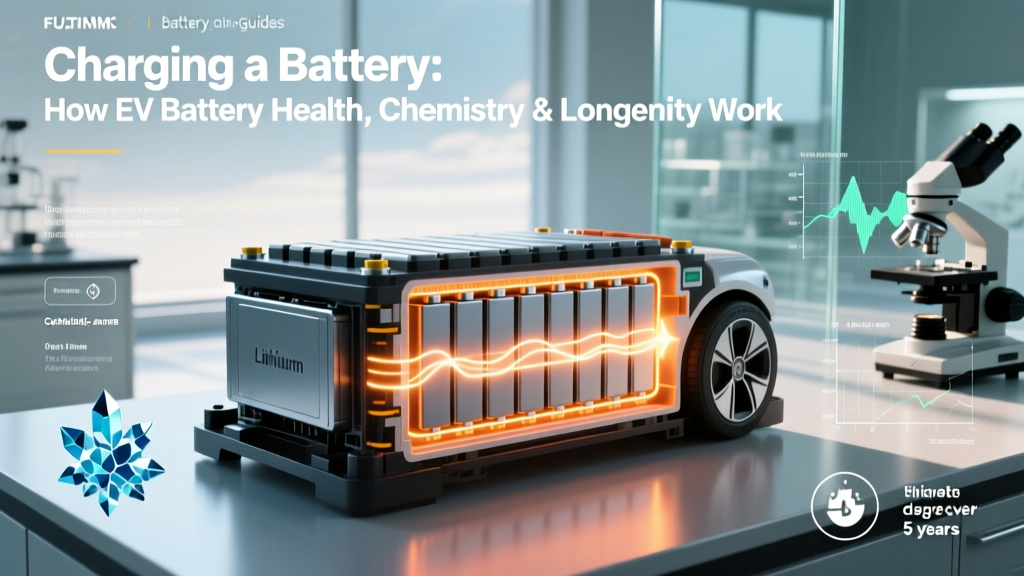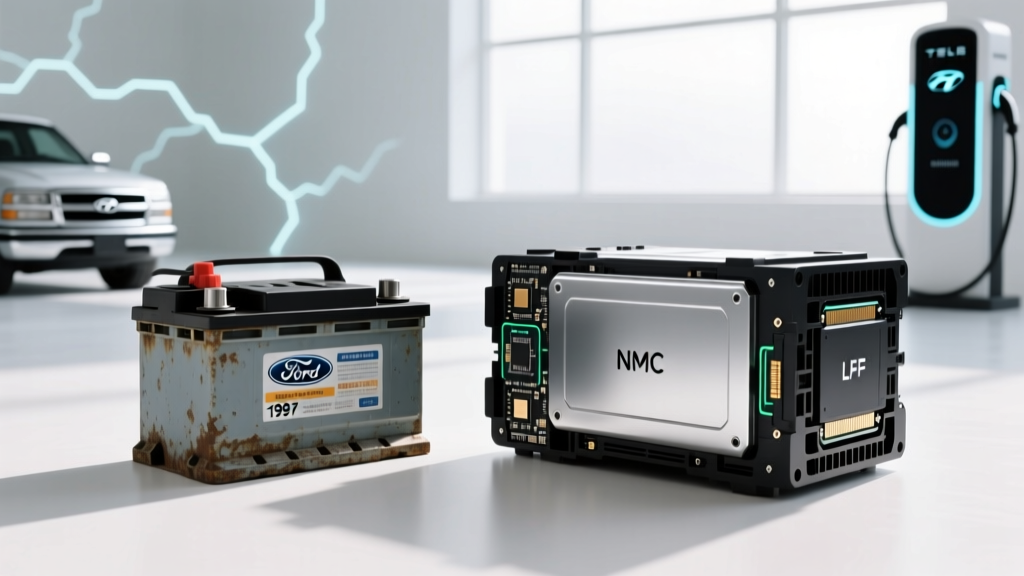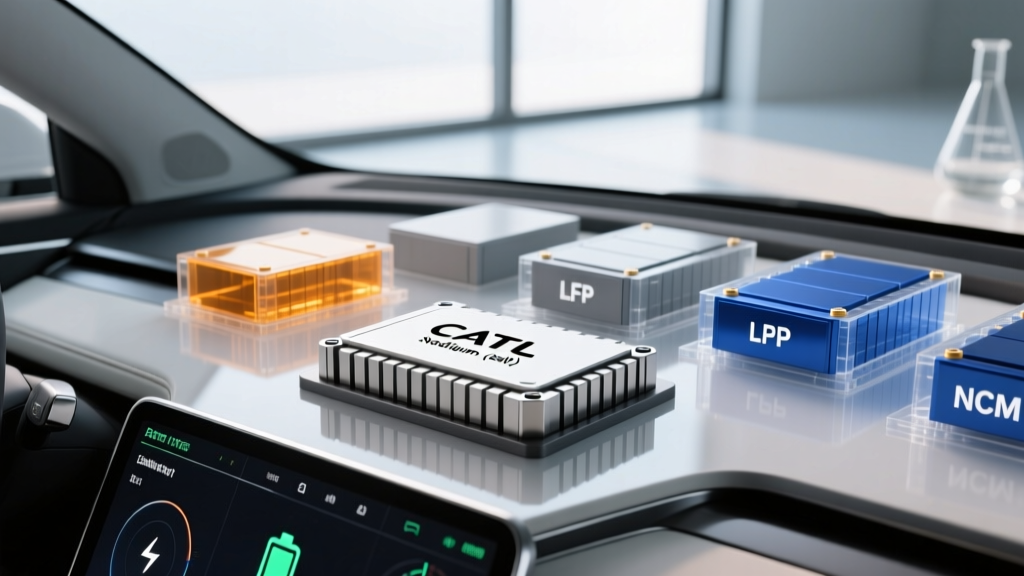
Sodium-ion batteries have moved from lab curiosity to production reality, and the company leading the charge is China's Contemporary Amperex Technology Co. Limited (CATL). The so-called "CATL salt battery" — a colloquial name for CATL's first-generation sodium-ion (Na-ion) battery cells — entered mass production in 2025 and began appearing in select Chinese-market EVs from brands like Chery and Jianghuai (JAC). For US-based EV shoppers, the technology is not yet available domestically, but understanding what sodium-ion brings to the table — and where it falls short compared to established lithium-ion chemistries like LFP (lithium iron phosphate) and NMC (nickel manganese cobalt) — is essential as these cells are expected to reach global markets within the next few years.
This guide breaks down the chemistry, performance data, cost implications, and ownership considerations of sodium-ion batteries alongside the LFP and NMC chemistries that power virtually every EV on US roads today.
What Is the CATL Salt (Sodium-Ion) Battery?
CATL unveiled its first-generation sodium-ion battery in 2021 and began volume production in 2025. The cells use sodium (Na) as the charge-carrying ion instead of lithium (Li). Sodium is roughly 1,000 times more abundant in the Earth's crust than lithium, is distributed globally (reducing geopolitical supply-chain risk), and can be extracted from common salt (NaCl) and soda ash rather than from hard-rock mining or brine evaporation.
CATL's first-generation Na-ion cell specifications, as published by the manufacturer:
- Energy density: ~160 Wh/kg at the cell level
- Fast-charge capability: 10–80% in approximately 15 minutes (at optimal temperature)
- Cold-weather performance: 90%+ capacity retention at -20°C (-4°F)
- Cycle life: 3,000+ cycles to 80% capacity retention (CATL claim)
- Thermal stability: Passes nail-penetration test without thermal runaway
CATL's second-generation sodium-ion cell, announced for 2026–2027 production, targets 200 Wh/kg — which would close much of the gap with current LFP cells. The company has also introduced a hybrid "AB battery pack" that combines sodium-ion and LFP cells in a single pack, using an integrated battery management system (BMS) to balance the trade-offs: the LFP cells provide higher energy density for range, while the Na-ion cells contribute cold-weather resilience and rapid-charge tolerance.
Sodium-Ion vs LFP vs NMC: Chemistry Trade-Offs Compared
To understand where sodium-ion fits, you need to see it alongside the two dominant lithium-ion chemistries in today's EVs. Here is a direct comparison:
| Attribute | Sodium-Ion (CATL Gen 1) | LFP (LiFePO₄) | NMC/NCA |
|---|---|---|---|
| Cell energy density | ~160 Wh/kg | 170–200 Wh/kg | 230–300 Wh/kg |
| Typical pack-level range (midsize sedan) | ~180–250 mi | 230–330 mi | 280–400+ mi |
| Cycle life (to 80% SoH) | 3,000+ cycles | 3,000–5,000 cycles | 1,000–2,000 cycles |
| Cold performance (-20°C) | 90%+ capacity | ~70–80% capacity | ~75–85% capacity |
| Fast-charge tolerance | Excellent (10–80% ~15 min) | Good (10–80% ~20–30 min) | Good to excellent (10–80% ~18–25 min) |
| Thermal runaway risk | Very low | Low | Moderate (requires robust BMS/cooling) |
| Raw material cost (relative) | Lowest | Low–moderate | Highest (Ni, Co) |
| Supply-chain risk | Low (Na globally abundant) | Moderate (Li, Fe, P) | High (Ni, Co, Li concentrated in few countries) |
| Current US availability | Not available | Widely available (Tesla, Ford, Rivian) | Widely available (most OEMs) |
How Long Do EV Batteries Last? Degradation Data by Chemistry
Battery longevity is the single most common concern among prospective EV buyers. The data, however, is reassuring: modern EV batteries are outlasting their vehicles in most cases.
Here is what real-world degradation data shows across chemistries:
| Chemistry | Avg. degradation at 100k mi | Avg. degradation at 200k mi | Expected lifespan to 70% SoH |
|---|---|---|---|
| NMC (liquid-cooled, modern BMS) | 5–8% | 10–15% | 250,000–350,000 mi |
| LFP | 3–6% | 7–12% | 300,000–500,000 mi |
| Sodium-ion (projected, CATL Gen 1) | 3–5% (projected) | 6–10% (projected) | 300,000+ mi (projected) |
These figures come from aggregated fleet data published by Geotab's EV battery health study, which tracked over 6,300 electric vehicles across multiple model years and manufacturers. The study found that the average EV loses approximately 2.3% of its battery capacity per year under typical use — meaning a 15-year ownership period would still leave most batteries above 65–70% State of Health (SoH).
CATL's sodium-ion cells, with a claimed 3,000+ cycle life to 80% retention, project to similar or slightly better longevity than LFP. A full cycle is a complete 0–100% discharge and recharge; most owners never do a full cycle in daily driving, so real-world calendar life typically exceeds cycle-life ratings.
EV Battery Warranties: What's Covered and for How Long?
Federal law in the United States mandates that EV batteries carry a minimum warranty of 8 years or 100,000 miles (whichever comes first). In California and states that follow CARB (California Air Resources Board) standards, the requirement extends to 10 years or 150,000 miles. Most major manufacturers exceed these minimums.
| Manufacturer | Warranty period | Capacity retention threshold |
|---|---|---|
| Tesla (Model 3/Y RWD, LFP) | 8 yr / 120,000 mi | 70% SoH |
| Tesla (Model 3/Y Long Range, NMC) | 8 yr / 120,000 mi | 70% SoH |
| Hyundai / Kia | 10 yr / 100,000 mi | 70% SoH |
| Ford (Mustang Mach-E, F-150 Lightning) | 8 yr / 100,000 mi | 70% SoH |
| GM (Ultium-based: Equinox EV, Blazer EV, Silverado EV) | 8 yr / 100,000 mi | 70% SoH |
| Rivian | 8 yr / 175,000 mi | 70% SoH |
| BMW | 8 yr / 100,000 mi | 70% SoH |
What the warranty covers: If your battery's usable capacity drops below the stated threshold (typically 70% of original capacity) within the warranty period, the manufacturer will repair or replace the battery pack at no cost. This covers cell-level degradation — not damage from accidents, flooding, or unauthorized modifications.
What sodium-ion could change: Because Na-ion cells are projected to degrade more slowly and cost significantly less to manufacture, future warranties could either extend further or reduce the overall cost of out-of-warranty replacement. CATL has not yet published warranty terms for its Na-ion packs, as they have not been adopted by any US-market vehicle as of early 2026.
How Much Does an EV Battery Cost to Replace?
This is the question that generates the most anxiety — and the most misinformation. Let's look at actual replacement costs and the context around when replacement is needed.
| Vehicle | Battery size (kWh) | Chemistry | Replacement cost (out of warranty) |
|---|---|---|---|
| Tesla Model 3 RWD | 60 kWh | LFP | $8,000–$12,000 |
| Tesla Model Y Long Range | 75 kWh | NMC | $12,000–$16,000 |
| Hyundai Ioniq 5 | 77.4 kWh | NMC | $12,000–$18,000 |
| Ford F-150 Lightning Extended Range | 131 kWh | NMC | $20,000–$30,000 |
| Chevrolet Equinox EV | 85 kWh | NMC (Ultium) | $14,000–$18,000 |
When is replacement actually needed? Based on current degradation data, the vast majority of EV batteries will never need replacement during the first owner's tenure. Geotab's fleet data shows that at the current average degradation rate, most batteries will still hold 75–85% of their original capacity at the 15-year mark. Out-of-warranty replacements are rare and typically occur only after high-mileage use (200,000+ miles), exposure to extreme conditions, or manufacturing defects that fall outside normal degradation curves.
The sodium-ion cost advantage: CATL has stated that its sodium-ion cells cost approximately 30% less to produce than equivalent LFP cells, primarily because sodium carbonate costs a fraction of lithium carbonate. If this cost advantage translates to replacement pricing, a future 60 kWh Na-ion pack could cost $5,000–$8,000 to replace — making the already-low risk of battery replacement even less financially daunting.
Factors That Affect EV Battery Life (and How to Maximize It)
Regardless of chemistry — sodium-ion, LFP, or NMC — the same physics govern how quickly your battery degrades. Here is a practical care checklist based on data from battery researchers and fleet operators:
- Avoid sustained 100% SoC: For NMC batteries, daily charging to 80% is ideal. LFP batteries tolerate 100% better and manufacturers (including Tesla) recommend periodic full charges for LFP to calibrate the BMS. Na-ion behavior is closer to LFP in this regard.
- Minimize DC fast-charging frequency: Occasional fast charging is fine, but daily use of 150+ kW DC chargers accelerates degradation by 1–2% additional per year vs. Level 2 home charging. Sodium-ion cells show superior fast-charge tolerance in CATL testing, but long-term fleet data is not yet available.
- Precondition before fast charging: Battery preconditioning (warming the pack to ~25–35°C) before DC fast charging reduces lithium plating risk and preserves cycle life. Most modern EVs do this automatically when you navigate to a charger.
- Avoid prolonged storage at extremes: Storing an EV at 100% SoC in high heat (above 95°F / 35°C) for weeks accelerates calendar degradation. If storing for extended periods, aim for 40–60% SoC in a cool, shaded location.
- Cold-weather charging: Charging a cold battery (below 32°F / 0°C) at high power can cause lithium plating on NMC and LFP anodes. Sodium-ion cells are notably more tolerant of cold charging, which is one of their primary engineering advantages.
- Use regenerative braking wisely: Aggressive regen that frequently pushes high current back into the battery can add stress. Most OEMs moderate regen intensity when the battery is cold or near full charge — let the BMS do its job.
How to Check Your EV Battery's State of Health (SoH)
Monitoring your battery's health is straightforward, though the tools vary by manufacturer:
1. Built-in vehicle displays: Some EVs show battery health directly. Tesla's service menu (accessible via the software screen) displays estimated battery capacity. Hyundai/Kia's infotainment system includes a battery condition indicator on newer models.
2. OBD-II diagnostic apps: Tools like OBD2 scanners paired with apps such as EVNotify, LeafSpy (Nissan), or Car Scanner can read the BMS-reported SoH percentage. These typically cost $30–$60 for the hardware adapter and provide real-time data on cell voltage balance, pack temperature, and estimated remaining capacity.
3. Dealer diagnostics: Any authorized dealer can run a full battery health report. This is often included free during routine service visits and provides the most authoritative SoH reading, as it uses manufacturer-specific diagnostic protocols.
4. Third-party services: Companies like Recurrent offer battery health reports that compare your pack's degradation against a fleet of identical vehicles, giving you context on whether your battery is degrading faster or slower than average.
For sodium-ion batteries, SoH monitoring will work through the same BMS interfaces, though CATL's Na-ion packs use different voltage curves than lithium-ion, meaning the BMS algorithms and diagnostic readouts will be chemistry-specific.
Emerging Battery Technologies: What Comes After Sodium-Ion?
Sodium-ion is not the only next-generation chemistry in development. Here is a realistic timeline for other technologies, based on manufacturer announcements and industry analysis:
- Solid-state batteries: Toyota, Samsung SDI, and QuantumScape are targeting limited production in 2027–2028, with solid-state cells promising 350–500 Wh/kg energy density and 10-minute fast charging. However, manufacturing scalability remains the primary bottleneck, and widespread availability before 2030 is unlikely. These are announced/preliminary targets, not confirmed production timelines.
- Silicon-dominant anodes: Companies like Sila Nanotechnologies and Group14 are replacing graphite anodes with silicon composites, boosting energy density by 20–40%. Mercedes-Benz's next-generation EQ models and select Panasonic/Tesla cells are beginning to incorporate silicon anode technology, with broader rollout expected in 2026–2028.
- Lithium-sulfur (Li-S): Still in the research and prototype phase, Li-S cells offer theoretical energy densities above 500 Wh/kg but suffer from rapid cycle-life degradation. Commercial EV application is unlikely before 2030+.
- CATL's condensed-matter battery: Announced in 2023 with an energy density of 500 Wh/kg, this cell is primarily targeted at aviation applications in the near term. Automotive use is possible but has no confirmed timeline.
What the CATL Salt Battery Means for US EV Buyers
As of early 2026, no vehicle sold in the United States uses CATL's sodium-ion battery. The cells are currently deployed in Chinese-market vehicles, including the Chery iCAR 03 and JAC Yiwei E10X, and CATL has supply agreements with several global automakers that could bring Na-ion packs to international markets in 2027 or beyond.
For US buyers, the practical implications are:
- Short-term (2026–2027): LFP remains the best-value chemistry for budget-conscious buyers who don't need maximum range. NMC continues to dominate long-range and performance models. Sodium-ion is not a purchase consideration.
- Medium-term (2027–2029): If sodium-ion cells enter US-market vehicles — likely in entry-level or urban-commuter models — they could offer a lower-cost alternative to LFP with superior cold-weather performance. Watch for announcements from manufacturers with CATL supply agreements, including Tesla (which sources LFP cells from CATL for the Model 3 RWD).
- Long-term (2030+): A diversified battery market with Na-ion for budget/cold-climate vehicles, LFP for mainstream models, NMC/NCA for long-range/performance, and potentially solid-state for premium applications is the most likely outcome.
The CATL salt battery is a legitimate advancement that addresses real limitations of lithium-ion chemistry — specifically cost, cold-weather performance, and supply-chain concentration. It is not a replacement for all lithium-ion batteries, but rather a complementary chemistry that expands the toolkit automakers have to match battery properties to vehicle use cases.
Frequently Asked Questions
Is the CATL salt battery available in any US car?
No. As of early 2026, CATL's sodium-ion battery is only available in select Chinese-market EVs. There are no confirmed US-market vehicles using Na-ion cells, though CATL supplies other battery chemistries (including LFP) to manufacturers that sell in the US.
How does sodium-ion compare to LFP for daily commuting?
For daily commutes under 100 miles, sodium-ion and LFP are both excellent choices. Na-ion has a slight edge in cold-weather range retention (90%+ at -20°C vs. ~70–80% for LFP) and faster charging. LFP currently offers higher energy density, meaning more range in the same pack size. For most US commuters today, LFP is the practical choice since Na-ion vehicles are not yet available domestically.
Will a sodium-ion battery qualify for the federal EV tax credit?
Eligibility for the IRS §30D clean vehicle credit depends on battery component sourcing, critical mineral sourcing, MSRP caps, buyer income limits, and final assembly location — not on the specific chemistry used. A sodium-ion battery could theoretically qualify, but the critical-mineral sourcing rules (which currently reference lithium and other minerals) may need regulatory updates to account for sodium. Consult a tax professional for current-year eligibility.
Can I convert my existing EV to a sodium-ion battery?
No. Battery packs are engineered for specific cell chemistries, form factors, voltage ranges, and thermal management requirements. Swapping an NMC or LFP pack for sodium-ion cells would require a complete BMS redesign, different charge profiles, and manufacturer-level engineering. This is not a consumer-feasible modification.
Do sodium-ion batteries degrade faster than lithium-ion?
Current data suggests the opposite. CATL's first-generation Na-ion cells are rated for 3,000+ cycles to 80% capacity retention, which is comparable to LFP and significantly better than typical NMC cells (1,000–2,000 cycles). However, long-term fleet data spanning multiple years and diverse operating conditions is not yet available for sodium-ion, so these projections carry more uncertainty than the well-established degradation curves for lithium-ion chemistries.
What is the biggest disadvantage of sodium-ion batteries?
Energy density. At ~160 Wh/kg for CATL's Gen 1 cells, sodium-ion packs are heavier and bulkier than LFP or NMC packs for the same range. This limits Na-ion to smaller vehicles, urban commuters, and applications where weight and space are less constrained. CATL's Gen 2 cell targets 200 Wh/kg, which would narrow the gap considerably.