Understanding CATL's Dominance in EV Battery Supply
Contemporary Amperex Technology Co. Limited (CATL) supplies battery cells to nearly every major automaker selling electric vehicles in 2026 — from Tesla and BMW to Ford, Hyundai, and Volvo. As the world's largest lithium-ion battery manufacturer, CATL's cells power millions of EVs globally, making its degradation performance one of the most consequential data points for any EV buyer or owner.
Yet CATL doesn't sell batteries directly to consumers. Its cells are packaged by automakers into modules with proprietary thermal management systems, software buffers, and warranty terms. This means CATL battery degradation performance in your vehicle depends as much on the automaker's battery management system (BMS) as on the underlying cell chemistry.
This guide breaks down what we know from fleet data, manufacturer disclosures, and independent testing about how CATL-supplied batteries hold up over time — and what you can do to maximize lifespan.
LFP vs NMC: The Chemistry Divide in CATL Cells
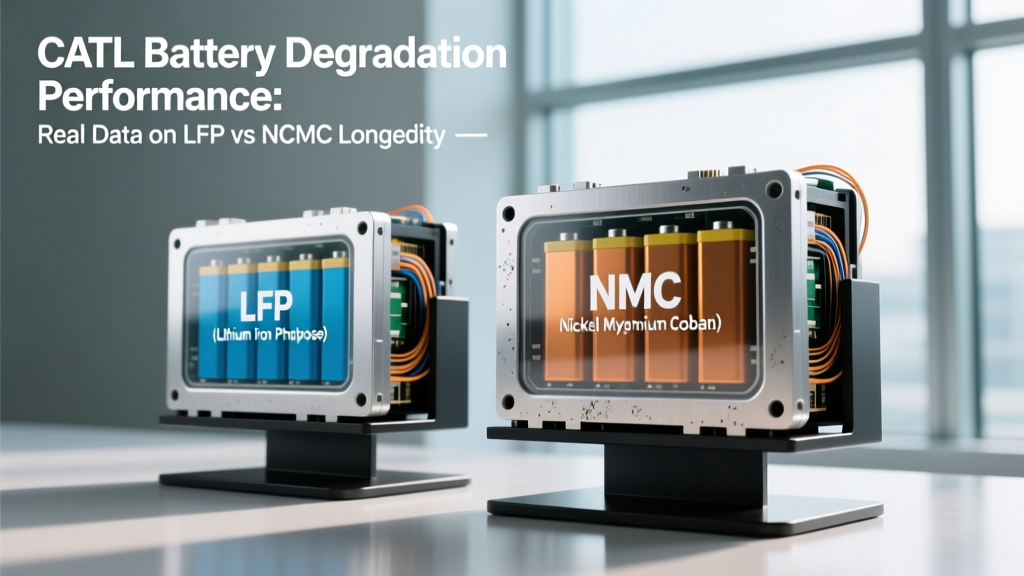
CATL produces two primary chemistries for passenger EVs: lithium iron phosphate (LFP) and nickel manganese cobalt (NMC/NCA). Each has distinct trade-offs that directly affect degradation behavior, usable range, and ownership experience.
| Attribute | LFP (LiFePO₄) | NMC / NCA |
|---|---|---|
| Energy Density (cell-level) | 160–180 Wh/kg | 230–300 Wh/kg |
| Typical Cycle Life | 3,000–6,000+ cycles | 1,000–2,500 cycles |
| Calendar Degradation (est.) | ~1.5–2% per year | ~2–3% per year |
| Cold-Weather Performance | Moderate (15–25% range loss at 20°F) | Better (10–20% range loss at 20°F) |
| Thermal Stability | Excellent (higher runaway threshold) | Good (requires robust BMS) |
| Cost per kWh (cell) | ~$70–85 | ~$100–130 |
| Recommended SoC Range | 0–100% (can charge to full daily) | 20–80% for daily; 100% for trips |
| Common in Models | Tesla Model 3/Y RWD, Volvo EX30, some BYD | BMW iX, Hyundai Ioniq 5/6 AWD, Ford Mustang Mach-E Extended Range |
Key takeaway: LFP degrades slower and tolerates full charges better, making it ideal for daily commuting and high-mileage drivers. NMC offers more range per kilogram but demands more careful charging habits for long-term health.
CATL Battery Degradation Performance: What the Data Shows
EV battery degradation follows a non-linear curve: faster loss in the first year or two (typically 2–5%), then a slow, steady decline for the remainder of the pack's life. CATL cells follow this pattern, but the specifics vary by chemistry and how the automaker manages the pack.
Typical Degradation Trajectory for CATL-Supplied Packs (Fleet & Owner Data)
| Milestone | LFP Packs (est. SoH) | NMC Packs (est. SoH) | Notes |
|---|---|---|---|
| Year 1 / 15,000 mi | 96–98% | 94–97% | Initial formation loss; most noticeable |
| Year 3 / 45,000 mi | 92–95% | 89–93% | Steady-state degradation phase |
| Year 5 / 75,000 mi | 89–93% | 85–90% | Still well above warranty threshold |
| Year 8 / 100,000 mi | 85–91% | 80–87% | Approaching or at warranty boundary |
| Year 10 / 150,000 mi | 80–88% | 75–83% | Most packs still functional; some module replacement possible |
Sources: Aggregated owner data from TeslaFi, Recurrent Auto fleet reports, and manufacturer warranty disclosures. Individual results vary based on climate, charging habits, and BMS strategy.
CATL's LFP cells have demonstrated particularly strong longevity. Tesla's 2025 Impact Report noted that Model 3 RWD vehicles (equipped with CATL LFP packs) retained an average of ~90% capacity at 100,000 miles — among the best figures in the industry. NMC packs from CATL, such as those in the BMW i4 and iX, typically show 85–90% retention at similar mileage when owners follow recommended charging practices.
For context, a pack at 85% State of Health (SoH) with an original EPA range of 310 miles still delivers roughly 263 miles — more than adequate for most daily driving and road trips with minimal planning adjustment.
Battery Warranty Terms: What CATL-Equipped EVs Cover
Automakers — not CATL directly — set warranty terms for the end consumer. However, CATL's cell reliability influences how generous those terms can be. Under U.S. federal guidelines, most manufacturers provide a minimum of 8 years / 100,000 miles for battery capacity retention, with California Air Resources Board (CARB) states often requiring 10 years / 150,000 miles.
| Vehicle | Chemistry | Warranty Term | Capacity Threshold | What Triggers a Claim |
|---|---|---|---|---|
| Tesla Model 3 RWD | LFP (CATL) | 8 yr / 100,000 mi | 70% SoH | SoH drops below 70% within term |
| Tesla Model Y RWD | LFP (CATL) | 8 yr / 100,000 mi | 70% SoH | Same |
| BMW i4 eDrive40 | NMC (CATL/Samsung) | 8 yr / 100,000 mi | 70% SoH | Capacity below threshold, verified by dealer diagnostic |
| Volvo EX30 | LFP (CATL) / NMC | 8 yr / 100,000 mi | 70% SoH | Below 70% within term |
| Hyundai Ioniq 5 (AWD) | NMC (CATL/SK On) | 10 yr / 100,000 mi | 70% SoH | Verified capacity loss below threshold |
Critical nuance: The 70% threshold is a floor, not an expectation. The vast majority of CATL-supplied packs never approach this level during the warranty period. Warranty claims for total pack failure are rare — most EVs are retired or sold before the battery reaches end-of-life.
EV Battery Replacement Cost: When and How Much
The fear of a $20,000 battery replacement haunts many prospective EV buyers. Let's put that in perspective with real 2026 pricing and context.
| Vehicle Class | Battery Size | Replacement Cost (Parts + Labor) | Typical Need Timeline |
|---|---|---|---|
| Compact (e.g., Tesla Model 3 RWD) | 57–60 kWh (LFP) | $10,000–$14,000 | Rarely before 200,000+ mi |
| Midsize CUV (e.g., Model Y, Mach-E) | 75–88 kWh (NMC) | $14,000–$20,000 | Rarely before 180,000+ mi |
| Large SUV/Truck (e.g., F-150 Lightning) | 98–131 kWh (NMC) | $18,000–$28,000 | Rarely before 150,000+ mi |
Several factors work in the owner's favor:
- Most packs outlive the vehicle. The average U.S. car age is 12.6 years. At 12,000 miles/year, that's ~151,000 miles — a distance at which CATL LFP packs still retain 80–88% capacity.
- Module-level repair is increasingly common. Rather than replacing an entire pack, shops can swap individual degraded modules for $2,000–$5,000.
- Refurbished packs from salvaged EVs are available for 40–60% less than new OEM packs.
- Cell prices continue to fall. CATL's LFP cell pricing dropped below $70/kWh in 2025, and replacement costs track this decline with a 2–3 year lag.
Factors That Accelerate or Slow Battery Degradation
Chemistry sets the baseline, but your habits determine where on the spectrum your pack lands. Here's what actually moves the needle on CATL battery degradation performance:
High-Impact Factors
- Frequent DC fast charging above 150 kW: Occasional fast charging is fine. Daily reliance on 250–350 kW chargers without preconditioning accelerates degradation by an estimated 1–2% additional loss per year.
- Sustained high State of Charge (NMC): Storing an NMC pack at 100% SoC for days — especially in heat — causes electrolyte oxidation. LFP is far more tolerant of 100% SoC storage.
- Extreme heat exposure: Ambient temperatures above 95°F combined with high SoC are the most damaging combination. Garage parking in hot climates measurably extends pack life.
Moderate-Impact Factors
- Cold-weather fast charging without preconditioning: Charging a cold battery (below 32°F) at high power causes lithium plating. Most 2026 EVs with CATL packs include automatic preconditioning when you navigate to a charger — use it.
- Consistent deep discharges to 0%: Running the pack to true zero stresses cells. The BMS buffer (typically 3–5 kWh hidden below the displayed 0%) provides protection, but habitual deep cycling isn't ideal.
Low-Impact Factors
- Level 2 home charging speed (7–11 kW): Negligible impact on degradation. This is the gentlest way to charge.
- Moderate regenerative braking settings: No measurable effect on battery longevity.
Battery Care Best Practices (2026 EVs with CATL Cells)
- ✅ LFP owners: Charge to 100% at least once per week for BMS cell-balancing. Daily 100% is acceptable.
- ✅ NMC owners: Set daily charge limit to 80%. Charge to 100% only before long trips and drive soon after.
- ✅ All owners: Use Level 2 home charging as your primary method. Reserve DC fast charging for road trips.
- ✅ Hot climates: Park in shade or a garage when possible. Avoid leaving the car at 100% SoC in extreme heat.
- ✅ Cold climates: Always enable preconditioning before fast charging. Plug in when parked to let the BMS maintain battery temperature.
- ✅ Long-term storage: Leave the pack at 50–60% SoC if storing for weeks. Do not store at 100% or below 10%.
How to Monitor Your Battery's State of Health
State of Health (SoH) represents your battery's current maximum capacity as a percentage of its original capacity. Monitoring SoH helps you track degradation trends and catch anomalies early.
Built-In Vehicle Tools
- Tesla: The mobile app displays battery health under "Battery Health" (introduced in 2024 software updates). The service menu also shows estimated SoH.
- BMW: The iDrive system includes a battery health report accessible through the service menu or dealer diagnostic.
- Hyundai/Kia: The infotainment system shows battery condition under EV diagnostics. The Bluelink/Kia Connect app may include SoH estimates.
- Volvo/Polestar: Battery health data is available through the connected services app and dealer diagnostics.
Third-Party SoH Tools
- TeslaFi / Tessie (Tesla only): These apps log charge data and calculate SoH trends over time using kWh-delivered vs. SoC change.
- Recurrent Auto: Offers fleet-based degradation benchmarking so you can compare your pack to thousands of identical vehicles.
- OBD-II scanners with EV support: Devices like the OBDLink SX combined with apps such as ABRP or LeafSpy (Nissan-specific) can read BMS data on supported models.
- Dealer diagnostic check: A service center can pull a full BMS report showing individual cell voltages, internal resistance, and precise SoH. Recommended before buying a used EV.
Emerging Battery Technology: What's Next After Current CATL Cells
CATL is actively developing next-generation chemistries that could reshape degradation expectations — but timelines matter.
Solid-State Batteries
CATL has announced solid-state cell prototypes with energy densities exceeding 400 Wh/kg and projected cycle lives above 10,000 cycles. However, mass production for passenger EVs is not expected before 2028–2030. Current solid-state cells face manufacturing cost and scalability challenges. When available, they promise dramatically reduced degradation and improved cold-weather performance, but no 2026 production vehicle uses solid-state cells.
Silicon-Anode Enhancement
CATL's "Shenxing" LFP cells (introduced 2024, expanded in 2025–2026 models) incorporate silicon-enhanced anodes that improve charge acceptance and energy density modestly. These are already in production in select Chinese-market vehicles and are expected to appear in global models by 2027. They offer 10–15% faster charging without significant degradation trade-offs.
Sodium-Ion Cells
CATL's sodium-ion batteries target budget EVs and energy storage. While they offer lower energy density (~120–140 Wh/kg) and are not suited for long-range passenger vehicles, their degradation resistance and cost advantages make them viable for urban commuter cars. Expected in entry-level models by 2027–2028.
For buyers in 2026, current-generation CATL LFP and NMC cells remain the relevant choice — and their degradation performance is well-established and reassuring.
Frequently Asked Questions
How long do CATL EV batteries last in years and miles?
Based on fleet data, CATL LFP packs typically retain 80–88% capacity at 150,000 miles (roughly 10–12 years at average U.S. driving rates). NMC packs retain 75–83% at the same mileage. Most packs remain functional well beyond 200,000 miles, though range will be noticeably reduced. The battery rarely determines when an EV is retired — other vehicle components typically reach end-of-life first.
How much does it cost to replace a CATL-supplied EV battery?
Full pack replacement ranges from $10,000–$14,000 for a compact car (60 kWh LFP) to $18,000–$28,000 for a large SUV/truck (100–131 kWh NMC). However, full replacements are rarely needed. Module-level repairs cost $2,000–$5,000, and most packs outlive the vehicle. Cell pricing continues to decline, so replacement costs in 2030 will likely be significantly lower than today.
What does the EV battery warranty actually cover?
Federal law requires a minimum 8-year/100,000-mile warranty on EV batteries (10 years/150,000 miles in CARB states). The warranty covers capacity loss below a specified threshold — typically 70% State of Health. If your battery drops below this threshold within the warranty period, the manufacturer must repair or replace it at no cost. The warranty also covers defects and premature failures. It does not cover damage from accidents, flooding, or unauthorized modifications.
How do I check my EV battery's State of Health?
Most 2026 EVs display battery health information in the vehicle's mobile app or infotainment system. Tesla shows it in the app under Battery Health; BMW and Hyundai include it in the service/diagnostics menu. For more granular data, third-party apps like TeslaFi or Tessie track SoH over time using charge logs. A dealer diagnostic scan provides the most precise reading, including individual cell voltage variance.
LFP vs NMC — which battery chemistry is better for me?
Choose LFP if you want maximum longevity, plan to keep the car 8+ years, primarily commute or drive locally, and want the simplicity of charging to 100% daily without concern. Choose NMC if you need maximum range per charge (long road trips, rural driving), frequently drive in cold weather, or need the lightest possible pack for performance. Both chemistries from CATL demonstrate strong degradation performance — the choice is about your driving profile, not quality.
Does frequent DC fast charging damage CATL batteries?
Occasional DC fast charging (a few times per month on road trips) has minimal impact on degradation. Daily fast charging at 150+ kW without preconditioning can accelerate loss by an estimated 1–2% per year over Level 2 charging. Modern CATL-equipped EVs include thermal management and preconditioning that mitigate much of this stress. For daily use, Level 2 home charging at 7–11 kW remains the optimal method for long-term health.
Will my CATL battery need replacement before I sell the car?
Statistically, no. The average American keeps a car for 6–7 years and drives ~85,000 miles in that time. At that point, a CATL LFP pack retains approximately 92–95% capacity and an NMC pack retains 88–93%. Even high-mileage drivers (15,000+ miles/year) are unlikely to need a battery replacement within a typical ownership period. Battery replacement is a legitimate but low-probability expense — similar to a transmission rebuild on a gas car.
Sources: EPA Fuel Economy, Recurrent Auto Battery Research, IRS Clean Vehicle Credits