Why California's Climate Makes EV Battery Health a Unique Conversation
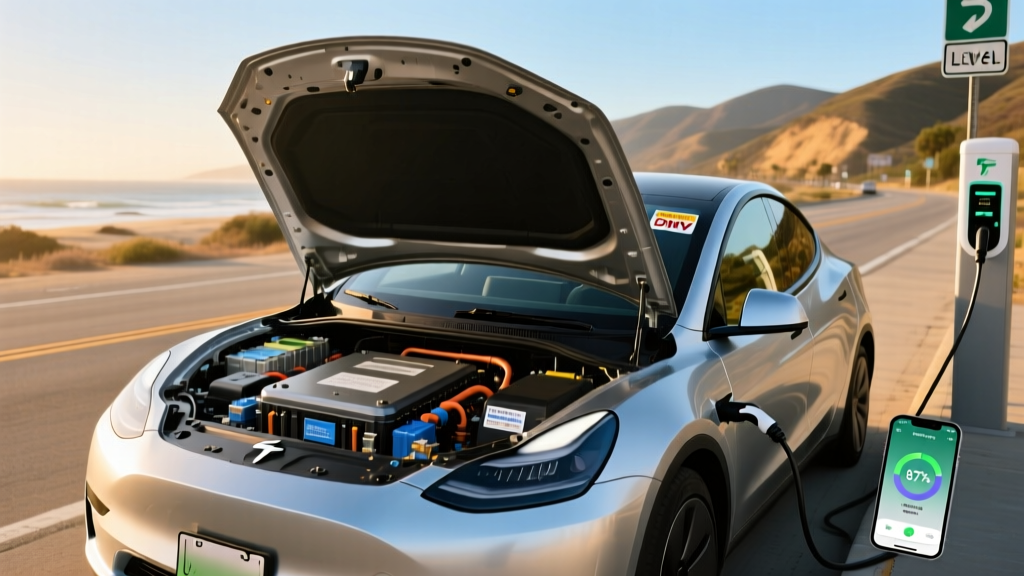
California leads the U.S. in EV adoption, with over 2 million battery-electric vehicles registered statewide as of early 2026. But the Golden State's climate — scorching Central Valley summers, coastal humidity swings, and high-altitude mountain routes — places distinct thermal demands on lithium-ion traction batteries that owners in cooler regions rarely face.
Heat is the primary enemy of long-term battery health. Ambient temperatures regularly exceeding 95°F (35°C) in places like Bakersfield, Fresno, and the Inland Empire accelerate electrolyte decomposition and increase solid-electrolyte interphase (SEI) layer growth inside cells. The result? Slightly faster capacity loss compared to identical vehicles in temperate climates.
This guide covers what California EV owners — and anyone shopping in the state — need to know about battery chemistry, real-world degradation, warranty protection, replacement costs, and daily habits that extend pack life.
LFP vs NMC/NCA: Choosing the Right Chemistry for California Driving
Two dominant cathode chemistries power today's EVs: LFP (lithium iron phosphate) and NMC/NCA (nickel manganese cobalt / nickel cobalt aluminum). Each carries distinct trade-offs that matter more in a hot climate.
| Attribute | LFP (LiFePO₄) | NMC / NCA |
|---|---|---|
| Energy density | ~160–180 Wh/kg (lower) | ~220–300 Wh/kg (higher) |
| Cycle life | 3,000–5,000+ cycles | 1,000–2,000 cycles |
| Thermal stability | Excellent — resists thermal runaway to ~270°C | Good — onset ~210°C; requires robust BMS |
| Cold-weather range loss | Greater (~30–40% below freezing) | Moderate (~20–30% below freezing) |
| Cost per kWh | Lower (~$85–100/kWh pack-level, 2026) | Higher (~$110–135/kWh pack-level, 2026) |
| Recommended SoC ceiling | 100% daily OK | 80% daily; 100% for trips only |
| Typical applications | Tesla Model 3/Y RWD, base Ford Mustang Mach-E, BYD models | Long-range & performance trims, Lucid, Rivian, Hyundai Ioniq 5 LR |
California relevance: LFP's superior thermal stability is a genuine advantage in hot inland valleys. Its longer cycle life also means less degradation from frequent DC fast charging along I-5 or US-101 corridors. The trade-off — lower energy density — matters less in a state with dense charging infrastructure.
How Long Do EV Batteries Actually Last? Real Degradation Data
Most modern EV batteries outlast the vehicles they power. Data aggregated from fleet operators, owner surveys, and manufacturer reports shows a consistent pattern:
Typical capacity retention trajectory (NMC, liquid-cooled, moderate climate):
- Year 1 / 15,000 mi: ~97–98% State of Health (SoH)
- Year 3 / 45,000 mi: ~93–95% SoH
- Year 5 / 75,000 mi: ~90–92% SoH
- Year 8 / 120,000 mi: ~85–88% SoH
- Year 10 / 150,000 mi: ~80–85% SoH (varies significantly by use pattern)
Sources: Geotab fleet battery study, Tesla Impact Reports, Recurrent Auto battery data.
California heat penalty: Vehicles regularly parked outdoors in 100°F+ environments without garage shade may see an additional 2–4% capacity loss over 8 years compared to garage-kept equivalents. Tesla's Model 3 fleet data shows vehicles in hot climates averaging ~12% degradation at 100,000 miles versus ~10% in temperate zones.
The degradation curve is not linear. Most packs lose 2–3% in the first year (initial SEI formation), then settle into a slow, roughly 0.5–1% annual decline. Sudden drops are rare and typically indicate a manufacturing defect covered under warranty.
What Does the Battery Warranty Cover — and What Does California Require?
Federal law mandates a minimum 8-year / 100,000-mile battery warranty for EVs. California, as a CARB (California Air Resources Board) state, enforces stricter requirements under its Advanced Clean Cars II regulations.
| Requirement | Federal Minimum | California (CARB State) |
|---|---|---|
| Duration | 8 years / 100,000 mi | 10 years / 150,000 mi (PZEV/TZEV standards) |
| Capacity retention threshold | Typically 70% of original | Typically 70% of original |
| What triggers a claim | Battery drops below threshold | Battery drops below threshold |
| Coverage scope | Defects + capacity loss | Defects + capacity loss |
| Transferable to second owner | Usually yes | Usually yes |
Key 2026 manufacturer warranty snapshots:
- Tesla Model 3/Y (LFP RWD): 8 yr / 100,000 mi, 70% retention
- Tesla Model 3/Y (Long Range/Performance): 8 yr / 120,000 mi, 70% retention
- Hyundai Ioniq 5/6: 10 yr / 100,000 mi (California: 10 yr / 150,000 mi), 70% retention
- Ford Mustang Mach-E: 8 yr / 100,000 mi, 70% retention
- Rivian R1T/R1S: 8 yr / 175,000 mi, 70% retention
- BMW i4/iX: 8 yr / 100,000 mi, 70% retention
The 70% threshold means a vehicle originally rated at 310 miles EPA range would need to drop below ~217 miles of usable range before a warranty claim is valid. In practice, very few modern liquid-cooled packs fall this far within the warranty period under normal use.
EV Battery Replacement Costs: What California Owners Should Budget
Full traction battery replacement remains uncommon within the first 10–12 years of ownership. When it is needed — typically due to physical damage, coolant intrusion, or rare cell-group failure — costs vary significantly by pack size and chemistry.
| Vehicle (2025–2026) | Pack Size (usable kWh) | Chemistry | Replacement Cost Range |
|---|---|---|---|
| Tesla Model 3 RWD | 57.5 kWh | LFP | $7,000–$10,000 |
| Tesla Model Y Long Range | 78.1 kWh | NMC | $12,000–$16,000 |
| Hyundai Ioniq 5 Long Range | 77.4 kWh | NMC | $11,000–$15,000 |
| Ford F-150 Lightning Ext. Range | 131 kWh | NMC | $18,000–$25,000 |
| Chevrolet Equinox EV | 85 kWh | NMC | $10,000–$14,000 |
| Rivian R1T Dual-Motor Max | 141 kWh | NMC | $20,000–$28,000 |
Important context: These figures represent out-of-warranty, full-pack replacement including labor. Module-level repair (replacing individual cell groups rather than the entire pack) is increasingly available from independent EV shops in California for 40–60% less than full-pack cost. Brands like Tesla and Hyundai have moved toward modular pack designs that make partial replacement more feasible.
For perspective, the average California driver covers ~13,500 miles annually. A battery lasting 150,000 miles serves roughly 11 years — at which point the vehicle's residual value is typically $5,000–$12,000 regardless of battery condition. Most EV batteries are recycled or repurposed for stationary storage before the vehicle is scrapped.
Factors That Accelerate (or Preserve) Battery Life in California
Understanding degradation drivers helps owners make informed daily choices.
Heat Exposure
Consistent exposure to ambient temperatures above 95°F degrades electrolyte faster. Parking in shade or a garage reduces pack temperature by 10–20°F. Vehicles with active thermal management (liquid cooling) handle this far better than older passive-cooled packs (early Nissan Leaf, early BMW i3).
DC Fast-Charging Frequency
High-power DC charging (150–350 kW) generates internal cell heat. Occasional use is fine — Tesla's Supercharger fleet data shows no significant difference between frequent Supercharger users and home-charger-only users at 100,000 miles. But daily 350 kW sessions in 105°F heat, combined with high state of charge, compounds stress.
State of Charge Habits
For NMC/NCA batteries, the sweet spot is 20–80% daily SoC. Storing a vehicle at 100% SoC in 110°F heat for days accelerates degradation measurably. LFP batteries tolerate 100% daily charging better — Tesla recommends periodic 100% charges for LFP calibration.
Charge Rate at Home
Level 2 home charging at 7–11 kW (240V, 32–48A) generates minimal heat and is ideal for battery longevity. Level 1 (120V) is even gentler but impractically slow for most daily needs.
California Battery Care Checklist:
- Park in shade or garage when possible, especially summer afternoons
- Set NMC charge limit to 80% for daily driving; 100% only before long trips
- LFP owners: charge to 100% at least weekly for BMS calibration
- Precondition battery before DC fast charging (most EVs do this automatically when a charger is set as navigation destination)
- Avoid leaving vehicle at 100% SoC in extreme heat for extended periods
- Use scheduled charging to finish charging just before departure (avoids sitting at high SoC)
- Check coolant levels per service schedule — thermal management fluid degrades over time
Monitoring Battery Health: How to Check Your State of Health
State of Health (SoH) represents the battery's current maximum capacity as a percentage of its original capacity. Monitoring it helps you track degradation and plan for warranty claims if needed.
Built-in vehicle displays:
- Tesla: Service mode (accessible via the software menu in 2025+ updates) shows nominal full-pack kWh and SoH percentage
- Hyundai/Kia: The EV battery health screen in infotainment shows SoH as a percentage
- Ford: Available through the FordPass app and dealer diagnostic tools
- BMW: iDrive system shows estimated range vs. original; dealer can pull exact SoH
Third-party tools:
- OBD-II dongles + apps: Devices like the OBDLink SX paired with apps such as ABRP (A Better Route Planner) or Leaf Spy (Nissan) can read battery management system data directly
- Recurrent Auto: A free service that tracks your battery health over time using connected-car data and provides a degradation report
- Dealer diagnostic: Any authorized service center can perform a full battery health check, typically free during scheduled maintenance
Track SoH quarterly. If you notice a sudden drop (more than 2–3% in a single month), schedule a diagnostic — this may indicate a cell imbalance or cooling system issue covered under warranty.
Emerging Battery Tech: What's on the Horizon for California Drivers
Several next-generation technologies are in development, though none are commercially available in consumer EVs as of 2026.
Solid-state batteries: Replace liquid electrolyte with a solid ceramic or polymer separator, promising higher energy density (~400–500 Wh/kg), faster charging, and improved thermal safety. Toyota has announced a solid-state battery targeting 2027–2028 production vehicles, initially in limited volumes. Samsung SDI and QuantumScape are also in advanced testing. Realistic mass-market availability: 2029–2032.
Silicon-dominant anodes: Replacing graphite anodes with silicon can boost energy density 20–40%. Companies like Sila Nanotechnologies and Group14 are supplying early production cells. Expect incremental adoption in 2026–2028 model-year premium vehicles.
Sodium-ion batteries: CATL and BYD are producing sodium-ion cells for lower-cost, shorter-range urban EVs. Energy density is lower (~120–150 Wh/kg), but raw materials are abundant and cheap. Unlikely to appear in U.S.-market vehicles before 2028.
These technologies are forward-looking. For buyers shopping today, current LFP and NMC packs from major manufacturers have proven durable enough that battery replacement within the first decade of ownership is statistically uncommon.
Frequently Asked Questions
How long do EV batteries last in years and miles?
Most modern liquid-cooled EV batteries retain 80–88% of original capacity at 8 years / 120,000 miles. With proper care, reaching 150,000–200,000 miles with 75%+ capacity is common. Many packs will outlast the vehicle itself.
How much does an EV battery cost to replace in 2026?
Full pack replacement ranges from ~$7,000 for a compact LFP pack (Tesla Model 3 RWD) to ~$25,000+ for large packs (F-150 Lightning, Rivian Max). Module-level repair can reduce cost by 40–60%. Most owners never need a replacement under normal ownership timelines.
What does the EV battery warranty actually cover?
Battery warranties cover capacity loss below a defined threshold (typically 70% of original capacity) and manufacturing defects. In California (a CARB state), the minimum is 10 years / 150,000 miles for many models. The warranty does not cover damage from accidents, flooding, or unauthorized modifications.
How do I check my EV battery's health?
Most modern EVs display State of Health (SoH) in the infotainment system or through a connected app. Third-party services like Recurrent Auto offer free tracking. Dealers can run full diagnostics during service visits.
LFP vs NMC — which battery chemistry is better for California?
LFP offers superior thermal stability, longer cycle life, and lower cost — advantages that matter in California's heat. NMC provides higher energy density for longer range and better cold-weather performance. For daily commuting in hot inland areas, LFP is the stronger choice. For long-range road trips and mountain driving, NMC's density advantage is worthwhile.
Does frequent DC fast charging damage my battery?
Modern thermal management systems mitigate most fast-charging stress. Tesla fleet data shows negligible difference between frequent Supercharger users and home-charging-only users at 100,000 miles. Preconditioning (automatic when navigating to a charger) further reduces heat. Occasional DC fast charging is not a concern; daily 350 kW sessions in extreme heat may slightly accelerate degradation.
Will my EV battery need replacement before the car is retired?
Statistically, no. Data from Geotab, Recurrent, and manufacturer reports show that fewer than 1–2% of modern EV batteries require full replacement within the warranty period. Most packs retain sufficient capacity for the vehicle's entire usable life.