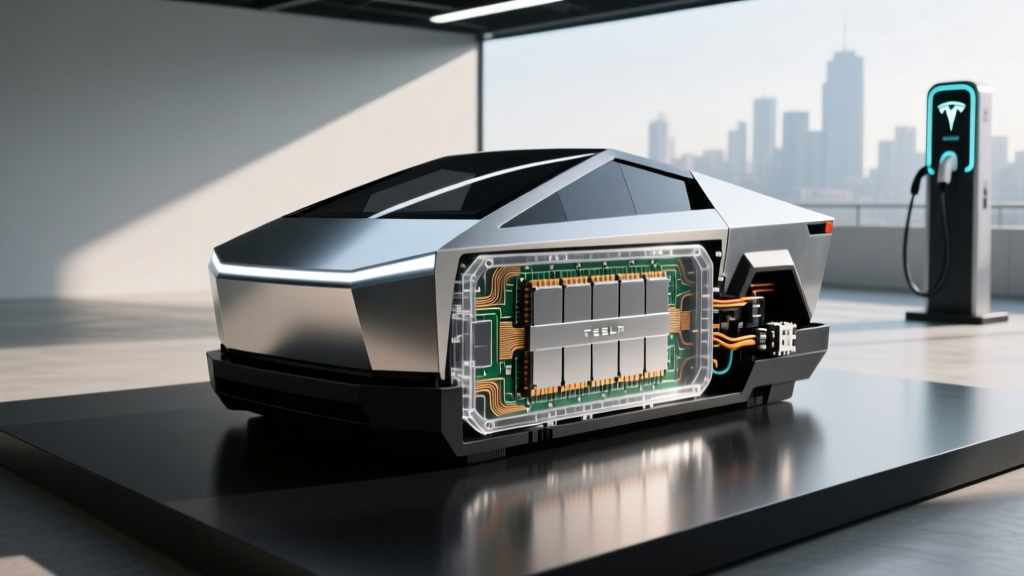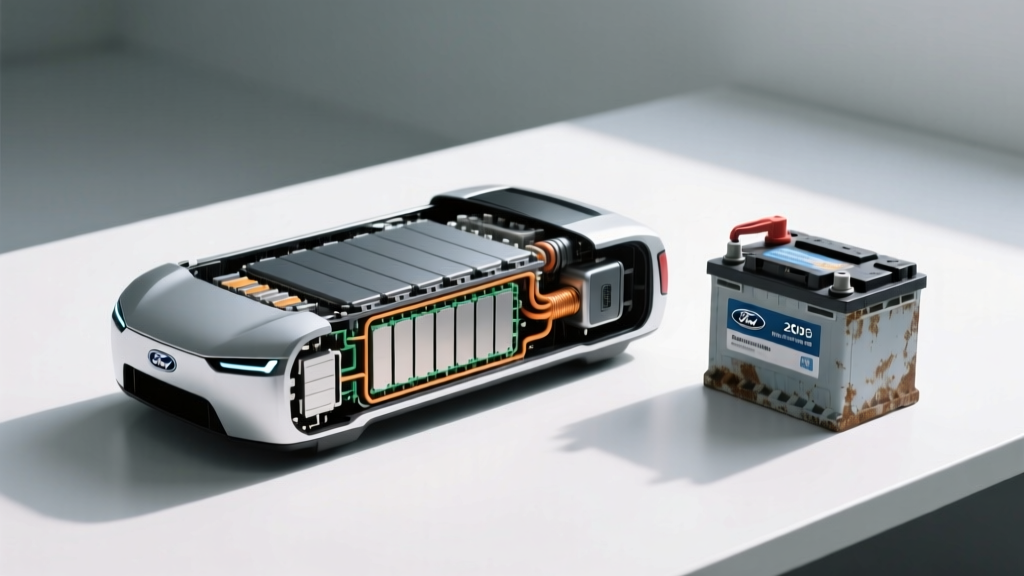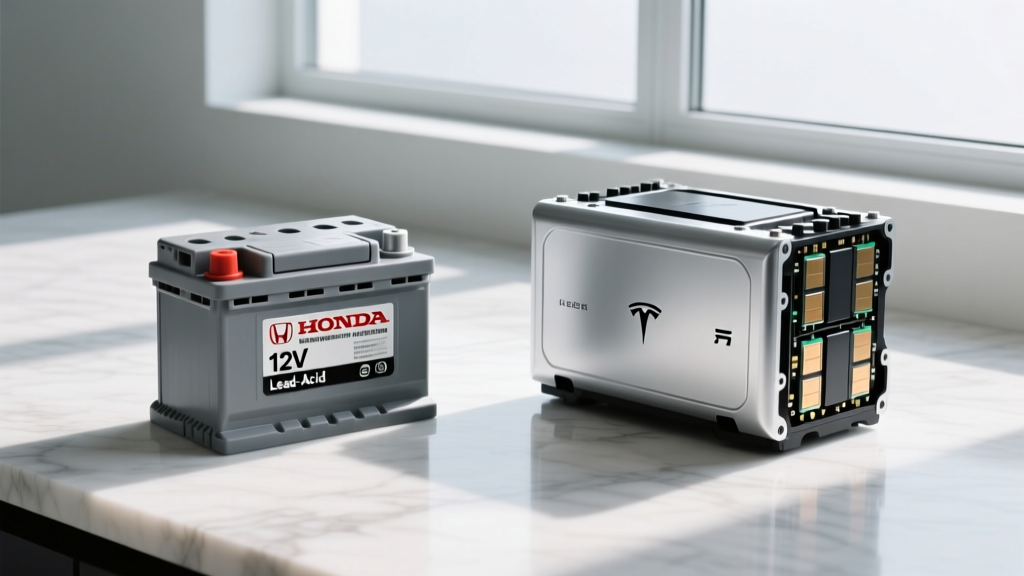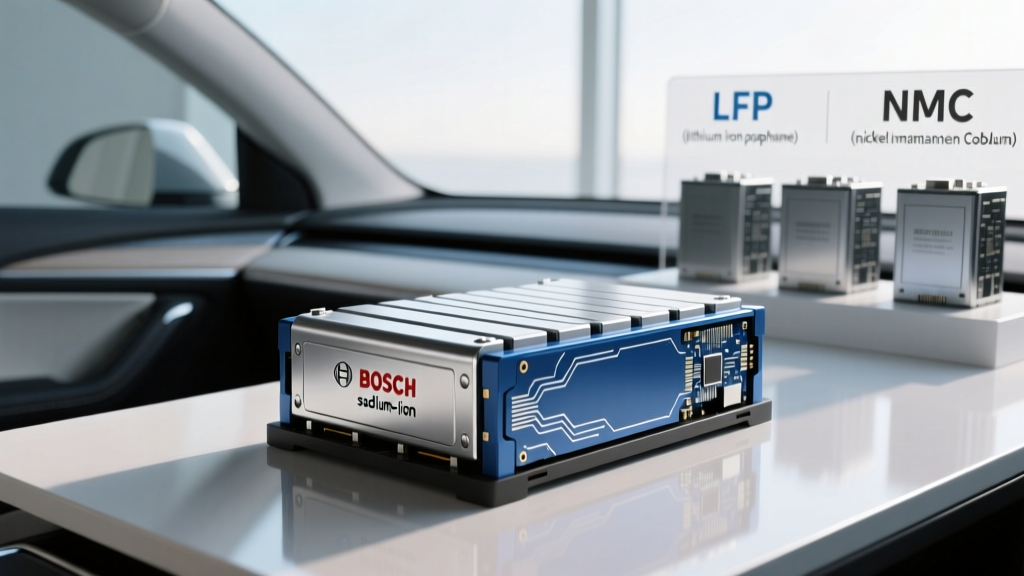
The electric vehicle battery landscape is shifting fast. While most EVs on the road today run on lithium-ion cells—either NMC (nickel manganese cobalt) or LFP (lithium iron phosphate)—a new challenger is emerging from the supply chain: sodium-ion. Bosch, the German engineering giant and one of the world's largest automotive suppliers, has been investing heavily in sodium-ion battery R&D, positioning the chemistry as a lower-cost, resource-secure alternative for next-generation EVs. But how does the Bosch sodium-ion battery stack up against the chemistries powering the EVs you can buy today?
This guide breaks down every major EV battery chemistry on the market and on the horizon, with hard numbers on degradation, warranty coverage, replacement costs, and the daily habits that determine how long your pack actually lasts. Whether you're shopping now or planning your next purchase, understanding what's inside the battery case is the single most important factor in long-term EV ownership.
EV Battery Chemistries Explained: NMC, LFP, and Sodium-Ion
Before comparing the Bosch sodium-ion battery to current options, it helps to understand what each chemistry actually trades off. Every EV battery is a compromise across four axes: energy density (how much range you get per kilogram), cycle life (how many charge-discharge cycles before significant degradation), cold-weather performance, and cost per kWh.
NMC / NCA (Nickel-based lithium-ion): Used in most long-range EVs—Tesla Model 3/Y Long Range, Hyundai Ioniq 5, Ford Mustang Mach-E Extended Range. These cells offer the highest energy density (roughly 250–300 Wh/kg at the cell level), enabling 300+ mile EPA ranges without excessive weight. The trade-off is higher cost, reliance on cobalt and nickel (supply-chain and ethical concerns), and a somewhat shorter cycle life compared to LFP. NCA (nickel cobalt aluminum), used by Tesla/Panasonic, is a close variant with similar characteristics.
LFP (Lithium Iron Phosphate): Found in the Tesla Model 3 RWD, standard-range BYD models, and the Ford F-150 Lightning standard-range. LFP sacrifices some energy density (~160–200 Wh/kg) but gains dramatically in cycle life (3,000–5,000+ cycles vs. ~1,000–2,000 for NMC), thermal stability (far less prone to thermal runaway), and cost. LFP also tolerates being held at 100% state of charge without accelerated degradation—a major practical advantage for daily drivers who want full range available every morning. The downsides: reduced range for a given pack weight, and poorer performance in sub-freezing temperatures without aggressive preconditioning.
Sodium-Ion (Na-ion): The newcomer. Sodium-ion cells replace lithium with sodium—a vastly more abundant, cheaper element (sodium carbonate costs a fraction of lithium carbonate). Bosch has been developing sodium-ion technology through partnerships and its venture arm, targeting applications where cost and resource security outweigh the need for maximum energy density. CATL began shipping first-generation sodium-ion packs in Chinese-market EVs in 2024–2025, and Bosch's roadmap positions it as a Tier 1 supplier for European and potentially North American OEMs looking to diversify away from lithium dependence.
| Attribute | NMC / NCA | LFP | Sodium-Ion (Bosch / CATL gen) |
|---|---|---|---|
| Cell energy density | 250–300 Wh/kg | 160–200 Wh/kg | 120–160 Wh/kg (1st gen); 160–200 targeted |
| Cycle life (to 80% SoH) | 1,000–2,000 | 3,000–5,000+ | 2,000–4,000 (projected, early data) |
| Cost per kWh (cell) | ~$100–$130 | ~$70–$95 | ~$50–$70 (projected at scale) |
| Cold performance (-10°C capacity retention) | ~75–85% | ~60–75% | ~80–90% (lab data, promising) |
| Thermal stability | Moderate (requires BMS safeguards) | Excellent | Excellent (inherently stable) |
| 100% SoC daily charging | Not recommended (accelerates degradation) | Recommended by OEMs | Tolerant (similar to LFP) |
| Key raw materials | Lithium, nickel, cobalt, manganese | Lithium, iron, phosphate | Sodium, iron, manganese (no lithium, no cobalt) |
| Current EV availability (US, 2026) | Widely available | Widely available | Not yet in US-market vehicles |
How Long Do EV Batteries Actually Last?
The short answer: almost certainly longer than you think, and longer than most owners keep the car. Real-world fleet data has consistently shown that modern EV battery packs degrade far more slowly than early skepticism predicted.
According to long-term fleet data from Tesla's impact reports and independent analysis by researchers like Geotab, the average EV battery loses approximately 1.5% to 2.5% of capacity per year under normal use. That means after 8 years, most packs retain between 80% and 90% of their original capacity. LFP packs tend to sit at the higher end of that range; NMC packs at the lower end, though still well within warranty thresholds.
Typical Degradation Curve (Illustrative, based on fleet averages):
- Year 1: ~2–3% loss (initial "break-in" drop, common across chemistries)
- Years 2–5: ~1–2% per year (linear, gradual phase)
- Years 6–10: ~1–1.5% per year (degradation rate often slows as the pack stabilizes)
- Year 10 projected SoH: ~82–90% depending on chemistry, climate, and charging habits
A Tesla Model 3 Long Range (NMC, 82 kWh usable) with 2% annual loss would retain roughly 83% after 10 years—still delivering about 257 miles of its original 310-mile EPA range. An LFP-equipped Model 3 RWD (60 kWh) with 1.5% annual loss would hold ~86%, translating to roughly 232 of its original 272 EPA miles.
Critically, catastrophic battery failure is rare. Most out-of-warranty issues involve individual module or cell imbalances that can sometimes be addressed without a full pack replacement. Data from fueleconomy.gov and warranty claim rates suggest fewer than 1–2% of EV battery packs require full replacement under normal ownership.
EV Battery Warranty Terms: What's Actually Covered
Federal law mandates that EV batteries carry a minimum warranty of 8 years / 100,000 miles (10 years / 150,000 miles in CARB states like California, New York, and others that follow California emissions standards). Most major automakers meet or exceed this baseline. The key metric is the capacity retention threshold—the point at which the manufacturer considers the battery "degraded" enough to warrant repair or replacement.
| Manufacturer | Warranty Term | Capacity Retention Threshold | Notes |
|---|---|---|---|
| Tesla (Model 3/Y NMC) | 8 yr / 120,000 mi | 70% | Long Range & Performance trims |
| Tesla (Model 3 RWD, LFP) | 8 yr / 100,000 mi | 70% | LFP packs, standard range |
| Hyundai / Kia | 10 yr / 100,000 mi | 70% | Among the longest terms |
| Ford (F-150 Lightning, Mach-E) | 8 yr / 100,000 mi | 70% | Covers battery & hybrid/electric components |
| GM (Ultium platform) | 8 yr / 100,000 mi | 70% | Covers capacity loss and defects |
| Volkswagen (ID.4) | 8 yr / 100,000 mi | 70% | Net usable capacity guarantee |
| BMW (i4, iX) | 8 yr / 100,000 mi | 70% | Includes battery management system |
The 70% threshold is industry standard. If your 82 kWh pack degrades to below 57.4 kWh of usable capacity within the warranty period, the manufacturer is obligated to repair, replace, or (in some cases) provide a prorated credit. In practice, very few packs hit this threshold within the warranty window based on current degradation data.
How Much Does an EV Battery Replacement Cost?
This is the question that generates the most anxiety—and the most misinformation. Let's anchor the discussion in reality: the vast majority of EV batteries will never need a full replacement during typical ownership. But if one does, here's what the numbers look like in 2026.
| Vehicle / Pack Size | Chemistry | Battery Capacity | Estimated Replacement Cost |
|---|---|---|---|
| Tesla Model 3 RWD | LFP | 60 kWh | $8,000 – $12,000 |
| Tesla Model 3/Y Long Range | NMC | 82 kWh | $12,000 – $16,000 |
| Hyundai Ioniq 5 | NMC | 77.4 kWh | $11,000 – $15,000 |
| Ford F-150 Lightning Ext. Range | NMC | 131 kWh | $18,000 – $25,000 |
| Chevrolet Equinox EV | NMC (Ultium) | 85 kWh | $12,000 – $17,000 |
| Nissan Leaf (40 kWh pack) | NMC (older gen) | 40 kWh | $6,500 – $9,000 |
These costs have been declining steadily. In 2015, replacement packs could exceed $30,000 for large-capacity vehicles. By 2026, cell-level pricing has dropped to roughly $100–$130/kWh for NMC and $70–$95/kWh for LFP, with total pack replacement costs (including labor, BMS, and diagnostics) running roughly 1.5x to 2x the raw cell cost.
This is precisely where the Bosch sodium-ion battery value proposition becomes compelling. At a projected $50–$70/kWh at the cell level, a sodium-ion pack could eventually bring replacement costs down to $5,000–$8,000 for a mid-size EV—making long-term ownership economics even more favorable. However, sodium-ion packs are not yet available in US-market vehicles as of 2026, and Bosch has not announced a specific production timeline for North American OEM integration.
What Kills an EV Battery? Factors That Accelerate Degradation
Not all miles and charge cycles are created equal. Research from the National Renewable Energy Laboratory (NREL) and fleet data from companies like Geotab have identified several behaviors and conditions that measurably accelerate battery wear:
Battery Longevity: What Hurts and What Helps
- Frequent DC fast charging (150+ kW): Regularly relying on high-power DCFC generates sustained heat in the cells. Occasional road-trip fast charging is fine, but daily fast-charging can add 0.5–1% extra annual degradation compared to Level 2 home charging.
- Sustained high state of charge (NMC/NCA only): Storing an NMC pack at 100% SoC for extended periods accelerates electrolyte breakdown. LFP packs don't have this problem—OEMs like Tesla recommend charging LFP to 100% at least weekly.
- Deep discharges below 10%: Running the pack to near-zero stresses the anode. Most BMS systems include a buffer (typically 2–5 kWh below the displayed 0%), but habitually draining below 10% displayed SoC is still suboptimal.
- Extreme heat exposure: Parking in sustained 100°F+ ambient temperatures without thermal management active is more damaging than extreme cold. Battery thermal management systems mitigate this, but packs left idle in hot climates with low SoC can suffer calendar aging.
- Extreme cold charging without preconditioning: Attempting to fast-charge a cold-soaked battery forces lithium plating on the anode—a permanent, irreversible capacity loss mechanism. Always precondition before DCFC in winter.
Best Practices for Maximizing Battery Life
- For NMC/NCA: Set daily charge limit to 80%. Charge to 100% only when needed for a long trip, and try to depart shortly after reaching full charge rather than sitting at 100%.
- For LFP: Charge to 100% at least once a week as recommended. The BMS needs full-charge events to accurately calibrate cell balancing.
- Use Level 2 home charging (7–11 kW) as your primary method. It's gentler on the pack and far cheaper than public DCFC.
- In winter, always precondition the battery before fast charging—either via the vehicle's navigation-to-charger feature or by initiating preconditioning manually 15–30 minutes before plugging in.
- Keep the pack between roughly 20% and 80% SoC for daily use (NMC/NCA). The "middle 60%" is the sweet spot for minimizing stress.
How to Check Your EV's Battery Health (State of Health)
State of Health (SoH) is the metric that tells you how much of your battery's original capacity remains. A new pack is 100% SoH; a pack that can now hold only 85% of its original kWh is at 85% SoH. Here's how to monitor it:
In-vehicle displays: Some manufacturers (notably Tesla, Hyundai/Kia, and BMW) provide a battery health indicator in the service menu or app. Tesla's service mode (accessible via a hidden menu) shows a "Battery Health" percentage. Hyundai's Bluelink app provides a battery condition readout on newer models.
OBD-II diagnostic tools: Third-party tools like the OBD Eleven (for VW/Audi/Porsche), Leaf Spy (for Nissan Leaf), or Scan My Tesla (with an OBD adapter) can read the BMS-reported SoH directly. These tools pull the same data the dealership diagnostic computer sees.
Manual calculation: Charge to a known SoC (ideally 100% for LFP, or a calibrated 90% for NMC), note the displayed estimated range, and compare to the EPA-rated range at the same SoC when new. This is approximate—ambient temperature and recent driving style affect the estimate—but it gives a rough SoH trend over time.
Dealership diagnostic check: If you suspect abnormal degradation (e.g., range dropping faster than ~2% per year), a dealership can perform a full capacity test that discharges and recharges the pack under controlled conditions. This is typically covered under warranty if a defect is found.
Bosch Sodium-Ion Battery: Where It Fits in the EV Future
Bosch's sodium-ion battery development sits within a broader industry push to reduce dependence on lithium, cobalt, and nickel—all of which face supply-chain bottlenecks and geopolitical risk. Sodium is the sixth most abundant element in the Earth's crust, extractable from soda ash at a fraction of lithium's cost.
What we know about the Bosch sodium-ion battery program as of 2026:
- Bosch has invested in sodium-ion cell development through its venture arm and partnerships, targeting 160+ Wh/kg energy density in next-generation cells (up from ~140 Wh/kg in early CATL first-gen cells).
- The chemistry shows superior cold-weather performance in lab testing—retaining roughly 80–90% capacity at -10°C compared to 60–75% for LFP. This is a significant advantage for northern-climate EV adoption.
- Sodium-ion cells can be manufactured on existing lithium-ion production lines with minimal retooling, easing the transition for battery gigafactories.
- The most likely initial applications are urban/compact EVs, entry-level models, and stationary energy storage—segments where cost matters more than maximum range.
What it won't do: Sodium-ion will not replace NMC in long-range, performance-oriented EVs anytime soon. The energy density gap (~160 Wh/kg vs. ~280 Wh/kg) means a sodium-ion pack would need to be roughly 75% heavier to deliver the same range as a comparable NMC pack. For a 300-mile SUV, that's impractical. For a 150–200-mile city car, it's a compelling cost savings.
Realistic timeline: Industry analysts project sodium-ion cells reaching meaningful volume in European and Chinese EVs by 2027–2028, with US-market vehicles potentially following by 2029–2030 depending on OEM adoption and IRS §30D tax credit battery-sourcing implications (sodium-ion's lack of critical minerals could complicate or simplify eligibility depending on how sourcing rules evolve).
Emerging Battery Technologies Beyond Sodium-Ion
Sodium-ion isn't the only next-generation technology in development. Here's a realistic assessment of other chemistries on the horizon:
Solid-state batteries: The long-promised technology that replaces the liquid electrolyte with a solid conductor, enabling lithium-metal anodes and potentially 400+ Wh/kg energy density. Toyota has announced a solid-state battery targeting 2027–2028 production in limited volumes. Samsung SDI and QuantumScape are also in advanced testing. However, manufacturing scalability remains the bottleneck—every solid-state announcement in the past decade has been "3–5 years away," and 2028–2030 is the earliest realistic date for meaningful consumer availability at scale.
Silicon-dominant anodes: Companies like Sila Nanotechnologies and Group14 are replacing graphite anodes with silicon-based composites, boosting energy density by 20–40% without changing the cathode chemistry. Mercedes-Benz's upcoming G-Class EV (announced for 2025–2026) uses Sila's silicon anode cells. This is the nearest-term energy density improvement likely to reach production vehicles.
Lithium-sulfur (Li-S): Offers theoretical energy density of 500+ Wh/kg but suffers from rapid cycle-life degradation (the "polysulfide shuttle" problem). Remains a research-stage technology with no announced production timeline for automotive use.
None of these technologies are currently available in production EVs, and all face significant manufacturing and cost hurdles before reaching scale. For buyers shopping today, NMC and LFP remain the proven, data-backed choices—with LFP increasingly favored for cost-conscious and high-longevity applications.
Frequently Asked Questions
How long do EV batteries last in years and miles?
Based on fleet data, most modern EV batteries retain 80–90% of their original capacity after 8–10 years and 100,000–150,000 miles. At that rate, a battery can reasonably be expected to provide functional service for 15–20 years before degrading to a point where range becomes noticeably limiting (below 70% SoH). Most batteries will outlast the vehicle they're installed in.
How much does it cost to replace an EV battery?
In 2026, full battery replacement costs range from roughly $6,500 for a small pack (40 kWh, older models) to $25,000 for a large pack (131 kWh, F-150 Lightning Extended Range). The typical mid-size EV (75–85 kWh) falls in the $11,000–$17,000 range including parts and labor. However, full replacements are rare—fewer than 2% of packs require one within the first decade.
What does the EV battery warranty actually cover?
Federal law requires a minimum 8-year/100,000-mile warranty (10/150,000 in CARB states). The warranty covers capacity loss below a defined threshold (typically 70% of original capacity) as well as manufacturing defects. It does not cover damage from accidents, flooding, or aftermarket modifications. Some manufacturers also cover the battery management system and associated power electronics under the same warranty.
LFP vs. NMC — which battery chemistry is better?
Neither is universally "better." NMC wins on energy density and range-per-kilogram, making it the choice for long-range and performance vehicles. LFP wins on cycle life, cost, thermal safety, and the ability to charge to 100% daily without harm—making it ideal for standard-range daily drivers. If you need 300+ miles, choose NMC. If you want the lowest cost of ownership and longest pack life with 250 miles or less, LFP is the stronger pick.
Will the Bosch sodium-ion battery be available in US EVs?
Not yet. As of 2026, sodium-ion batteries (from Bosch, CATL, and others) are in early production for Chinese-market vehicles and in development for European applications. US-market availability is projected for 2029–2030 at the earliest, likely in entry-level and compact EV segments where cost matters more than maximum range.
Does frequent fast charging damage my EV battery?
Occasional DC fast charging on road trips has minimal impact. However, daily reliance on 150+ kW DCFC does measurably accelerate degradation—adding roughly 0.5–1% extra annual capacity loss compared to Level 2 home charging. The heat generated during high-power charging is the primary mechanism. If you must fast-charge frequently, ensure the vehicle's thermal management system is active (preconditioning) and avoid charging above 80% SoC on DCFC unless needed, since charge rates taper significantly above 80%.
Sources: EPA fuel economy data via fueleconomy.gov; IRS clean vehicle credit rules via irs.gov; battery degradation fleet data from Geotab and NREL research publications; manufacturer warranty documentation.