What Is BlueOvalSK Battery Park and Why It Matters for EV Buyers
If you have been following Ford's electric-vehicle strategy, you have likely seen the name BlueOvalSK Battery Park surface in headlines. This $11.4 billion, 3,600-acre manufacturing campus in Glendale, Kentucky — a joint venture between Ford and South Korea's SK On — is designed to become one of the largest EV battery production facilities in the Western Hemisphere. When fully operational, the site aims to produce roughly 127 gigawatt-hours (GWh) of battery cells annually, enough to equip well over a million electric vehicles per year.
For current and prospective EV owners, BlueOvalSK Battery Park is significant not because of its sheer scale, but because of what it signals about battery chemistry direction, domestic supply-chain resilience, and long-term replacement costs. The cells produced here will power future Ford and Lincoln EVs, and the chemistry choices made at this facility will directly shape the degradation curves, warranty terms, and total cost of ownership for those vehicles.
This guide uses BlueOvalSK as a lens to explain the battery technology that matters to real owners: LFP versus NMC chemistry, realistic degradation timelines, warranty coverage, replacement economics, and how to monitor and maximize your battery's State of Health (SoH).
LFP vs. NMC/NCA: The Chemistry Decision at BlueOvalSK
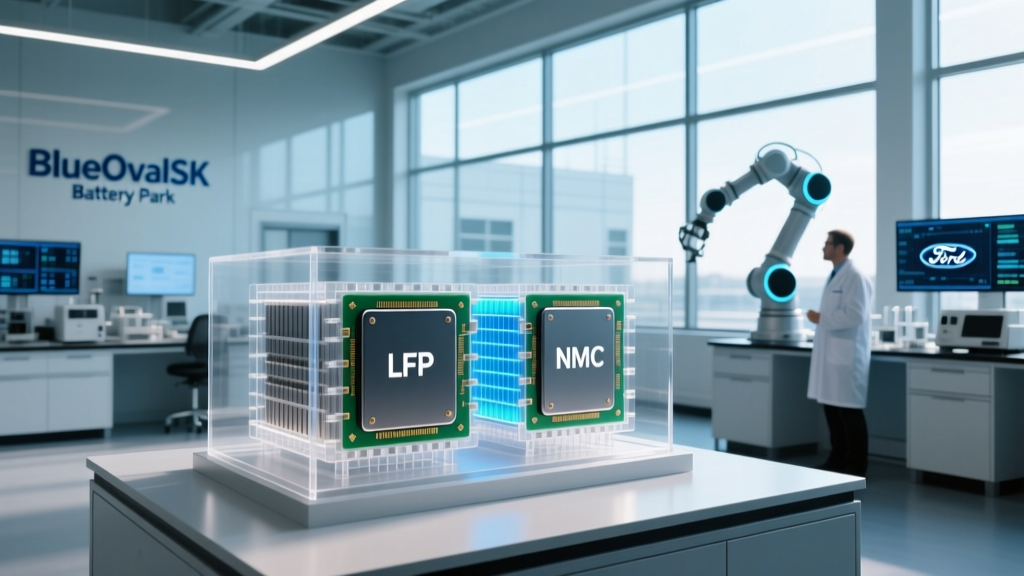
BlueOvalSK Battery Park is expected to produce cells based on NMC (nickel-manganese-cobalt) chemistry, which has been the dominant choice for long-range EVs. However, Ford has also separately invested in LFP (lithium iron phosphate) battery production — including a dedicated LFP plant in Marshall, Michigan — signaling a dual-chemistry strategy across its lineup.
Understanding the trade-offs between these two chemistries is the single most important battery-knowledge gap for today's EV buyer.
| Attribute | LFP (Lithium Iron Phosphate) | NMC / NCA (Nickel-based) |
|---|---|---|
| Energy Density | Lower (~160-180 Wh/kg cell-level) | Higher (~220-300 Wh/kg cell-level) |
| Typical Use Case | Standard-range / cost-focused models | Long-range / performance models |
| Cycle Life | 3,000-5,000+ cycles to 80% capacity | 1,000-2,000 cycles to 80% capacity |
| Cold-Weather Performance | Weaker — greater range loss below freezing | Better — less range penalty in cold |
| Cost per kWh | Lower — no cobalt or nickel | Higher — commodity-sensitive pricing |
| Thermal Stability | Excellent — lower thermal runaway risk | Good — requires robust BMS/cooling |
| SoC Charging Habit | Can charge to 100% daily without harm | Best kept at 80% daily; 100% for trips |
| Critical Mineral Sourcing | Easier for US/EU domestic supply chains | Cobalt/nickel supply chain complexity |
The practical takeaway: If your daily commute is under 60 miles and you want maximum battery longevity with minimal charging-habit management, an LFP-equipped Ford (or any brand) is a strong fit. If you need 300+ miles of EPA range for road trips or live in a cold climate where every mile counts, NMC remains the better choice — provided you follow the 80% daily charge guideline.
BlueOvalSK's NMC production is aimed at Ford's higher-range vehicles, including future electric trucks and SUVs where energy density directly translates to payload and towing capability. The Marshall, Michigan LFP plant, meanwhile, targets more affordable models where lower cell cost can bring MSRP down — a critical factor for §30D federal tax credit eligibility, since the IRS enforces MSRP caps ($55,000 for sedans, $80,000 for SUVs/trucks/vans) that determine whether a buyer can access the up-to-$7,500 point-of-sale credit.
How Long Do EV Batteries Actually Last?
The most persistent myth in EV ownership is that batteries need replacement the way a gas car needs a new transmission — frequently and expensively. Real-world data tells a different story.
Most modern EV batteries are engineered to retain 70-80% of their original capacity after 100,000 to 150,000 miles. That means a vehicle with an EPA-rated 300-mile range when new might deliver 210-240 miles at the 150,000-mile mark. For the vast majority of owners, the battery will outlast the vehicle's useful life or remain functional well beyond the typical 8-12 year ownership window.
Typical EV Battery Degradation Curve
| Milestone | Average Capacity Retained | Range Impact (on 300-mi EPA vehicle) |
|---|---|---|
| Year 1 / 15,000 mi | ~95-97% | ~285-291 mi |
| Year 3 / 45,000 mi | ~92-95% | ~276-285 mi |
| Year 5 / 75,000 mi | ~88-92% | ~264-276 mi |
| Year 8 / 100,000 mi | ~82-88% | ~246-264 mi |
| Year 10 / 150,000 mi | ~75-83% | ~225-249 mi |
Data synthesized from fleet studies by Recurrent Auto, Geotab, and manufacturer warranty thresholds. Individual results vary based on climate, charging habits, and chemistry.
Key insight: degradation is not linear. Most lithium-ion batteries experience a steeper capacity drop in the first 12-18 months (roughly 3-5%), then settle into a slow, gradual decline. This initial "formation loss" is normal and should not alarm new owners who notice a few miles of range disappear in the first year.
According to fleet data analyzed by Recurrent Auto, the average EV battery in their study sample retained approximately 90% of its original range after three years of real-world use — a figure that aligns closely with what we see in NMC-equipped vehicles from major manufacturers.
What Does the Battery Warranty Cover?
Federal law mandates that EV batteries carry a minimum warranty of 8 years or 100,000 miles (whichever comes first). In California and states that have adopted CARB (California Air Resources Board) emissions standards, that extends to 10 years or 150,000 miles. Most manufacturers, including Ford, meet or exceed these thresholds.
| Manufacturer | Warranty Period | Capacity Threshold | Notes |
|---|---|---|---|
| Ford (current EVs) | 8 yr / 100,000 mi | 70% retention | Covers defects + excessive degradation |
| Hyundai / Kia | 10 yr / 100,000 mi | 70% retention | Among the longest standard coverage |
| Tesla (Model Y/3) | 8 yr / 100,000-120,000 mi | 70% retention | Varies by model and battery size |
| GM (Ultium platform) | 8 yr / 100,000 mi | 70% retention | Modular pack design may reduce repair cost |
| CARB states (all brands) | 10 yr / 150,000 mi | Varies by OEM | Applies in CA and adopting states |
What "70% retention" means in practice: If your EV had 300 miles of EPA range when new, the warranty guarantees at least 210 miles of range through the warranty period. If the battery degrades below that threshold, the manufacturer must repair or replace it at no cost. In reality, very few batteries fall below this line within the warranty window — the threshold is set conservatively.
One nuance buyers often miss: the warranty covers capacity degradation and manufacturing defects, but not damage from accidents, flooding, or improper modifications. Always review the specific warranty booklet for your model year, as terms can shift between model years.
EV Battery Replacement Cost: What to Expect
This is where fear-mongering runs rampant, so let us anchor the discussion in data. A full high-voltage traction battery replacement is expensive — but it is also rare within the first 10-15 years of ownership.
| Vehicle / Battery Size | Battery Chemistry | Estimated Replacement Cost | When Typically Needed |
|---|---|---|---|
| Compact EV (~60 kWh) | LFP | $6,000 - $9,000 | Rarely before 200,000+ mi |
| Mid-size EV (~80 kWh) | NMC | $9,000 - $14,000 | 150,000 - 200,000+ mi |
| Large EV / Truck (~100-130 kWh) | NMC | $14,000 - $22,000 | 150,000 - 200,000+ mi |
| PHEV (~15-25 kWh) | NMC | $4,000 - $8,000 | 100,000 - 150,000 mi |
Costs include parts and labor. Prices declining as domestic production scales (BlueOvalSK, etc.). Module-level repair can reduce cost by 40-60% on vehicles with modular packs.
Two factors are working in owners' favor. First, cell prices have fallen roughly 80-90% since 2010 (from over $1,000/kWh to approximately $100-130/kWh at the pack level in 2025-2026, per BloombergNEF tracking). Domestic production at facilities like BlueOvalSK Battery Park is expected to further reduce costs by eliminating shipping and tariff overhead on imported cells.
Second, many modern battery packs are modular — meaning a technician can replace individual modules rather than the entire pack. On vehicles with this architecture, a partial replacement might cost $3,000-$6,000 rather than the full-pack price. Ford's Ultium-competitor architectures and SK On-derived packs are designed with serviceability in mind.
Factors That Accelerate (or Protect) Battery Life
Not all miles are created equal when it comes to battery wear. Here is what the data shows about the biggest factors affecting lithium-ion longevity:
Battery Care Best Practices
- Minimize DC fast charging to 1-2 sessions per week. Frequent use of 150+ kW DC fast chargers generates sustained heat that accelerates electrolyte degradation. For daily charging, Level 2 (7-19 kW) at home is ideal. Reserve DCFC for road trips.
- Keep State of Charge between 20-80% for NMC batteries. Sustained storage at 100% SoC stresses the cathode. LFP batteries are an exception — they tolerate and even benefit from periodic 100% charges for cell balancing.
- Precondition the battery before fast charging. Most EVs do this automatically when you navigate to a charger. A cold battery charged at high power experiences lithium plating, which permanently reduces capacity.
- Avoid prolonged exposure to extreme heat. Parking in direct sun in 100°F+ climates for extended periods accelerates calendar degradation. Garage parking or shade helps. Cold is less damaging to long-term health but reduces temporary range.
- Do not let the battery sit at 0% or near-empty for days. Deep discharge can trigger copper dissolution in the anode current collector. If storing the vehicle, leave it at ~50% SoC.
- Use scheduled charging to time Level 2 sessions. Charging to 80% and finishing just before you leave minimizes time spent at high SoC.
The single highest-impact habit is reducing DC fast-charging frequency. A 2024 study by Geotab found that vehicles fast-charged more than three times per week showed approximately double the degradation rate of vehicles that primarily used Level 2 charging over a three-year period. That does not mean you should avoid fast chargers on road trips — just that daily reliance on them carries a measurable cost.
Monitoring Your Battery's State of Health (SoH)
State of Health (SoH) is the percentage of your battery's original capacity that remains usable. A new battery is at 100% SoH; at 70% SoH, your battery holds 70% of its original energy — and your range has dropped proportionally.
Most modern EVs surface SoH data through the infotainment system or companion app. Ford's SYNC system and the FordPass app include battery health indicators. Third-party tools can also pull SoH data via the OBD-II port:
- OBD-II scanners with EV support (e.g., OBDLink SX + LeafSpy-style apps adapted for your brand) can read cell-level voltage and estimated SoH.
- Manufacturer diagnostics: Any Ford dealer can run a full battery health report during a service visit — request this if you are approaching a warranty threshold or considering a used EV purchase.
- Third-party platforms: Services like Recurrent allow you to opt in to battery monitoring that tracks SoH over time and compares it to fleet averages for your specific model.
If you are buying a used EV, always request a battery health report before purchase. A vehicle showing 92% SoH at 40,000 miles is tracking well; one showing 82% at the same mileage may indicate heavy fast-charging use or a defective module that should be addressed under warranty.
Emerging Battery Technology: Solid-State and Beyond
BlueOvalSK Battery Park is built around today's proven lithium-ion technology — liquid-electrolyte cells with NMC cathodes. But the broader industry is investing heavily in next-generation chemistries that could reshape EV economics within the next decade.
Solid-state batteries replace the liquid electrolyte with a solid material (ceramic, sulfide, or polymer), promising higher energy density (potentially 400+ Wh/kg at the cell level), faster charging, and improved safety. Toyota, Samsung SDI, and QuantumScape are among the companies targeting limited production in the 2027-2030 timeframe. However, manufacturing scalability and cost remain significant hurdles. Solid-state cells are currently produced in small batches at costs many multiples of conventional lithium-ion. Expect solid-state to debut in premium/low-volume applications first, not in mass-market vehicles.
Silicon-dominant anodes are a nearer-term evolution. By replacing graphite anodes with silicon (which can store roughly 10x more lithium ions per gram), manufacturers can boost energy density by 20-40% without changing the cathode chemistry. Companies like Sila Nanotechnologies and Group14 are already supplying silicon-composite anode materials for limited production. Ford has expressed interest in this technology for future BlueOvalSK-derived cells, though no specific model-year commitment has been announced.
Sodium-ion batteries are emerging as a low-cost alternative for entry-level EVs and stationary storage. They use abundant sodium instead of lithium, eliminating critical-mineral supply constraints entirely. CATL has begun volume production in China, but energy density remains too low for long-range passenger vehicles. These may appear in future budget Ford models or commercial fleet applications.
The realistic timeline: NMC and LFP will remain the dominant chemistries through at least 2030. Solid-state is a 2028-2032 prospect for limited applications. Silicon anodes are a 2026-2028 incremental improvement. None of these technologies should factor into a purchase decision today — buy the best EV available now, and the next generation will be better still when you are ready to upgrade.
BlueOvalSK's Impact on Ford EV Pricing and Tax Credits
Domestic battery production is not just a supply-chain story — it directly affects whether Ford's EVs qualify for the IRS §30D federal clean vehicle credit. The credit requires that a specified percentage of battery components be manufactured or assembled in North America, and that critical minerals be sourced from the US or free-trade-agreement partners. These percentages increase annually.
BlueOvalSK Battery Park, by producing cells in Kentucky, directly satisfies the battery-component manufacturing requirement. Combined with SK On's separate US cell plants and Ford's LFP facility in Michigan, this positions Ford to keep more of its EV lineup eligible for the full credit through 2026 and beyond — provided buyers also meet the income caps ($150,000 single / $300,000 joint for new vehicles) and MSRP limits.
For buyers, this means that future Ford EVs powered by BlueOvalSK cells are more likely to offer the point-of-sale credit transfer, effectively reducing the purchase price by up to $7,500 at the dealer. Always verify eligibility for the specific model year and trim you are considering, as battery sourcing can change between model years.
Frequently Asked Questions
How long do EV batteries last in years and miles?
Most modern EV batteries retain 75-85% of original capacity after 150,000 miles or 10 years. LFP batteries typically last longer in terms of cycle count (3,000-5,000+ cycles vs. 1,000-2,000 for NMC). In practical terms, the battery will usually outlast the vehicle or remain functional well beyond the typical ownership period. Full replacement before 150,000 miles is uncommon unless the pack has a manufacturing defect covered under warranty.
How much does an EV battery cost to replace?
Full replacement costs range from approximately $6,000 for a compact LFP pack to $22,000 for a large NMC truck battery, including labor. However, most packs are modular, and partial module replacement can reduce costs by 40-60%. Cell prices continue to decline as domestic production scales at facilities like BlueOvalSK Battery Park, and replacement costs in 2028-2030 are expected to be meaningfully lower than today's figures.
What does the EV battery warranty cover?
Federal law requires a minimum 8-year/100,000-mile warranty on EV batteries. The warranty covers manufacturing defects and excessive capacity loss — typically defined as falling below 70% of original capacity. In CARB states, coverage extends to 10 years/150,000 miles. The warranty does not cover damage from accidents, flooding, or aftermarket modifications.
How do I check and maximize my EV battery health?
Check SoH through your vehicle's infotainment system, companion app, or a dealer diagnostic report. To maximize longevity: rely on Level 2 home charging, keep NMC batteries between 20-80% SoC for daily use, precondition before DC fast charging, avoid prolonged high-heat exposure, and never store the vehicle at 0% SoC. LFP owners can charge to 100% daily without concern.
LFP vs. NMC — which battery chemistry is better for me?
Choose LFP if you want maximum cycle life, lower cost, can charge to 100% daily, and do not need the longest possible range. Choose NMC if you need 300+ miles of EPA range, live in a cold climate where energy density matters, or need maximum towing/payload capability. Neither chemistry is universally "better" — the right choice depends on your driving pattern and priorities.
Will BlueOvalSK batteries make Ford EVs cheaper?
Domestic production reduces logistics costs, tariff exposure, and currency risk compared to importing cells from Asia. Over time, this should allow Ford to lower MSRP or improve margins without raising prices. Combined with §30D tax credit eligibility, BlueOvalSK-sourced vehicles should be among the most cost-competitive options in their segments. Exact pricing impacts will depend on the specific models that receive these cells.
Sources: Recurrent Auto battery degradation research, IRS §30D Clean Vehicle Credit guidelines, Ford Motor Company press releases on BlueOvalSK and battery strategy.