When Ford and SK On broke ground on the $5.6 billion BlueOval SK Battery Park in Glendale, Kentucky, it signaled more than a factory build — it reshaped where and how the cells powering American EVs are made. As of 2026, the twin-plant complex is ramping production of lithium-ion pouch cells destined for the F-150 Lightning, next-generation Ford EVs, and potentially SK-supplied models from other automakers. For buyers and owners, understanding what rolls out of this facility matters: the chemistry inside these cells dictates your real-world range, charging speed, cold-weather performance, and long-term degradation.
This guide uses BlueOval SK Battery Park as the lens to explain modern EV battery technology — the chemistries being produced, how long they actually last, what warranties protect you, what replacement really costs, and how to monitor and maximize the health of your pack over a decade of driving.
BlueOval SK Battery Park: Scale, Chemistry, and Why It Matters
The BlueOval SK Battery Park campus spans two plants with a combined target capacity of roughly 86 GWh annually — enough to supply batteries for well over a million EVs per year once fully operational. The joint venture between Ford Motor Company and South Korea's SK On produces pouch-format lithium-ion cells, a form factor chosen for its packaging flexibility and thermal characteristics.
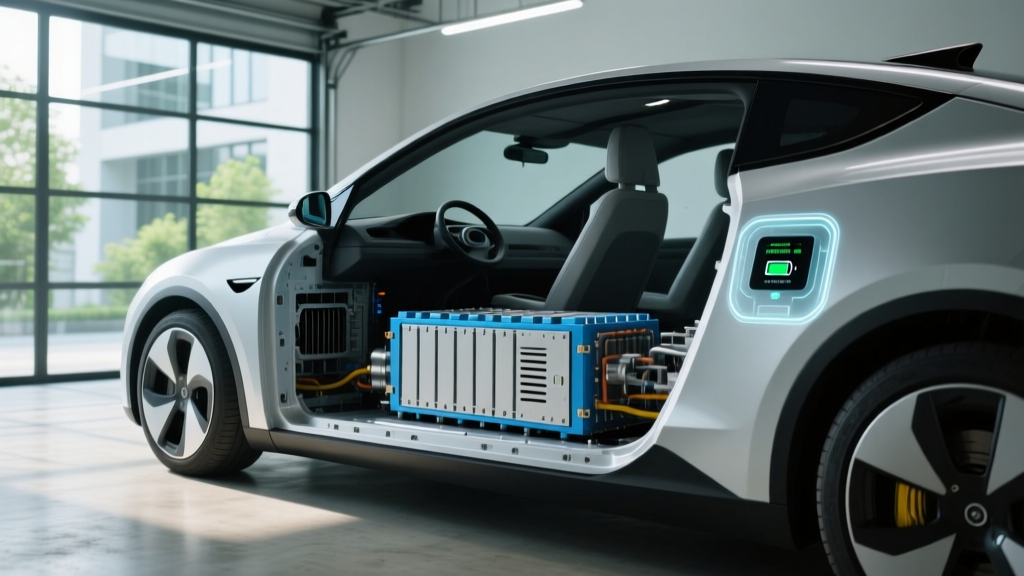
For the F-150 Lightning Extended Range, these cells assemble into a ~131 kWh usable pack (NMC chemistry). The Standard Range Lightning uses a smaller ~98 kWh pack. As Ford transitions more models to its next-gen EV platform, expect BlueOval SK to produce both NMC (nickel-manganese-cobalt) and potentially LFP (lithium iron phosphate) cells, aligning with the industry-wide bifurcation of battery chemistry by vehicle segment.
The domestic production angle matters for federal tax credit eligibility. Under current IRS §30D rules, vehicles must meet battery-component and critical-mineral sourcing thresholds to qualify for the full $7,500 credit. Cells manufactured in Kentucky with qualifying supply chains help Ford models clear these requirements — a direct pocketbook impact for buyers.
LFP vs NMC: The Chemistry Trade-Offs Explained
Every EV battery relies on a specific cathode chemistry, and the two dominant types in 2026 are NMC (nickel-manganese-cobalt) and LFP (lithium iron phosphate). BlueOval SK's current output is predominantly NMC, optimized for the energy density demands of trucks and long-range SUVs. Here's how they compare head-to-head:
| Attribute | NMC (Nickel-Manganese-Cobalt) | LFP (Lithium Iron Phosphate) |
|---|---|---|
| Energy Density | 200–260 Wh/kg (cell level) | 140–180 Wh/kg (cell level) |
| Cycle Life | 1,000–2,000 full cycles | 3,000–5,000+ full cycles |
| Cold Performance | Better low-temp conductivity; ~15–25% range loss at 20°F | More affected by cold; ~25–35% range loss at 20°F without heat pump |
| Thermal Stability | Good; requires active thermal management | Excellent; inherently more stable, lower runaway risk |
| Cost per kWh | $110–$140 (2026 pack-level) | $80–$105 (2026 pack-level) |
| Typical Use Case | Long-range, performance, trucks, AWD | Standard-range, fleet, daily commuters, budget models |
| Recommended Charge Habit | Daily 80% SoC; 100% for trips only | Can sustain 100% SoC daily; periodic full charge helps BMS calibration |
| Cobalt Content | Yes (reduced vs older gens) | None — cobalt-free |
Which is better? It depends on your driving profile. If you need 320+ miles of EPA range, tow frequently, or live in a cold climate, NMC's superior energy density and cold-weather performance justify the higher cost and stricter charging habits. If you commute 40 miles daily, charge at home, and want maximum cycle life with lower cost, LFP is the pragmatic pick. Ford's standard-range models are increasingly candidates for LFP, while the Extended Range F-150 Lightning and performance-oriented vehicles will continue using NMC from BlueOval SK.
How Long Do EV Batteries Actually Last?
The short answer: longer than most buyers expect. Real-world degradation data from fleets and high-mileage owners consistently shows that modern liquid-cooled lithium-ion packs retain 85–92% of original capacity after 100,000 miles.
Typical EV Battery Degradation Curve (Liquid-Cooled NMC, Average Climate):
- Year 1 / 15,000 mi: ~2–4% capacity loss (initial formation drop)
- Year 3 / 45,000 mi: ~5–8% total loss
- Year 5 / 75,000 mi: ~7–11% total loss
- Year 8 / 120,000 mi: ~10–15% total loss
- Year 10 / 150,000 mi: ~12–18% total loss
Sources: Geotab fleet data, Recurrent Auto battery health reports, owner-collected data from F-150 Lightning forums.
Key insight: degradation is not linear. The steepest drop occurs in the first 12–18 months (the "formation" phase where the solid-electrolyte interlayer stabilizes), then the curve flattens considerably. A BlueOval SK-supplied F-150 Lightning Extended Range starting at 320 miles EPA should realistically deliver ~270–285 miles of usable range at the five-year mark — still more than adequate for most daily and road-trip use.
LFP packs degrade even more slowly, often showing only 5–8% loss at 100,000 miles, making them compelling for high-mileage drivers and fleet use.
Battery Warranty Terms: What's Actually Covered
Federal law mandates a minimum 8-year/100,000-mile warranty on EV battery packs for emissions-related compliance, and most automakers meet or exceed this baseline. Here's how warranty terms stack up for vehicles likely using BlueOval SK cells:
| Vehicle | Warranty Period | Capacity Threshold | Notes |
|---|---|---|---|
| Ford F-150 Lightning | 8 years / 100,000 miles | 70% retention minimum | Covers defects and excessive degradation below threshold |
| Ford Mustang Mach-E | 8 years / 100,000 miles | 70% retention minimum | Same terms; applies to both NMC and any future LFP variants |
| Hyundai Ioniq 5 (SK On cells) | 10 years / 100,000 miles | 70% retention minimum | Hyundai's longer 10-year term applies in the US market |
| Tesla Model Y (for comparison) | 8 years / 120,000 miles | 70% retention minimum | Higher mileage cap; LFP models same terms |
What the warranty covers: Cell defects, module failures, BMS malfunctions, and degradation below the stated retention threshold (typically 70% of original capacity). If your pack drops below 70% within the warranty window, the manufacturer will repair or replace modules — or the full pack — at no cost.
What it doesn't cover: Damage from accidents, flooding, improper modifications, or using non-approved charging equipment. Normal degradation above the 70% threshold is also not a warranty claim — a pack at 75% capacity at year 7 is functioning within spec.
EV Battery Replacement Cost: The Real Numbers
This is where fear often outpaces reality. Full battery replacement is rarely needed — the vast majority of EVs are retired or sold before the pack reaches end-of-life. But if replacement becomes necessary (typically beyond the warranty period at 150,000+ miles or due to physical damage), here's what it costs in 2026:
| Vehicle / Pack Size | Battery Chemistry | Replacement Cost (Parts + Labor) | When Typically Needed |
|---|---|---|---|
| F-150 Lightning Extended Range (~131 kWh) | NMC | $18,000–$25,000 | Rarely before 200,000 mi; most packs outlive vehicle |
| F-150 Lightning Standard Range (~98 kWh) | NMC | $14,000–$19,000 | Same as above |
| Mid-size SUV (~77 kWh, e.g., Mach-E ER) | NMC | $11,000–$16,000 | 150,000–200,000+ mi if needed at all |
| Compact EV (~60 kWh, LFP) | LFP | $7,000–$11,000 | Extremely rare; LFP cycle life often exceeds 300,000 mi |
Important context: module-level repair is increasingly common and far cheaper. If a single module within a pack degrades disproportionately, dealerships can swap just that module for $1,500–$4,000 rather than replacing the entire pack. BlueOval SK's pouch-cell design lends itself to this modular service approach.
Also worth noting: by the time a 2026 F-150 Lightning needs an out-of-warranty battery replacement (likely 2036 or later), pack pricing is projected to be 40–60% lower than today's figures based on industry cost-reduction trajectories.
Factors That Accelerate (or Preserve) Battery Life
Battery longevity isn't just about chemistry — it's about how you use and store the vehicle. Here are the primary factors that influence how quickly your BlueOval SK-supplied pack degrades:
Habits That Preserve Battery Health:
- Daily SoC between 20–80%: For NMC packs, this is the sweet spot. Reserve 100% charges for road trips.
- Use Level 2 home charging as primary: Slow, steady charging at 7–11 kW generates far less heat than DC fast charging.
- Precondition before fast charging: Navigate to a charger using the vehicle's built-in routing (e.g., Ford's navigation to a DC station) — this activates battery preconditioning, warming the pack to optimal temperature for faster charging and less stress.
- Park in shade or garages during extreme heat: Sustained ambient temps above 95°F with a high SoC accelerates electrolyte decomposition.
- Plug in during extreme cold: A plugged-in vehicle can use grid power for thermal management rather than draining the pack.
Habits That Accelerate Degradation:
- Frequent DC fast charging: Daily use of 150+ kW chargers adds cumulative thermal stress. Occasional road-trip use is fine; daily reliance on DCFC shortens lifespan.
- Sitting at 100% SoC for extended periods: Especially harmful in hot weather. If fully charged, drive within a few hours.
- Regularly draining below 10% SoC: Deep discharge stresses the anode. Recharge before the pack drops to single digits.
- Towing at maximum capacity in high heat: Sustained high-current draw generates significant pack heat. Use tow/haul modes and allow cool-down periods.
Monitoring Your Battery's State of Health (SoH)
Most 2026 EVs, including Ford models supplied by BlueOval SK, provide State of Health data through the vehicle's infotainment system or companion app. Here's how to check and interpret it:
In-vehicle and app methods:
- FordPass App: Navigate to Vehicle Health → Battery. The app displays estimated range versus original rated range, which serves as a proxy for SoH.
- OBD-II diagnostic tools: Third-party scanners (e.g., OBDeleven, Carista) or dedicated EV tools can read BMS-reported SoH percentage directly.
- Dealer inspection: Ford service centers can run a full pack diagnostic, providing cell-level voltage variance and overall capacity measurement — the most accurate method.
- Third-party services: Companies like Recurrent Auto offer free battery health reports that benchmark your pack against thousands of comparable vehicles.
What to watch for: If your SoH drops more than 3–4% in a single year after the initial formation period, or if individual cell voltage variance exceeds 0.1V consistently, schedule a dealer diagnostic. These can signal a failing module that's dragging down the entire pack — caught early, it's a targeted repair rather than a full replacement.
Emerging Battery Technology: What's Next After BlueOval SK
BlueOval SK Battery Park produces today's proven lithium-ion technology, but the next generation of cell chemistries is advancing rapidly. Here's where emerging tech stands as of 2026 — with realistic timelines, not hype:
Silicon-dominant anodes: Replacing graphite anodes with silicon can boost energy density by 20–40%. Companies like Sila Nanotechnologies and Group14 are already supplying silicon-composite anode materials for select 2025–2026 models. Expect broader adoption in BlueOval SK cells by 2028–2030, yielding packs with the same physical size but 350+ miles of range in a full-size truck.
Solid-state batteries: These replace the liquid electrolyte with a solid conductor, promising higher energy density, faster charging, and improved safety. Toyota, Samsung SDI, and QuantumScape have all demonstrated prototype cells, but mass production at automotive scale remains the bottleneck. Realistic timeline for solid-state EVs in meaningful volume: 2029–2032. They will initially appear in premium vehicles at significant cost premiums before filtering down to mainstream models by the mid-2030s.
Sodium-ion batteries: CATL and other manufacturers are producing sodium-ion cells for lower-cost, shorter-range applications. These won't replace NMC in long-range trucks but could power budget EVs and urban runabouts by 2027–2028, potentially at pack costs below $60/kWh.
For buyers today: current NMC and LFP technology from facilities like BlueOval SK is mature, well-understood, and backed by robust warranties. Waiting for solid-state means waiting at least 3–5 years for limited availability at premium pricing.
Frequently Asked Questions
How long do EV batteries last in years and miles?
Modern liquid-cooled EV batteries from facilities like BlueOval SK typically last 150,000–250,000 miles before reaching 70–80% of original capacity. In years, that translates to 10–15+ years of average driving. LFP packs often exceed 300,000 miles. Most EV batteries outlast the vehicle they're installed in.
How much does it cost to replace an EV battery?
Full pack replacement ranges from roughly $7,000 for a compact LFP pack to $25,000 for a large NMC truck battery like the F-150 Lightning Extended Range. However, full replacement is rarely needed — module-level repairs cost $1,500–$4,000, and the vast majority of packs never require service during the vehicle's useful life.
What does the Ford EV battery warranty cover?
Ford covers its EV battery packs for 8 years or 100,000 miles, guaranteeing a minimum of 70% capacity retention. This includes cell defects, module failures, BMS issues, and excessive degradation below the threshold. It does not cover accident damage, improper modifications, or normal degradation above 70%.
How do I check my EV battery's health?
Use the FordPass app's Vehicle Health section, an OBD-II EV diagnostic scanner, or visit a Ford dealer for a full pack diagnostic. Third-party services like Recurrent Auto also provide comparative battery health reports. Check SoH at least twice yearly and monitor for unusual range drops.
Is LFP or NMC better for my EV?
NMC is better if you need maximum range, tow frequently, or live in cold climates — it offers higher energy density (200–260 Wh/kg) and better cold-weather performance. LFP is better if you commute short distances, want maximum longevity (3,000–5,000+ cycles), prefer lower cost, and don't mind slightly reduced range. Both are proven, safe chemistries — the right choice depends on your driving profile.
Does frequent DC fast charging damage my battery?
Occasional DC fast charging (road trips, a few times per month) has minimal impact on battery health. Daily DCFC use, however, adds cumulative thermal stress that accelerates degradation over time. For daily charging, a home Level 2 charger at 7–11 kW is far gentler on the pack. BlueOval SK's cells are designed to handle 150+ kW DCFC, but physics still favors slower charging for longevity.
Will BlueOval SK Battery Park produce solid-state batteries?
Not in the near term. The facility is designed for current-generation lithium-ion pouch cells (NMC primarily). Solid-state battery mass production is not expected before 2029–2032 at the earliest, and would likely require significant retooling or a separate production line. Ford and SK On have indicated flexibility to adapt future cell lines as technology matures.