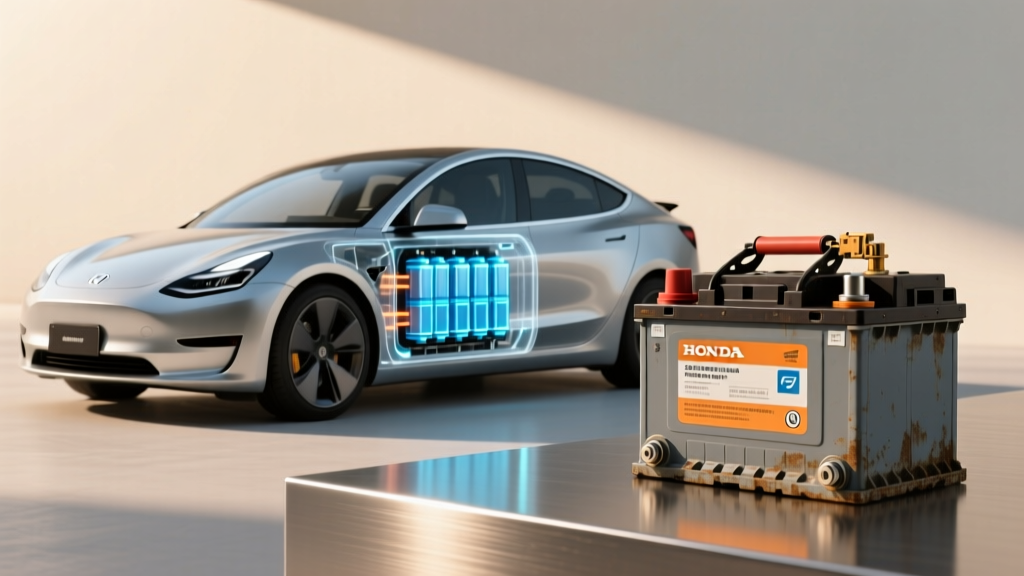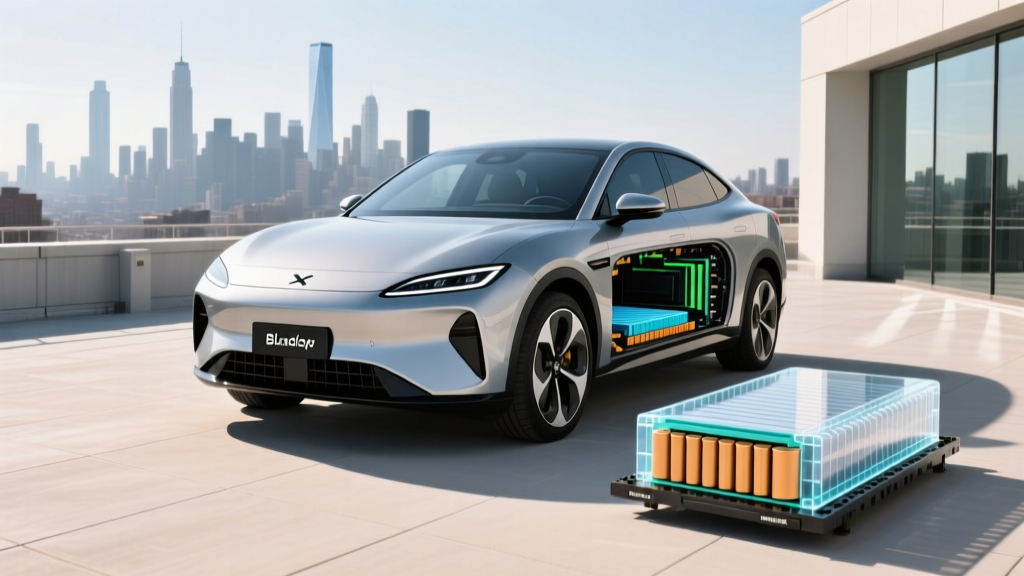
Blade batteries have moved from a BYD exclusive to a mainstream EV talking point. If you're shopping a 2026 Tesla Model 3 Rear-Wheel Drive, a BYD Atto 3/Seal, or any LFP-equipped EV, you'll see "blade battery" in the spec sheet. But what actually changes for you as an owner — in range, longevity, charging speed, and eventual replacement cost — compared to the nickel-manganese-cobalt (NMC) or nickel-cobalt-aluminum (NCA) packs that still power most long-range and performance EVs?
This guide breaks down blade-battery architecture, LFP vs. NMC/NCA chemistry trade-offs with real data, degradation curves, warranty terms, replacement costs, and how to maximize your pack's State of Health (SoH) over a decade of ownership.
What Is a Blade Battery, Exactly?
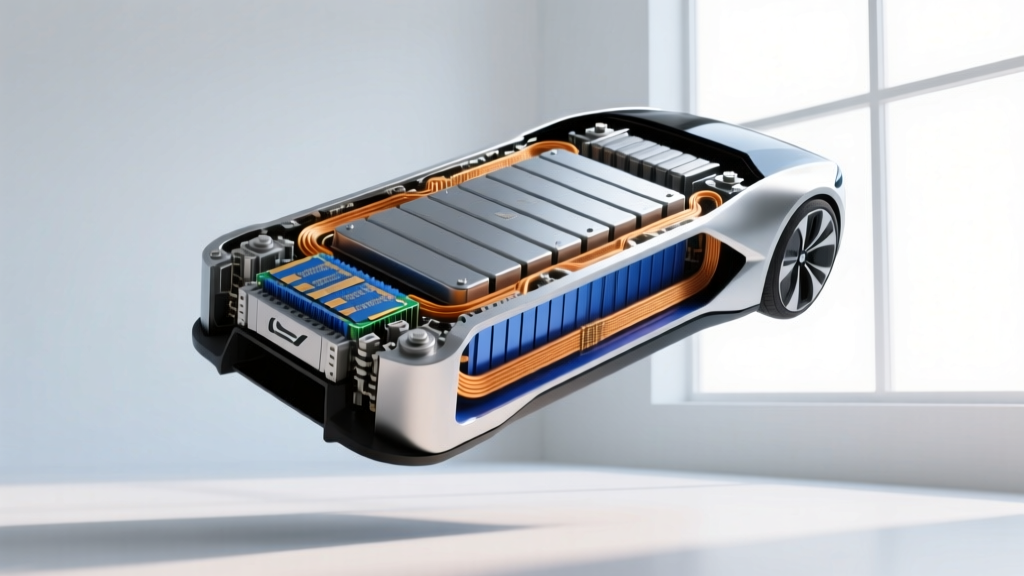
A blade battery is a cell-to-pack (CTP) structural design pioneered by BYD and first mass-produced in 2020. Instead of bundling cylindrical or prismatic cells into modules and then into a pack, blade batteries use long, thin, prismatic lithium iron phosphate (LFP) cells — up to ~960 mm long — stacked directly into the pack tray like blades in a sheath.
The engineering payoff:
- Volume utilization: ~50% better pack-level space use versus traditional module-based LFP packs, narrowing the energy-density gap with NMC.
- Structural rigidity: The cells themselves become load-bearing members of the pack, improving torsional stiffness.
- Thermal runaway resistance: LFP chemistry is inherently more stable than NMC; BYD's nail-penetration test demonstrated no fire or smoke — a benchmark NMC cells typically fail without additional mitigation.
- Lower cost: No cobalt or nickel; iron and phosphate are abundant and price-stable.
By 2026, blade-style CTP LFP packs are supplied not only by BYD (to its own vehicles plus Tesla, Toyota bZ3 in China, and others) but also emulated by CATL, EVE Energy, and Gotion High-Tech in similar long-cell prismatic formats. The term "blade battery" is now shorthand for structural LFP CTP packs, regardless of supplier.
LFP (Blade) vs. NMC/NCA: The Chemistry Trade-Offs
Chemistry determines more than range. It shapes how the pack ages, how it handles cold, what it costs to replace, and even how you should charge it daily. Here's how the two dominant chemistries compare for a 2026 buyer:
| Attribute | LFP (Blade / CTP) | NMC / NCA |
|---|---|---|
| Cell-level energy density | ~170–200 Wh/kg | ~250–300 Wh/kg |
| Pack-level energy density (CTP) | ~140–170 Wh/kg | ~180–220 Wh/kg |
| Typical cycle life (to 80% SoH) | 3,000–6,000 cycles | 1,000–2,000 cycles |
| Cold-weather range loss (−10°C / 14°F) | ~30–40% | ~20–30% |
| Recommended daily SoC | 100% (beneficial for cell balancing) | 80–90% (limits calendar aging) |
| DC fast-charge peak rate (typical) | 150–200 kW (tapers early) | 200–350 kW (flatter curve) |
| Thermal runaway risk | Very low (no oxygen release from cathode) | Moderate (requires robust BMS + cooling) |
| Raw-material cost exposure | Low (Fe, P abundant) | High (Ni, Co price-volatile) |
| Typical pack $/kWh (2026) | ~$90–$110 | ~$120–$155 |
The practical read: If you drive a standard-range commuter (Tesla Model 3 RWD at 272 mi EPA, BYD Dolphin, Volvo EX30 Single Motor) and charge at home nightly, LFP is the lower-cost, longer-life, lower-worry choice — accept the cold-weather hit and slower DC charging. If you need 320+ miles of EPA range, frequent 250+ kW road-trip charging, or live in sub-zero climates, NMC/NCA still wins on pack-level energy density and cold performance.
How Long Do EV Batteries Actually Last?
The short answer: most modern EV traction batteries outlast the car they're in. The long answer requires separating cycle aging (use-driven) from calendar aging (time-driven), and looking at real fleet data.
- Tesla Model 3/Y (NMC & LFP): ~5–7% capacity loss at 100,000 miles, per Tesla's 2025 Impact Report and Recurrent fleet data.
- Chevrolet Bolt EV/EUV (NMC, LG): ~8–10% at 100,000 mi, higher in hot climates; partly offset by the 2021–2023 recall battery replacements.
- Nissan LEAF (LMO/NMC, passively cooled): 15–25% loss by 100,000 mi in hot climates — the cautionary tale that drove the industry to active liquid cooling.
- BYD blade-battery taxis (LFP, China fleets): 5–8% loss at 300,000+ km (~186,000 mi), consistent with LFP's higher cycle-life rating.
For a typical US driver averaging 13,500 miles/year (FHWA data), that translates to:
- 10 years / 135,000 mi: expect 90–94% retained capacity on a liquid-cooled NMC pack, 92–96% on LFP blade packs.
- 15 years / 200,000 mi: 85–90% NMC, 88–93% LFP — still well above the 70% warranty threshold.
The outlier risk is calendar aging at high SoC in heat: an NMC pack stored at 100% SoC in Phoenix will lose more capacity in 3 years than a pack cycled daily to 80% in Seattle. LFP is more tolerant of high-SoC storage, which is why OEMs recommend 100% daily charging for LFP-equipped vehicles.
Battery Warranty Terms: What's Actually Covered
Federal law (EPA emissions-warranty precedent) and California's ZEV rules have pushed the industry to a de facto minimum of 8 years / 100,000 miles on the traction battery, with California-emissions states requiring 10 years / 150,000 miles. The capacity-retention threshold matters as much as the term:
| Vehicle | Chemistry | Warranty Term | Capacity Threshold |
|---|---|---|---|
| Tesla Model 3 RWD (LFP) | LFP blade-style | 8 yr / 100,000 mi | 70% |
| Tesla Model 3 Long Range AWD | NMC | 8 yr / 120,000 mi | 70% |
| Hyundai Ioniq 5 / Kia EV6 | NMC | 10 yr / 100,000 mi | 70% |
| Ford Mustang Mach-E | NMC (LFP on Select trim) | 8 yr / 100,000 mi | 70% |
| Chevrolet Equinox EV / Blazer EV | NMC (Ultium) | 8 yr / 100,000 mi | 70% (60% on commercial) |
| BYD Atto 3 / Seal (where sold) | LFP blade | 8 yr / 160,000 km (~100k mi) | 70% |
| Rivian R1T / R1S | NMC (Samsung SDI) | 8 yr / 175,000 mi | 70% |
What's covered: Capacity loss below the threshold, manufacturing defects, cell imbalance, BMS failures, thermal events. What's not: Damage from collisions, flooding, improper charging equipment, aftermarket modifications, or failure to maintain the thermal-management coolant. Read the fine print — some OEMs prorate coverage after year 5.
Replacement Cost: When, and How Much?
Let's address the elephant in the room. Out-of-warranty traction-battery replacement is expensive — but it's also rare. Catastrophic pack failures in liquid-cooled packs are well under 1% in the first 8 years, per Recurrent and OEM warranty-claim data. Most owners sell the car before needing one.
| Vehicle / Pack Size | Chemistry | Parts + Labor | Notes |
|---|---|---|---|
| Tesla Model 3 RWD (~60 kWh) | LFP | $8,000–$11,000 | LFP lower $/kWh; remanufactured packs available |
| Tesla Model Y LR (~75 kWh) | NMC | $12,000–$16,000 | Structural pack, higher labor |
| Hyundai Ioniq 5 (~77 kWh) | NMC | $13,000–$18,000 | E-GMP platform |
| Ford F-150 Lightning Ext. Range (~131 kWh) | NMC | $20,000–$28,000 | Largest consumer pack on market |
| Chevrolet Bolt EV (~65 kWh, post-recall) | NMC | $9,000–$14,000 | Older platform, parts availability improving |
For context, a 10-year-old ICE vehicle often needs a $4,000–$7,000 transmission or engine rebuild — the EV equivalent is just deferred further into the ownership timeline. Module-level repair (replacing 1–2 of 4–6 modules rather than the full pack) is increasingly offered by independents like Electrified Garage and Gruber Motor Company for $3,000–$7,000, cutting costs substantially on out-of-warranty vehicles.
What Actually Kills a Battery — and How to Prevent It
Based on 2026 fleet data, the top five degradation accelerators, in rough order of impact:
- Sustained high SoC + heat (NMC/NCA): Storing at 100% SoC in 90°F+ ambient for weeks is the single worst thing you can do to a nickel-based pack. Set your charge limit to 80% for daily use.
- Frequent DC fast-charging above 150 kW: Occasional road-trip Supercharging is fine; daily 250 kW sessions measurably increase impedance growth. One 2025 IDTechEx analysis pegged the penalty at ~2–3% extra loss over 100,000 mi vs. AC-only charging.
- Deep discharges to 0%: Going below ~5% SoC stresses the anode copper current collector. Treat 10% as your effective floor.
- Neglected thermal-management coolant: Most OEMs specify coolant replacement at 5–7 years. Skip it and the pack runs hotter, aging faster.
- LFP-specific: never charging to 100%: Paradoxically, LFP packs need periodic 100% charges for the BMS to recalibrate cell voltage. Running LFP at 80% daily causes SoC drift and phantom range loss.
- ✅ NMC/NCA: set daily charge limit to 80%; 100% only before road trips
- ✅ LFP: charge to 100% at least weekly; daily 100% is fine
- ✅ Precondition the pack before DC fast-charging (most EVs do this automatically when a charger is in the nav route)
- ✅ Avoid leaving the car at <10% or >90% SoC for more than 48 hours
- ✅ Replace thermal-management coolant per the OEM service schedule (typically 5–7 yr)
- ✅ Park in shade or a garage during summer; plug in during extreme cold so the pack can stay warm
- ✅ Limit routine use of 250–350 kW chargers if a 150 kW option is convenient
How to Check Your Battery's State of Health (SoH)
State of Health is the percentage of original usable capacity the pack still holds. A new pack is 100% SoH; a pack at 85% SoH that originally delivered 300 mi EPA now delivers ~255 mi.
In-vehicle methods:
- Tesla: Service menu → Battery Health test (requires a ~30-min drive cycle).
- Hyundai/Kia/Genesis: EV-specific service screen in the cluster or infotainment, often under "Battery" in the diagnostic menu.
- Ford/GM: Available via dealer scan tool (MDI / GDS); not exposed in the consumer UI as of 2026.
- BYD / Polestar / Volvo: SoH visible in the companion app on most 2024+ models.
Third-party / OBD-II methods: Apps like Tessie, Scan My Tesla, LeafSpy (Nissan), and ABRP's OBD integration read SoH directly from the BMS over the CAN bus. A $30–$60 OBD-II dongle (OBDLink MX+, vLinker FS) is usually all that's needed.
When to check: At purchase (especially used), annually, and before/after a long road trip to establish a baseline. A drop of more than ~3% in 12 months warrants a dealer visit.
Beyond Blade Batteries: What's Coming Next
Blade-style LFP packs are the current-generation value champion, but three emerging technologies will reshape the landscape over the next 3–7 years:
- Silicon-dominant anodes (2026–2028): Companies like Sila Nanotechnologies and Group14 are shipping silicon-anode cells that boost energy density 15–25% over graphite anodes. First applications are in performance vehicles (Mercedes-AMG, Porsche). Expect mainstream adoption by 2029.
- Semi-solid-state (2027–2029): NIO's 150 kWh semi-solid pack (WeLion, 360 Wh/kg cell-level) is already in limited service in China. Toyota, Samsung SDI, and CATL have announced production timelines for 2027–2028. These use a thin solid electrolyte layer with liquid infill — a bridge technology, not true solid-state.
- All-solid-state (2030+): Toyota, QuantumScape, and Solid Power target 2030–2032 for volume production. Promises: 2× energy density, 10-minute 10–80% charging, no thermal-runaway risk. Realistic timeline for affordable consumer vehicles: 2032–2035. Treat any "solid-state EV in 2026" claim as marketing.
For a 2026 buyer, the decision remains LFP blade (value, longevity, safety) vs. NMC/NCA (range, cold performance, charge speed). Solid-state is a next-decade story.
FAQ: Blade Batteries & EV Battery Ownership
How long do EV batteries last in years and miles?
Modern liquid-cooled packs (LFP blade or NMC) typically retain 85–95% of original capacity at 150,000 miles / 10 years. Most outlast the vehicle's useful economic life. The outlier is early passively-cooled packs (2011–2017 Nissan LEAF), which degraded much faster in hot climates.
How much does an EV battery cost to replace?
$8,000–$28,000 out of warranty, depending on pack size (60–131 kWh) and chemistry (LFP cheaper than NMC). Module-level repair can reduce this to $3,000–$7,000. Under warranty, replacement is $0 to the owner if capacity falls below ~70%.
What does the battery warranty cover?
Capacity loss below the stated threshold (typically 70% over 8 yr / 100,000 mi), manufacturing defects, cell failures, and BMS faults. It does not cover collision damage, flood damage, aftermarket modifications, or neglected cooling-system maintenance.
How do I check my EV's battery health?
Use the OEM service menu (Tesla, Hyundai/Kia), companion app (Volvo/Polestar/BYD), or an OBD-II dongle with an app like Tessie, Scan My Tesla, or LeafSpy. Check at purchase, annually, and before major trips.
LFP vs. NMC — which is better and why?
Neither is universally better. LFP (including blade batteries) wins on cost, cycle life, safety, and daily-charge convenience (100% OK). NMC/NCA wins on energy density (more range in a lighter pack), cold-weather performance, and DC fast-charge speed. For standard-range commuters: LFP. For 320+ mi range and road-trip-heavy drivers: NMC.
Are blade batteries only in BYD vehicles?
No. As of 2026, BYD supplies blade packs to Tesla (certain Model Y markets), Toyota (bZ3 in China), and several commercial-van makers. CATL, EVE, and Gotion also produce similar long-cell CTP LFP packs sold under their own branding. "Blade-style" is now an industry-wide format, not a BYD exclusive.
Does frequent DC fast-charging destroy my battery?
It accelerates degradation modestly — roughly 2–3% extra capacity loss over 100,000 miles versus AC-only charging, per 2025 IDTechEx data. Occasional road-trip fast-charging is fine; daily reliance on 250+ kW chargers is what measurably hurts. Prefer 150 kW chargers for routine use when convenient.
Sources: EPA fueleconomy.gov, Tesla 2025 Impact Report, Recurrent Auto battery research, IRS §30D clean-vehicle credit guidance (for ownership-cost context).