The Companies Powering Your EV — And Why It Matters
When you buy an electric vehicle, you're not just choosing a brand — you're choosing a battery supplier. The big battery companies behind today's EVs — CATL, BYD, LG Energy Solution, Panasonic, SK On, and Samsung SDI — determine your vehicle's range, charging speed, longevity, and ultimately its replacement cost. Yet most buyers never look past the badge on the hood.
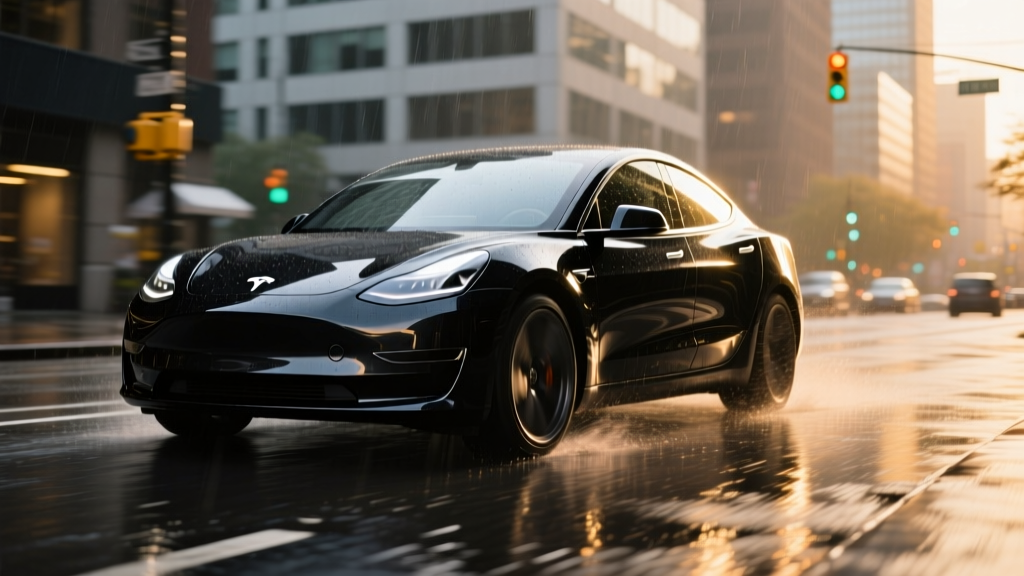
Understanding which cell manufacturer supplies your EV, and what chemistry they use, is one of the most consequential ownership decisions you'll make. A Tesla Model 3 Rear-Wheel Drive with a CATL-supplied LFP (lithium iron phosphate) pack behaves fundamentally differently from a Model 3 Long Range with a Panasonic NMC/NCA (nickel manganese cobalt / nickel cobalt aluminum) pack — different charging habits, different cold-weather range, different degradation curves.
This guide maps the major suppliers to the vehicles they power, explains the chemistry trade-offs with hard data, and gives you the degradation figures, warranty terms, and replacement costs you need to buy and own an EV with confidence.
Who Are the Big Battery Companies in EVs?
Six manufacturers dominate the global EV battery supply chain as of 2026:
- CATL (China): World's largest EV battery maker by volume. Supplies Tesla (LFP packs for Model 3/Y RWD), Ford (F-150 Lightning LFP option), BMW, Volvo, and others. Pioneer of LFP adoption in Western-market EVs and sodium-ion development.
- BYD (China): Vertically integrated — makes both batteries and vehicles. Its Blade Battery (LFP) supplies its own lineup and is increasingly exported to partners including Tesla for some markets.
- LG Energy Solution (South Korea): Major supplier to GM (Ultium platform), Hyundai/Kia, Ford, and Stellantis. Primarily NMC chemistry, with large-format pouch cells.
- Panasonic (Japan): Longtime Tesla partner, producing 2170 and 4680 cylindrical cells at the Nevada and Kansas Gigafactories. NCA/NMC chemistry, high energy density.
- SK On (South Korea): Supplies Ford (F-150 Lightning, Mustang Mach-E), Hyundai, and others through joint ventures including BlueOval SK with Ford in Kentucky and Tennessee.
- Samsung SDI (South Korea): Supplies BMW, Rivian, and Stellantis. Known for high-nickel NMC prismatic cells and solid-state development.
The chemistry these companies deploy in your specific vehicle matters more than the brand name. Let's break down the two dominant chemistries.
LFP vs NMC/NCA: The Chemistry That Defines Your Ownership
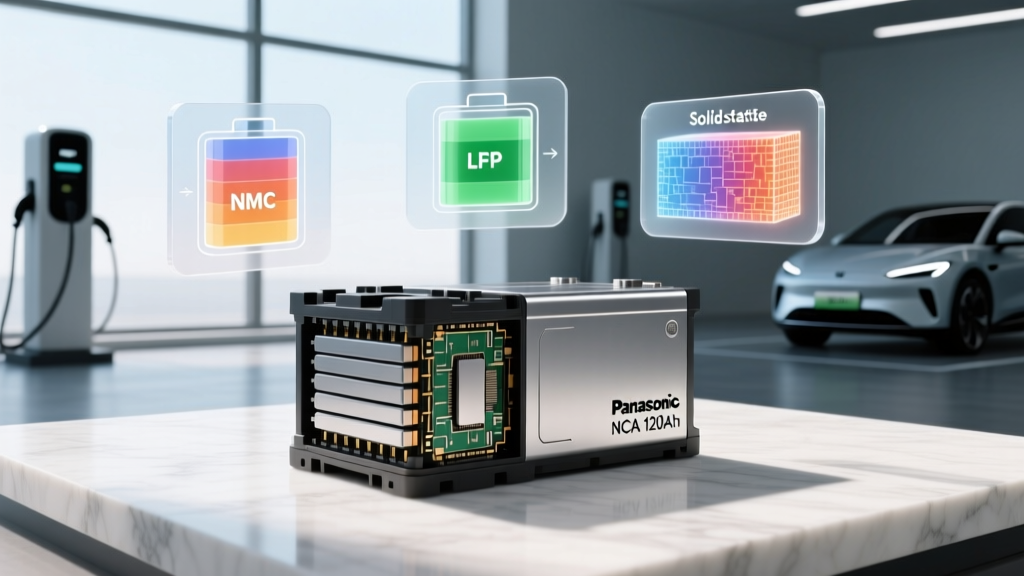
Every EV battery on the US market in 2026 uses one of two lithium-ion chemistries: LFP (lithium iron phosphate) or NMC/NCA (nickel-based). The choice affects range, charging, longevity, cold-weather behavior, and cost.
| Attribute | LFP (Lithium Iron Phosphate) | NMC/NCA (Nickel-Based) |
|---|---|---|
| Energy Density | ~160-180 Wh/kg (lower) | ~250-300 Wh/kg (higher) |
| Typical Range Impact | Shorter range for same pack weight | Longer range for same pack weight |
| Cycle Life | 3,000-5,000+ cycles | 1,000-2,000 cycles |
| Cold-Weather Performance | Greater range loss in freezing temps (~30-40%) | Better cold performance (~20-30% loss) |
| Recommended Charge Habit | Can charge to 100% daily; benefits from periodic full charges for BMS calibration | Best kept 20-80% for daily use; 100% only for trips |
| Cost per kWh | ~$80-100/kWh (cell-level, 2026) | ~$110-140/kWh (cell-level, 2026) |
| Cobalt Content | None (cobalt-free) | Contains cobalt and/or nickel |
| Key Suppliers | CATL, BYD | LG, Panasonic, SK On, Samsung SDI |
| Example Vehicles (2026) | Tesla Model 3 RWD, Model Y RWD, Ford Mustang Mach-E Select (LFP option) | Tesla Model 3 LR, Hyundai Ioniq 5, GM Ultium vehicles, Rivian R1S/R1T |
Which Chemistry Is Better?
Neither is universally better — the right choice depends on your driving pattern.
Choose LFP if: You can charge at home daily, your commute is under 200 miles round-trip, you live in a moderate climate, and you want maximum long-term cycle life with simpler charging habits (charge to 100% without worry).
Choose NMC/NCA if: You need maximum range per charge, you regularly drive in freezing climates, you take frequent road trips where the extra 50-80 miles of EPA range matters, or you rely on public DC fast charging and want the higher energy density.
How Long Do EV Batteries Actually Last?
The data is reassuring: the vast majority of EV batteries outlast the vehicles they're installed in. According to analysis from fueleconomy.gov and long-term fleet data, modern lithium-ion packs are engineered for 1,500-3,000+ full charge cycles — translating to 200,000-500,000+ miles depending on the pack size and chemistry.
- Tesla Model 3/Y (NMC/NCA, Panasonic): Tesla's 2025 Impact Report showed average fleet degradation of ~12% at 200,000 miles. Most packs retain 88-92% capacity at 100,000 miles.
- CATL LFP packs (Tesla Model 3 RWD): Early fleet data suggests 5-8% degradation at 100,000 miles, with a flatter degradation curve than NMC — consistent with LFP's higher cycle-life rating.
- Hyundai/Kia (NMC, LG/SK On): Owner-reported data on Ioniq 5 and EV6 models shows ~7-10% loss at 80,000 miles under mixed charging conditions.
- Nissan Leaf (early air-cooled packs): The cautionary tale — first-generation Leafs with passive air cooling showed 20-30% degradation by 80,000 miles, prompting the industry-wide shift to active liquid thermal management.
Sources: Tesla Impact Reports, Recurrent Auto battery data, owner forums aggregated by InsideEVs.
Key takeaway: a modern, liquid-cooled EV battery from any of the major suppliers will likely retain 80-90% of its original capacity at 150,000 miles. Complete failure before 200,000 miles is statistically rare.
Battery Warranty Terms: What's Actually Covered
Federal law mandates a minimum 8-year/100,000-mile warranty on EV battery packs (10 years/150,000 miles in California Air Resources Board states). But the details vary significantly by automaker.
| Automaker | Warranty Term | Capacity Retention Threshold | Notes |
|---|---|---|---|
| Tesla | 8 yr / 120,000 mi (LR/AWD); 8 yr / 100,000 mi (RWD) | 70% | Covers defects and capacity below threshold |
| Hyundai / Kia | 10 yr / 100,000 mi | 70% | Among the most generous terms |
| GM (Ultium) | 8 yr / 100,000 mi | 70% | Covers battery and electric drive components |
| Ford | 8 yr / 100,000 mi | 70% | Applies to Mustang Mach-E, F-150 Lightning |
| BMW | 8 yr / 100,000 mi | 70% | Module-level replacement where possible |
| Rivian | 8 yr / 175,000 mi | 70% | Higher mileage cap than most competitors |
What triggers a warranty claim: If your battery's State of Health (SoH) drops below the threshold (typically 70% of original capacity) within the warranty period, the manufacturer must repair or replace the pack at no cost. The key phrase is "capacity retention" — if your 82 kWh pack can only hold 57 kWh, you're eligible. Normal degradation above the threshold is not covered.
For full warranty details and current IRS §30D tax credit eligibility (which includes battery-sourcing requirements tied to these manufacturers), consult the IRS directly or a qualified tax professional.
EV Battery Replacement Costs: The Real Numbers
This is the number that generates the most anxiety — and the most misinformation. Here's what replacement actually costs in 2026, and how often it's needed.
| Vehicle | Pack Size | Chemistry | Full Pack Replacement (parts + labor) | Typical Need Timeline |
|---|---|---|---|---|
| Tesla Model 3 RWD | ~60 kWh | LFP (CATL) | $10,000 - $14,000 | 200,000+ mi (rare before vehicle end-of-life) |
| Tesla Model Y Long Range | ~82 kWh | NMC/NCA (Panasonic) | $14,000 - $18,000 | 200,000+ mi |
| Hyundai Ioniq 5 | ~77.4 kWh | NMC (LG/SK) | $12,000 - $16,000 | 200,000+ mi |
| Ford F-150 Lightning Ext. Range | ~131 kWh | NMC (SK On) | $18,000 - $25,000 | 200,000+ mi |
| Chevrolet Equinox EV | ~85 kWh | NMC (LG Ultium) | $13,000 - $17,000 | 200,000+ mi |
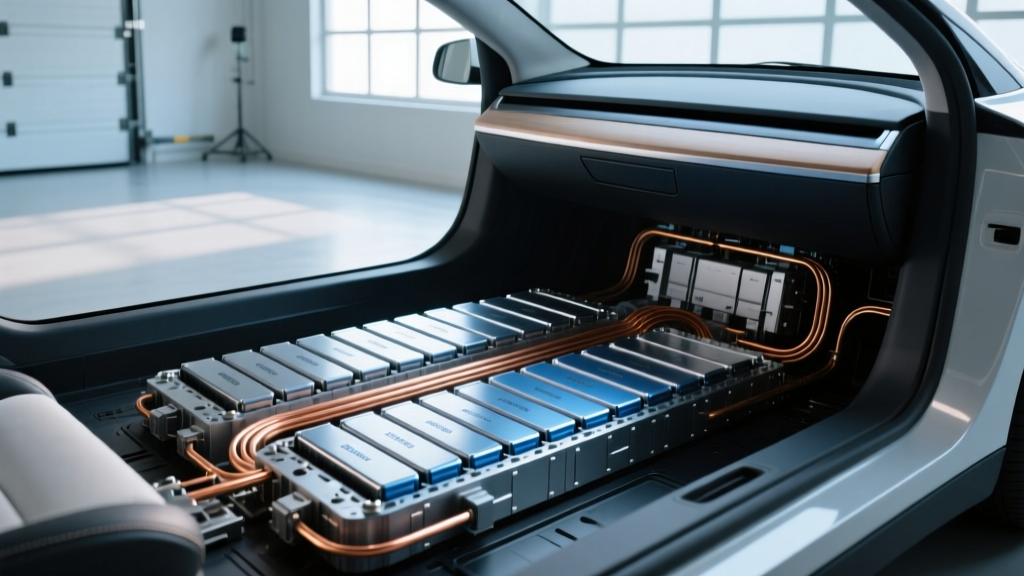
Critical context: Out-of-pocket full-pack replacement is extraordinarily uncommon. The vast majority of replacements occur under warranty at no cost to the owner. When packs do fail outside warranty, many manufacturers now offer module-level repairs (replacing individual cell modules rather than the entire pack) for $2,000-$6,000, depending on the architecture. CATL and BYD's cell-to-pack (CTP) designs make module replacement harder, while GM's Ultium and BMW's modular designs facilitate it.
The probability of needing a $20,000 battery replacement on a modern, liquid-cooled EV is low — most packs will outlast the vehicle's economic life.
Factors That Accelerate Battery Degradation
Battery chemistry sets the ceiling, but your habits determine how close you get to it. The big battery companies engineer for abuse tolerance, but physics still applies.
- Limit DC fast charging to road trips. Frequent 150-350 kW DC sessions generate sustained heat. For daily use, Level 2 home charging (7-11 kW) is gentler. Occasional fast charging is fine — daily fast charging accelerates degradation by an estimated 2-5% over 100,000 miles vs. L2-only.
- Avoid prolonged storage at 100% or 0% SoC. For NMC/NCA packs, store at 40-60% if the vehicle will sit for weeks. LFP packs tolerate 100% storage better but still prefer moderate SoC for long-term parking.
- Use preconditioning before fast charging. Every major EV (Tesla, Hyundai, Ford, GM) now preconditions the battery when you navigate to a DC fast charger. This brings the pack to optimal temperature (~25-35°C) and is essential for both charge speed and longevity. If your EV doesn't precondition automatically, do a few laps of moderate regen driving before plugging in.
- Minimize extreme-temperature exposure. Parking in shade during 100°F+ summers and in a garage during sub-zero winters reduces thermal stress. Active thermal management systems handle most of this, but they can't fully offset sustained ambient extremes.
- Don't baby it too much. The difference between "perfect" habits and "normal" habits is typically 2-4% of capacity over 150,000 miles. Charge when convenient, precondition for fast charging, and drive the car.
How to Monitor Your Battery's State of Health
State of Health (SoH) is the percentage of your battery's original capacity that remains available. A new 82 kWh pack at 95% SoH holds ~78 kWh. Here's how to check it:
- In-vehicle displays: Tesla provides a battery health estimate in the Service menu (added in 2024 software updates). Some Hyundai/Kia models show SoH in the EV diagnostics screen. GM's Ultium vehicles display estimated range that implicitly reflects degradation.
- OBD-II dongles + apps: Tools like OBDeleven, Car Scanner, or ABRP (A Better Route Planner) with an OBD-II adapter can read the BMS (Battery Management System) directly for SoH percentage, cell voltage variance, and pack temperature. This is the most accurate consumer method.
- Manual calculation: Charge to 100% (or your known max), note the displayed range, and compare it to the EPA-rated range when new. A Model 3 LR that showed 341 miles at 100% when new and now shows 310 miles has roughly 91% SoH (adjusting for the fact that displayed range isn't perfectly linear).
- Dealer diagnostics: Request a battery health report during service visits. Most manufacturers can pull a detailed BMS log showing individual module voltages and impedance.
What's Next: Solid-State, Silicon Anodes, and Realistic Timelines
The big battery companies are investing heavily in next-generation chemistries, but buyers should separate announcements from availability.
Solid-state batteries: Toyota, Samsung SDI, and CATL have all announced solid-state or semi-solid-state prototypes promising 500+ mile range and 10-minute charging. Toyota targets limited production in 2027-2028; Samsung SDI aims for 2027. These are announced timelines for low-volume, premium-vehicle deployment — mass-market availability at competitive pricing is not expected before 2030. Cost remains the primary barrier: solid-state cells currently cost 3-5x more per kWh than liquid-electrolyte lithium-ion.
Silicon anode technology: Companies like Sila Nanotechnologies (partnered with Panasonic/Mercedes) and Group14 (partnered with SK On) are replacing graphite anodes with silicon-dominant materials, boosting energy density by 20-40%. Early deployments are appearing in premium vehicles (Mercedes G-Class EV, 2025) and will gradually scale through 2027-2029.
Sodium-ion batteries: CATL has begun producing sodium-ion cells for lower-cost, shorter-range EVs (primarily in China). These offer lower energy density (~120-140 Wh/kg) but eliminate lithium entirely. US-market adoption is not expected before 2028 at the earliest, and likely in budget segments or stationary storage first.
For current buyers: today's LFP and NMC packs from the major suppliers are mature, well-tested products. The next-generation tech will be compelling when it arrives at scale, but waiting for solid-state is not a practical purchase strategy in 2026.
Frequently Asked Questions
How long do EV batteries last in years and miles?
Modern liquid-cooled EV batteries from major suppliers (CATL, LG, Panasonic, SK On, Samsung SDI) are engineered for 15-20 years of service and 200,000-500,000 miles before reaching 70-80% capacity retention. Real-world fleet data shows most packs retain 85-92% capacity at 100,000 miles. LFP packs generally last longer by cycle count than NMC, though they offer less range per kWh.
How much does it cost to replace an EV battery?
Full pack replacement ranges from ~$10,000 for a 60 kWh LFP pack (Tesla Model 3 RWD) to ~$25,000 for a 131 kWh NMC pack (F-150 Lightning Extended Range), including labor. However, most replacements occur under the 8-year/100,000-mile federal warranty at no cost. Module-level repairs, where available, cost $2,000-$6,000. Complete out-of-pocket replacement before 200,000 miles is statistically rare.
What does the EV battery warranty actually cover?
Federal law requires a minimum 8-year/100,000-mile warranty (10/150,000 in CARB states) covering manufacturing defects and capacity loss below a defined threshold — typically 70% of original capacity. If your battery's SoH drops below 70% within the warranty period, the manufacturer repairs or replaces it free of charge. The warranty does not cover normal degradation above the threshold, damage from accidents, or improper modifications.
How do I check and maximize my EV battery health?
Monitor SoH through your vehicle's built-in diagnostics, an OBD-II adapter with a battery-read app (OBDeleven, Car Scanner), or dealer service reports. To maximize longevity: favor Level 2 home charging over daily DC fast charging, keep NMC packs between 20-80% SoC for daily use (LFP can go to 100%), use preconditioning before fast charging, and avoid prolonged storage at extreme SoC levels or temperatures.
LFP vs NMC — which battery chemistry should I choose?
LFP (from CATL, BYD) offers longer cycle life (3,000-5,000 cycles), simpler charging habits (100% daily is fine), and lower cost, but sacrifices ~15-20% energy density and performs worse in freezing weather. NMC/NCA (from LG, Panasonic, SK On, Samsung SDI) delivers more range per pound, better cold-weather performance, and faster DC charging speeds, but benefits from 20-80% daily SoC management. For most commuters with home charging, LFP is the pragmatic choice. For road-trippers and cold-climate drivers, NMC/NCA remains the stronger option.