The high-voltage traction pack is the single most expensive component in any battery electric vehicle. It is also the most misunderstood. Buyers fixate on EPA range stickers and 0-60 times, yet the question that actually determines long-term ownership satisfaction is simpler: how much capacity will this BEV battery retain after 100,000 miles, and what happens if it fails outside warranty?
This guide cuts through marketing claims and forum speculation. We will walk through the two dominant chemistries shipping in 2026 model-year EVs, the real degradation curves observed across hundreds of thousands of vehicles, what warranties actually cover (and exclude), and the replacement economics that most owners will never face — but should understand before signing a purchase agreement.
LFP vs NMC: The Chemistry Choice That Defines Your BEV Battery
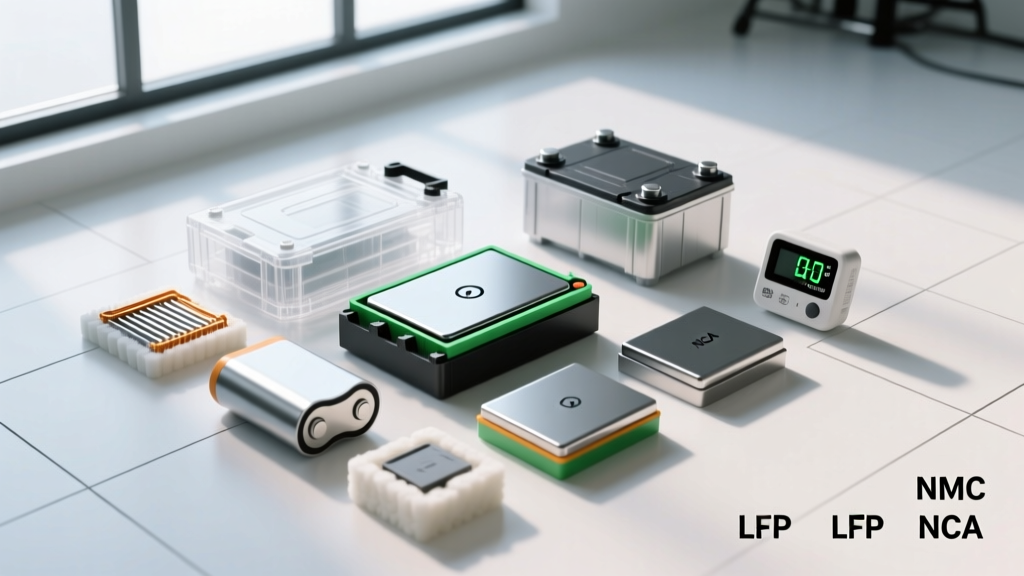
Every BEV battery sold in the United States in 2026 uses one of two cathode chemistries: lithium iron phosphate (LFP) or nickel manganese cobalt (NMC), with some manufacturers using nickel cobalt aluminum (NCA) variants. The chemistry determines not just energy density, but how you should charge, store, and think about the pack over a decade of ownership.
LFP cells sacrifice roughly 15-20% in energy density compared to NMC, which is why LFP packs tend to appear in standard-range trims (the Tesla Model 3 RWD, the base Ford Mustang Mach-E Select, the Chevrolet Equinox EV 2LT). NMC powers the extended-range and performance variants where packing maximum kWh into a fixed volume matters more than cycle longevity.
| Attribute | LFP (Lithium Iron Phosphate) | NMC / NCA (Nickel-based) |
|---|---|---|
| Energy Density | ~160-180 Wh/kg (cell-level) | ~220-260 Wh/kg (cell-level) |
| Typical Cycle Life | 3,000-5,000+ full cycles | 1,000-2,000 full cycles |
| Recommended Daily SoC | 100% (charge to full daily) | 80% (reserve 100% for trips) |
| Cold-Weather Performance | Moderate — slower charge acceptance below 32°F | Better low-temp charge/discharge |
| Thermal Runaway Risk | Very low | Low, but higher than LFP |
| Cost per kWh (pack-level) | ~$100-$120 | ~$130-$160 |
| Cobalt Content | None | Yes (supply-chain & ethics factor) |
| Common 2026 Applications | Tesla Model 3/Y RWD, Ford Mach-E Select, Chevy Equinox EV | Tesla Model Y LR, Hyundai Ioniq 5 LR, Rivian R1T Dual-Motor Max |
The practical upshot: if you can charge at home every night and rarely need maximum range, an LFP pack is arguably the better long-term ownership choice. You can charge to 100% daily without accelerating degradation, and the cycle-life headroom is enormous. If you regularly drive 250+ miles between charges or live in a climate where winters drop below zero, NMC's energy density and cold-weather charge acceptance become meaningful advantages.
Real-World BEV Battery Degradation: What the Data Actually Shows
Automakers warrant their packs against catastrophic failure, but all lithium-ion batteries lose capacity gradually through use and time. The question is how fast — and whether the loss matters in practice.
Observed Degradation Curves (aggregated fleet data, 2020-2025 model years):
- Year 1 / 15,000 miles: 2-4% capacity loss (initial formation loss, steepest part of the curve)
- Year 3 / 45,000 miles: 5-8% total loss (curve flattens significantly)
- Year 5 / 75,000 miles: 7-11% total loss (NMC); 4-7% total loss (LFP)
- Year 8 / 120,000 miles: 10-15% total loss (NMC); 6-10% total loss (LFP)
- Year 10 / 150,000 miles: 12-18% total loss (NMC); 8-12% total loss (LFP)
Sources: Geotab fleet battery health study, Recurrent Auto battery data reports. Individual results vary based on climate, charging habits, and thermal management system quality.
A critical nuance: degradation is non-linear. Most BEV batteries experience their steepest capacity drop in the first 12-18 months — what engineers call "formation loss" — then settle into a slow, predictable decline. A 2023 Tesla Model 3 that lost 4% in its first year will not lose another 4% per year. It will likely lose 1-2% annually thereafter.
For a 2026 Hyundai Ioniq 5 Long Range with an EPA-rated 305-mile range and a 77.4 kWh usable NMC pack, expect roughly 275-285 real-world miles at the 5-year mark — still entirely practical for daily driving and road trips. Range loss becomes a genuine inconvenience only when it drops below 70% of original capacity, which fleet data suggests takes 150,000+ miles for most modern packs with active thermal management.
What the BEV Battery Warranty Actually Covers (and What It Doesn't)
Federal law mandates that automakers warranty the high-voltage battery for a minimum of 8 years or 100,000 miles, whichever comes first. California Air Resources Board (CARB) states extend that to 10 years/150,000 miles. But the details buried in the fine print determine whether a warranty claim succeeds.
| Manufacturer | Warranty Term | Capacity Retention Threshold | What Triggers a Claim |
|---|---|---|---|
| Tesla (Model 3/Y RWD — LFP) | 8 yr / 100,000 mi | 70% | SoH drops below 70% as measured by Tesla diagnostics |
| Tesla (Model Y LR/Perf — NMC) | 8 yr / 120,000 mi | 70% | SoH below 70% |
| Hyundai / Kia | 10 yr / 100,000 mi | 70% | Capacity below 70% (EPA-rated range basis) |
| Ford (Mach-E, F-150 Lightning) | 8 yr / 100,000 mi | 70% | SoH below 70% per Ford diagnostic tool |
| General Motors (Ultium platform) | 8 yr / 100,000 mi | 70% | Battery capacity below 70% |
| Rivian | 8 yr / 175,000 mi (Max pack) | 70% | Capacity below 70% |
| BMW (iX, i4) | 8 yr / 100,000 mi | 70% | Net capacity below 70% |
The 70% threshold is industry-standard, but it is worth interrogating. A BEV battery retaining 72% of original capacity at 95,000 miles technically passes warranty — yet the owner has lost 84 miles of range on a 300-mile EPA vehicle. That is noticeable. Most manufacturers will not replace a pack that has not crossed the 70% line, even if the owner perceives meaningful degradation.
Warranties typically cover defects in materials and workmanship, and capacity loss beyond the stated threshold under normal use. They do not cover damage from collisions, flooding, improper charging equipment, or modifications to the high-voltage system. Read your specific warranty booklet — language varies.
BEV Battery Replacement Cost: The Numbers Owners Fear (But Rarely Face)
Out-of-warranty battery replacement is the specter that haunts EV purchase decisions. Let us put actual numbers to it, then contextualize how often it occurs.
| Vehicle | Pack Size (kWh usable) | Chemistry | Replacement Cost Range |
|---|---|---|---|
| Tesla Model 3 RWD | 57.5 | LFP | $8,000 - $12,000 |
| Tesla Model Y Long Range | 75 | NMC | $12,000 - $16,000 |
| Hyundai Ioniq 5 Long Range | 77.4 | NMC | $11,000 - $15,000 |
| Ford Mustang Mach-E Extended Range | 91 | NMC | $14,000 - $18,000 |
| Ford F-150 Lightning Extended Range | 131 | NMC | $18,000 - $25,000 |
| Rivian R1T Max Pack | 141 | NMC | $20,000 - $28,000 |
| Chevrolet Equinox EV | 85 | NMC (Ultium) | $12,000 - $16,000 |
Costs include battery pack, labor, and dealership/service-center diagnostic and programming fees. Third-party and refurbished pack options may reduce costs by 30-50%. Sources: manufacturer service bulletins, Recurrent Auto replacement cost analysis.
Context matters enormously here. According to fleet data from Geotab and Recurrent Auto, fewer than 5% of BEV batteries have required full replacement — and the vast majority of those replacements occurred under warranty due to manufacturing defects (bad cell groups, BMS failures, coolant leaks into the pack), not gradual degradation.
The pack is not a wear item like brake pads. Modern BEV batteries with active liquid thermal management are engineered to outlast 200,000 miles before reaching the 70% capacity threshold. Most vehicles will be totaled in a collision, traded in, or retired for other mechanical reasons before the battery requires replacement at the owner's expense.
That said, buyers of used EVs outside warranty should budget for a pre-purchase battery health inspection (typically $150-$300 at a dealer or qualified EV shop) and factor in the possibility of a future replacement if the pack shows more than 15% degradation at purchase.
Factors That Accelerate (or Preserve) BEV Battery Health
Not all miles are equal when it comes to battery wear. The same pack can degrade 8% or 18% over 100,000 miles depending on how it is treated. Here is what the electrochemistry actually rewards and punishes.
Habits That Maximize BEV Battery Longevity
- Charge to 80% daily (NMC packs): Set your charge limit to 80% for routine commuting. Reserve 100% charges for road-trip mornings. LFP owners can charge to 100% daily — the chemistry tolerates it and actually benefits from periodic full-charge calibration.
- Minimize DC fast charging above 150 kW: Occasional road-trip fast charging is fine. Daily reliance on 250+ kW DCFC accelerates lithium plating and electrolyte decomposition. Level 2 home charging (7-11 kW) is the longevity sweet spot.
- Precondition before fast charging: Use your vehicle's navigation-based preconditioning (Tesla, Hyundai, Ford all offer this) to warm the pack to optimal temperature before arriving at a DC fast charger. A cold pack forced to accept 200+ kW suffers internal damage.
- Avoid prolonged storage above 90% or below 10% SoC: If leaving the vehicle for more than a week, store at 50-60% SoC. High state of charge at high ambient temperature is the single worst combination for calendar degradation.
- Park in shade or a garage during summer: Battery temperature matters more than ambient temperature. A pack sitting at 110°F in a Phoenix parking lot at 100% SoC degrades measurably faster than one stored at 70°F at 50% SoC.
- Use regenerative braking in moderate settings: Aggressive regen in cold weather (below 32°F) can force high charge currents into a cold pack. Most modern BEVs automatically limit regen when the pack is cold, but manually reducing regen in winter is an extra safeguard.
The single most impactful habit is avoiding high state of charge combined with high temperature. A 2024 study published in the Journal of Power Sources found that NMC cells stored at 100% SoC and 104°F (40°C) lost roughly 4x the capacity of cells stored at 50% SoC and 77°F (25°C) over the same period. LFP cells showed roughly half the calendar degradation under identical conditions.
How to Monitor Your BEV Battery State of Health (SoH)
State of Health (SoH) is the percentage of original capacity your pack currently holds. A brand-new BEV battery is at 100% SoH; one that can store only 65 kWh of its original 77.4 kWh is at roughly 84% SoH.
Most 2026 model-year EVs do not surface a precise SoH percentage in the driver-facing infotainment system — a frustrating omission given that ICE vehicles display 12V battery voltage on demand. Here are the methods available to owners:
Method 1: OBD-II Dongle + App
Devices like the OBDLink MX+ ($120-$140) paired with apps such as Car Scanner (iOS/Android) or LeafSpy (Nissan-specific) can read the battery management system's internal SoH estimate. This is the most accessible option for technically inclined owners. Results are approximate — the BMS estimate can drift and may require a full 100%-to-10% discharge cycle for recalibration.
Method 2: Dealer Diagnostic Report
Request a battery health check during scheduled service. Dealerships can pull a detailed SoH report from the manufacturer's diagnostic tool, including individual module voltage variance (a key indicator of cell imbalance). Expect to pay $0-$150 depending on the brand and whether you are within a service interval.
Method 3: Third-Party Battery Health Certificates
Companies like Recurrent Auto and AVILOO offer battery health certificates based on telematics data or standardized drive-cycle testing. These are increasingly used in the used-EV market and provide a range estimate at 100% SoC compared to the vehicle's original EPA rating. Cost: $0-$100.
Method 4: Manual Calculation
Charge to 100% (or 90% for NMC, then extrapolate). Note the vehicle's displayed range. Compare to the EPA sticker. A 2026 Ioniq 5 displaying 268 miles at 100% versus its 305-mile EPA rating suggests roughly 88% SoH — though this method is confounded by temperature, tire condition, and the vehicle's range-estimate algorithm.
Emerging BEV Battery Technology: What's Real and What's Years Away
The battery landscape is evolving rapidly, but separating shipping products from PowerPoint promises is essential for anyone making a purchase decision today.
Solid-State Batteries
Solid-state cells replace the liquid electrolyte with a solid ceramic, polymer, or sulfide separator, theoretically enabling higher energy density (~350-400 Wh/kg), faster charging, and reduced fire risk. Toyota has announced solid-state EV production beginning in 2027-2028, with initial deployment likely in limited-production luxury models. Samsung SDI and QuantumScape are targeting 2027-2029 production timelines.
Realistic expectation: solid-state packs will debut in low-volume, high-price vehicles before reaching mainstream models. Mass-market availability at current NMC pricing is unlikely before 2030-2032. If you are buying an EV in 2026, solid-state is not a reason to wait.
Silicon-Dominant Anodes
Replacing graphite anodes with silicon can boost cell energy density by 20-40%. Companies like Sila Nanotechnologies and Group14 Technologies are shipping silicon-composite anodes in limited applications (the Mercedes G-Class 580e PHEV uses Group14 silicon anode cells). Expect broader adoption in BEV batteries by 2027-2028, primarily as a range-extending upgrade to existing NMC platforms rather than a ground-up chemistry change.
Sodium-Ion Batteries
CATL and BYD are producing sodium-ion cells for lower-cost, shorter-range applications in China. Energy density (~120-150 Wh/kg) limits sodium-ion to urban EVs and micro-cars. US-market availability is uncertain and likely post-2028 for any volume application. Not relevant for current US EV shoppers, but worth watching for future budget segments.
The bottom line: today's LFP and NMC chemistries are mature, well-understood, and backed by massive manufacturing scale. They will remain the dominant BEV battery technologies through at least 2030. Buy based on what exists, not what is announced.
BEV Battery FAQ: Answers to the Questions Buyers Actually Ask
How long do BEV batteries last in years and miles?
Modern liquid-cooled BEV batteries routinely last 150,000-250,000 miles before reaching the 70% capacity threshold that defines "end of life" for automotive use. In calendar years, that translates to 12-20 years for the average US driver (13,500 miles/year per FHWA data). Many will outlast the vehicle's body, suspension, and interior. LFP packs with their superior cycle life are pushing the upper end of this range.
How much does a BEV battery cost to replace out of warranty?
Between $8,000 and $28,000 depending on pack size and vehicle, with most mainstream crossovers (75-91 kWh packs) falling in the $11,000-$18,000 range including labor. However, fewer than 5% of packs have required replacement, and the vast majority of those were covered under the 8-year/100,000-mile warranty. Treat replacement cost as a low-probability, high-impact risk — similar to a transmission failure on an ICE vehicle — rather than an expected ownership expense.
Does the BEV battery warranty cover gradual degradation?
Yes, but only if capacity drops below the manufacturer's threshold — almost universally 70% of original capacity — within the warranty period (typically 8 years/100,000 miles, or 10 years/150,000 miles in CARB states). A pack at 72% capacity at 95,000 miles is technically within spec and would not trigger a warranty replacement, even though the owner has lost roughly 85 miles of range on a 300-mile vehicle.
Is LFP better than NMC for battery longevity?
For pure cycle life and calendar longevity, yes — LFP cells demonstrably outlast NMC cells under equivalent conditions, with 3,000-5,000+ full cycles versus 1,000-2,000 for NMC. LFP also tolerates daily 100% charging without accelerated degradation. The trade-off is lower energy density (less range per pound) and slower charge acceptance in freezing temperatures. If your commute is under 60 miles round-trip and you charge at home, LFP is the superior longevity choice. If you need maximum range or live in extreme cold, NMC remains the better fit.
How do I check my BEV battery health without a dealer visit?
An OBD-II Bluetooth dongle ($120-$140) paired with an app like Car Scanner or EV-specific software can read the BMS-reported State of Health percentage. For a more rigorous assessment, charge to 100%, record the displayed range, and compare it to the original EPA rating — a rough but informative proxy. Third-party services like Recurrent Auto also offer battery health reports based on telematics data. For a definitive assessment, request a dealer diagnostic report.
Does frequent DC fast charging damage the BEV battery?
Frequent high-power DC fast charging (150+ kW) accelerates degradation compared to Level 2 home charging, but the effect is smaller than many owners fear. Tesla's own fleet data has shown that Model 3 vehicles that fast-charge more than 90% of the time exhibit roughly 2-3% additional capacity loss over 100,000 miles compared to vehicles that primarily use Level 2. The bigger risk is fast-charging a cold pack without preconditioning — always use your vehicle's navigation-based battery preconditioning feature when routing to a DCFC station.
Should I wait for solid-state batteries before buying an EV?
No. Solid-state batteries are not expected in volume production vehicles until 2027-2028 at the earliest, and initial deployment will be limited to high-end, low-volume models at premium prices. Mass-market solid-state EVs at competitive pricing are unlikely before 2030-2032. Current LFP and NMC batteries are mature, reliable, and backed by extensive warranty coverage. Waiting for solid-state means delaying an EV purchase by 4-6+ years with no guarantee of affordable availability.
The BEV battery is no longer the liability it was perceived to be a decade ago. Modern packs with active thermal management, conservative buffer strategies, and mature cell chemistries are lasting longer than most owners will keep their vehicles. Understand the chemistry you are buying, follow the straightforward care guidelines, and monitor SoH periodically — and the pack will be the least of your ownership concerns.